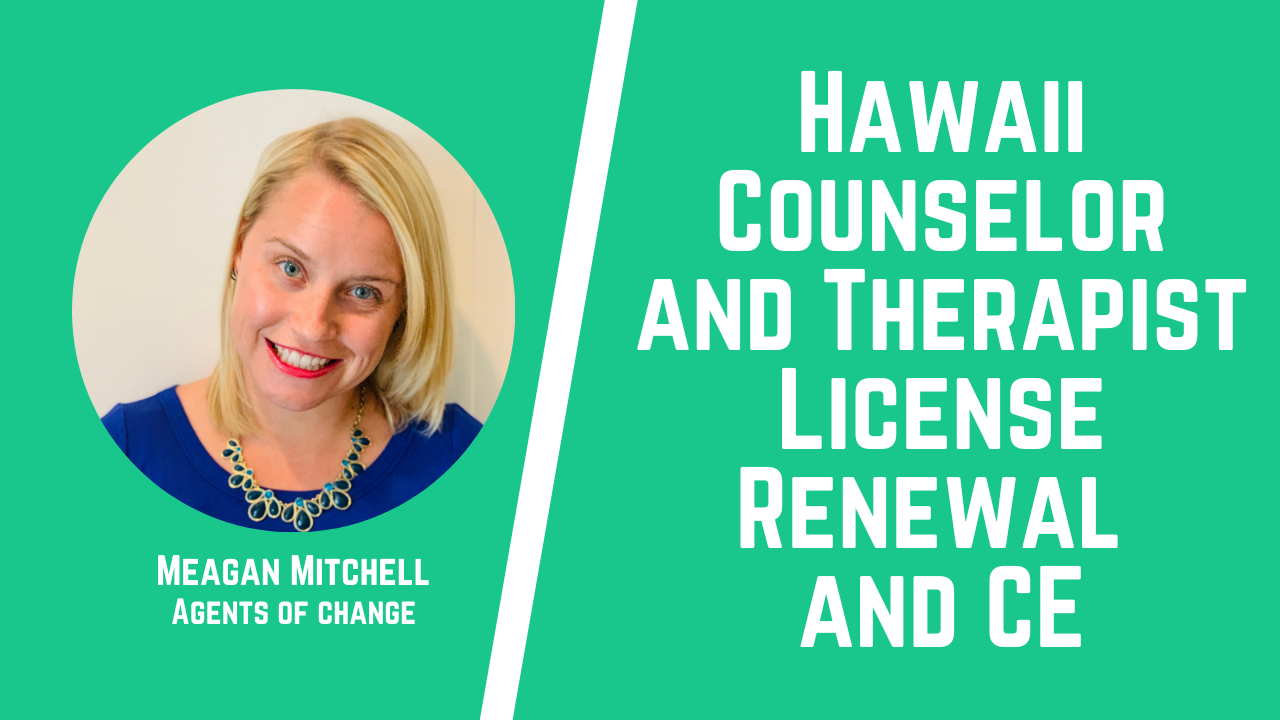
Hawaii Counselor and Therapist Licensure Renewal Dates and CE Requirements

Hawaii Counselor and Therapist Licensure Renewal Dates and CE Requirements

Renewing your counseling or therapy license in Hawaii is an important step to maintaining your professional standing and ensuring that you continue to provide the highest level of care to your clients. The state has specific guidelines and deadlines that every licensed mental health counselor (LMHC) and marriage and family therapist (MFT) must follow.

Keeping up with licensure renewal requirements can sometimes feel overwhelming, especially as these regulations may change over time. This blog post will help you stay informed by outlining the key dates and continuing education (CE) requirements necessary for maintaining your counseling or therapy license in Hawaii.

In Hawaii, counseling and therapy licenses must be renewed biennially, with specific renewal deadlines depending on your licensing board. The renewal process ensures that licensed professionals remain competent in their field, keeping up with the latest research, techniques, and ethical standards in mental health care. Failure to renew your license on time can result in penalties or even suspension, so it’s crucial to know exactly when your license expires and what to do to stay compliant.

Did you know? Agents of Change Continuing Education offers Unlimited Access to 150+ NBCC-approved CE courses for one low annual fee to meet your state’s requirements for Continuing Education credits.

We’ve helped thousands of Counselors and Therapists with Continuing Education, learn more here about Agents of Change and claim your 5 FREE CEs!

1) Key Hawaii Counselor and Therapist Licensure Renewal Dates

In Hawaii, both Licensed Mental Health Counselors (LMHCs) and Marriage and Family Therapists (MFTs) must meet specific credentialing and licensure requirements to practice. These requirements include educational qualifications, supervised experience, and passing relevant exams.

Below is an overview of the credentialing process for each of these licenses.

1. Licensed Mental Health Counselor (LMHC) Requirements

  • Education: Applicants must complete a master’s or doctoral degree in counseling or a closely related field from an accredited institution. The program should include coursework in counseling theory, skills, ethics, and at least one course in psychopathology.

  • Supervised Experience: After completing the educational requirements, candidates must accumulate a minimum of 3,000 hours of post-graduate supervised experience. This experience should include at least 100 hours of face-to-face supervision.

  • Examination: LMHC candidates must pass the National Counselor Examination (NCE) administered by the National Board for Certified Counselors (NBCC) or a similar board-approved exam.

2. Marriage and Family Therapist (MFT) Requirements

  • Education: MFT applicants must have a master’s or doctoral degree in marriage and family therapy or a related mental health field. The program must be accredited by the Commission on Accreditation for Marriage and Family Therapy Education (COAMFTE) or meet equivalent state standards.

  • Supervised Experience: MFT candidates must complete 3,000 hours of supervised clinical experience, including at least 1,000 hours of direct client contact. A minimum of 200 hours of supervision by a licensed MFT or equivalent professional is required.

  • Examination: MFT applicants must pass the national MFT licensing exam administered by the Association of Marital and Family Therapy Regulatory Boards (AMFTRB).


Licensure Renewal Details and Costs

Hawaii requires counselors and therapists to renew their licenses every two years. The licensure renewal process includes maintaining current credentials and completing continuing education (CE) requirements.

1. LMHC License Renewal

  • Renewal Period: Every two years (biennially), typically by June 30th of odd-numbered years.
  • CE Requirements: LMHCs must complete at least 40 hours of continuing education over the two-year period. At least six of these hours must cover ethics.
  • Renewal Fee: The LMHC license renewal fee is $240.

2. MFT License Renewal

  • Renewal Period: Every two years (biennially), typically by December 31st of even-numbered years.
  • CE Requirements: MFTs must complete a minimum of 45 hours of continuing education during each renewal period, including at least six hours in ethics.
  • Renewal Fee: The MFT license renewal fee is $246.

Fees for Licenses

Here is a breakdown of the fees associated with obtaining and maintaining a counseling or therapy license in Hawaii:

  • LMHC Initial Application Fee: $60
  • MFT Initial Application Fee: $60
  • LMHC License Fee (if issued in an odd-numbered year): $128
  • LMHC License Fee (if issued in an even-numbered year): $240
  • MFT License Fee (if issued in an even-numbered year): $246
  • License Restoration Fee (for late renewal): $12 in addition to the standard renewal fee.

Sources:

Agents of Change Continuing Education offers Unlimited Access to 150+ NBCC-approved CE courses for one low annual fee to meet Hawaii requirements for Counselor and Therapist Continuing Education credits.

2) Hawaii Counselor and Therapist Continuing Education Requirements

In Hawaii, both Licensed Mental Health Counselors (LMHCs) and Marriage and Family Therapists (MFTs) are required to complete continuing education (CE) to maintain their licensure. These CE requirements ensure that counselors and therapists stay updated on current practices, ethics, and advancements in the field of mental health.

Below is a detailed overview of the CE requirements for each license.

1. Licensed Mental Health Counselors (LMHC) CE Requirements

  • Total CE Hours: LMHCs must complete 40 hours of continuing education every two years.

  • Ethics Requirement: Out of the 40 required hours, at least 6 hours must be specifically in ethics training. This ensures that counselors remain current on professional standards, legal responsibilities, and ethical decision-making in their practice.

  • Approved CE Courses: CE activities must be related to the practice of counseling and can include courses, workshops, seminars, or other professional development activities. The courses should be approved by organizations such as:

    • National Board for Certified Counselors (NBCC)
    • American Counseling Association (ACA)
    • State-approved or accredited educational institutions
  • Documentation: LMHCs must retain documentation of completed CE hours for at least four years, in case of an audit by the licensing board. This documentation should include certificates of completion that show the number of hours earned, the date of completion, and the title of the course.

2. Marriage and Family Therapists (MFT) CE Requirements

  • Total CE Hours: MFTs must complete 45 hours of continuing education during each two-year renewal period.

  • Ethics Requirement: At least 6 hours of the required 45 must be focused on ethics. This ensures that MFTs are well-versed in maintaining professional boundaries, confidentiality, and legal responsibilities in their clinical work.

  • Approved CE Courses: CE activities for MFTs must be directly related to marriage and family therapy or general mental health care. Approved CE providers include:

    • American Association for Marriage and Family Therapy (AAMFT)
    • Accredited universities and institutions that offer courses in family therapy or mental health
    • Any continuing education program approved by a professional body or regulatory board related to marriage and family therapy
  • Documentation: Similar to LMHCs, MFTs are required to maintain records of completed CE for at least four years. Certificates or transcripts must include the date, course title, provider name, and the number of hours earned.


CE Content Areas

While ethics training is mandatory for both LMHCs and MFTs, the remaining CE hours can be focused on a variety of content areas, including but not limited to:

  • Counseling Theories and Techniques: Courses on evidence-based practices, cognitive-behavioral therapy (CBT), mindfulness, and other therapeutic approaches.
  • Cultural Competency: CE activities that focus on working with diverse populations, addressing cultural and systemic issues in mental health care.
  • Trauma-Informed Care: Training in recognizing and addressing trauma in clients, including specific modalities like Eye Movement Desensitization and Reprocessing (EMDR).
  • Substance Abuse Counseling: Courses related to addiction, co-occurring disorders, and substance abuse treatment.

Failure to Meet CE Requirements

If a licensee does not complete the required CE hours within the renewal period, they may face penalties, including fines, delayed renewal, or license suspension. In some cases, an extension or grace period may be granted, but this is not guaranteed. Practitioners are encouraged to plan their continuing education activities well in advance to avoid these issues.

Online and Distance Learning for CE

Hawaii allows counselors and therapists to complete their CE requirements through online or distance learning platforms, as long as the courses are from approved providers. This flexibility enables busy professionals to stay current with their education without needing to attend in-person events.


Resources for Finding CE Courses

Here are some key resources where counselors and therapists in Hawaii can find approved continuing education courses:

By staying up-to-date on CE requirements, LMHCs and MFTs in Hawaii can ensure they continue to provide high-quality, ethical, and evidence-based care to their clients while maintaining their professional licensure.

Agents of Change Continuing Education is a great way to meet Hawaii Counselor and Therapist CE requirements and track your completed CEs, with over 150 NBCC-approved courses that meet these requirements!

Agents of Change has been approved by NBCC as an Approved Continuing Education Provider, ACEP No. 7620. Programs that do not qualify for NBCC credit are clearly identified. Agents of Change is solely responsible for all aspects of the programs.

3. FAQs – Hawaii Counselor and Therapist Licensure Renewal and CEs

Q: How often do I need to renew my counseling or therapy license in Hawaii?

A: In Hawaii, both Licensed Mental Health Counselors (LMHCs) and Marriage and Family Therapists (MFTs) are required to renew their licenses every two years. The renewal deadlines differ depending on your license type:

  • LMHCs must renew their licenses by June 30th of odd-numbered years.
  • MFTs must renew their licenses by December 31st of even-numbered years. Be sure to complete all required continuing education (CE) hours before these deadlines to avoid penalties or delays in your renewal process.

Q: How many Continuing Education (CE) hours do I need to complete to renew my license as an LMHC or MFT in Hawaii?

A: LMHCs must complete 40 hours of CE every two years, with at least 6 hours in ethics.

MFTs must complete 45 hours of CE every two years, including 6 hours in ethics. These CE hours ensure that you remain current with developments in mental health care, counseling techniques, and professional ethics. Approved CE providers include national organizations such as the National Board for Certified Counselors (NBCC) and the American Association for Marriage and Family Therapy (AAMFT).

Q: What happens if I don’t complete my CE requirements or fail to renew my license on time?

A: If you fail to complete the required CE hours or do not renew your license by the deadline, you may face penalties such as late fees, suspension of your license, or ineligibility to practice until your license is restored. For both LMHCs and MFTs, the late renewal fee is typically $12 in addition to the standard renewal fee.

It is essential to plan and complete your CE requirements well in advance of your renewal date to avoid any disruptions in your ability to practice. If necessary, contact the Hawaii Department of Commerce and Consumer Affairs (DCCA) for guidance on extensions or reinstating your license.

Resources for CE: Agents of Change Continuing Education offers over 150 NBCC-approved courses that meet Hawaii Counselor and Therapist CE requirements. 

4) Conclusion

Renewing your counseling or therapy license in Hawaii requires careful attention to deadlines, continuing education (CE) requirements, and adherence to ethical standards. Both Licensed Mental Health Counselors (LMHCs) and Marriage and Family Therapists (MFTs) must stay on top of the biennial renewal process to ensure they can continue providing essential mental health services to their clients. Understanding the licensure renewal process and fulfilling all CE obligations on time helps you maintain your professional status and enhances your skills as a mental health professional.

By completing the necessary CE hours, you not only meet state requirements but also enhance your clinical knowledge and competencies. The emphasis on ethics ensures that you remain aligned with best practices and legal standards, while other CE opportunities allow you to explore new therapeutic methods and stay current with trends in mental health care.

Taking advantage of approved CE courses through reputable organizations like the NBCC and AAMFT ensures that your educational efforts are recognized and applicable toward your license renewal.

Resources like Agents of Change Continuing Education provide accessible and varied learning opportunities for Counselors and Therapists to meet Continuing Education requirements. Learn more about Agents of Change Continuing Education.

We’ve helped thousands of Counselors and Therapists with their Continuing Education and want you to be next!


► Learn more about the Agents of Change Continuing Education here: Agents of Change Continuing Education

About the Instructor, Meagan Mitchell: Meagan is a Licensed Clinical Social Worker and has been providing Continuing Education for Counselors, Therapists, and Social Workersfor more than 10 years. From all of this experience helping others pass their exams, she created Agents of Change Continuing Education to help Counselors, Therapists, and Social Workers stay up-to-date on the latest trends, research, and techniques.

#counselor #NBCC #therapist #NBCC #continuinged #continuingeducation #ce #freeCE

Disclaimer: This content has been made available for informational and educational purposes only. This content is not intended to be a substitute for professional medical or clinical advice, diagnosis, or treatment

Share:

Discover more from Agents of Change

Subscribe now to keep reading and get access to the full archive.

Continue reading

New LIVE CE event - Therapeutic Interventions for the Treatment of Clients with Chronic Pain - Get 3 CE credits