What is Reflective Functioning (RF) and How is it Measured?
What is Reflective Functioning (RF) and How is it Measured?
Reflective functioning might sound like a technical term reserved for psychology textbooks, but it shows up in everyday life more often than you might think. It’s there in the moments when you pause and wonder why you reacted strongly to something, or when you try to understand what someone else is feeling beneath their words. That quiet process of thinking about thoughts and emotions is at the core of how we connect, communicate, and make sense of our experiences.

In recent years, interest in reflective functioning has grown across mental health fields, especially among therapists, social workers, and counselors. Professionals are paying closer attention to how this skill shapes attachment, emotional regulation, and interpersonal relationships. As a result, more people are asking an important question: what is Reflective Functioning (RF) and how is it measured? Understanding the answer can provide valuable insight into both personal growth and clinical practice.

This article explores reflective functioning in a clear and approachable way, breaking down what it means, why it matters, and how it is assessed. Whether you are a mental health professional seeking to deepen your knowledge or simply someone curious about how the mind works, gaining a better understanding of reflective functioning can open the door to more meaningful connections and greater self-awareness.

Did you know? Agents of Change Continuing Education offers Unlimited Access to 150+ ASWB and NBCC-approved online CE courses and 15+ Live Events per year for one low annual fee to meet your state’s requirements for Continuing Education credits and level up your career.

We’ve helped hundreds of thousands of Social Workers, Counselors, and Mental Health Professionals with Continuing Education, learn more here about Agents of Change and claim your 7.5 free CEUs.

1) What is Reflective Functioning (RF)?

Reflective Functioning, often abbreviated as RF, refers to the ability to understand human behavior in terms of underlying mental states. In simpler terms, it’s the capacity to recognize that thoughts, feelings, intentions, and desires drive what people do. Instead of taking actions at face value, someone with strong reflective functioning pauses and considers what might be happening internally, both within themselves and in others.

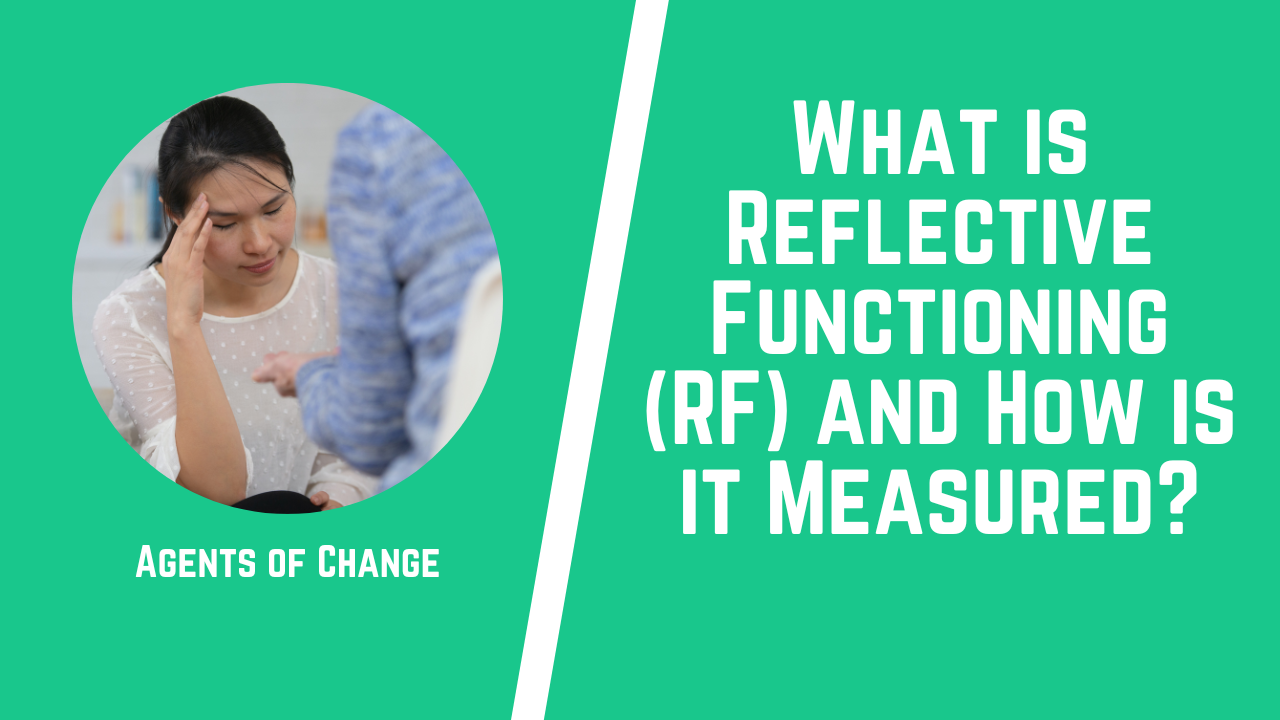
a diverse client in a therapy session pausing and reflecting

This ability is closely tied to the concept of mentalizing. When you mentalize, you’re essentially asking, “What might this person be thinking or feeling right now?” or “Why did I react that way?” It’s not about getting a perfect answer. It’s about staying curious and open to the idea that behavior has meaning beneath the surface. That curiosity creates space for empathy, flexibility, and deeper understanding in relationships.

Reflective functioning also involves recognizing that mental states are complex and sometimes unclear. People with well-developed RF understand that they can’t always know exactly what someone else is thinking, and they’re comfortable with that uncertainty. They’re less likely to jump to conclusions or assume the worst. Instead, they consider multiple possibilities and remain open to new information.

In everyday life, reflective functioning shows up in small but meaningful ways. For example, instead of assuming a friend is ignoring you out of indifference, you might wonder if they’re overwhelmed or distracted. Rather than reacting immediately in a moment of frustration, you might pause and ask yourself what emotion is driving your response. These moments of reflection help prevent misunderstandings and support healthier communication.

At its core, reflective functioning is about making sense of ourselves and others in a thoughtful, emotionally aware way. It’s not something people are simply born with or without. It develops over time, shaped by early relationships and life experiences, and it can continue to grow with intentional effort and practice.

Learn more about Agents of Change Continuing Education. We’ve helped hundreds of thousands of Social Workers, Counselors, and Mental Health Professionals with their online continuing education and CEUs, and we want you to be next!

2) Why Reflective Functioning Matters More Than You Might Think

Reflective functioning might seem like a subtle skill, but its impact runs deep. It influences how we relate to others, how we manage emotions, and how we interpret the world around us. When this ability is strong, life tends to feel more understandable and relationships more manageable. When it’s limited, even small interactions can spiral into confusion or conflict.

Let’s take a closer look at why reflective functioning plays such an important role across different areas of life.


Stronger and Healthier Relationships

At the heart of every relationship is the ability to understand one another. Reflective functioning helps people move beyond surface-level reactions and consider what might be happening internally.

When RF is well developed, people are more likely to:

  • Pause before reacting in emotionally charged situations
  • Consider alternative explanations for someone’s behavior
  • Show empathy, even during disagreements
  • Communicate with more clarity and less defensiveness

Without this skill, it’s easy to misinterpret intentions. A delayed response might feel like rejection. A short comment might seem like criticism. Reflective functioning creates a buffer against these misunderstandings by encouraging curiosity instead of assumptions.


Improved Emotional Regulation

Emotions can feel overwhelming, especially when they come on quickly or intensely. Reflective functioning helps create space between feeling and reacting.

Instead of being swept up in the moment, individuals with stronger RF can:

  • Identify what they’re feeling in real time
  • Understand why the emotion is arising
  • Choose how to respond rather than reacting automatically

This doesn’t mean emotions disappear or become easier overnight. It simply means there’s more awareness and control in how they’re handled. Over time, this can reduce impulsivity and increase emotional resilience.


A Strong Foundation for Parenting

Reflective functioning is especially important in caregiving relationships. Parents and caregivers who can interpret a child’s behavior through the lens of mental states are better equipped to respond in supportive ways.

For example, a child’s tantrum might be understood as frustration, fatigue, or a need for attention rather than “bad behavior.”

Caregivers with strong RF tend to:

  • Respond to children with sensitivity and patience
  • Help children name and understand their emotions
  • Foster secure attachment and trust
  • Create a more emotionally attuned environment

These early interactions shape how children learn to understand themselves and others, setting the stage for their own reflective functioning later in life.


Mental Health and Psychological Well-Being

Reflective functioning plays a key role in mental health. When individuals struggle to understand their own internal experiences or those of others, it can contribute to emotional distress and interpersonal difficulties.

Low or impaired RF has been associated with:

  • Difficulty managing intense emotions
  • Challenges in forming stable relationships
  • Increased vulnerability to certain mental health conditions
  • Misinterpretation of social cues and intentions

On the other hand, strengthening reflective functioning can support recovery and growth. Many therapeutic approaches focus on helping individuals build this skill, leading to greater insight and improved coping.


Better Decision-Making and Self-Awareness

Every decision we make is influenced by internal processes, whether we’re aware of them or not. Reflective functioning brings those processes into focus.

With stronger RF, individuals are more likely to:

  • Recognize patterns in their behavior
  • Understand how past experiences influence present choices
  • Make decisions aligned with their values and goals
  • Learn from mistakes without becoming overly self-critical

This kind of awareness doesn’t just improve decision-making. It fosters a deeper sense of self-understanding that can guide personal growth over time.


Why It All Adds Up

Reflective functioning touches nearly every aspect of human experience. It shapes how we think, feel, relate, and grow. While it may operate quietly in the background, its effects are anything but small.

By strengthening this ability, people can:

  • Navigate relationships with greater ease
  • Respond to challenges more thoughtfully
  • Build a stronger sense of identity
  • Create more meaningful connections in everyday life

In many ways, reflective functioning acts like an internal compass. It doesn’t eliminate difficulties, but it helps you make sense of them, which can make all the difference.

Agents of Change has helped hundreds of thousands of Social Workers, Counselors, and Mental Health Professionals with Continuing Education, learn more here about Agents of Change and claim your 7.5 free CEUs!

3) How is Reflective Functioning Measured?

Understanding reflective functioning is one thing. Measuring it is another challenge entirely. Since RF involves internal processes like thoughts, emotions, and interpretations, it can’t be captured with a simple checklist alone. Instead, clinicians and researchers rely on a mix of interviews, structured scoring systems, and self-report tools to assess how well someone can mentalize.

a picture of a diverse client in a therapy session pausing and reflecting

Each method offers a different window into reflective functioning. Some go deep and provide rich detail, while others are quicker and more practical for everyday use. Let’s walk through the most commonly used screeners and tools, along with their strengths and limitations.


1. Reflective Functioning Scale (RFS)

The Reflective Functioning Scale is considered the gold standard for assessing RF, especially in research and clinical settings.

How It Works

  • Applied to transcripts from structured interviews
  • Most often paired with the Adult Attachment Interview (AAI)
  • Trained evaluators score responses based on evidence of mentalizing

Scores typically range from negative or absent reflective functioning to very high levels of insight and complexity.

Pros

  • Provides a deep, nuanced understanding of reflective functioning
  • Captures subtle differences in how people think about mental states
  • Strong research backing and reliability when used by trained raters

Cons

  • Time-intensive to administer and score
  • Requires specialized training to use accurately
  • Not practical for quick screenings or high-volume settings

2. Adult Attachment Interview (AAI)

While not a direct measure of RF on its own, the AAI is often used alongside the RFS to evaluate reflective functioning.

How It Works

  • A semi-structured interview focused on early relationships and attachment experiences
  • Participants describe childhood memories and emotional dynamics
  • Responses are analyzed for coherence, insight, and mentalizing capacity

Pros

  • Offers rich, in-depth qualitative data
  • Helps link reflective functioning to attachment patterns
  • Useful in both clinical and research contexts

Cons

  • Lengthy and resource-intensive
  • Requires trained interviewers and coders
  • May feel emotionally demanding for participants

3. Reflective Functioning Questionnaire (RFQ)

The RFQ is a widely used self-report screener designed for efficiency and accessibility.

How It Works

  • Short questionnaire completed by the individual
  • Measures two main dimensions:
    • Certainty about mental states
    • Uncertainty about mental states

The goal is to assess whether someone is overly rigid, overly unsure, or balanced in their understanding of mental states.

Pros

  • Quick and easy to administer
  • Cost-effective and scalable
  • Useful for screening in clinical and community settings

Cons

  • Relies on self-awareness, which may be limited
  • Less nuanced than interview-based methods
  • Can be influenced by response bias

4. Parent Development Interview (PDI)

The PDI is specifically designed to assess reflective functioning in caregivers.

How It Works

  • Semi-structured interview focused on the parent-child relationship
  • Explores how parents interpret their child’s thoughts and feelings
  • Responses are scored using reflective functioning criteria

Pros

  • Highly relevant for parenting and attachment research
  • Provides insight into caregiving dynamics
  • Helps identify strengths and areas for growth in parental mentalizing

Cons

  • Time-consuming to conduct and score
  • Requires training for accurate interpretation
  • May not generalize beyond the parenting context

5. Brief and Emerging Screeners

In recent years, shorter and more practical tools have been developed to assess reflective functioning in busy clinical environments.

Examples May Include

  • Short-form RF questionnaires
  • Adapted interview protocols
  • Digital or app-based assessments

Pros

  • Faster to administer
  • More accessible for routine use
  • Easier to integrate into clinical workflows

Cons

  • Still being validated in research
  • May lack depth compared to established tools
  • Risk of oversimplifying a complex construct

Choosing the Right Measurement Tool

There’s no one-size-fits-all approach to measuring reflective functioning. The choice depends on the setting, purpose, and available resources.

For example:

  • Research studies often favor the RFS and AAI for their depth
  • Clinical screenings may rely on the RFQ for efficiency
  • Parenting assessments benefit from tools like the PDI

In practice, many professionals combine methods to get a more complete picture.


Why Measurement Still Matters

Even with its challenges, measuring reflective functioning provides valuable insight. It helps clinicians:

  • Identify strengths and gaps in mentalizing
  • Tailor interventions to individual needs
  • Track progress over time

For professionals looking to deepen their understanding of these tools, continuing education can be incredibly helpful. Programs like Agents of Change Continuing Education offer training opportunities that explore assessment methods, attachment theory, and evidence-based practices. With over 150 ASWB and NBCC-approved courses and more than 15 live events each year, it’s a practical way to stay informed while earning required CE credits.

At the end of the day, measuring reflective functioning isn’t about assigning a number to someone’s inner world. It’s about gaining insight into how people make sense of themselves and others, which can guide more effective support and meaningful change.

4) Can Reflective Functioning Be Improved?

Yes, it absolutely can. Reflective functioning isn’t a fixed trait that you either have or don’t. It’s a skill that develops over time and can continue to grow with intention, practice, and the right kind of support. While early relationships play a big role in shaping RF, later experiences, especially those that encourage curiosity and self-awareness, can strengthen it in meaningful ways.

For many people, improving reflective functioning feels less like learning something new and more like rediscovering a capacity that was never fully developed. With consistent effort, the ability to pause, reflect, and understand mental states becomes more natural.


The Role of Therapy in Strengthening RF

Therapy is one of the most effective ways to build reflective functioning. Certain therapeutic approaches are specifically designed to enhance mentalizing.

Mentalization-Based Therapy (MBT)

MBT focuses directly on improving a person’s ability to understand their own and others’ mental states.

  • Encourages curiosity about thoughts and feelings
  • Helps individuals slow down emotional reactions
  • Builds awareness of how misunderstandings happen

Over time, clients learn to interpret situations with more flexibility and less emotional reactivity.

Psychodynamic and Attachment-Based Therapies

These approaches also support RF development by exploring past relationships and emotional patterns.

  • Clients reflect on early experiences and how they shape current behavior
  • Therapists model reflective thinking during sessions
  • Emotional insight deepens through guided exploration

The therapeutic relationship itself becomes a space where reflective functioning can grow.


Everyday Practices That Build Reflective Functioning

You don’t need to be in therapy to strengthen reflective functioning. Small, consistent habits can make a noticeable difference.

Simple Strategies to Try

  • Pause before reacting
    Give yourself a moment to notice what you’re feeling
  • Name your emotions
    Try to identify specific feelings rather than general discomfort
  • Ask reflective questions
    “Why might I be feeling this way?” or “What else could be going on here?”
  • Consider other perspectives
    Think about what someone else might be experiencing internally
  • Stay open to uncertainty
    Accept that you might not fully understand every situation

These practices may feel awkward at first, but with repetition, they become more intuitive.


The Importance of Safe and Supportive Relationships

Reflective functioning grows best in environments where people feel emotionally safe. When someone feels understood and not judged, they’re more likely to explore their own thoughts and feelings openly.

Supportive relationships can:

  • Encourage honest self-reflection
  • Provide feedback in a constructive way
  • Model curiosity and empathy
  • Reduce defensiveness during difficult conversations

In many ways, reflective functioning develops through connection. Being around people who mentalize well can help strengthen your own capacity.


Barriers to Improving Reflective Functioning

While growth is possible, it’s not always easy. Certain factors can make it more challenging to develop RF.

Common Obstacles

  • High levels of stress or emotional overwhelm
  • Past trauma or attachment disruptions
  • Difficulty identifying or expressing emotions
  • Rigid thinking patterns or strong assumptions about others

When someone feels overwhelmed, the brain often shifts into survival mode, making reflective thinking harder. That’s why building RF often involves learning to regulate emotions alongside developing insight.


The Role of Ongoing Learning for Professionals

For therapists, social workers, and counselors, improving reflective functioning is an ongoing process. It’s not just about helping clients develop RF. It’s also about strengthening their own ability to mentalize in clinical work.

Continuing education plays a key role here. Programs like Agents of Change Continuing Education offer practical, accessible ways to deepen these skills. With more than 150 ASWB and NBCC-approved courses, professionals can explore topics like attachment, trauma, and evidence-based interventions that support reflective functioning.

Agents of Change Continuing Education also provides more than 15 live continuing education events each year, creating opportunities to engage with new ideas and real-world applications. With a $99 per year subscription, it remains one of the most affordable options for earning CEUs while expanding clinical expertise.


Growth Takes Time, But It’s Worth It

Improving reflective functioning doesn’t happen overnight. It’s a gradual process that unfolds through awareness, practice, and experience. There will be moments of clarity and moments of confusion, and that’s part of the journey.

What matters most is the willingness to stay curious. Each time you pause to reflect instead of react, you’re strengthening this skill. Over time, those small moments add up, leading to deeper understanding, stronger relationships, and a greater sense of emotional balance.

5) FAQs – Reflective Functioning (RF)

Q: How is reflective functioning different from simply “thinking about your feelings”?

A: While thinking about your feelings is part of reflective functioning, RF goes a step further. It involves understanding the connection between thoughts, emotions, and behaviors in both yourself and others. For example, it’s not just recognizing that you feel angry, but also asking why that anger showed up and how it influenced your reaction. It also includes considering that other people’s actions are driven by their own internal experiences, even when those aren’t immediately obvious.

Q: Can reflective functioning change depending on the situation?

A: Yes, reflective functioning isn’t always consistent. Even people with strong RF can struggle to mentalize when they’re stressed, overwhelmed, or emotionally triggered. In high-pressure situations, the brain may shift into a more reactive mode, making it harder to pause and reflect. That’s why building reflective functioning isn’t about being perfect all the time. It’s about increasing your ability to return to a reflective state more quickly after those moments.

Q: Why is reflective functioning important for mental health professionals specifically?

A: For therapists, social workers, and counselors, reflective functioning is essential because it shapes how they understand and respond to clients. Strong RF allows professionals to remain curious, avoid assumptions, and explore clients’ inner experiences with greater depth. It also helps in managing complex emotional dynamics within sessions. Ongoing training can strengthen this skill, and resources like Agents of Change Continuing Education provide structured opportunities to build expertise while earning required CE credits through flexible courses and live learning experiences.

6) Conclusion

Reflective functioning offers a powerful lens for understanding human behavior. By looking beyond surface actions and considering the thoughts and emotions that drive them, people can develop deeper self-awareness and stronger connections with others. Whether in personal relationships or professional settings, this ability creates space for empathy, flexibility, and more thoughtful responses.

Throughout this article, we’ve explored what reflective functioning is, why it matters, and how it can be measured using tools like interviews and questionnaires. While assessing something as complex as mentalizing comes with challenges, these methods provide valuable insight into how individuals interpret their inner world and the minds of others. More importantly, reflective functioning is not fixed. It can grow over time through intentional practice, supportive relationships, and therapeutic work.

————————————————————————————————————————————————

► Learn more about the Agents of Change Continuing Education here: https://agentsofchangetraining.com

About the Instructor, Dr. Meagan Mitchell: Meagan is a Licensed Clinical Social Worker and has been providing Continuing Education for Social Workers, Counselors, and Mental Health Professionals for more than 10 years. From all of this experience helping others, she created Agents of Change Continuing Education to help Social Workers, Counselors, and Mental Health Professionals stay up-to-date on the latest trends, research, and techniques.

#socialwork #socialworker #socialwork #socialworklicense #socialworklicensing #continuinged #continuingeducation #ce #socialworkce #freecesocialwork #lmsw #lcsw #counselor #NBCC #ASWB #ACE

Disclaimer: This content has been made available for informational and educational purposes only. This content is not intended to be a substitute for professional medical or clinical advice, diagnosis, or treatment

Note: Certain images used in this post were generated with the help of artificial intelligence.

Share:

Discover more from Agents of Change

Subscribe now to keep reading and get access to the full archive.

Continue reading

SOCIAL WORK MONTH SPECIAL: Unlimited CE + Live Events for $49. Spots are limited!