Powerful Techniques for Motivating and Engaging Mental Health Clients
Powerful Techniques for Motivating and Engaging Mental Health Clients
 

Motivating and engaging mental health clients isn’t just a skill—it’s an art. Every session holds the potential for transformation, but that can’t happen if clients aren’t truly present, emotionally invested, or willing to participate in the work. Whether you’re a Social Worker meeting a new client who’s uncertain about therapy, or a seasoned clinician navigating burnout in long-term treatment, figuring out how to inspire meaningful engagement is often one of the toughest (and most rewarding) parts of the job.

Clients come to therapy carrying so much—trauma, grief, shame, resistance, hope—and it’s rarely a straight line to connection. Building trust and motivation takes time, creativity, and often, a shift in perspective. What worked in school or textbooks doesn’t always translate in the real world, especially when your client has already been let down by systems or people they’ve trusted. That’s why knowing and using a variety of techniques for motivating and engaging mental health clients is essential for any effective therapeutic relationship.

In this post, we’ll break down practical, evidence-informed methods that go beyond the basics—approaches you can actually use in sessions that feel stuck, stagnant, or strained. From collaborative goal-setting to using expressive modalities like movement or art, these tools are all about meeting your client where they are, without losing sight of where they’re capable of going. Whether you’re new to the field or looking to refresh your toolbox, these strategies can help you spark momentum, deepen rapport, and create the kind of therapeutic space that clients want to return to.

Did you know? Agents of Change Continuing Education offers Unlimited Access to 150+ ASWB and NBCC-approved CE courses for one low annual fee to meet your state’s requirements for Continuing Education credits and level up your career.

We’ve helped tens of thousands of Social Workers, Counselors, and Mental Health Professionals with Continuing Education, learn more here about Agents of Change and claim your 5 free CEUs.

1) Why Engagement and Motivation Matter in Mental Health Work

Motivation and engagement aren’t just buzzwords—they’re the pulse of effective therapy. Without them, sessions can drift, feel aimless, or even end prematurely. When clients are engaged and internally motivated, they’re not just showing up—they’re invested. And that investment is what leads to real, sustainable progress.

a diverse therapist working with a motivated and engaged client in a warm office setting.

Let’s explore why this matters so much and how it directly shapes outcomes in mental health care.


The Foundation of the Therapeutic Relationship

Therapy isn’t something we do to clients. It’s something we build with them. And at the core of that collaboration is the relationship. When clients feel seen, heard, and respected, their engagement naturally increases.

Here’s how engagement strengthens the alliance:

  • Builds trust between client and therapist

  • Reduces defensiveness and resistance

  • Encourages emotional openness

  • Helps create a shared vision for change

Without this relational groundwork, clients may disengage—or simply go through the motions. Genuine connection is what keeps them anchored, even when the work gets hard.


Motivation as the Engine for Change

Motivation isn’t a fixed trait—it fluctuates. And part of our role as clinicians is to help clients discover (or rediscover) their why. It’s what drives action, persistence, and hope.

When motivation is nurtured, clients are more likely to:

  • Set and pursue meaningful goals

  • Tolerate emotional discomfort during difficult sessions

  • Practice new skills outside the therapy room

  • Take ownership of their growth process

On the flip side, when motivation is low, even the most well-designed treatment plan can stall. That’s why identifying internal motivators—values, aspirations, life roles—is a game-changer.


Dropout Prevention and Treatment Retention

Let’s be honest: therapy dropout is a real challenge. Research consistently shows that a significant number of clients leave therapy prematurely. But the reasons aren’t always what you’d expect—it’s often a lack of engagement or unclear purpose.

What keeps clients coming back?

  • Feeling like sessions are relevant and personalized

  • A clear sense of progress (even small wins)

  • A therapist who adapts to their pace and style

  • Space to talk about what matters to them

When clients feel like therapy is working with them—not against them—they’re far more likely to stay committed.


Empowerment Over Compliance

Motivation isn’t about getting clients to “follow directions.” It’s about helping them feel empowered in their own journey. When we shift from a compliance-based model to one centered on choice and agency, we invite clients to become active participants in their healing.

Empowered clients tend to:

  • Make more thoughtful, values-aligned decisions

  • Develop a stronger sense of self-efficacy

  • Advocate for themselves in and out of therapy

  • Build resilience for future challenges

This isn’t just better for the client—it makes our work more meaningful too.


Cultural and Contextual Relevance

Engagement also hinges on whether the therapeutic space feels culturally safe. If clients don’t see their identity, background, or experiences reflected or respected in treatment, motivation can shut down—fast.

To promote culturally responsive engagement:

  • Ask about their experiences with identity, community, and systemic stressors

  • Avoid assumptions—stay curious

  • Use language and metaphors that resonate with their world

  • Validate mistrust or skepticism if it comes up

This kind of responsiveness isn’t extra—it’s essential.


Bottom Line: Motivation and Engagement Aren’t Optional

If you’ve ever left a session wondering, “Did that even land?”—you’re not alone. But with the right mindset and tools, you can shift the dynamic from passive to participatory. Techniques for motivating and engaging mental health clients aren’t about fancy tricks or clinical jargon. They’re about fostering connection, tapping into what really matters, and inviting your clients to see themselves as capable of change.

And if you’re looking to go deeper with this work, Agents of Change Continuing Education offers incredible courses that explore these exact dynamics. With over 150 approved options and live trainings throughout the year, it’s a go-to resource for sharpening your clinical intuition and engagement strategies.

Learn more about Agents of Change Continuing Education. We’ve helped tens of thousands of Social Workers, Counselors, and Mental Health Professionals with their continuing education, and we want you to be next!

2) Core Techniques for Motivating and Engaging Mental Health Clients
Engaging a mental health client isn’t about pushing them harder—it’s about meeting them where they are and helping them see that forward motion is possible, even if it’s slow. Motivation comes in waves, and clients don’t always arrive with it. That’s okay. Our job isn’t to provide the fuel—it’s to help them discover their own source of it.

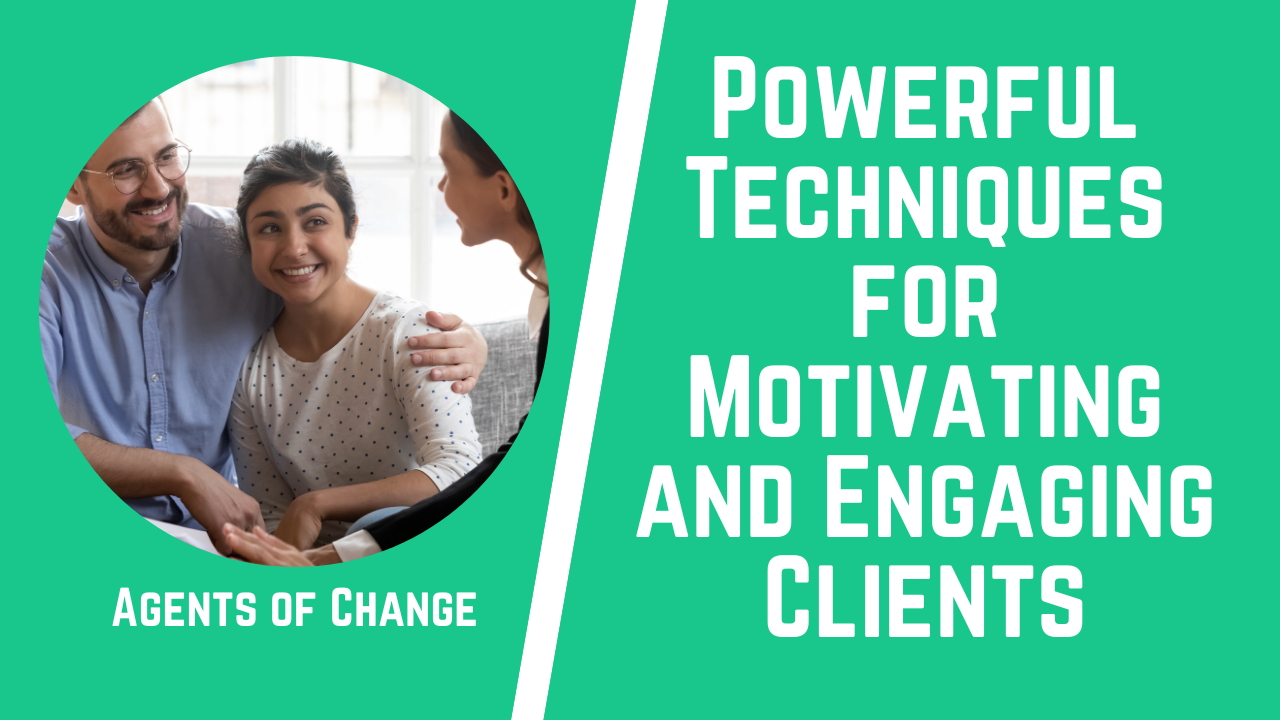
a diverse therapist working with a motivated and engaged client in a warm office setting.

These core techniques are designed for real-life use, not just theory. Whether you’re supporting someone navigating trauma, struggling with depression, or feeling stuck in cycles of self-sabotage, these tools can reawaken curiosity, confidence, and the willingness to try again.


1. Motivational Interviewing: Listening for Change, Not Just Talking

Motivational Interviewing (MI) isn’t just a buzzword—it’s a mindset. Rooted in collaboration and compassion, MI is about helping clients explore their ambivalence and come to their own conclusions about change. That’s where the motivation sticks.

What MI looks like in action:

  • Open-ended questions that avoid yes/no traps:
    “What would be different in your life if this problem wasn’t so heavy?”

  • Affirmations that recognize effort:
    “You’ve been through so much, and you’re still here, still showing up.”

  • Reflections to deepen awareness:
    “It sounds like part of you wants to move forward, and another part’s afraid to let go.”

  • Summarizing what you’ve heard, then asking for clarity:
    “So you’re tired of feeling stuck, but change feels overwhelming. Did I get that right?”

The key? Slow down and listen for “change talk.” It’s often subtle, but it tells you where the door is cracked open.


2. Collaborative Goal-Setting: Focus on What They Want

Therapy isn’t effective when we’re the only ones driving. When clients are part of setting their goals, they’re more likely to invest in the process—and feel like it’s theirs, not yours.

Tips for collaborative goal-setting:

  • Ask “What matters most to you right now?”
    Don’t assume what’s urgent for you is urgent for them.

  • Use scaling questions:
    “On a scale from 1–10, how motivated do you feel to work on this?”
    Then explore what would move them up the scale by even one number.

  • Chunk it down:
    If a client says they want to “feel better,” break that into smaller, trackable wins:

    • Sleeping more regularly

    • Reaching out to one friend this week

    • Writing down one helpful thought per day

Small wins build big momentum.


3. Strength-Based Framing: Flip the Script

Clients often walk into therapy feeling broken or defeated. They may have internalized messages about failure, weakness, or inadequacy. One of the most powerful things we can do? Shift the narrative.

How to apply a strength-based lens:

  • Spot and name strengths they don’t recognize in themselves
    “You’ve developed some serious survival skills. Let’s talk about how those could be tools—not just reactions.”

  • Ask about past successes, even small ones
    “Can you remember a time you handled something better than expected?”

  • Reframe “problems” as adaptations
    For example:

    • Anxiety? That’s a hyper-attuned nervous system trying to protect.

    • Numbness? That’s the mind’s way of managing overload.

Clients are more motivated when they see themselves as resourceful—not defective.


4. Personalize the Process: One Size Doesn’t Fit Anyone

Cookie-cutter therapy just doesn’t work. If your methods don’t match your client’s communication style, learning preferences, or emotional bandwidth, they’ll check out. Fast.

Ways to personalize sessions:

  • Ask about their learning style:
    Do they like visuals, conversation, hands-on tools?

  • Incorporate their interests:

    • Use sports analogies with athletes

    • Bring in music or film for those who connect emotionally that way

    • Let clients sketch, build, or role-play when words feel flat

  • Let them lead sometimes:
    Ask: “What do you wish therapists would do differently?”
    That one question can unlock a whole new level of honesty and engagement.


5. Use the Power of Visualization and Future-Self Work

Clients often struggle to imagine a future that feels safe, stable, or satisfying. Helping them create even a rough sketch of their “future self” can bring clarity, direction, and hope.

Try this exercise:

  • “Picture yourself six months from now. What’s different about your life? How do you walk into a room? Who’s in your corner?”

Or flip it:

  • “If future-you could talk to present-you, what would they say?”

These prompts can spark powerful insights. They move clients out of the immediate pain and into possibility.


6. Make Room for Resistance—Don’t Fight It

Resistance isn’t the enemy. In fact, it’s full of information. It tells you where there’s fear, mistrust, or unmet needs. When you honor resistance instead of pushing against it, you build trust—and create space for deeper work.

How to work with resistance, not against it:

  • Validate first:
    “Of course this is hard to talk about. You’ve been through a lot, and opening up might not feel safe yet.”

  • Stay curious, not confrontational:
    “What feels risky about making this change?”

  • Normalize ambivalence:
    Let clients know it’s okay to want change and fear it at the same time.

Often, the resistance will soften on its own once it feels respected.


7. Build Rituals That Anchor Clients in the Work

Structure can be grounding. Whether your clients are dealing with trauma, grief, or anxiety, predictable therapeutic rhythms can increase their sense of emotional safety.

Examples of engagement-building rituals:

  • Start sessions with a “one-word check-in”
    It’s a low-pressure way to get a pulse on how they’re entering the room.

  • End sessions with a reflection prompt:

    • “What’s one thing you’re taking with you?”

    • “What would you like to focus on next time?”

  • Use creative closings like breathing exercises or gratitude prompts to center them before reentering their day.

These rituals may seem simple, but they create a sense of continuity—and clients often start to look forward to them.


8. Provide Choices and Flexibility Whenever Possible

One of the quickest ways to kill engagement? Making clients feel powerless. Offering choices—even small ones—helps restore a sense of agency.

What choice can look like in session:

  • “Would you prefer to keep exploring this topic or shift gears?”

  • “Want to talk it out, write it down, or try a visual tool?”

  • “Should we do a check-in first or dive straight into the issue?”

When clients feel like they have a say, they’re more likely to stay connected.


Bonus Tip: Don’t Be Afraid to Pause and Reflect

Sometimes, the most powerful thing you can do is slow down and ask, “How is this going for you?” or “What’s it like for you to be in this space?” These moments of transparency not only re-engage your client—they reinforce that therapy is theirs, not yours.


These core techniques for motivating and engaging mental health clients aren’t just methods—they’re a mindset. They reflect a deep respect for the complexity of being human, especially when healing feels out of reach.

If you’re looking to strengthen these skills and earn required CE credits while you’re at it, Agents of Change Continuing Education offers dynamic courses and live continuing education events that dig deep into this kind of real-world clinical engagement. Their programs are built specifically for Social Workers, Counselors, and Mental Health Professionals who want more than textbook theory—they want to feel empowered in the room.

When you’ve got the right tools and the right mindset, motivation becomes a partnership—and that’s where the real magic happens.

Agents of Change has helped tens of thousands of Social Workers, Counselors, and Mental Health Professionals with Continuing Education, learn more here about Agents of Change and claim your 5 free CEUs!

3) Creative and Less Conventional Approaches

While foundational techniques are critical, sometimes clients need something different—something that doesn’t feel like “typical therapy.” Creative and unconventional approaches can breathe new life into sessions that feel flat or disconnected. These methods help clients engage in ways that feel more personal, expressive, or even playful, allowing for deeper exploration without the pressure of traditional talk therapy.

a therapist working with a client on art therapy where the client is drawing to convey emotions

Let’s look at some powerful yet less conventional ways to ignite engagement and keep motivation alive.


1. Narrative Therapy & Storytelling Tools

Everyone’s living in a story—some empowering, others rooted in shame, fear, or survival. Helping clients step back and examine the narrative they’ve internalized gives them the chance to rewrite it.

Ways to use narrative techniques:

  • Re-authoring exercises:
    Invite clients to rewrite a difficult memory as if they were the hero, not the victim.

  • Externalizing problems:
    Instead of saying “I’m anxious,” shift to “Anxiety has been showing up a lot lately.” This creates distance from the issue, which makes it easier to explore.

  • Timeline creation:
    Have clients map their life like a story arc—highlighting turning points, moments of growth, and future chapters they’d like to create.

These tools help clients see their identity as fluid, not fixed. That can be a huge boost to motivation.


2. Expressive Arts: Unlocking Emotion Without Words

Some clients struggle to articulate what they’re feeling—especially those dealing with trauma, grief, or early life attachment issues. That’s where expressive arts come in.

Creative modalities to explore:

  • Drawing or painting emotions, thoughts, or body sensations

  • Using collage to create a vision board for future goals or personal values

  • Music therapy techniques—like analyzing lyrics or building playlists tied to specific moods

  • Guided movement or somatic expression, like stretching or grounding through body-based awareness

These approaches bypass the analytical brain and engage the emotional body, often leading to breakthroughs that words alone can’t reach.


3. Metaphors, Props, and Visual Aids

Sometimes, a well-placed metaphor or a tangible object can unlock a client’s insight far more effectively than clinical language.

How to use metaphors and props in therapy:

  • Bring in physical items:

    • A tangled ball of yarn to represent overwhelming thoughts

    • A candle for hope or resilience

    • A rock for strength or stability

  • Create visual scales:
    Use drawings, charts, or emotion wheels to help clients gauge progress or identify feelings.

  • Use metaphor-rich questions:

    • “What’s one chapter you’re ready to close?”

    • “If this feeling were a storm, what kind of weather would it be?”

These tools can make therapy feel more grounded and relatable—especially for clients who think in pictures or sensations.


4. Incorporate Movement and Environment

Sitting face-to-face in an office doesn’t work for everyone. Changing the physical environment or adding movement can re-engage clients, especially those who feel restless, stuck, or guarded.

Try these body-oriented or setting-based strategies:

  • Walk-and-talk therapy:
    When appropriate and safe, getting outside can shift energy and open up conversation in a more organic way.

  • Movement-based check-ins:
    Ask clients to express how they’re feeling using body posture, stretching, or movement instead of words.

  • Grounding games:
    Use sensory objects like textured fabrics, scented oils, or kinetic sand to engage clients in regulating their nervous system.

When clients feel their body is part of the process—not just their mind—they engage more holistically.


5. Playfulness, Creativity, and Humor (Used Wisely)

Therapy doesn’t have to be heavy every second. In fact, strategically bringing in playfulness can deepen connection and lower emotional defenses.

Ways to bring lightness without losing depth:

  • Gamify goals:
    Turn a behavioral goal into a challenge or quest with mini rewards or milestones.

  • Use therapeutic card decks or prompts:
    Great for clients who feel overwhelmed by open-ended questions.

  • Incorporate humor:
    Laugh with clients—not at them—to validate their humanity and make space for complexity.

Of course, timing and tone matter. But a well-placed smile or creative twist can reignite motivation when things feel stuck.


6. Rituals and Symbolic Acts

Sometimes, doing something symbolic can provide closure, renewal, or motivation in ways that verbal processing just can’t.

Examples of symbolic acts:

  • Write and burn a letter to release anger or grief (in a safe, guided setting)

  • Create a goodbye ritual when ending a chapter (like leaving an item behind or planting something new)

  • Design a personal mantra or visual affirmation they can keep with them

These gestures tap into something deeper than logic—they give meaning to moments, and that meaning can spark real change.


Why These Creative Approaches Work

Creative methods activate different areas of the brain and nervous system. They help bypass shame, rigidity, or numbness and make space for curiosity, play, and emotional safety. And when clients feel safe and curious? They show up with more honesty, motivation, and energy.

You don’t have to be an artist, dancer, or poet to use these techniques. Just be willing to step outside the box—and invite your client to do the same.


Pro Tip: Want to learn more about how to use creative tools clinically and ethically? Agents of Change Continuing Education offers innovative courses and live events throughout the year to help Social Workers, Counselors, and Mental Health Professionals integrate expressive therapies, somatic work, and narrative techniques into their practice—while earning CE credits to keep their license active.


Creative engagement isn’t a gimmick. It’s an invitation. A chance to say, “You don’t have to heal in a straight line—and you’re allowed to find your own rhythm.” These less conventional approaches can be the very thing that turns a passive client into an empowered one.

With so many options available through trusted providers like Agents of Change Continuing Education, you can build a CE path that works with your real life—not against it.

4) Training Makes a Difference—Here’s Where to Start

Even the most naturally gifted therapist hits walls. Motivation dips. Sessions stall. New client challenges emerge that you didn’t train for—or didn’t expect. The truth? Knowing how to motivate and engage mental health clients isn’t something you master once and check off a list. It’s a muscle that grows with reflection, practice, and ongoing training.

Investing in your own learning is one of the most effective ways to strengthen your impact. Whether you’ve been practicing for twenty years or you’re newly licensed, targeted professional development can reconnect you to what brought you to this work in the first place.


Why Continuing Education Isn’t Just a Requirement

Let’s be honest—most clinicians pursue CE credits because we have to. But the right training isn’t just a box to tick—it’s a doorway to more meaningful, skillful, and energizing practice.

High-quality continuing education can:

  • Introduce new, evidence-based techniques for client engagement

  • Sharpen core skills like motivational interviewing, trauma-informed care, and cultural humility

  • Offer fresh insights on common challenges—like client resistance or therapeutic rupture

  • Reignite your own motivation when you’re feeling stuck or burnt out

When you learn something that clicks, it doesn’t just help your clients—it makes you feel more confident, aligned, and ready to show up.


What to Look for in a Great Training Program

Not all continuing education is created equal. A slideshow with outdated PowerPoint slides? Pass. You deserve interactive, engaging, and practical learning experiences that mirror the complexity of your work.

Signs of a high-quality training:

  • Taught by real-world clinicians who still practice

  • Includes client scenarios and tools you can apply immediately

  • Offers flexibility—self-paced and live options

  • Addresses both clinical skills and human connection

  • Approved by licensing boards like ASWB and NBCC

And when the training connects theory with day-to-day practice? That’s when you’ll feel the shift—not just in your knowledge, but in your sessions.


Start Here: Agents of Change Continuing Education

If you’re wondering where to start (or restart), Agents of Change Continuing Education is a standout choice. Their courses are tailor-made for Social Workers, Counselors, and other Mental Health Professionals looking to stay sharp, responsive, and licensed.

Here’s what makes Agents of Change worth checking out:

  • Over 150 ASWB and NBCC-approved CE courses
    Covering everything from trauma recovery to client motivation to social justice-informed practice

  • Frequent live continuing education events
    So you can engage in real-time, ask questions, and connect with peers

  • Flexible formats
    Take courses at your own pace or join a scheduled event—your choice, your rhythm

  • Designed by clinicians, for clinicians
    These aren’t dry lectures. They’re grounded in real experience and practical wisdom

You can browse their full list of offerings right here. Chances are, you’ll find a training that speaks directly to the challenges you’re facing right now.


Make Ongoing Learning a Sustainable Habit

Don’t wait for burnout or doubt to creep in before recharging your skill set. Make learning part of your professional rhythm. Just like we encourage clients to grow, stretch, and reflect—we need that too.

Ways to build learning into your practice:

  • Block out one hour a week for CE coursework or reading

  • Sign up for quarterly live trainings to stay current

  • Join a peer consultation group or community forum tied to your CE program

  • Keep a “skills to explore” list as you notice gaps in your sessions

Training isn’t about becoming perfect—it’s about staying present, creative, and curious. That’s where real connection begins.


In a field as complex and human-centered as mental health, your learning should grow with your clients. The techniques for motivating and engaging mental health clients evolve—and so can you. With the right training partner like Agents of Change Continuing Education, you’re not just earning credits—you’re stepping back into your power as a truly transformative clinician.

5) FAQs – Motivating and Engaging Mental Health Clients

Q: What should I do if a client seems completely unmotivated and disengaged, even after trying multiple techniques?

A: This is more common than most clinicians like to admit—and it doesn’t mean you’re failing. When a client appears entirely unmotivated, it’s important to shift your focus from “fixing” them to understanding them. Start by exploring what engagement looks like for them, not just what it looks like on paper. Disengagement often masks fear, shame, or trauma—not laziness or disinterest.

Try this approach:

  • Ask gentle, curiosity-based questions like, “What’s it like for you to be in therapy right now?”

  • Normalize resistance without judgment.

  • Offer more control: let them set the pace or choose session structure.

  • Reinforce safety and consistency—even if progress feels invisible.

Sometimes, just being a non-judgmental presence over time is the intervention. Trust builds slowly, and motivation may emerge only after your client knows you’re truly in it with them.

Q: How do I keep clients engaged in long-term therapy when progress starts to plateau?

A: Plateaus are natural—and sometimes necessary—parts of the therapeutic process. But they can feel disheartening for both clients and clinicians. When things begin to feel stale, it’s often a signal to shake up the process, revisit goals, or reconnect with the client’s deeper values.

Here’s what might help:

  • Reflect on how far they’ve come—celebrate subtle shifts.

  • Introduce a creative or somatic method to reawaken emotional insight.

  • Revisit the client’s core why: “What’s still important to you about this work?”

  • Shift from outcome-focused to process-focused conversations: “What’s feeling different inside you, even if it’s hard to name?”

  • Invite feedback: “How has this space been feeling lately? Anything you’d like to change?”

Sometimes, leaning into the plateau—rather than resisting it—can reveal the client’s next step.

Q: How can I stay motivated as a clinician when I’m struggling to engage my clients?

A: Let’s be real—clinician burnout is very real, especially when you’re working hard to connect and still hitting walls. When client motivation is low, it can subtly drain your own energy. But your well-being matters just as much. You can’t engage clients effectively if you’re running on fumes.

Ways to protect and recharge your own motivation:

  • Reconnect with your “why.” What called you to this work in the first place?

  • Switch things up: try new techniques, trainings, or consultation groups.

  • Normalize the hard days. Even the best clinicians have sessions that fall flat.

  • Set boundaries around emotional labor—especially with high-needs caseloads.

  • Invest in ongoing training that actually inspires you, like courses through Agents of Change Continuing Education, which offer relevant, clinician-driven content that reminds you why this work matters.

You don’t have to carry every client’s transformation on your shoulders. Your presence, your effort, and your consistency already matter more than you think.

6) Conclusion

Motivating and engaging mental health clients isn’t about having the perfect script—it’s about showing up with intention, curiosity, and a willingness to adapt. When clients feel seen, valued, and empowered to participate in shaping their own healing, that’s when transformation begins. Whether it’s through small wins, creative strategies, or simply holding space during resistance, the real power of engagement comes from the therapeutic relationship itself.

As clinicians, our job isn’t to push or pull—it’s to walk beside. These techniques for motivating and engaging mental health clients remind us that progress doesn’t always look linear or dramatic. Sometimes, it’s a hesitant “I guess I’ll try,” a moment of honest reflection, or a shift in tone that tells you something’s landed. The more we expand our toolkit and embrace flexibility, the more we can meet clients where they are and invite them into meaningful, sustainable change.

If you’re ready to go deeper, grow your confidence, or just refresh your approach, remember that support is out there. Agents of Change Continuing Education offers over 150 CE-approved courses and live events designed specifically for Social Workers, Counselors, and Mental Health Professionals. When you invest in your own learning, you don’t just check a requirement off—you sharpen your ability to connect, inspire, and lead clients toward real growth.

————————————————————————————————————————————————

► Learn more about the Agents of Change Continuing Education here: https://agentsofchangetraining.com

About the Instructor, Meagan Mitchell: Meagan is a Licensed Clinical Social Worker and has been providing Continuing Education for Social Workers, Counselors, and Mental Health Professionals for more than 8 years. From all of this experience helping others, she created Agents of Change Continuing Education to help Social Workers, Counselors, and Mental Health Professionals stay up-to-date on the latest trends, research, and techniques.

#socialwork #socialworker #socialwork #socialworklicense #socialworklicensing #continuinged #continuingeducation #ce #socialworkce #freecesocialwork #lmsw #lcsw #counselor #NBCC #ASWB #ACE

Disclaimer: This content has been made available for informational and educational purposes only. This content is not intended to be a substitute for professional medical or clinical advice, diagnosis, or treatment

Share:

Discover more from Agents of Change

Subscribe now to keep reading and get access to the full archive.

Continue reading

New LIVE CE event - Therapeutic Interventions for the Treatment of Clients with Chronic Pain - Get 3 CE credits