What is Sustain Talk in Motivational Interviewing?
What is Sustain Talk in Motivational Interviewing?
Change is rarely a straight line. People can want something new and still feel pulled toward what is familiar, sometimes at the exact same time. If you have ever listened to a client explain why they should change and then immediately list all the reasons they cannot, you have already heard the tension that sits at the heart of Motivational Interviewing. That tension is not failure or stubbornness. It is a natural part of being human.

This is where the concept of sustain talk becomes so important. In therapy rooms, clinics, hospitals, and community settings, sustain talk shows up as hesitation, doubt, and attachment to current habits. It can sound logical, emotional, practical, or deeply personal. When clinicians misunderstand it, sessions can slip into power struggles or advice-giving that leaves everyone feeling frustrated. When clinicians understand it, those same moments become opportunities for connection and insight.

So what is sustain talk in Motivational Interviewing, really, and why does it deserve careful attention? This article breaks down what sustain talk looks like, why it appears, and how therapists and other helping professionals can respond in ways that support genuine change rather than resistance. Along the way, we will keep things practical, grounded, and focused on real conversations that happen every day in clinical work.

Did you know? Agents of Change Continuing Education offers Unlimited Access to 150+ ASWB and NBCC-approved CE courses and 12+ Live Events per year for one low annual fee to meet your state’s requirements for Continuing Education credits and level up your career.

We’ve helped hundreds of thousands of Social Workers, Counselors, and Mental Health Professionals with Continuing Education, learn more here about Agents of Change and claim your 5 free CEUs.

1) What Is Sustain Talk in Motivational Interviewing?
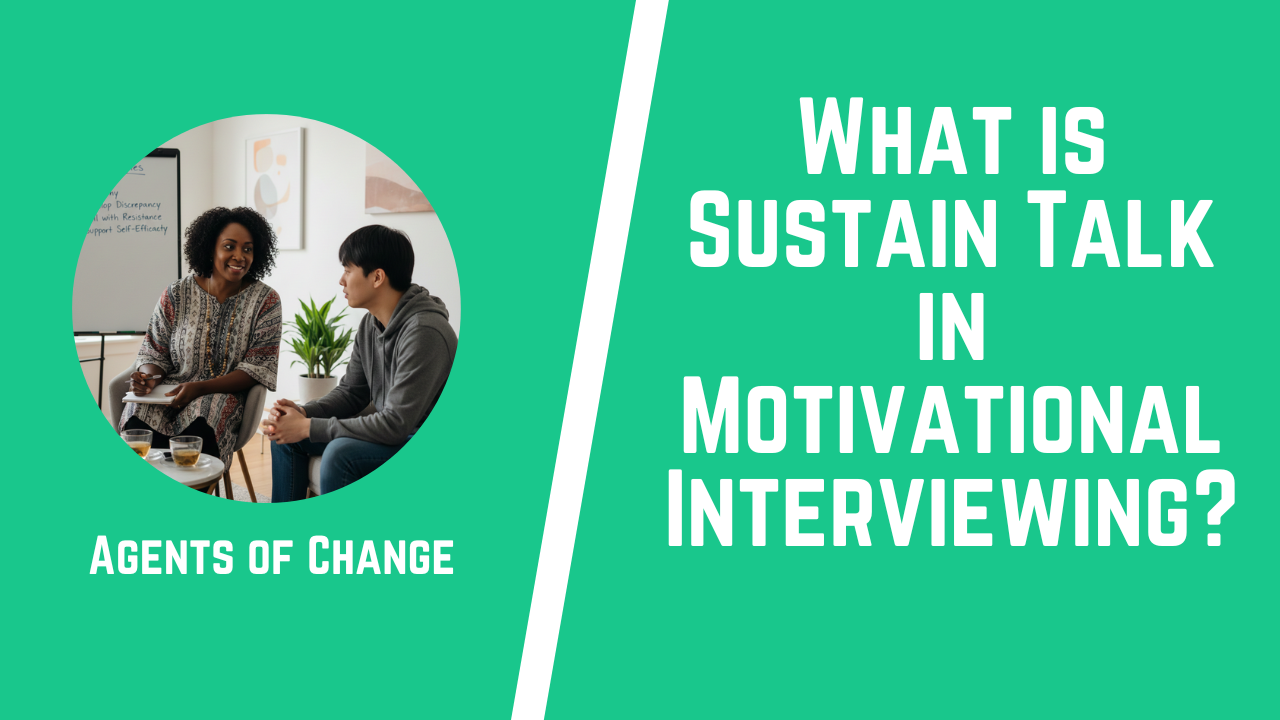
Sustain talk is the side of a client’s language that supports staying the same. It reflects the thoughts, feelings, and beliefs that pull a person toward familiar patterns, even when they are also talking about wanting something different. In Motivational Interviewing, this is expected and even welcomed, because it tells us where the client feels stuck, uncertain, or protective of their current way of coping.

Rather than treating sustain talk as resistance or lack of motivation, MI views it as meaningful communication. It gives therapists valuable information about fears, values, habits, and unmet needs. When you hear sustain talk clearly, you are hearing the client explain why change feels risky or overwhelming right now.

How Sustain Talk Fits Within Ambivalence

Ambivalence means holding two opposing desires at once. A client might want better health and still want the comfort of routines that feel safe. Sustain talk represents one side of that inner debate.

You might hear it when clients say things like:

  • “I know this is not great for me, but it helps me get through the day.”

  • “Part of me wants to change, but part of me is scared to try again.”

  • “I am not sure I can handle everything if I add this on top.”

These statements are not contradictions of progress. They are expressions of the emotional and practical costs that clients associate with change. When clinicians treat ambivalence as normal, the conversation becomes less about convincing and more about understanding.

Common Forms of Sustain Talk

In Motivational Interviewing, sustain talk is often grouped into familiar categories that mirror change talk. These categories help clinicians listen more carefully to what kind of concern is being expressed.

Sustain talk may show up as:

  • Desire to sustain
    Statements about wanting to keep things as they are.

  • Ability to sustain
    Doubts about being able to manage change.

  • Reasons to sustain
    Practical or emotional benefits of current behavior.

  • Need to sustain
    Beliefs that change is not possible or not safe right now.

  • Commitment to sustain
    Clear statements about not changing at this time.

Each type points to a different barrier. Hearing which one is present helps shape how you respond, whether that means reflecting emotions, exploring values, or shifting the focus of the conversation.

What Sustain Talk Is Not

It is easy to misinterpret sustain talk, especially when progress feels slow. Clarifying what it is not can prevent unhelpful reactions in session.

Sustain talk is not:

  • A personal challenge to the therapist

  • A refusal to ever change

  • A sign that therapy is failing

  • Proof that the client does not care

Most clients who express sustain talk are still engaged. They are just trying to protect themselves from disappointment, discomfort, or loss of control. Recognizing this keeps the therapeutic relationship collaborative instead of confrontational.

Why Listening to Sustain Talk Matters

Sustain talk highlights what the client is afraid to lose if they change. That might be comfort, connection, identity, or a coping tool that has worked in the past. When those concerns are ignored, clients often feel misunderstood and may pull back emotionally.

When sustain talk is explored with empathy, it can reveal:

  • Core values that matter deeply to the client

  • Past experiences of failure or shame

  • Environmental barriers that feel overwhelming

  • Emotional needs that current behaviors are meeting

Once these are visible, therapy can move toward finding safer, more supportive ways to meet those same needs. In this way, sustain talk becomes a guide rather than a roadblock, pointing directly toward the work that matters most.

Learn more about Agents of Change Continuing Education. We’ve helped hundreds of thousands of Social Workers, Counselors, and Mental Health Professionals with their continuing education, and we want you to be next!

2) Sustain Talk vs Resistance: Are They the Same Thing?

At first glance, sustain talk and resistance can sound very similar. Both may involve hesitation, disagreement, or a lack of movement toward goals. But in Motivational Interviewing, these concepts are not treated as the same thing. Understanding the difference can completely change how a clinician responds in the moment.

sustain talk in motivational interviewing

MI shifted the field away from labeling clients as resistant and toward examining how conversations unfold. Instead of asking, “Why is this client resisting?” MI asks, “What is happening in this interaction that is making change feel unsafe or premature?” That shift places the focus on the process rather than on blaming the person.

How Traditional Models Viewed Resistance

In older clinical frameworks, resistance was often seen as something the client brought into the room. It was described as a trait, a defense, or even a lack of insight.

Resistance was commonly associated with:

  • Missing appointments

  • Disagreeing with recommendations

  • Avoiding difficult topics

  • Not completing homework

While these behaviors can be frustrating, labeling them as resistance sometimes led to power struggles. Therapists might push harder, and clients might pull back even more, creating a cycle that stalled progress.

How Motivational Interviewing Reframes the Issue

Motivational Interviewing does not treat sustain talk as opposition to the therapist. Instead, it treats it as attachment to current behavior or circumstances. This is a very different lens.

From an MI perspective:

  • Sustain talk reflects ambivalence, not defiance

  • Hesitation signals uncertainty, not unwillingness

  • Pushback often means the pace is too fast

This reframing invites therapists to adjust their approach instead of trying to correct the client. When the interaction changes, the client’s language often shifts too.

Key Differences Between Sustain Talk and Resistance

Although the terms are sometimes used interchangeably in casual conversation, they point to different dynamics.

Here are some practical distinctions:

  • Source of the behavior
    Sustain talk comes from internal conflict about change, while resistance is often described as conflict with the therapist or treatment plan.

  • Emotional tone
    Sustain talk may sound thoughtful, worried, or practical, while resistance is often framed as oppositional or avoidant.

  • Clinical response
    Sustain talk calls for empathy and exploration, while resistance has historically triggered confrontation or persuasion.

Seeing sustain talk as part of the client’s inner dialogue makes it easier to stay curious instead of defensive.

Why the Distinction Matters in Practice

When clinicians interpret sustain talk as resistance, they may feel pressure to fix, persuade, or correct. That can activate the righting reflex, the urge to push clients toward healthier choices as quickly as possible.

Common reactions when sustain talk is mistaken for resistance include:

  • Giving more advice than the client asked for

  • Arguing for change more strongly

  • Repeating the same recommendations

  • Feeling personally frustrated or ineffective

Unfortunately, these responses often strengthen the client’s reasons for staying the same. It becomes a debate, and debates rarely lead to lasting behavior change.

What Happens When Sustain Talk Is Treated as Information

When therapists treat sustain talk as valuable data rather than a problem to eliminate, the tone of the session changes. The conversation becomes more collaborative and less directive.

This approach allows therapists to:

  • Explore what the client is protecting

  • Identify fears linked to past experiences

  • Understand what needs are being met by current behavior

  • Support autonomy instead of pushing outcomes

Over time, this style of responding tends to increase trust and openness, which are essential ingredients for genuine motivation.

A More Compassionate Way to See Client Hesitation

Hesitation makes sense when change feels uncertain, risky, or exhausting. Most people weigh comfort against growth every day, whether they are in therapy or not. Sustain talk is simply that human process spoken out loud.

When clinicians recognize that, it becomes easier to stay patient, even when progress is slow. Instead of asking why a client is resisting, the more useful question becomes, “What is making this hard right now?”

That question keeps the focus on understanding, and understanding is where meaningful change usually begins.

Agents of Change has helped hundreds of thousands of Social Workers, Counselors, and Mental Health Professionals with Continuing Education, learn more here about Agents of Change and claim your 5 free CEUs!

3) The Five Types of Sustain Talk

In Motivational Interviewing, sustain talk is not treated as one single kind of statement. It appears in different forms, each pointing to a specific way the client is holding onto current behavior. Recognizing these types helps clinicians listen more precisely and respond in ways that match what the client is actually expressing.

These five categories mirror the structure used for change talk, which makes them easier to remember and easier to work with in real conversations.

1. Desire to Sustain

This type reflects wanting to keep things the way they are. It focuses on preference and emotional attachment rather than on practical barriers.

Examples include:

  • “I like my routine and I do not really want to change it.”

  • “I enjoy the way things are right now.”

  • “Part of me does not want to give this up.”

These statements point to comfort, familiarity, and emotional satisfaction. Responding with empathy helps clients feel understood rather than pressured.

2. Ability to Sustain

Ability-based sustain talk expresses doubts about being able to handle change or succeed at it. It often reflects low confidence shaped by past experiences.

Examples include:

  • “I do not think I could stick with that.”

  • “I have tried before and it never lasts.”

  • “I am not strong enough to change right now.”

Here, the client is not necessarily saying they do not want to change. They are saying they do not trust their capacity to follow through. Reflections that highlight effort and past strengths can be helpful in these moments.

3. Reasons to Sustain

This form highlights the perceived benefits of current behavior. It often sounds logical and practical, which can make it especially persuasive for the client.

Examples include:

  • “This helps me cope when I am stressed.”

  • “If I stop, my anxiety will get worse.”

  • “I need this to get through the day.”

These statements reveal what the behavior is doing for the person emotionally or socially. Understanding these benefits is essential before exploring alternatives.

4. Need to Sustain

Need-based sustain talk suggests that change feels unsafe, unrealistic, or impossible given current circumstances.

Examples include:

  • “I cannot deal with this on top of everything else.”

  • “I have too much going on to change right now.”

  • “This is the only way I know how to cope.”

These statements often reflect overwhelm, burnout, or fear of collapse if too much is asked of the client. Slowing the pace and validating stress levels is often more helpful than pushing for action.

5. Commitment to Sustain

Commitment sustain talk includes clear statements about continuing current behavior or choosing not to change at this time.

Examples include:

  • “I am not ready to stop.”

  • “I am going to keep doing things the way I am.”

  • “I do not plan to change this right now.”

These statements may sound firm, but they still deserve respect. Emphasizing autonomy and keeping the door open for future conversation helps maintain engagement rather than creating shutdown.

Why Identifying the Type Matters

Each type of sustain talk points to a different concern:

  • Desire highlights emotional attachment

  • Ability highlights confidence

  • Reasons highlight benefits

  • Need highlights survival and capacity

  • Commitment highlights readiness

When clinicians can hear which category is present, responses become more targeted and compassionate. Instead of offering generic encouragement, therapists can address what is actually keeping the client anchored to the present situation.

Over time, this careful listening often helps clients feel safe enough to explore the other side of ambivalence, where change talk begins to grow.

4) Sustain Talk in Real-World Clinical Settings

Sustain talk does not live only in theory or training videos. It shows up every day in therapy offices, hospitals, schools, and community programs. The words may change depending on the setting, but the emotional function is the same. Clients are explaining why change feels risky, exhausting, or complicated right now.

Recognizing how sustain talk sounds across different environments helps clinicians avoid mislabeling hesitation as noncompliance or lack of interest in treatment.

In Substance Use Treatment

In addiction and recovery settings, sustain talk often reflects social pressures, fear of withdrawal, or doubts about identity without substances.

You may hear statements like:

  • “All my friends drink, so I would be alone if I stopped.”

  • “This is the only way I know how to relax.”

  • “I am functioning, so maybe it is not that serious.”

Common themes behind this sustain talk include:

  • Fear of losing social connections

  • Belief that substances are necessary for coping

  • Minimizing harm to avoid facing painful changes

Responding with empathy allows the therapist to explore what the substance provides emotionally before discussing alternatives.

In Mental Health Therapy

In mental health settings, sustain talk often connects to long-standing self-concepts, fear of instability, or concern about changing familiar emotional patterns.

Examples include:

  • “My anxiety has always been part of who I am.”

  • “If I feel better, I will let my guard down.”

  • “Medication makes me nervous, I like being in control.”

Underlying concerns may involve:

  • Identity tied to symptoms

  • Fear of vulnerability

  • Mistrust of medical interventions

Here, sustain talk is frequently about safety and predictability, not about refusing to feel better.

In Health and Lifestyle Change

When working on nutrition, exercise, sleep, or chronic illness management, sustain talk often reflects real-world barriers and past disappointment.

Clients may say:

  • “Healthy food costs too much.”

  • “I never keep up with workout plans.”

  • “I am too tired after work to cook.”

This type of sustain talk often includes:

  • Financial constraints

  • Time limitations

  • Low confidence due to repeated setbacks

Validating these realities helps prevent the conversation from turning into unrealistic goal-setting.

In Child, Adolescent, and Family Work

With younger clients or family systems, sustain talk may come through parents, caregivers, or teens who feel overwhelmed or powerless.

Examples include:

  • “We have tried everything and nothing works.”

  • “This is just how our family is.”

  • “I cannot make them change.”

Common dynamics behind this language include:

  • Burnout from past interventions

  • Feelings of helplessness

  • Fear of disrupting fragile routines

In these cases, sustain talk often reflects exhaustion rather than opposition to help.

In Mandated or Court-Involved Settings

When clients are required to attend services, sustain talk can sound like disengagement but often reflects fear, mistrust, or lack of perceived choice.

You might hear:

  • “I am only here because I have to be.”

  • “Nothing I say will change the outcome anyway.”

  • “This program will not help me.”

Themes that often appear include:

  • Loss of autonomy

  • Distrust of systems

  • Hopelessness about long-term outcomes

Emphasizing personal choice within required structures can reduce defensiveness and open space for more honest conversation.

Why Context Matters When Hearing Sustain Talk

Sustain talk always makes sense within the client’s lived experience. When clinicians consider environmental stressors, social systems, and personal history, sustain talk becomes easier to understand and less frustrating to hear.

Across settings, sustain talk often reflects:

  • Protection from emotional overload

  • Fear of repeating past failures

  • Concern about losing stability

When therapists respond to these concerns rather than the surface behavior alone, clients are more likely to feel seen and stay engaged in the change process.

5) FAQs – What is Sustain Talk in Motivational Interviewing?

Q: Can sustain talk and change talk happen in the same session, or even in the same sentence?

A: Yes, and this is extremely common. Most people feel pulled in two directions when considering change, especially if the behavior has helped them cope or survive in difficult situations. A client might say, “I know I need to stop, but I cannot imagine how I would handle my stress without this.”

That single statement contains both a desire for change and a reason to stay the same. In Motivational Interviewing, this is seen as a normal part of the process rather than a contradiction. Therapists listen for both sides and respond in ways that gently strengthen the client’s own motivation without ignoring their fears.

Q: Should therapists challenge sustain talk directly to move clients toward action?

A: Generally, no. Directly challenging sustain talk often increases defensiveness and strengthens the client’s attachment to current behavior. When clients feel pushed, they tend to argue for staying the same, even if they originally came in wanting help.

Motivational Interviewing encourages clinicians to acknowledge sustain talk with empathy, reflect what the client is protecting, and then invite exploration of values, goals, or concerns that may support change. This approach reduces power struggles and makes it more likely that change talk will emerge naturally over time.

Q: Does frequent sustain talk mean a client is not ready for treatment?

A: Not at all. Sustain talk does not mean the client does not want help. It usually means the client is uncertain, overwhelmed, or worried about the consequences of change. Many clients begin therapy in early stages of readiness, where ambivalence is strong and confidence is low. Motivational Interviewing is designed specifically for this phase of change. With supportive, collaborative conversations, clients often move from expressing mostly sustain talk to expressing more change talk as they feel safer, more understood, and more hopeful about their ability to succeed.

6) Conclusion

Sustain talk reminds us that change is rarely simple or linear. When clients express hesitation, doubt, or attachment to familiar behaviors, they are often protecting themselves from disappointment, fear, or emotional overload. Seeing sustain talk as meaningful communication rather than a barrier helps therapists stay curious, patient, and compassionate, even when progress feels slow.

Motivational Interviewing offers a way to work with ambivalence instead of fighting against it. By listening carefully, reflecting emotions, and honoring client autonomy, clinicians create space for people to explore both sides of their internal conflict. Over time, this supportive environment makes it easier for clients to discover their own reasons and readiness for change, which is far more powerful than being told what they should do.

————————————————————————————————————————————————

► Learn more about the Agents of Change Continuing Education here: https://agentsofchangetraining.com

About the Instructor, Dr. Meagan Mitchell: Meagan is a Licensed Clinical Social Worker and has been providing Continuing Education for Social Workers, Counselors, and Mental Health Professionals for more than 10 years. From all of this experience helping others, she created Agents of Change Continuing Education to help Social Workers, Counselors, and Mental Health Professionals stay up-to-date on the latest trends, research, and techniques.

#socialwork #socialworker #socialwork #socialworklicense #socialworklicensing #continuinged #continuingeducation #ce #socialworkce #freecesocialwork #lmsw #lcsw #counselor #NBCC #ASWB #ACE

Disclaimer: This content has been made available for informational and educational purposes only. This content is not intended to be a substitute for professional medical or clinical advice, diagnosis, or treatment

Note: Certain images used in this post were generated with the help of artificial intelligence.

Share:

Discover more from Agents of Change

Subscribe now to keep reading and get access to the full archive.

Continue reading

New LIVE CE event - Therapeutic Interventions for the Treatment of Clients with Chronic Pain - Get 3 CE credits