
We’re incredibly excited to share our second annual “State of Social Work” report with the world of Social Workers. The report is derived from 270 responses from the Social Work community collected in December 2023.
It’s our sincere hope that the insights in this report help Social Workers (and aspiring Social Workers) better understand the state of the Social Work profession and make more informed decisions about how to thrive within it.
Would you like to see the full report and download the infographic? Click this link and share your email address and we’ll send you both: Download Full Report + Infographic
Who Took the Survey?
The 2024 State of Social Work survey reached a diverse group of respondents in terms of experience, age, and geographic location.
Experience Level
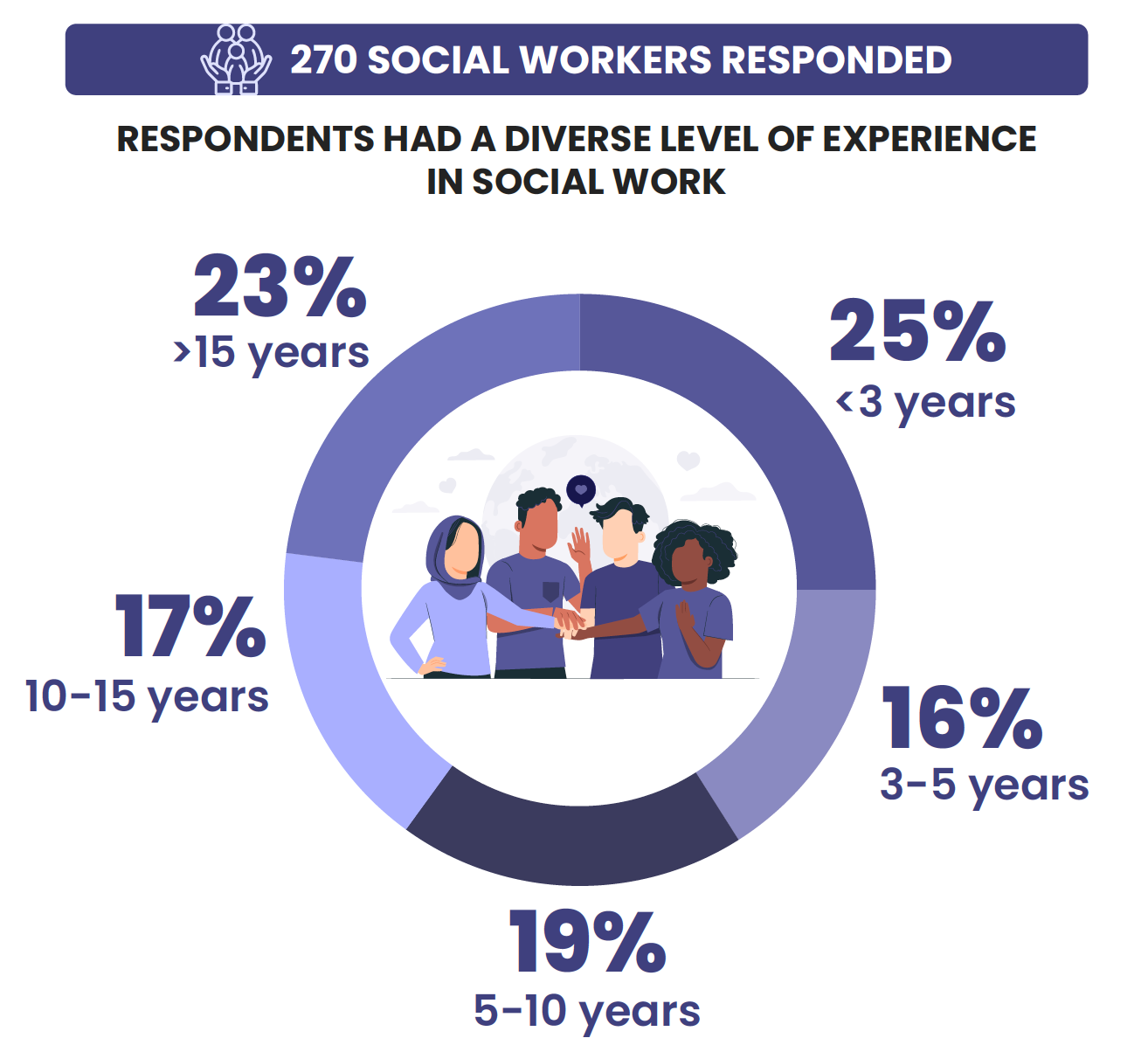
Among respondents, 25% had less than three years of experience in the field, 16% had between three and five years of experience, 19% had between five and ten years of experience, 17% had between ten and fifteen years of experience, and 23% had more than fifteen years of experience.
This was a similar distribution to last year, with slightly more (23% vs. 19%) highly tenured Social Workers (>15 years).
Age
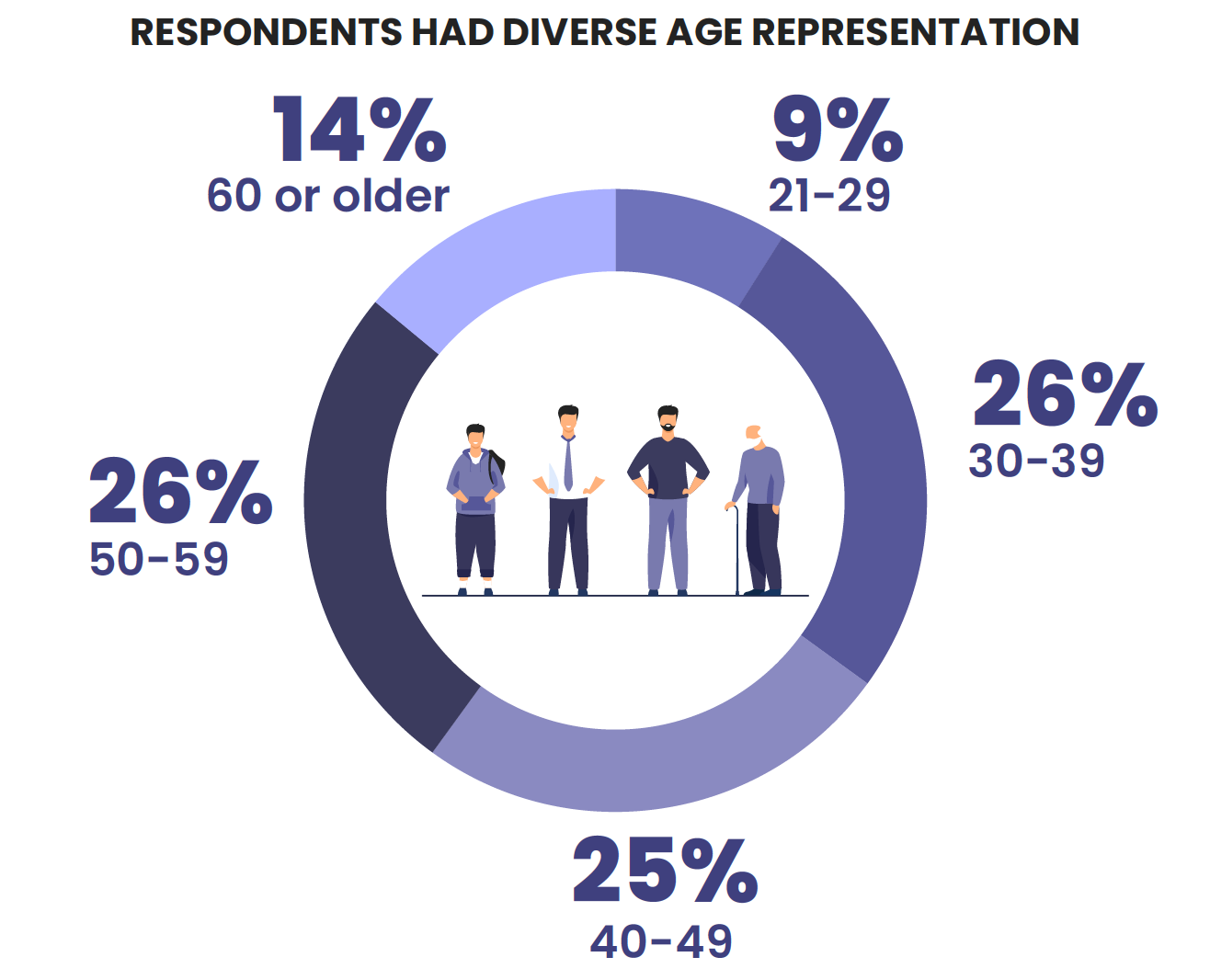
In terms of age, 9% fall in the 21-29 age range, 26% in the 30-39 age range, 25% in the 40-49 age range, 26% in the 50-59 age range, and 14% were 60 or older.
This distribution skewed slightly older than last year’s State of Social Work survey where we had only 9% 60 or older and 24% in the 50-59 age range.
Gender, Race, and Ethnicity
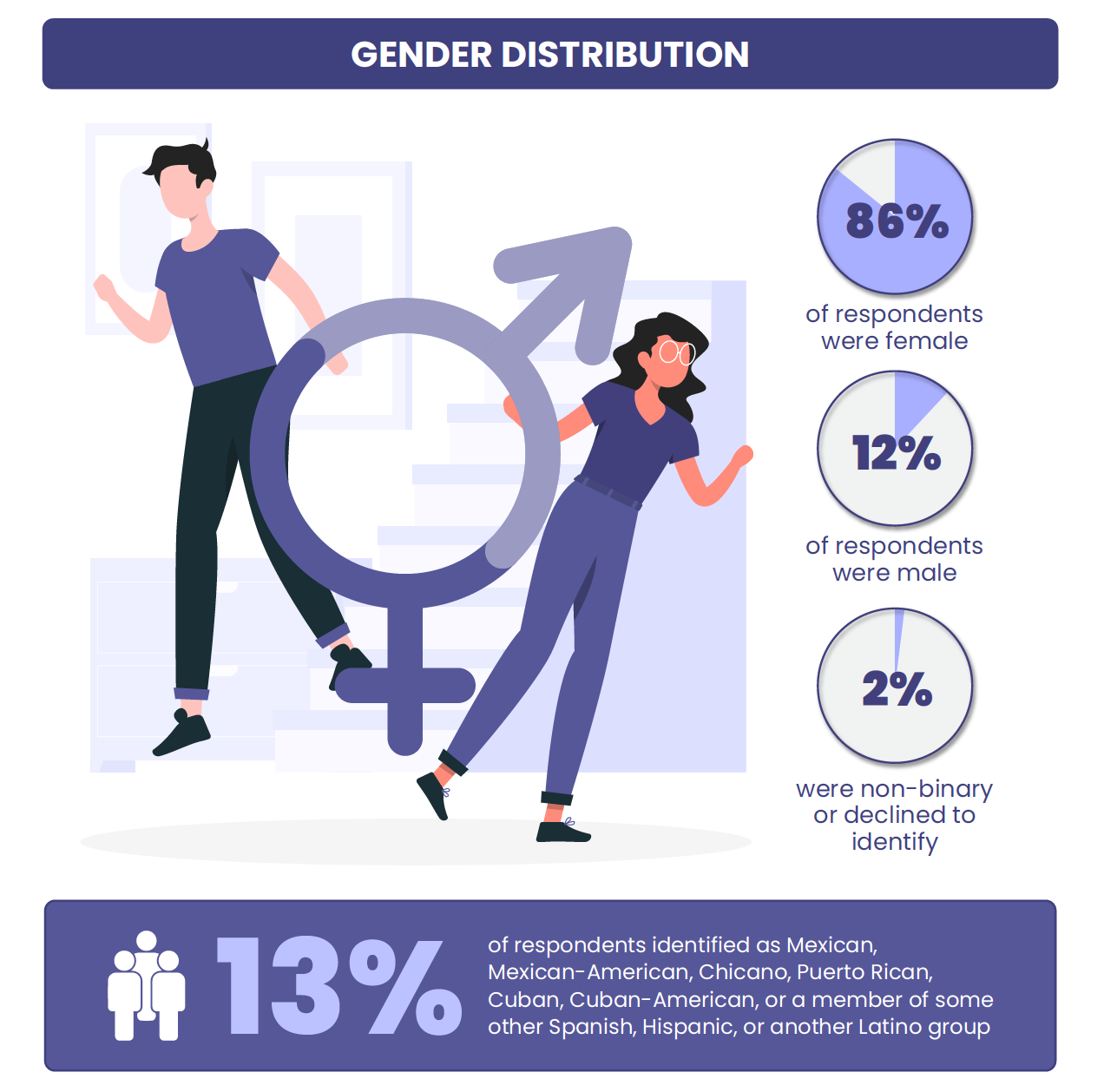
Of the respondents, 86% identified as female, 12% as male, and <1% as non-binary or declined to identify. In terms of race and ethnicity, 47% identified as Black, 50% as White, 2% as Asian, and 2% as American Indian or Alaskan Native. 13% of respondents identified as Mexican, Mexican-American, Chicano, Puerto Rican, Cuban, Cuban-American, or a member of another Spanish, Hispanic, or Latino group.

This was a slightly different distribution from last year, where 52% of respondents identified as Black (vs. 47%) and 90% identified as female (vs. 86%).
Geography

The survey included respondents from 44 states (3 more than last year!), the District of Columbia, the US Virgin Islands, and Canada. Of those surveyed, 84% were currently employed as Social Workers.
In last year’s survey, 78% of respondents were employed as Social Workers.
Findings About the ASWB Exam and Licensing
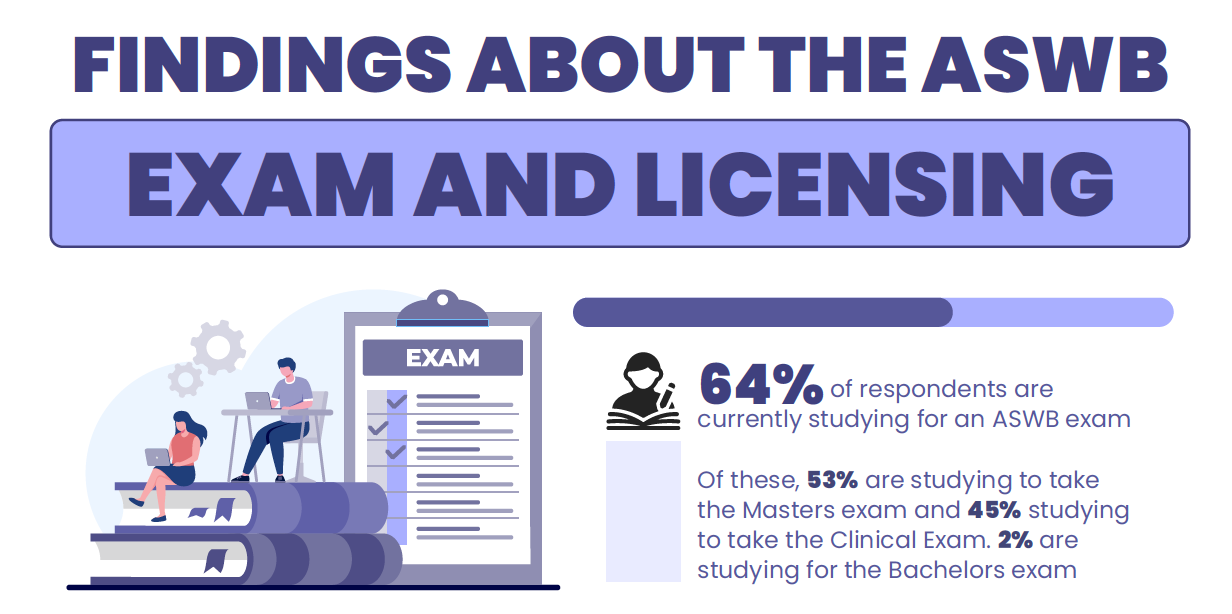
Most respondents (64%) are currently studying for an Association of Social Work Boards (ASWB) exam. Of these, 53% are preparing to take the Masters exam and 45% are studying for the Clinical Exam. Only 2% of respondents are preparing for the Bachelors exam.
This was highly similar to the distribution last year.
Motivation to Take Exam
When asked about their primary reason for taking the exam:
- 37% of respondents cited the desire to “acquire a valuable credential”
- 12% said the exam was “required for a job they are applying for”
- 10% said it was “required for their current job”
- 10% said they wanted to “build skills as a social worker”
This distribution is meaningfully different from last year, where 42% of respondents cited the desire to “acquire a valuable credential,” (vs. 37%), 25% said the exam was “required for a job they are applying for,” (vs. 12%) 17% said it was “required for their current job” (vs. 10%).
Changes Respondents Want to See in ASWB Exam
5 common themes emerged in terms of what changes respondents wanted to see in the ASWB exam in the future:
- Improved Exam Structure and Content:
- Verbatims:
- “More straightforward questions.”
- “Less ambiguity in questions.”
- “More in-depth information on macro practice.”
- “Less bias, more real-life experiences in the questions.”
- Verbatims:
- Better Support and Resources:
- Verbatims:
- “More support from ASWB, Agencies, and Social Work schools.”
- “Guidance from ASWB on what to study.”
- “More cohesive with the curriculums.”
- Verbatims:
- Increase Accessibility and Inclusivity:
- Verbatims:
- “Accommodations for neurodivergent people.”
- “More culturally inclusive.”
- “Less bias in questions.”
- “Have the option to take it in Spanish.”
- Verbatims:
- Improve Testing Conditions and Environment:
- Verbatims:
- “Less anxiety-producing conditions at testing center.”
- “More time and breaks allowed without clock still running.”
- “Allow for untimed breaks away from the computer.”
- “Reduce the number of questions or more support in the test-taking environment.”
- Verbatims:
- Reduce Licensing Process and Costs:
- Verbatims:
- “One exam requirement.”
- “Less costly for multiple attempts.”
- Verbatims:
Several of these desires were similar to respondents’ wishes last year including easier and more straightforward questions with clearer wording, fewer questions overall, and the incorporation of more time or a break into the exam.
Overall, the 2024 State of Social Work survey provides valuable insights into the motivations and experiences of social workers preparing for ASWB exams, as well as areas where improvements could be made in the exam process.
Findings About Social Work Careers
This year, we saw an incredible amount of career diversity with 216 specific types of careers mentioned by respondents!
The Top 10 categories of Social Work Careers represented included:
- Clinician/private practice (2024: 36%; 2023: 17%)
- Medical/hospital (2024: 13%; 2023: 20%)
- Child and family (2024: 11%; 2023: 6%)
- Case management (2024: 9%; 2023: 7%)
- Education (2024: 7%; 2023: 13%)
- Substance use and addiction (2024: 4%; 2023: 3%)
- Community: 3% in 2024
- Hospice (2024: 2%; 2023: 3%)
- Homelessness (2024: 1%; 2023: 2%)
- Employment (2024: 1%; 2023: 1%)
Changing Jobs and Motivations
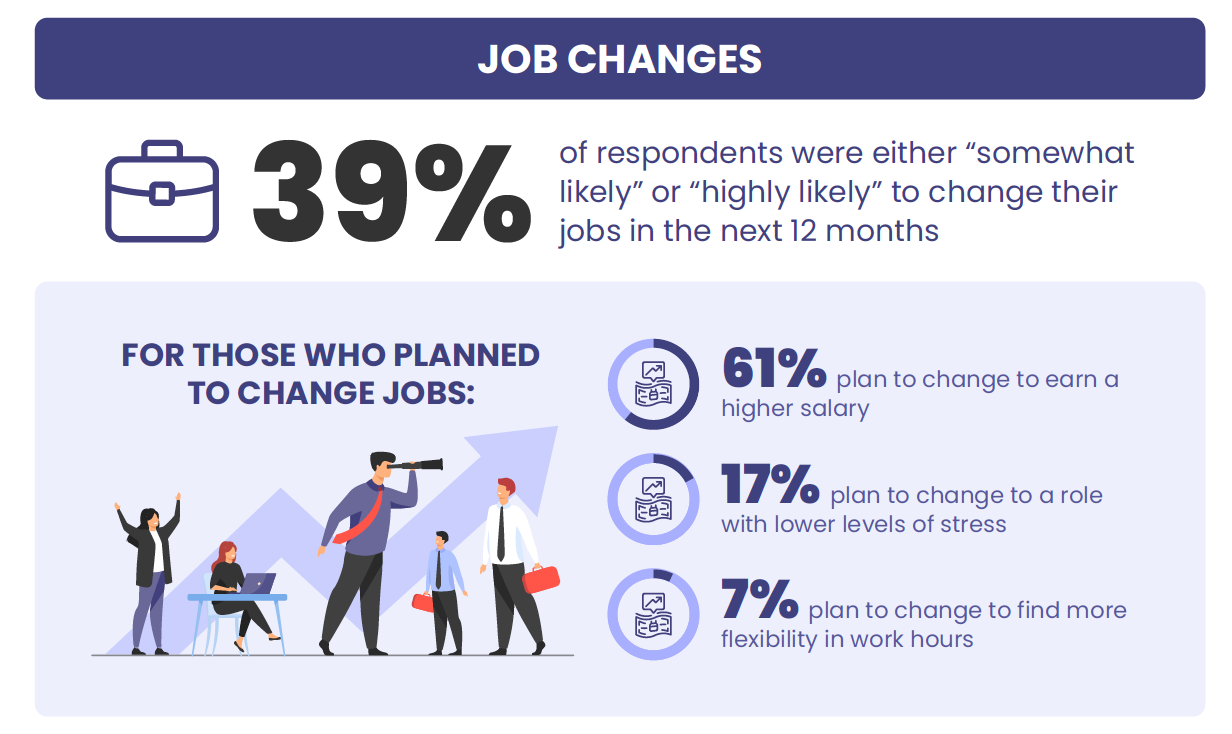
The survey also found that 39% of respondents were either “somewhat likely” or “very likely” to change their jobs in the next 12 months. This is lower than 2023, where 44% responded they were “somewhat likely” or “very likely” to change jobs.
Of those planning to change jobs, 61% cited the desire to earn a higher salary as their primary reason (2023: 64%), 17% said they wanted to change to a role with lower levels of stress (2023: 13%), and 7% wanted to find more flexibility in their work hours (2023: 10%).
Most Likely to Change Jobs
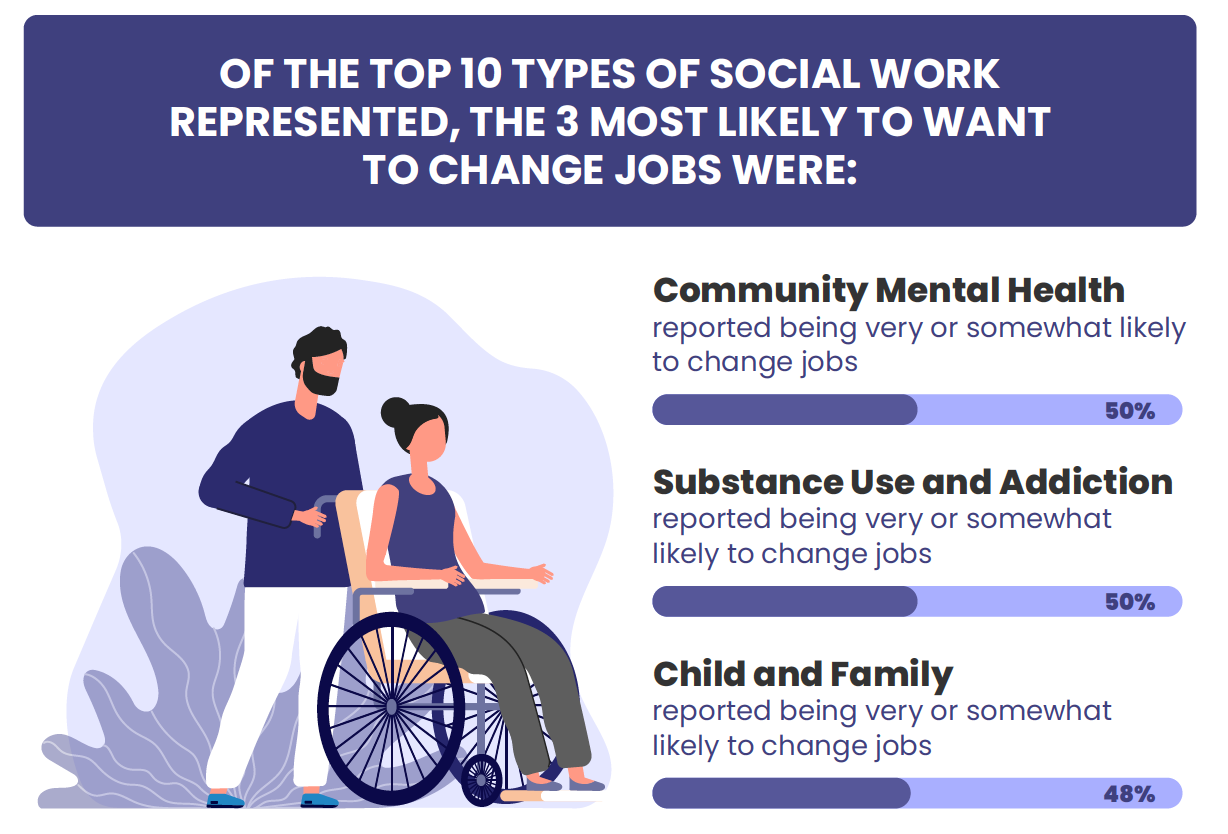
When examining the top 10 categories of Social Work represented, the three types of Social Work that were most likely to want to change jobs were Community (50% reported being very or somewhat likely to change jobs), Substance Use and Addiction (50% reported being very or somewhat likely to change jobs), and Child and Family (48% reported being very or somewhat likely to change jobs).
These were meaningfully different from last year where the most likely to change jobs were Case Management (57% reported being very or somewhat likely to change jobs), General Mental Health (50% reported being very or somewhat likely to change jobs), and Medical/Hospital (40% reported being very or somewhat likely to change jobs).
Least Likely to Change Jobs

The three least likely to want to change jobs were Medical/Hospital (26% reported being very or somewhat likely to change jobs), Hospice (33% reported being very or somewhat likely to change jobs), and Education (35% reported being very or somewhat likely to change jobs).
These were somewhat different from last year where the least likely to change jobs were Education (36% reported being very or somewhat likely to change jobs), Child and Family (36% reported being very or somewhat likely to change jobs), and Clinician/Private Practice (38% reported being very or somewhat likely to change jobs).
Highest Stress Level Social Work Careers
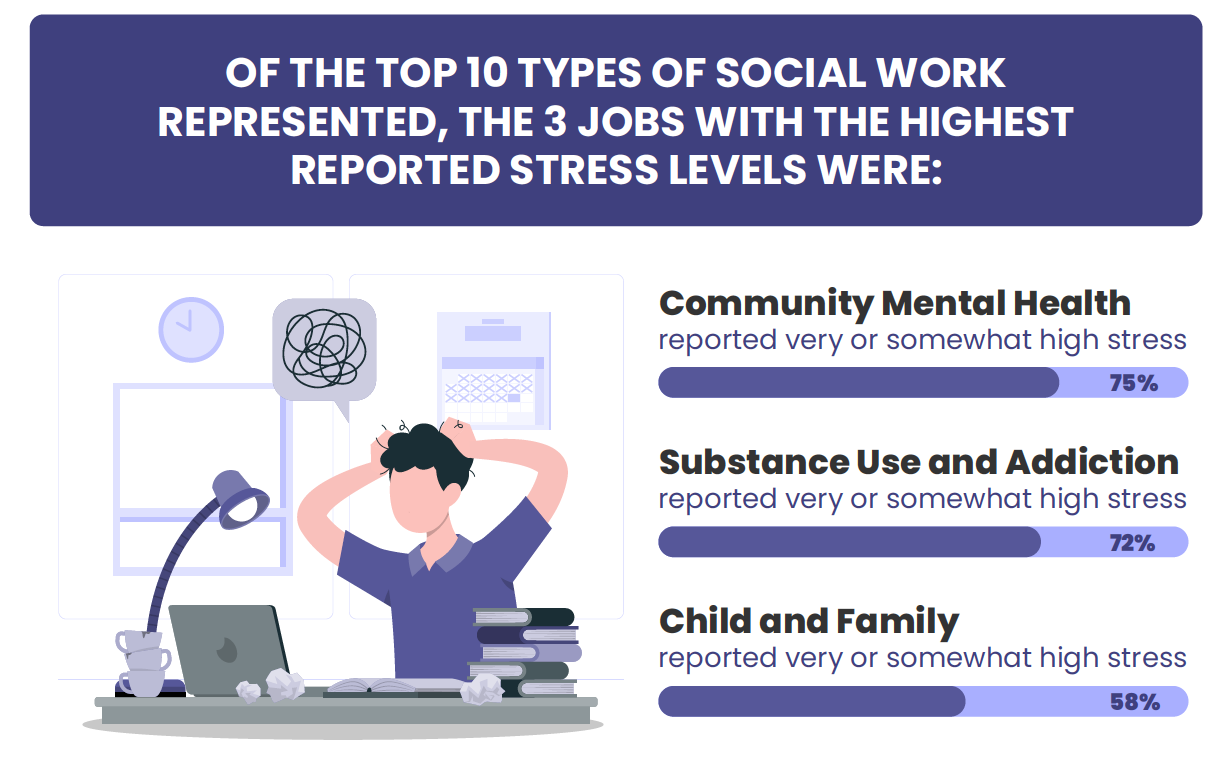
In terms of stress levels, the three types of Social Work with the highest reported stress levels were Community (75% reported very or somewhat high stress), Child and Family (72% reported very or somewhat high stress), and Substance Use and Abuse (58% reported very or somewhat high stress).
These were meaningfully different from last year, where the three types of Social Work with the highest reported stress levels were Case Management (57% reported very or somewhat high stress), Mental Health (50% reported very or somewhat high stress), and Clinician/Private Practice (46% reported very or somewhat high stress).
Lowest Stress Level Social Work Careers

The three types of Social Work with the lowest reported stress levels were Hospice (33% reported very or somewhat high stress), Education (45% reported very or somewhat high stress), and Medical/Hospital (46% reported very or somewhat high stress).
This is relatively similar to last year, where the three types of Social Work with the lowest reported stress levels were Education (39% reported very or somewhat high stress), Child and Family (43% reported very or somewhat high stress), and Medical/Hospital (44% reported very or somewhat high stress).
Findings About the Future of Social Work
According to the 2024 State of Social Work survey, 64% of respondents are either “very positive” or “somewhat positive” about the future of Social Work, while 21% are neutral. This is a slight increase from 2023, where 61% were “very positive” or “somewhat positive”

Level of Positivity About Future Varies Based on Experience
However, the level of positivity varies depending on the respondent’s level of experience in the field. Among those with less than three years of experience as a Social Worker, 67% reported being somewhat or very positive about the future of Social Work. This number increased to 69% among those with three to five years of experience, decreased to 55% among those with five to ten years of experience, 55% among those with ten to fifteen years of experience, and rises to 60% among those with more than fifteen years of experience.
These percentages were similar to last year:
- <3 years of experience: 71% reported being somewhat or very positive about the future of social work.
- 3-5 years of experience: 60%
- 5-10 years of experience: 57%
- 10-15 years of experience: 41%
- >15 years of experience: 71%
Reasons for Positivity
For those who were somewhat or very positive about the future of Social Work, the main reasons cited were:
Reasons for Negativity
On the other hand, those who were somewhat or very negative about the future of Social Work cited:
- Overwork and Underpayment: A recurring theme is the feeling that Social Workers are often overworked and underpaid. This includes concerns about high workload, burnout, and lack of sufficient compensation for the demanding nature of the work.
- Licensing and Examination Challenges: Many responses highlight issues with the licensing exam for Social Workers. There are concerns about people, particularly people of color, struggling to pass the exam, and the impact this has on the diversity and availability of qualified professionals in the field.
- Lack of Support and Appreciation: A significant number of responses express a feeling of being underappreciated and unsupported in the profession. This includes a lack of respect, inadequate managerial support, and a feeling of isolation in dealing with complex issues.
- Professional Culture and Training Issues: Negative perceptions of the professional culture within Social Work are mentioned, including descriptions of a toxic work environment and concerns about the adequacy of training and education for Social Workers.
- Systemic and Ethical Concerns: Responses also touch on broader systemic issues within the field of Social Work, such as the focus of the profession, ethical concerns, the balance between macro and micro issues, and challenges in advocating for higher standards and inclusivity in the profession.
AI and Potential Impact on Social Work

In 2024, we asked for the first time about AI and its potential impact on Social Work.
53% of Social Workers are “Neutral” on AI, by far the largest segment of the population. 21% of Social Workers are “Very Positive” or “Somewhat Positive.” 26% of Social Workers are “Very Negative” or “Somewhat Negative” about the potential impact of AI on Social Work.
Reasons for Positivity
For those who were somewhat or very positive about AI and its potential impact on Social Work, the main reasons cited were:
- Efficiency in Administrative Tasks: Many responses highlight AI’s potential to automate and streamline administrative work, such as paperwork, note-taking, and form-filling. This use of AI is seen as a way to reduce the workload on Social Workers, allowing them more time for direct client engagement and improving overall efficiency in their practice.
- Enhanced Resource Utilization: Some responses suggest that AI could assist in better resource management and prediction, like forecasting areas of need or assisting in treatment planning. This perspective sees AI as a tool that can help Social Workers make more informed decisions and allocate resources more effectively.
- Support in Research and Information Gathering: AI is viewed as a valuable tool for conducting research and gathering information, which can be especially useful in keeping up with the latest developments in the field and providing evidence-based care.
- Educational and Training Aid: AI’s role in education and training is seen positively, with some respondents noting its usefulness in studying for tests, providing psychoeducation materials, and offering new methods for treating disorders. This theme emphasizes AI as a tool for enhancing knowledge and skills among Social Workers.
- Innovation and Adaptation to Modern Challenges: There is an acknowledgment of AI as a part of technological advancement and innovation, necessary for the field to evolve and adapt to modern challenges. This theme reflects a recognition of the importance of staying current with technological trends to provide the best possible care and service.
These positive themes indicate a recognition among some Social Workers of the potential benefits of AI as a supportive tool, enhancing various aspects of their work without replacing the essential human element of the profession.
Reasons for Negativity
For those who were somewhat or very negative about AI and its potential impact on Social Work, the main reasons cited were:
Download the Full Report + Infographic
Would you like to see the full report and download the infographic?
Click this link and share your email address and we’ll send you both: Download Full Report + Infographic.
By the way, did you know Agents of Change offers Continuing Education? Use code 10OFFCEBLOG for $10 off our Unlimited Access Subscription!
————————————————————————————————————————————————
► Learn more about the course here: https://agentsofchangeprep.com
About the Instructor, Meagan Mitchell: Meagan is a Licensed Clinical Social Worker and has been providing individualized and group test prep for the ASWB for over five years. From all of this experience helping others pass their exams, she created the Agents of Change course to help you prepare for and pass the ASWB exam!
Find more from Agents of Change here:
► Facebook Group: https://www.facebook.com/groups/aswbtestprep
► Podcast: https://anchor.fm/agents-of-change-sw
#socialwork #testprep #aswb #socialworker #socialwork #socialworktest #socialworkexam #exam #socialworktestprep #socialworklicense #socialworklicensing #licsw #lmsw #lcsw #aswbexam #aswb #lcswexam #lmswexam #aswbtestprep #aswbtest #lcswtestprep #lcswtest #lmswtestprep #lmswtest #aswbcourse #learningstyles #learningstyle
Disclaimer: This content has been made available for informational and educational purposes only. This content is not intended to be a substitute for professional medical or clinical advice, diagnosis, or treatment