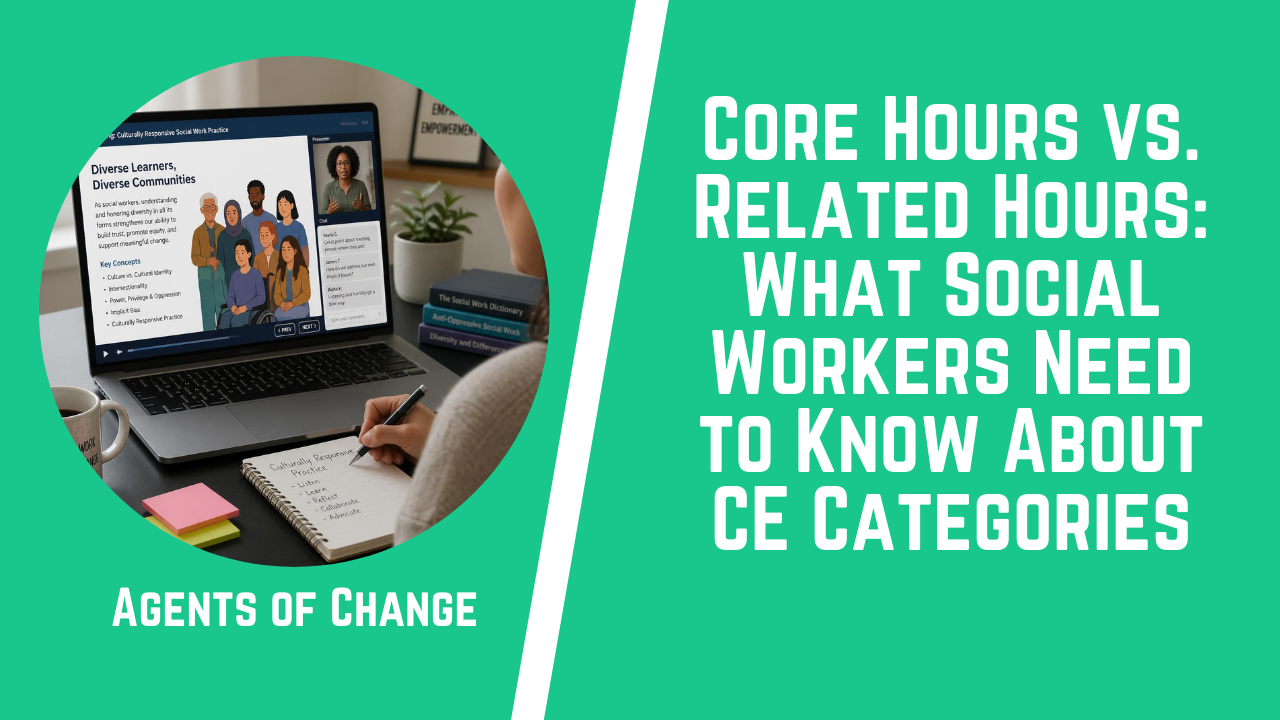
Core Hours vs. Related Hours: What Social Workers Need to Know About CEU Categories
Core Hours vs. Related Hours: What Social Workers Need to Know About CEU Categories
Continuing education is intended to help Social Workers stay current, strengthen their skills, and maintain their licenses. Yet the terminology surrounding CE requirements can make the process feel far more complicated than it needs to be. Terms like core hours, related hours, ethics hours, supervision hours, live hours, and general CE hours often appear in licensing rules without much explanation, leaving Social Workers wondering which courses actually count toward which requirements.

Part of the confusion comes from the fact that CE categories are not standardized across every state. A clinical training might count as a core hour in one jurisdiction, a general hour in another, or fall under a related category depending on how the state defines professional content. Even experienced Social Workers can get tripped up when trying to determine whether a course on trauma, psychopharmacology, supervision, ethics, or another common topic satisfies a specific renewal requirement.

Understanding core hours vs. related hours and other CEU categories can make planning for license renewal much easier. In this guide, we’ll break down the most common CE categories in plain language, explain how they can overlap, and walk through examples of how common Social Work trainings may be classified. You’ll also learn how to track your progress, avoid common renewal mistakes, and make sure the courses you’re taking actually move you closer to meeting your state’s requirements.

Did you know? Agents of Change Continuing Education offers Unlimited Access to 200+ ASWB and NBCC-approved online CE courses and 25+ Live Events per year for one low annual fee to meet your state’s requirements for Continuing Education credits and level up your career.

We’ve helped hundreds of thousands of Social Workers, Counselors, and Mental Health Professionals with Continuing Education, learn more here about Agents of Change and claim your 7.5 free CEUs.

1) Why Are Social Work CEU Categories So Confusing?

a diverse social worker taking an online CE course in a warm home setting

Social Work continuing education sounds straightforward at first. Complete the required number of hours, submit your renewal, and move on. In practice, however, Social Workers quickly discover that CE requirements often involve several overlapping categories, different definitions, and state-specific rules that can make even a simple renewal cycle surprisingly difficult to interpret.

The biggest source of confusion is that there is no single national system governing how every Social Worker must complete continuing education. Each state licensing board establishes its own requirements, which means the terminology and rules can look very different depending on where you’re licensed.

There Is No Universal Definition of “Core” or “Related”

One of the most important things to understand is that terms like core hours and related hours are not used consistently across the country.

Some licensing boards specifically divide continuing education into core and related categories. Others require a certain number of clinical hours but never use the word “core.” Still others focus primarily on total CE hours plus specific requirements such as ethics, cultural competency, suicide prevention, or supervision.

As a result, Social Workers may encounter requirements such as:

  • A minimum number of core Social Work hours
  • A maximum number of related professional hours
  • A required number of clinical CE hours
  • A specific number of ethics hours
  • Required supervision CE hours
  • Limits on self-study or asynchronous courses
  • A minimum number of live or synchronous hours
  • State-specific topics such as implicit bias, human trafficking, mandated reporting, or suicide prevention

This means advice from a colleague in another state may be completely accurate for their license while being irrelevant to yours.

CE Categories Can Overlap

Another reason CE requirements become confusing is that one course may satisfy several requirements at the same time.

Imagine you attend a three-hour live webinar titled Ethical Challenges in Clinical Social Work Supervision.

Depending on your state’s rules, those three hours might potentially count as:

  • Three total CE hours
  • Three ethics hours
  • Three live or synchronous hours
  • Three supervision hours
  • Three core Social Work hours

That does not usually mean you earned 15 hours of continuing education. You still completed a three-hour course. The difference is that those same three hours may help fulfill several categories simultaneously.

This overlap is helpful once you understand it, but it can be confusing when you’re first reviewing your requirements.

Course Topics Don’t Always Determine the Category

Social Workers also tend to assume that a course’s title tells them exactly how it will count. Unfortunately, it isn’t always that simple.

Consider a training on psychopharmacology. The topic is certainly relevant to Clinical Social Workers, especially those working alongside psychiatrists, physicians, and psychiatric nurse practitioners. However, a licensing board that distinguishes between core Social Work education and related professional education could classify that training differently depending on who developed the course, how it is presented, and whether the learning objectives are specifically tied to Social Work practice.

The same issue can arise with courses covering:

  • Neuroscience
  • Psychiatric medications
  • Occupational therapy
  • Special education
  • Counseling techniques
  • Healthcare practices
  • Psychology
  • Family therapy
  • Substance use treatment

A topic can be extremely useful to a Social Worker without automatically qualifying for every CE category.

“Live” Describes How You Learn, Not What You Learn

Format requirements add another layer of complexity.

When a state requires live continuing education, it is usually describing the way the course is delivered rather than the subject being taught.

For example, you could take a live course on:

  • Ethics
  • Trauma
  • ADHD
  • Supervision
  • Clinical assessment
  • Documentation
  • Grief and loss
  • Suicide prevention
  • Cultural responsiveness

The course topic determines one part of its classification, while the delivery format determines another.

A scheduled webinar with real-time instructor interaction may qualify as live or synchronous education. Watching the recording of the same webinar later may be considered asynchronous or self-study.

That distinction can matter considerably if your state limits how many hours you can complete independently.

Different License Levels May Have Different Requirements

Even within the same state, Social Workers may not all have identical CE requirements.

Requirements can vary based on factors such as:

  • License level
  • Clinical versus nonclinical licensure
  • Supervisor designation
  • Renewal cycle
  • Date of initial licensure
  • Whether the Social Worker provides clinical supervision

For example, a Social Worker who serves as an approved clinical supervisor may need supervision-specific continuing education that another licensee does not need.

This is why it’s important to review the requirements for your exact license, rather than simply searching for general Social Work CE requirements in your state.

Provider Approval Adds Another Layer

Even when you’ve selected the right topic and format, there’s another question to answer:

Will your licensing board accept the provider?

A course can be clinically relevant, well designed, and useful to your practice while still failing to meet your state’s renewal requirements if the provider or course does not satisfy the board’s approval rules.

Before completing continuing education, check:

  • Whether your state accepts ASWB Approved Continuing Education providers
  • Whether other national approvals are accepted
  • Whether the course requires separate state approval
  • Whether there are restrictions on online education
  • Whether your certificate includes the information needed for renewal
  • Whether the course specifically identifies specialized credit, such as ethics or supervision, when required

Checking these details before registering can save you from discovering later that a course you completed cannot be applied toward your renewal.

Social Workers Often Track Hours Instead of Requirements

Finally, one of the biggest practical problems is that Social Workers often keep track of how many hours they’ve completed without tracking which requirements those hours satisfy.

You might know that you’ve completed 24 of your required 30 hours. Great!

But do those 24 hours include:

  • Your required ethics credits?
  • Your live hours?
  • Any required supervision training?
  • Your minimum core hours?
  • A required state-specific topic?
  • Too many asynchronous hours?

That’s where a simple total can become misleading.

A better approach is to track each CE requirement separately throughout your renewal cycle. The free Agents of Change CE Tracker can help you identify your state’s requirements and keep track of your progress toward each category, making it much easier to see what’s completed and what you still need before renewal.

Once you start viewing continuing education as a collection of overlapping requirements rather than a single number of hours, the system becomes much easier to navigate.

Learn more about Agents of Change Continuing Education. We’ve helped hundreds of thousands of Social Workers, Counselors, and Mental Health Professionals with their online continuing education and CEUs, and we want you to be next!

2) What Are Core CE Hours?

Core CE hours generally refer to continuing education that is directly connected to Social Work practice and the professional responsibilities of a licensed Social Worker. In states that formally use the term “core,” these hours are usually expected to focus on knowledge, skills, ethics, assessment, intervention, or other areas that clearly fall within the Social Work profession.

a diverse social worker taking an online CE course in a warm home setting

The exact definition varies by state, so “core” should never be treated as a universal national category. Some licensing boards use the term specifically, while others organize CE requirements using different labels such as clinical, general, or professional practice hours.

Examples of Core Social Work CE Topics

Depending on your state’s rules, core CE hours may include trainings on topics such as:

  • Clinical assessment and diagnosis
  • Trauma-informed Social Work practice
  • Ethics and professional boundaries
  • Case management
  • Crisis intervention
  • Child welfare
  • School Social Work
  • Medical Social Work
  • Social determinants of health
  • Family and group interventions
  • Documentation and treatment planning
  • Evidence-based interventions used in Social Work
  • Community practice, advocacy, and policy
  • Cultural humility in Social Work practice

Importantly, core does not mean basic or introductory. Advanced training on trauma treatment, clinical assessment, supervision, or another complex topic may still qualify as core if it is clearly rooted in Social Work practice and meets the requirements established by the licensing board.

How Are Core Hours Different From Clinical Hours?

Core and clinical hours are sometimes confused, but they are not necessarily the same thing.

Clinical CE generally focuses on assessment, diagnosis, treatment, and direct behavioral health practice. Core Social Work education can be broader. A course on child welfare policy, case management, community organizing, healthcare Social Work, or ethical documentation could potentially qualify as core even though it is not primarily focused on psychotherapy.

The easiest question to ask is:

Is this training specifically designed to strengthen my knowledge or skills as a Social Worker?

If the answer is yes, it may qualify as core education in a state that uses that category. However, always verify the course and provider against your licensing board’s current requirements before assuming it will count.

Agents of Change has helped hundreds of thousands of Social Workers, Counselors, and Mental Health Professionals with Continuing Education, learn more here about Agents of Change and claim your 7.5 free CEUs!

3) What Are Related CE Hours?

Related CE hours generally refer to continuing education that is relevant to Social Work practice but comes from an allied profession or a subject area that is not specifically rooted in Social Work. These courses can still be highly valuable, especially for Social Workers who work on interdisciplinary teams, but some states may place limits on how many related hours can be applied toward license renewal.

In states that use this category, related education may come from fields such as:

  • Psychology
  • Psychiatry
  • Counseling
  • Marriage and Family Therapy
  • Nursing
  • Medicine
  • Public health
  • Occupational therapy
  • Education or special education
  • Substance use treatment

What Might Count as a Related CE Course?

Imagine a Clinical Social Worker attends a training on psychiatric medications taught primarily for psychiatrists and nurse practitioners. The information could be extremely useful for understanding a client’s treatment plan, medication side effects, and interdisciplinary care. However, because the course is rooted more heavily in another profession, a licensing board may classify it as related education rather than core Social Work education.

Other possible examples include:

  • A neuroscience course focused on brain functioning
  • A medical training on chronic illness management
  • A psychology seminar on personality assessment
  • An occupational therapy course on sensory processing
  • A special education training on classroom accommodations

Are Related Hours Less Valuable?

No. The distinction between core and related CE hours is about regulatory classification, not educational quality.

Related trainings can broaden a Social Worker’s perspective and strengthen collaboration with other professionals. In fact, learning from psychiatry, psychology, education, nursing, and other disciplines can be especially useful in clinical, school, healthcare, and community settings.

The important thing is to know whether your state allows related hours and whether it places a cap on how many you can count toward renewal. Before registering for a course, check your licensing board’s current rules so you know exactly how those hours will apply.

4) Use a CE Tracker Instead of Trying to Remember Everything

Keeping track of continuing education gets messy fast. You might complete an ethics webinar in January, a trauma course in March, a live supervision training over the summer, and several self-paced courses throughout the year. By renewal time, it can be surprisingly difficult to remember what you’ve completed, which category each course fits into, and whether you still have a specific requirement left to satisfy.

That’s why it’s much easier to track your progress as you go instead of trying to reconstruct everything at the end of your renewal cycle.

Track Requirements, Not Just Total Hours

Knowing that you’ve completed 24 CE hours is helpful, but it doesn’t necessarily tell you whether you’re ready to renew.

Depending on your state, you may still need to know:

  • How many ethics hours you’ve completed
  • Whether you’ve met any live or synchronous CE requirements
  • How many core or related hours you have
  • Whether you’ve completed required supervision training
  • Whether you still need a state-specific topic such as suicide prevention, cultural competency, or mandated reporting
  • Whether you’ve exceeded a limit on asynchronous or self-study courses

A simple total can hide important gaps.

Use the Free Agents of Change CE Tracker

The Agents of Change Free CE Tracker is designed to make this process much easier for Social Workers, Therapists, Counselors, and other Mental Health Professionals.

Rather than relying on a spreadsheet, a pile of certificates, or your memory, the CE Tracker helps you understand your state’s continuing education requirements and monitor your progress toward renewal in one place.

You can use it to:

  • Review continuing education requirements for your state and license
  • Track completed CE hours
  • Keep an eye on specialized CE categories
  • See what requirements you still need to complete
  • Plan upcoming trainings more intentionally
  • Reduce the last-minute scramble before renewal

The best time to start tracking your CE requirements is at the beginning of your renewal cycle, but it’s never too late to get organized. Visit the Agents of Change Free CE Tracker to see where you stand and make your next CE course count toward exactly what you need.

5) FAQs – Core Hours vs. Related Hours: What Social Workers Need to Know About CEU Categories
Q: Do clinical trainings automatically count as core CE hours?

A: No. A clinical training may qualify as core education, but that depends on how your state defines core CE and whether the course is considered directly related to Social Work practice. Always check your licensing board’s rules rather than assuming that any clinical topic automatically falls into the core category.

Q: Can one CE course count toward more than one requirement?

A: Sometimes. For example, a live ethics webinar may count toward your total CE requirement, your ethics requirement, and your live or synchronous requirement at the same time, depending on your state’s rules. That does not usually mean the hours are multiplied, since a three-hour course still represents three hours of continuing education.

Q: How can I tell which CE categories I still need before renewal?

A: Start by reviewing the requirements for your specific state and license, including any ethics, supervision, live, core, related, or state-mandated topic requirements. The Agents of Change Free CE Tracker can help you organize your completed hours and see which requirements you still need to satisfy before renewal.

6) Conclusion

Understanding core hours vs. related hours and other CEU categories can make license renewal feel much more manageable. Once you recognize that core, related, ethics, supervision, live, and general hours may represent different types of requirements, it becomes easier to choose courses intentionally instead of simply collecting credits. The key is to know how your state defines each category and how those categories apply to your specific license.

It also helps to remember that one course may satisfy more than one requirement, depending on your board’s rules. A live ethics training, for example, may count toward your total hours, your ethics requirement, and your live CE requirement at the same time. Keeping track of those overlaps throughout your renewal cycle can prevent last-minute confusion and help you avoid taking unnecessary courses.

Finally, don’t rely on memory when your license is on the line. Use the Agents of Change Free CE Tracker to monitor your completed hours, review state-specific requirements, and identify what you still need before renewal. With a little planning and a clear understanding of CE categories, you can spend less time worrying about compliance and more time choosing continuing education that actually strengthens your Social Work practice.

————————————————————————————————————————————————

► Learn more about the Agents of Change Continuing Education here: https://agentsofchangetraining.com

About the Lead Instructor, Dr. Meagan Mitchell: Meagan is a Licensed Clinical Social Worker and has been providing Continuing Education for Social Workers, Counselors, and Mental Health Professionals for more than 10 years. From all of this experience helping others, she created Agents of Change Continuing Education to help Social Workers, Counselors, and Mental Health Professionals stay up-to-date on the latest trends, research, and techniques.

#socialwork #socialworker #socialwork #socialworklicense #socialworklicensing #continuinged #continuingeducation #ce #socialworkce #freecesocialwork #lmsw #lcsw #counselor #NBCC #ASWB #ACE

Disclaimer: This content has been made available for informational and educational purposes only. This content is not intended to be a substitute for professional medical or clinical advice, diagnosis, or treatment

Note: Certain images used in this post were generated with the help of artificial intelligence.

Share:

Discover more from Agents of Change

Subscribe now to keep reading and get access to the full archive.

Continue reading