Live CEs and Webinars for Social Workers, Therapists, and Counselors: When Live Credit Matters for License Renewal
Live CEs and Webinars for Social Workers, Therapists, and Counselors: When Live Credit Matters for License Renewal
Continuing education is a routine part of maintaining a professional license, but the rules surrounding it can be surprisingly easy to misunderstand. A social worker, therapist, or counselor may complete all the required hours, only to discover that a licensing board expected some of those credits to be earned through live, synchronous, or interactive training. Recorded courses can be convenient and informative, but they may not satisfy every renewal requirement.

That is why understanding when live credit matters for license renewal is so important. Depending on the state, profession, license type, and renewal cycle, clinicians may need to complete a certain number of live social work CEUs, ethics hours, or interactive credits. Some boards accept live virtual webinars in the same way they accept in-person courses, while others place limits on self-study or asynchronous learning.

Fortunately, meeting live-credit requirements no longer has to involve traveling to an expensive conference or taking an entire weekend away from clients and family. Live webinars for social workers, therapists, and counselors make it possible to learn from experienced instructors, ask questions in real time, and earn qualifying credits from almost anywhere. By reviewing board requirements early and choosing approved CEU live webinars for social workers, clinicians can avoid last-minute surprises and create a renewal plan that is practical, affordable, and professionally meaningful.

Did you know? Agents of Change Continuing Education offers Unlimited Access to 200+ ASWB and NBCC-approved online CE courses and 20+ Live Events per year for one low annual fee to meet your state’s requirements for Continuing Education credits and level up your career.

We’ve helped hundreds of thousands of Social Workers, Counselors, and Mental Health Professionals with Continuing Education, learn more here about Agents of Change and claim your 7.5 free CEUs.

1) What Are Live CEs?

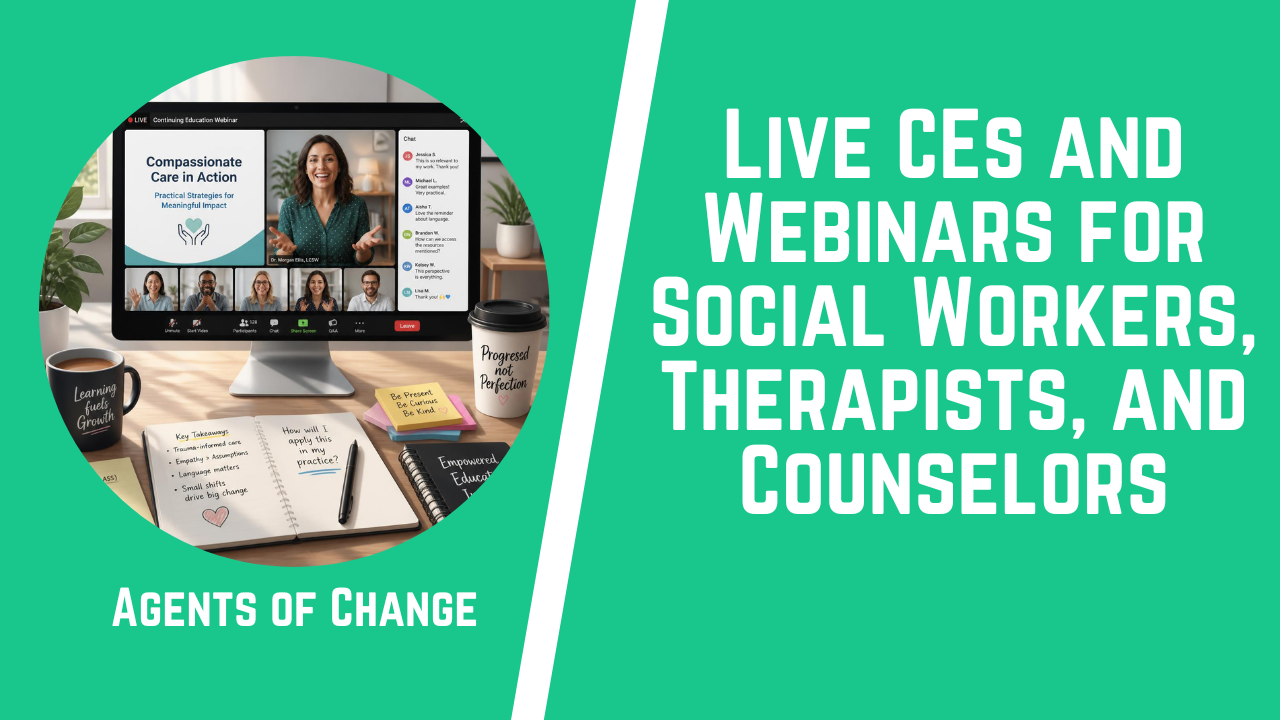
Live continuing education courses, often called live CEs or live CEUs, are professional learning events that take place at a scheduled time with an instructor and participants attending simultaneously. Social workers, therapists, counselors, and other mental health professionals may complete these trainings in person or through a live virtual platform such as Zoom. The defining feature is that the course happens in real time rather than being completed independently whenever the learner chooses.

create a picture of a live virtual continuing education event on computer photorealistic

During a live continuing education event, participants may listen to a presentation, respond to polls, review case examples, submit questions, participate in discussions, or interact with the instructor through chat or audio. These activities create a more engaged learning experience and may help the course meet a licensing board’s definition of live, synchronous, or interactive education.

Live CEs Can Be Virtual or In-Person

The word “live” does not always mean that the instructor and participants must be in the same physical room. Many licensing boards recognize live online webinars as synchronous continuing education because everyone attends at the same time and has an opportunity to interact.

Common examples of live CEs include:

  • In-person workshops and conferences
  • Live online webinars
  • Virtual professional panels
  • Real-time clinical trainings
  • Interactive ethics courses
  • Live supervision or consultation programs
  • Scheduled continuing education seminars

A recorded version of a webinar is usually considered asynchronous or self-paced, even when the original event was presented live. The content may be identical, but the learning format is different because the instructor is no longer available for real-time interaction.

Why the Format Matters

Licensing boards may place limits on how many continuing education hours can be earned through self-study or recorded courses. Some may require a portion of a professional’s credits to be completed through live or interactive learning. Certain subjects, such as ethics, supervision, suicide prevention, or laws and regulations, may also have specific delivery requirements.

For that reason, social workers, therapists, and counselors should review more than the topic and number of credits before registering for a course. It is also important to confirm:

  • Whether the course is live or recorded
  • Whether participation is required
  • Whether the provider is approved
  • Whether the course offers the correct type of credit
  • Whether the licensing board accepts live virtual webinars
  • Whether full attendance is required to receive a certificate

Understanding these distinctions can help mental health professionals choose the right courses, meet their renewal requirements, and avoid discovering too late that a completed training does not count toward a required live-credit category.

Learn about your state and license requirements with our free tracker: https://agentsofchangeprep.com/continuing-education/tracker/

Learn more about Agents of Change Continuing Education. We’ve helped hundreds of thousands of Social Workers, Counselors, and Mental Health Professionals with their online continuing education and CEUs, and we want you to be next!

2) Why Do Licensing Boards Require Live or Interactive Credit?

Licensing boards may require live or interactive continuing education to encourage active participation, professional discussion, and real-time engagement. While recorded courses can be valuable, live learning gives social workers, therapists, and counselors opportunities to ask questions, consider different perspectives, and apply information to realistic practice situations.

a live virtual mental health related continuing education event on computer

Live Learning Encourages Active Participation

During a live training, participants are expected to attend at a specific time and remain engaged throughout the course. Instructors may use polls, case examples, discussions, or attendance checks to support participation.

This format can help professionals:

  • Stay focused on the material
  • Reflect on how concepts apply to practice
  • Respond to questions and scenarios
  • Learn from the experiences of other attendees
  • Clarify confusing or complex information

Participants Can Ask Questions in Real Time

Mental health practice often involves situations that do not have one simple answer. Topics involving confidentiality, boundaries, risk assessment, documentation, telehealth, and cultural responsiveness can raise questions that are difficult to address through recorded content alone.

Live webinars allow participants to ask questions while the topic is being discussed. An instructor may explain a concept in greater detail, offer an additional example, or help attendees understand how general guidance might apply in different settings.

Interactive Courses Support Ethical Decision-Making

Ethics education involves more than memorizing a professional code. Social workers, therapists, and counselors must often weigh competing responsibilities, recognize potential risks, and make decisions based on the specific circumstances of a case.

Interactive learning may include:

  • Reviewing ethical dilemmas
  • Comparing possible responses
  • Identifying relevant professional standards
  • Discussing the risks of different decisions
  • Practicing a structured decision-making process

These activities can help professionals strengthen the reasoning skills they need when real ethical concerns arise.

Live Events Create Professional Connection

Many mental health professionals work in private practice, small agencies, schools, healthcare settings, or remote positions where opportunities for professional discussion may be limited. Live continuing education provides a structured space to hear from colleagues and instructors outside a person’s usual workplace.

This connection can introduce new ideas, reduce professional isolation, and help clinicians recognize that others may be navigating similar challenges.

Boards Want Evidence of Meaningful Engagement

Requiring some live or interactive credit helps licensing boards ensure that continuing education involves more than simply accessing course material. Real-time attendance, participation activities, and instructor interaction provide additional evidence that the professional was actively involved in the learning experience.

Agents of Change has helped hundreds of thousands of Social Workers, Counselors, and Mental Health Professionals with Continuing Education, learn more here about Agents of Change and claim your 7.5 free CEUs!

3) Live Webinars Versus On-Demand CE Courses

Live webinars and on-demand continuing education courses can both help social workers, therapists, and counselors meet license renewal requirements. The main difference is how and when the learning takes place. Live webinars happen at a scheduled time with an instructor present, while on-demand courses can be completed whenever it fits the learner’s schedule.

Simple Comparison

Feature Live Webinars On-Demand CE Courses
Schedule Held at a specific date and time Available to complete at any time
Instructor access Instructor is present in real time Instructor is usually not available live
Questions Participants may ask questions during the training Questions may not receive an immediate response
Interaction May include polls, chat, discussion, or case activities Usually completed independently
Flexibility Less flexible because attendance is scheduled Highly flexible and self-paced
Licensing use May satisfy live, synchronous, or interactive credit requirements Usually counts as asynchronous or self-study credit
Ability to pause Generally cannot be paused Can often be paused and resumed
Best for Complex topics, ethics, discussion, and live-credit requirements General education, convenience, and flexible learning

Benefits of Live Webinars

Live webinars may be especially useful when a licensing board requires synchronous or interactive education. They also give participants the opportunity to ask questions, hear different perspectives, and engage with case examples in real time.

Live courses may work well for topics such as:

  • Professional ethics
  • Clinical supervision
  • Suicide risk assessment
  • Trauma treatment
  • Confidentiality and documentation
  • Telehealth laws and boundaries

Benefits of On-Demand Courses

On-demand courses offer greater flexibility for busy professionals. Social workers, counselors, and therapists can complete them around client sessions, family responsibilities, or changing work schedules.

They may be a good choice for professionals who want to:

  • Learn at their own pace
  • Pause and review difficult material
  • Complete credits during evenings or weekends
  • Choose from a larger course library
  • Earn general continuing education hours conveniently

Which Format Should You Choose?

The best option depends on your learning preferences and licensing requirements. Many professionals use a combination of both formats. They complete required live or interactive credits through webinars and use on-demand courses for the rest of their continuing education hours.

Before registering, confirm how your licensing board classifies each course format. A recorded webinar may contain the same information as the live event, but it may not count toward a live-credit requirement.

Learn about your state and license requirements with our free tracker: https://agentsofchangeprep.com/continuing-education/tracker/

4) When Should You Prioritize Live Webinars?

Live webinars can be especially valuable when licensing requirements, course content, or your learning preferences call for more interaction. While on-demand courses offer flexibility, there are times when attending a scheduled, real-time training is the better choice.

When Your Licensing Board Requires Live Credit

The most important reason to prioritize live webinars is to meet a specific license renewal requirement. Some boards require a certain number of hours to be completed through live, synchronous, or interactive education. Others may limit how many credits can come from recorded or self-study courses.

Prioritize live training when your board requires:

  • A minimum number of live CE hours
  • Synchronous or interactive education
  • Live ethics credits
  • Real-time supervision training
  • Limited self-study or asynchronous hours

Always verify whether live virtual webinars are accepted, since requirements can vary by profession and jurisdiction.

Learn about your state and license requirements with our free tracker: https://agentsofchangeprep.com/continuing-education/tracker/

When You Need Ethics or Specialized Credits

Certain required topics may be offered less frequently than general continuing education courses. Ethics, supervision, suicide prevention, state laws, and cultural competency trainings may also have specific format requirements.

Completing these credits early can help you avoid searching for a qualifying event just before your renewal deadline.

When the Topic Is Complex

Live webinars are often a strong choice for subjects that involve clinical judgment, ethical uncertainty, or complicated practice decisions. Being able to ask questions and hear additional examples can make difficult material easier to understand.

Live learning may be especially useful for topics involving:

  • Risk assessment and safety planning
  • Confidentiality and mandated reporting
  • Professional boundaries
  • Trauma treatment
  • Clinical documentation
  • Telehealth practice
  • Ethical decision-making

When You Want Real-Time Questions and Discussion

Recorded courses cannot always address the exact questions that arise while you are learning. During a live webinar, participants may be able to ask the instructor for clarification, respond to polls, discuss case examples, or hear questions from other professionals.

This interaction can help connect broad concepts to real situations in social work, therapy, and counseling practice.

When You Need Accountability

Self-paced courses are convenient, but they can be easy to postpone. A scheduled webinar creates a clear commitment and gives you a specific time to focus on professional development.

Live events may be helpful when you:

  • Have unfinished courses in your account
  • Work better with deadlines
  • Want to complete credits consistently
  • Tend to wait until renewal approaches

When Your Renewal Deadline Is Getting Close

Live events are only available on certain dates, and registration may close before the presentation begins. Waiting until the final weeks of a renewal period can leave you with limited choices.

Prioritizing live webinars early gives you time to handle schedule conflicts, event cancellations, certificate questions, or unexpected changes in your renewal needs.

5) A Practical All-in-One Option: Agents of Change Continuing Education

Finding live events one at a time can get expensive. A one-hour webinar may cost $25 or more, while multi-hour ethics trainings can cost considerably more. Registering with several providers also means tracking multiple passwords, policies, certificates, and event calendars.

Agents of Change Continuing Education offers a simpler option for social workers, therapists, counselors, and other mental health professionals. Its annual subscription includes access to a growing library of more than 200 ASWB and NBCC-approved courses, along with more than 20 live continuing education events each year. That works out to more than one live event per month, with new opportunities available throughout the year.

The $99-per-year subscription includes:

  • More than 200 continuing education courses
  • Unlimited CE credit opportunities
  • More than 20 live CE webinars per year
  • ASWB ACE and NBCC-approved content
  • New courses added regularly
  • Live, video, podcast, reading, and research-based formats
  • Topics for social workers, counselors, therapists, and mental health professionals
  • Access to future live events included with the subscription
  • PLUS an easy-to-use CE tracker that helps you manage up to (5) license requirements and deadlines

For clinicians seeking this specific combination of a broad approved library and recurring live education, the platform stands out as the most affordable option available in an all-in-one annual format. The subscription price is $99 per year, compared with purchasing live events individually or paying separately for recorded and synchronous course access.

Clinicians can review upcoming topics, dates, times, instructors, and available credit hours on the live continuing education event schedule. The schedule includes general and ethics offerings across clinical practice, professional development, trauma-informed care, telehealth, medical social work, ADHD, grief, leadership, and other relevant areas.

6) FAQs – Live CEs and Webinars for Social Workers, Therapists, and Counselors

Q: Do live webinars count toward continuing education requirements for social workers, therapists, and counselors?

A: Live webinars may count when they are offered by an approved provider and meet your licensing board’s definition of live, synchronous, or interactive education. Some boards treat qualifying virtual webinars the same as in-person courses, while others use separate categories. Always confirm the course format, approval information, and credit type before registering.

Q: Can a recorded webinar satisfy a live CE requirement?

A: Usually, a recorded webinar is considered on-demand, asynchronous, or self-study education rather than live credit. Even when the recording contains the same material as the original presentation, participants cannot interact with the instructor in real time. The course may still count toward general continuing education hours if your board accepts the provider and format.

Q: How early should I complete my required live CE credits?

A: It is best to complete required live credits several months before your license renewal deadline. Live events are offered on specific dates, and your preferred course may fill up, conflict with your schedule, or be unavailable close to renewal. Finishing early also gives you time to confirm that your certificate includes the correct credit category and delivery method.

7) Conclusion

Live continuing education can play an important role in license renewal for social workers, therapists, and counselors, especially when a licensing board requires synchronous, interactive, ethics, or other specialized credits. Understanding the difference between live webinars and on-demand courses can help professionals choose the right format and avoid discovering too late that a completed course does not meet a specific requirement.

The best approach is to review your board’s current rules early, identify any required live hours, and complete harder-to-find credits before your renewal deadline gets close. Live webinars can also offer benefits beyond compliance, including real-time questions, practical case discussions, professional connection, and greater accountability for completing continuing education.

Agents of Change Continuing Education provides a convenient and affordable way to combine live and self-paced learning in one place. With more than 200 ASWB and NBCC-approved courses, over 20 live continuing education events each year, and a $99 annual subscription, professionals can build a flexible CE plan that supports both license renewal and meaningful professional growth.

————————————————————————————————————————————————

► Learn more about the Agents of Change Continuing Education here: https://agentsofchangetraining.com

About the Lead Instructor, Dr. Meagan Mitchell: Meagan is a Licensed Clinical Social Worker and has been providing Continuing Education for Social Workers, Counselors, and Mental Health Professionals for more than 10 years. From all of this experience helping others, she created Agents of Change Continuing Education to help Social Workers, Counselors, and Mental Health Professionals stay up-to-date on the latest trends, research, and techniques.

#socialwork #socialworker #socialwork #socialworklicense #socialworklicensing #continuinged #continuingeducation #ce #socialworkce #freecesocialwork #lmsw #lcsw #counselor #NBCC #ASWB #ACE

Disclaimer: This content has been made available for informational and educational purposes only. This content is not intended to be a substitute for professional medical or clinical advice, diagnosis, or treatment

Note: Certain images used in this post were generated with the help of artificial intelligence.

Share:

Discover more from Agents of Change

Subscribe now to keep reading and get access to the full archive.

Continue reading