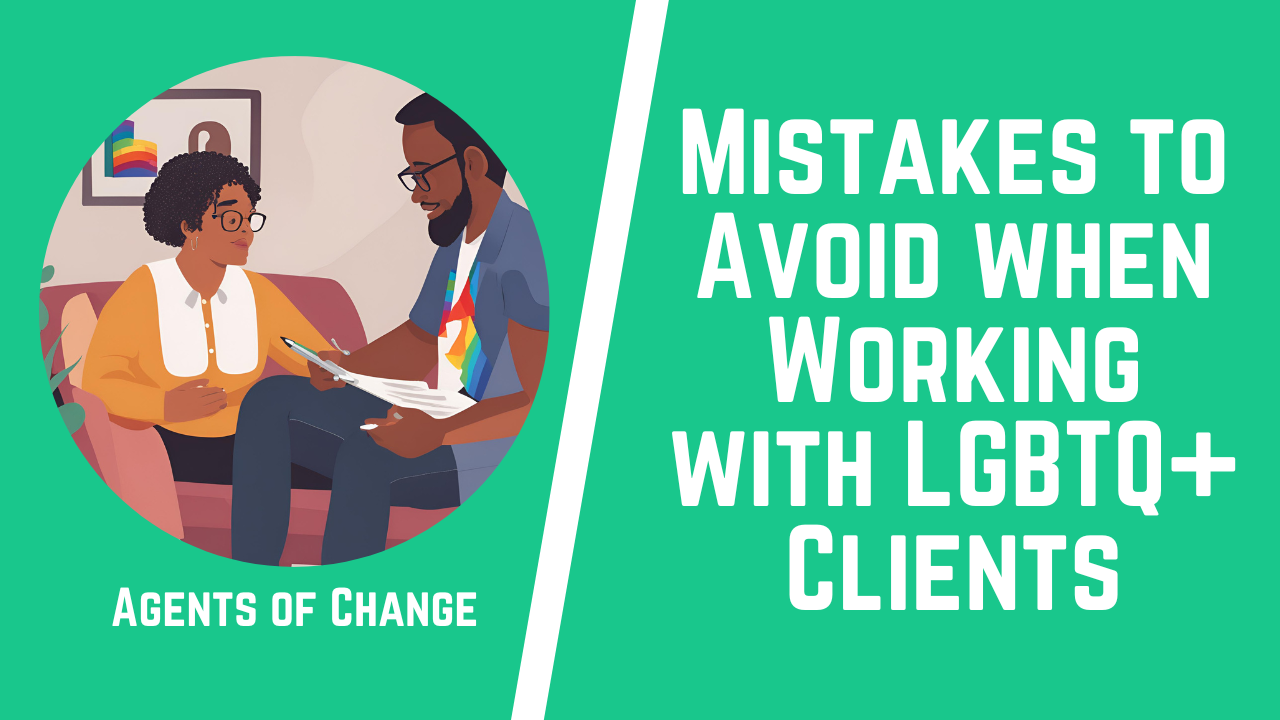
Mistakes to Avoid When Working with LGBTQ+ Clients

LGBTQ+ clients seek help for the same reasons anyone does: depression, anxiety, relationships, grief, substance use, work stress. Many also carry experiences that are specific to living as a sexual or gender minority, such as family rejection, discrimination, harassment, or the stress of deciding whom it is safe to come out to. A Social Worker’s first few interactions often decide whether a client feels safe enough to share what is really going on.
This guide covers key terms and context, the most common mistakes Social Workers make with LGBTQ+ clients and what to do instead, how to build trust, ethical and legal considerations, and resources for ongoing learning.
Did you know? Agents of Change Continuing Education offers Unlimited Access to 200+ ASWB and NBCC-approved online CE courses and 25+ Live Events per year for one annual fee to meet your state’s requirements for Continuing Education credits and level up your career.
We’ve helped more than 100,000 Social Workers, Counselors, and Mental Health Professionals with exam prep and Continuing Education. Learn more here about Agents of Change and claim your 7.5 free CEUs.
Quick answer: what are the most common mistakes to avoid?
- Assuming a client’s sexual orientation, gender identity, or relationship structure.
- Misusing names and pronouns, or not asking at all.
- Making identity the problem when the client came in for something else, or ignoring identity when it matters.
- Overlooking intersectionality, such as race, disability, immigration status, faith, and income.
- Mishandling confidentiality, including outing a client in records, referrals, or conversations with family.
- Asking the client to educate you instead of learning on your own.
In this guide
1) Key Terms and Context
Language evolves, and individual clients may use terms differently. The safest approach is to learn common definitions and then use the words each client uses for themselves.
| Term | General meaning |
|---|---|
| Sexual orientation | Who a person is emotionally, romantically, or sexually attracted to, such as lesbian, gay, bisexual, or asexual |
| Gender identity | A person’s internal sense of their own gender |
| Transgender | A person whose gender identity differs from the sex they were assigned at birth |
| Cisgender | A person whose gender identity matches the sex they were assigned at birth |
| Nonbinary | A person whose gender identity is not exclusively man or woman |
| Intersex | A person born with variations in sex characteristics that don’t fit typical definitions of male or female |
| Queer | An umbrella term some people use for sexual or gender identities outside heterosexual and cisgender norms. Some people embrace it; others find it hurtful, so follow the client’s lead |
| Questioning | A person who is exploring their sexual orientation or gender identity |
The Mental Health Context
LGBTQ+ people are not more likely to struggle because of who they are. Research points to minority stress: the added strain of stigma, discrimination, rejection, and hiding one’s identity. The Trevor Project’s 2024 national survey of LGBTQ+ people ages 13 to 24 found that 39% had seriously considered suicide in the past year (46% of transgender and nonbinary respondents), and half of those who wanted mental health care could not get it. The same survey found strong protective factors: young people in very accepting communities attempted suicide at less than half the rate of those in unaccepting communities, and respect for pronouns at home was linked to lower attempt rates among transgender and nonbinary youth.
That is why affirming practice matters. Small, consistent signals of respect can make a real difference.
2) Common Mistakes to Avoid
| Mistake | What it looks like | What to do instead |
|---|---|---|
| Making Assumptions | Assuming a client is heterosexual or cisgender, that a partner is a different gender, or that every LGBTQ+ client has the same experiences. | Use open, inclusive language (“Do you have a partner?” rather than “Do you have a husband?”), let clients describe their own identities and families, and avoid guessing based on appearance. |
| Getting Names and Pronouns Wrong | Not asking, using a legal name the client doesn’t use, or repeatedly misgendering a client. | Ask everyone, “What name and pronouns do you use?” and use them consistently. If you make a mistake, briefly apologize, correct yourself, and move on without a long explanation. |
| Making Identity the Problem, or Ignoring It | Assuming a client’s identity is the cause of their distress, or never asking how identity-related stress might be affecting them. | Focus on what the client came in for. Explore identity-related stressors, like discrimination or family conflict, when they are relevant, and let the client guide how much to discuss. |
| Overlooking Intersectionality | Treating LGBTQ+ identity as the only part of a client’s experience. | Consider how race, ethnicity, disability, immigration status, faith, age, and income shape a client’s experiences and access to support. An LGBTQ+ client of color, for example, may face both racism and anti-LGBTQ+ bias. |
| Mishandling Confidentiality | Disclosing a client’s identity to family, schools, employers, or other providers without consent, or documenting it carelessly. | Ask clients who knows about their identity and how they want it handled in records and referrals. Never out a client, and explain the limits of confidentiality clearly, especially with minors. |
| Expecting Clients to Educate You | Relying on the client to explain terminology, community issues, or basic concepts. | Do your own learning through training, reading, and supervision. Clients may share their personal experiences, but they shouldn’t have to teach you. |
| Ignoring Practical Needs | Focusing only on emotions while missing housing, employment, health care, or safety issues. | Ask about practical needs too. LGBTQ+ youth are overrepresented among young people experiencing homelessness, often after family rejection, and adults may face workplace or health care discrimination. |
3) Building Trust and Rapport
Create a Welcoming Environment
- Use intake forms that ask for chosen name and pronouns and offer inclusive options for gender and relationships.
- Make inclusive signals visible, such as a nondiscrimination statement or inclusive materials in the waiting area.
- Train front-desk and support staff, since they are often a client’s first contact.
- Offer all-gender restrooms when possible.
Listen and Follow the Client’s Lead
Reflect the language clients use for themselves and their relationships. Avoid curiosity-driven questions that aren’t needed for treatment, such as questions about a transgender client’s medical history that have nothing to do with why they are there.
Be Consistent
Trust grows when names, pronouns, and confidentiality are respected every time, in every setting, including documentation, phone calls, and team meetings.
Collaborate on Goals
Work with the client to set goals that reflect what they want, whether that is managing anxiety, navigating coming out, repairing family relationships, or something unrelated to identity.
We’ve helped more than 100,000 Social Workers, Counselors, and Mental Health Professionals with exam prep and Continuing Education. Learn more here about Agents of Change and claim your 7.5 free CEUs.
4) Ethical and Legal Considerations
The NASW Code of Ethics
The NASW Code of Ethics names sexual orientation, gender identity, and gender expression among the areas of diversity Social Workers must understand (Standard 1.05, Cultural Competence) and among the bases on which Social Workers must not discriminate (Standard 4.02). Standard 1.07 (Privacy and Confidentiality) applies directly to information about a client’s identity.
Conversion Efforts
NASW and other major professional organizations, including the American Psychological Association and the American Counseling Association, oppose sexual orientation and gender identity change efforts, often called conversion therapy, and describe them as ineffective and harmful. The legal landscape has also shifted. On March 31, 2026, in Chiles v. Salazar, the U.S. Supreme Court ruled 8 to 1 that Colorado’s law restricting conversion therapy for minors must be reviewed under strict scrutiny under the First Amendment, because it regulates talk therapy based on viewpoint. The Court sent the case back to the lower courts and did not directly strike down other states’ laws. Professional ethics standards and positions are separate from these legal questions, so Social Workers should stay current on both their state’s laws and their professional guidance.
Laws and Policies Vary and Change
State and federal laws and policies affecting LGBTQ+ people, including those related to schools, health care, and minors, differ by state and have changed frequently in recent years. Know the rules that apply in your state and setting, and consult your supervisor, agency, or legal counsel when a situation is unclear.
Crisis Resources
The 988 Suicide and Crisis Lifeline remains available to everyone by call or text. Its specialized “Press 3” option for LGBTQ+ youth ended on July 17, 2025. The Trevor Project continues to offer free, 24/7 crisis support for LGBTQ+ young people by phone (1-866-488-7386), text (START to 678-678), and chat.
5) Ongoing Learning and Resources
Supervision and Self-Reflection
Use supervision and consultation to explore your own beliefs and reactions, especially when they may conflict with a client’s identity or goals. Your professional obligation is to provide competent, unbiased care, and if you can’t, to consult and, when appropriate, refer in a way that doesn’t harm the client.
Trusted Resources
- The Trevor Project: Crisis support for LGBTQ+ young people and research on their mental health.
- PFLAG: Support and education for LGBTQ+ people and their families.
- GLAAD: Media and terminology resources.
- The Queer and Transgender Resilience Workbook by Anneliese Singh: Practical exercises for building resilience.
- Trans Bodies, Trans Selves, edited by Laura Erickson-Schroth: A comprehensive guide written by and for transgender people.
Continuing Education
Agents of Change Continuing Education offers courses that support this work, including Supporting and Affirming LGBTQI+ Youth, LGBTQ+ Youth in the Foster Care System, and Trauma-Informed Care. Many states also require cultural competence CE hours for license renewal.
6) FAQs: Working with LGBTQ+ Clients
Q: What should I do if I use the wrong pronoun or name?
A: Briefly apologize, correct yourself, and continue. For example: “Sorry, she. As she was saying…” Avoid a long apology, which can put the client in the position of reassuring you. Then make an effort to get it right going forward.
Q: Should I ask every client about sexual orientation and gender identity?
A: Many agencies now ask all clients about pronouns and invite them to share sexual orientation and gender identity if they choose. Asking everyone in the same respectful way avoids singling people out. Make clear that answers are optional and explain how the information will be protected.
Q: How can I create a more inclusive practice?
A: Use inclusive intake forms, train all staff, display a nondiscrimination policy, use clients’ names and pronouns consistently, protect confidentiality in records, and keep learning through CE and supervision.
Q: What if a client’s family is not accepting?
A: Explore the client’s goals and safety first. Some clients want help repairing relationships, while others need support setting boundaries or finding chosen family. With youth, assess for safety risks, including homelessness, and connect families with resources like PFLAG when appropriate.
Q: Where can LGBTQ+ youth get crisis support?
A: The 988 Suicide and Crisis Lifeline is available to everyone by call or text. The Trevor Project offers 24/7 support for LGBTQ+ young people by phone (1-866-488-7386), text (START to 678-678), and chat.
7) Related Reading
- Ethics and the ASWB Exam: 1.05 Cultural Awareness and Diversity
- Ethics and the ASWB Exam: 1.07 Privacy and Confidentiality
- Ethics and the ASWB Exam: 4.02 Discrimination
8) Conclusion
Working well with LGBTQ+ clients comes down to the core of good Social Work practice: respect, curiosity, cultural humility, and careful attention to safety and confidentiality. Avoid assumptions, use the names and language clients use for themselves, consider the whole person, and do your own learning. Because laws and resources in this area keep changing, staying current is part of competent, ethical practice.
Want to strengthen your skills? Agents of Change Continuing Education offers unlimited access to 200+ ASWB and NBCC-approved courses and 25+ live events each year for one annual fee. Start with 7.5 free CEUs today.
Learn more about Agents of Change Continuing Education. We’ve helped more than 100,000 Social Workers, Counselors, and Mental Health Professionals with exam prep and Continuing Education and want to help you next!
► Learn more about Agents of Change Continuing Education here: https://agentsofchangeprep.com/continuing-education/
About the Lead Instructor, Dr. Meagan Mitchell: Meagan is a Licensed Clinical Social Worker and has been providing Continuing Education for Social Workers, Counselors, and Mental Health Professionals for more than 10 years. From all of this experience helping others, she created Agents of Change Continuing Education to help Social Workers, Counselors, and Mental Health Professionals stay up-to-date on the latest trends, research, and techniques.
Disclaimer: This content has been made available for informational and educational purposes only. This content is not intended to be a substitute for professional medical or clinical advice, diagnosis, or treatment, or for legal advice.
Written by Agents of Change
Agents of Change will help you prepare to PASS your licensing exam and level up your career. With over 30 hours of visual and audio content, mock practice questions, test-taking tips, and strategies to break down and synthesize exam content, you will be prepared and confident to tackle your exam on test day!