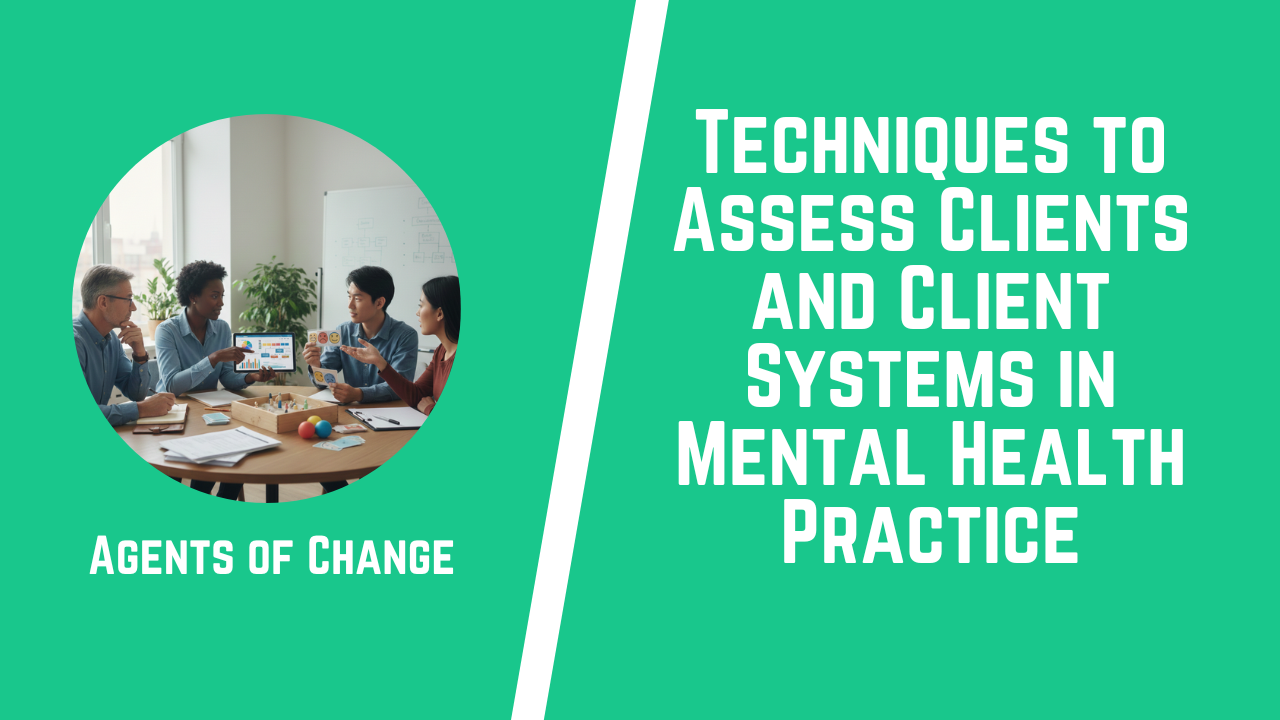
Techniques to Assess Clients and Client Systems in Mental Health Practice
Techniques to Assess Clients and Client Systems in Mental Health Practice
Starting a mental health assessment often feels like stepping into a story already in motion. Clients arrive carrying experiences shaped by family, culture, work, and community, and they may not yet know how to put all of that into words. The clinician’s role is to listen carefully, notice patterns, and gently ask questions that help bring meaning to what feels confusing or overwhelming. This first stage sets the tone for everything that follows, so it deserves attention, patience, and genuine curiosity.

Understanding people in context is what makes mental health practice both challenging and deeply human. Thoughts and emotions do not develop in isolation, and neither do coping strategies or struggles. Relationships, social expectations, and access to resources all influence how distress shows up and how healing can begin. When assessment includes these surrounding influences, it becomes easier to see why certain behaviors make sense and what kind of support might actually help.

This is where thoughtful techniques to assess clients and client systems in mental health practice become essential. These approaches help clinicians move beyond surface-level symptoms and toward a fuller picture of strengths, risks, and opportunities for change. When used with care and collaboration, assessment can feel less like an interrogation and more like a shared effort to understand what is happening and what might come next.

Did you know? Agents of Change Continuing Education offers Unlimited Access to 150+ ASWB and NBCC-approved CE courses and 12+ Live Events per year for one low annual fee to meet your state’s requirements for Continuing Education credits and level up your career.

We’ve helped hundreds of thousands of Social Workers, Counselors, and Mental Health Professionals with Continuing Education, learn more here about Agents of Change and claim your 5 free CEUs.

1) Why Assessment Is More Than Just a Checklist

It can be tempting to treat assessment like a task to complete and move past, especially when paperwork piles up and time feels tight. Still, meaningful assessment is much more than filling in boxes or scoring forms. It is an ongoing process that unfolds through conversation, observation, reflection, and collaboration. When done thoughtfully, assessment becomes a clinical tool that guides care in real and flexible ways.

Assessment Is a Process, Not an Event

Mental health concerns change over time, and so do people’s circumstances. What feels urgent today may shift next month, and new stressors can appear without warning. A one-time intake cannot capture that movement.

Ongoing assessment allows clinicians to:

  • Track progress and setbacks

  • Notice emerging risks or protective factors

  • Adjust treatment goals as needs evolve

  • Respond to life events that impact stability

This process helps treatment stay relevant instead of relying on outdated assumptions.

Context Shapes Every Symptom

Symptoms do not appear in a vacuum. Anxiety, depression, anger, or withdrawal often make sense once social and environmental pressures are considered. When clinicians look beyond individual behavior, they can identify stressors that may be driving distress.

Important contextual areas include:

  • Family roles and expectations

  • Work or school pressures

  • Financial strain or housing instability

  • Cultural norms around emotion and help-seeking

  • Experiences of discrimination or marginalization

Without this broader view, treatment risks focusing only on coping skills while missing the roots of the problem.

Relationships Influence Change

People heal, struggle, and grow within relationships. Supportive connections can strengthen recovery, while strained or unsafe relationships can maintain symptoms. Assessment that includes relational dynamics provides insight into how change might be supported or blocked.

Relational assessment may explore:

  • Communication patterns

  • Conflict resolution styles

  • Boundaries and caregiving roles

  • Levels of emotional safety

These factors often shape how clients respond to treatment and whether progress is sustainable.

Client Voice Matters More Than Perfect Data

Numbers, scores, and diagnostic criteria have their place, yet they never replace the meaning clients assign to their own experiences. When assessment prioritizes client perspective, it builds trust and increases engagement in treatment.

Ways to center client voice include:

  • Asking what they believe is causing their distress

  • Exploring what they hope will change through therapy

  • Checking whether interpretations feel accurate to them

  • Inviting feedback about the assessment process itself

This collaboration turns assessment into a shared understanding rather than a clinical verdict.

Strengths Are as Important as Risks

Focusing only on problems can unintentionally reinforce hopelessness. Strength-based assessment highlights what clients are already doing well and what resources they can draw on during difficult moments.

Strengths may include:

  • Past resilience during crises

  • Supportive relationships

  • Personal values or spiritual beliefs

  • Problem-solving abilities

  • Motivation for change

Recognizing these assets supports more balanced and empowering treatment planning.

Ethical and Cultural Awareness Are Ongoing

Ethical practice does not stop after informed consent is signed. Cultural identities, power dynamics, and social realities continue to influence how clients experience both their problems and the assessment process itself.

Ongoing awareness helps clinicians:

  • Avoid misinterpreting culturally influenced behaviors

  • Recognize personal bias when forming conclusions

  • Adapt communication to client preferences

  • Maintain respect and dignity in sensitive discussions

Assessment, when handled with humility and openness, becomes part of ethical care rather than a detached requirement.

In the end, assessment works best when it is flexible, relational, and responsive. Checklists may capture pieces of information, yet true understanding grows through curiosity, connection, and a willingness to keep learning from the client over time.

Learn more about Agents of Change Continuing Education. We’ve helped hundreds of thousands of Social Workers, Counselors, and Mental Health Professionals with their continuing education, and we want you to be next!

2) Understanding Client Systems: What Are We Actually Talking About?

When clinicians talk about client systems, it can sound abstract at first, like something pulled from a textbook rather than real life. In practice, client systems are simply the networks of people, institutions, and social forces that shape a person’s daily experiences.

a diverse modern family talking to eachother at a gathering

These systems influence how stress manifests, how support is offered or withheld, and how easy or difficult it is to make changes. Ignoring them can lead to incomplete conclusions about why problems persist or why progress feels slow.

Clients Live Inside Multiple Interacting Systems

No one belongs to just one system. People move through many at the same time, and these systems often overlap in ways that create both support and strain.

Common client systems include:

  • Family and extended family

  • Romantic and friendship networks

  • Schools, colleges, or training programs

  • Workplaces and professional settings

  • Healthcare providers and insurance structures

  • Faith communities and cultural groups

  • Social service agencies and legal systems

Each of these can influence mental health directly through stress or protection, and indirectly through expectations, access to care, and social roles.

Systems Can Support or Intensify Distress

Some systems offer stability and belonging, while others increase pressure or limit choices. A supportive workplace might reduce anxiety, while a hostile one can worsen it. A close family can help someone cope with illness, while a conflicted family may unintentionally reinforce symptoms.

During assessment, it helps to explore:

  • Which systems feel supportive

  • Which systems feel stressful or unsafe

  • Where clients feel heard versus dismissed

  • Where practical barriers limit progress

Understanding this balance helps guide whether interventions should focus on the individual, the environment, or both.

Power and Access Matter More Than We Sometimes Realize

Systems often control access to resources, opportunities, and even safety. Policies, institutional rules, and social hierarchies can shape a client’s options in powerful ways, even when those forces stay invisible in daily conversations.

Assessment may need to consider:

  • Discrimination or bias in schools or workplaces

  • Barriers to healthcare or medication

  • Immigration or legal concerns

  • Housing policies and neighborhood safety

  • Financial systems and employment stability

These factors can directly affect mental health and should be acknowledged as part of the client’s lived reality, not treated as side issues.

Change in One System Can Shift Others

Because systems are connected, changes in one area often ripple outward. A job loss can affect family stress. A new diagnosis can change how others relate to the client. Improved communication at home may reduce symptoms that seemed purely individual.

Clinicians can ask:

  • What has changed recently in your life?

  • Who else has been affected by this situation?

  • If one thing improved, what else might shift?

These questions help reveal how systems interact and where intervention may have the greatest impact.

Seeing Systems Helps Avoid Blaming the Individual

When behavior is viewed only through an individual lens, it is easy to assume lack of motivation or poor choices are the main problems. A systems perspective reminds clinicians that people often adapt to difficult environments in ways that make sense for survival, even if those adaptations later cause harm.

By recognizing systemic pressures, assessment becomes less about fault and more about understanding. That shift supports compassion, realistic goal setting, and interventions that fit the client’s actual circumstances rather than an idealized version of what change should look like.

Understanding client systems, then, is not an extra step added onto assessment. It is a way of seeing the whole picture, in which personal struggles and social environments are deeply connected and continually influence one another.

Agents of Change has helped hundreds of thousands of Social Workers, Counselors, and Mental Health Professionals with Continuing Education, learn more here about Agents of Change and claim your 5 free CEUs!

3) Interview-Based Techniques That Go Beyond Surface-Level Answers

Clinical interviews are often the first and most consistent assessment tool in mental health practice, yet the depth of information gathered depends less on the questions themselves and more on how they are asked and followed up.

When interviews are handled with intention, they can reveal patterns, values, fears, strengths, and motivations that never appear on standard forms. The goal is not to interrogate but to create a space where clients feel safe enough to reflect honestly and explore what may be hard to say out loud.

1. Open-Ended Questioning That Invites Story, Not Just Facts

Closed questions can be useful for clarification, but they often elicit short answers that end the conversation. Open-ended questions encourage clients to share experiences in their own words and at their own pace.

Examples include:

  • “Can you walk me through what a typical day looks like for you lately?”

  • “What was happening in your life when these concerns first started?”

  • “How do you usually cope when things begin to feel overwhelming?”

How to put this into practice:
Start sessions with broad questions, then narrow down as themes emerge. Resist the urge to interrupt too quickly. Silence can feel uncomfortable, but it often gives clients time to think more deeply and share what matters most to them.

2. Reflective Listening to Deepen Insight

Reflective statements show clients that they are being heard and give them a chance to clarify or expand on what they meant. This technique also helps slow down the conversation so meaning is not lost in fast-paced exchanges.

Types of reflections include:

  • Simple reflections that restate content

  • Complex reflections that capture emotional meaning

  • Reflections that highlight ambivalence or conflict

For example, if a client says, “I want to change, but I’m scared of failing again,” a reflective response might be, “Part of you is hopeful about change, and another part is worried about being hurt by disappointment.”

How to put this into practice:
Listen for emotional undertones rather than only facts. Try reflecting what you think the client is feeling or struggling with, and then pause to see if it fits their experience. Let them correct you if needed.

3. Strategic Follow-Up Questions That Explore Patterns

Initial answers often describe isolated events. Follow-up questions help reveal whether those events are part of a larger pattern.

Helpful prompts include:

  • “Does this happen often or only in certain situations?”

  • “What usually happens right before this starts?”

  • “How do people around you respond when this happens?”

These questions shift the focus from single incidents to broader behavioral and relational trends.

How to put this into practice:
After hearing a description of a problem, gently guide the client toward noticing sequences of events. This can uncover triggers, maintaining factors, and system dynamics that shape behavior.

4. Exploring Meaning Rather Than Just Behavior

Two people may show the same behavior for completely different reasons. Understanding what experiences mean to the client prevents misinterpretation and supports more accurate case conceptualization.

Questions that explore meaning include:

  • “What does this situation represent for you?”

  • “What worries you most about this happening again?”

  • “What do you tell yourself when this occurs?”

This line of inquiry often reveals core beliefs, fears, and expectations that drive emotional responses.

How to put this into practice:
When clients describe actions or symptoms, shift toward asking about thoughts, interpretations, and emotional reactions connected to those behaviors. This supports cognitive and emotional assessment simultaneously.

5. Motivational Interviewing to Assess Readiness and Ambivalence

Motivational interviewing techniques are especially useful when clients feel stuck or unsure about change. Instead of pushing for action, this approach explores mixed feelings respectfully.

Key techniques include:

  • Asking what clients like and dislike about current behaviors

  • Exploring past attempts at change

  • Highlighting discrepancies between goals and actions

  • Supporting autonomy rather than giving directives

A question like, “What are the good and not so good things about how things are right now?” can open up honest reflection without judgment.

How to put this into practice:
Avoid arguing for change. Instead, listen for client statements that express desire, ability, reasons, or need for change, and reflect those back. This helps clients hear their own motivation developing.

6. Gentle Probing for Sensitive Topics

Topics like trauma, substance use, or suicidal thoughts require careful pacing and emotional safety. Avoiding them entirely can leave serious risks unaddressed, while pushing too hard can shut clients down.

Effective strategies include:

  • Normalizing the question before asking it

  • Explaining why the information is important

  • Allowing clients to decline or pause if overwhelmed

For example, “Many people dealing with this level of stress have thoughts about hurting themselves, so I ask everyone about it. Have you had thoughts like that recently?”

How to put this into practice:
Maintain a calm, steady tone and avoid reacting with alarm. If a client becomes distressed, acknowledge the difficulty of the topic and slow the pace of the conversation.

7. Summarizing to Organize and Validate the Client’s Experience

Summaries help both the clinician and client see how different pieces of information connect. They also give clients a chance to confirm or correct the clinician’s understanding.

A useful summary might include:

  • Main concerns described

  • Emotional themes that emerged

  • Key stressors or supports

  • Areas the client wants to focus on

For instance, “From what you’ve shared, it sounds like work stress, family expectations, and feeling alone are all coming together and affecting your mood. Does that sound accurate?”

How to put this into practice:
Offer summaries at natural transitions, such as the end of a session or before shifting topics. Invite feedback and adjust based on the client’s response.

8. Attending to What Is Not Being Said

Sometimes avoidance, quick topic changes, or vague answers signal discomfort or fear. These moments can yield valuable assessment information when handled with sensitivity.

Possible responses include:

  • “I noticed that topic seemed hard to talk about. Would you like to share what made it uncomfortable?”

  • “We moved past that pretty quickly. Is there more there that feels important?”

This approach acknowledges the difficulty without forcing disclosure.

How to put this into practice:
Stay curious rather than confrontational. Let the client set the pace while gently naming observations that may help them feel understood.


Interview-based assessment becomes powerful when it moves beyond symptom checklists into the client’s lived experience. Through thoughtful questions, reflective listening, and careful pacing, clinicians can uncover deeper patterns and meanings that guide more effective and compassionate treatment planning

4) Standardized Assessment Tools and When to Use Them

Standardized assessment tools offer structured, evidence-based methods for screening for symptoms, tracking progress, and supporting diagnostic decisions.

They are especially helpful when clinicians need objective measures to complement clinical interviews and observations. Still, these tools work best when they are used thoughtfully, explained clearly to clients, and applied with consistency and care.

Why Standardized Tools Matter in Clinical Practice

Standardized tools serve several important purposes:

  • Provide benchmarks for symptom severity

  • Support diagnostic clarification

  • Track changes over time

  • Strengthen documentation for treatment planning and insurance

  • Help identify risks that might not emerge in conversation

They do not replace clinical judgment, yet they strengthen it when used alongside qualitative assessment.


Most Common Standardized Assessment Tools in Mental Health Practice

Below are widely used tools across many clinical settings, along with brief descriptions and links to learn more.

PHQ-9: Patient Health Questionnaire for Depression

What it assesses:
Severity of depressive symptoms over the past two weeks.

Common uses:
Initial screening, ongoing symptom monitoring, treatment outcome tracking.


GAD-7: Generalized Anxiety Disorder Scale

What it assesses:
Severity of generalized anxiety symptoms.

Common uses:
Screening for anxiety disorders, progress monitoring during treatment.


AUDIT: Alcohol Use Disorders Identification Test

What it assesses:
Risky or harmful alcohol use patterns.

Common uses:
Substance use screening in primary care and mental health settings.


DAST-10: Drug Abuse Screening Test

What it assesses:
Problems related to non-alcohol drug use.

Common uses:
Substance use screening and treatment planning.


PCL-5: PTSD Checklist for DSM-5

What it assesses:
Post-traumatic stress symptoms aligned with DSM-5 criteria.

Common uses:
Trauma screening, treatment progress monitoring, outcome evaluation.


Columbia Suicide Severity Rating Scale (C-SSRS)

What it assesses:
Suicidal ideation and behavior severity.

Common uses:
Risk assessment, safety planning, crisis response decisions.


ACE Questionnaire: Adverse Childhood Experiences

What it assesses:
Exposure to childhood trauma and household dysfunction.

Common uses:
Trauma-informed assessment, health risk screening, and case conceptualization.


Beck Depression Inventory (BDI-II) and Beck Anxiety Inventory (BAI)

What they assess:
Severity of depression and anxiety symptoms.

Common uses:
Clinical assessment, research settings, symptom tracking.

(Note: Beck tools are proprietary and require purchase and training for formal clinical use.)


When to Use Standardized Assessment Tools

Standardized tools are most useful at specific points in the care process.

Initial Screening and Intake

At the start of treatment, tools help identify:

  • Symptom severity

  • Possible diagnostic categories

  • Risk factors that need immediate attention

This supports early decision-making and safety planning when needed.

Monitoring Progress Over Time

Repeating tools periodically helps clinicians and clients see whether symptoms are improving, staying the same, or worsening.

Benefits include:

  • Objective feedback for clients

  • Data to guide treatment adjustments

  • Documentation of treatment effectiveness

Clients often find it encouraging to see numerical improvement even when change feels slow.

When Clinical Presentation Is Unclear

Some clients struggle to describe internal experiences. Structured tools can reveal patterns that are hard to articulate verbally, especially with anxiety, trauma, or depression.

For Program Evaluation and Reporting

Agencies often use standardized tools to demonstrate outcomes to funders, accreditation bodies, or insurance providers.


Applying Standardized Tools With Fidelity

Using tools correctly matters just as much as choosing the right one. Poor administration or interpretation can lead to inaccurate conclusions.

Follow Administration Instructions Exactly

Each tool includes guidelines for:

  • Time frame being assessed

  • Scoring methods

  • Cutoff scores

  • Interpretation recommendations

Skipping items, rewording questions, or altering response scales reduces reliability.

Explain the Purpose to Clients

Clients may worry that assessments are tests they can fail. Clear explanations reduce anxiety and improve honesty.

Helpful framing includes:

  • “This helps us understand what you are experiencing right now.”

  • “There are no right or wrong answers.”

  • “It gives us a way to track changes over time.”

When clients understand the purpose, they are more likely to answer accurately.

Use Results as Conversation Starters, Not Final Answers

Scores should lead to dialogue, not silent conclusions.

After scoring, clinicians might ask:

  • “Does this match how things feel for you?”

  • “Which of these symptoms feels most difficult right now?”

  • “Were there any questions that felt confusing or hard to answer?”

This integrates quantitative data with lived experience.

Stay Within Scope of Practice

Some assessments require specific training or credentials. Clinicians should only administer tools appropriate to their licensure and competence.

Before using a tool, consider:

  • Are you trained to interpret this measure?

  • Is this tool appropriate for your client’s age and culture?

  • Does your agency have policies about its use?

Ethical practice includes knowing when to refer for more specialized testing.

Consider Cultural and Linguistic Appropriateness

Standardized tools are often developed within specific populations. Cultural factors may influence how symptoms are understood and reported.

Best practices include:

  • Using validated translations when available

  • Asking clients if items make sense in their cultural context

  • Avoiding over-reliance on cutoff scores alone

Cultural humility remains essential even when tools are statistically reliable.


Balancing Structure With Clinical Flexibility

Standardized assessments bring valuable structure, consistency, and research support into mental health practice. Still, they work best when combined with clinical interviews, behavioral observation, and systems-based assessment. Numbers tell part of the story, while conversations reveal the meaning behind them.

When clinicians use these tools with fidelity, transparency, and collaboration, standardized assessments become allies rather than obstacles in building accurate understanding and effective treatment plans.

5) FAQs – Techniques to Assess Clients and Client Systems in Mental Health Practice
Q: How do I choose which assessment techniques to use with a new client?

A: Start with the client’s presenting concerns, risk level, and context. Clinical interviews and observation usually come first, since they help build rapport and identify what areas need deeper assessment. From there, you can decide whether standardized tools, system mapping, trauma screening, or risk assessments are appropriate. Agency requirements, cultural considerations, and your own scope of practice should also guide your choices. The goal is to select techniques that fit the client, not to apply every tool to every situation.

Q: Can assessment itself strengthen the therapeutic relationship?

A: Yes, when done collaboratively and with respect, assessment can actually deepen trust. Clients often feel validated when clinicians listen carefully, reflect their experiences accurately, and explain why certain questions are being asked.

Inviting feedback about whether your understanding feels right also shows humility and partnership. When clients feel involved in making sense of their situation, assessment becomes part of the healing process rather than something done to them.

Q: What should I do if standardized assessment results do not match what I am seeing clinically?

A: Discrepancies are not uncommon and should be explored rather than ignored. Scores may be influenced by misunderstanding questions, cultural differences, fear of disclosure, or temporary stressors. Use the results as a starting point for conversation, asking clients how they experienced the questions and whether the scores reflect how they actually feel.

Clinical judgment, observation, and client feedback should always be considered alongside standardized measures when forming treatment plans.

6) Conclusion

Assessment is at the core of effective mental health practice, shaping how clinicians understand concerns, plan interventions, and evaluate progress over time. When approached as an ongoing, collaborative process, it becomes more than a clinical requirement and instead serves as a meaningful way to understand the full complexity of a client’s life. By combining interviews, observations, standardized tools, and systems-based perspectives, clinicians gain a richer and more accurate picture of what clients are facing and what supports may help.

Focusing on both individuals and the systems around them allows treatment to address more than just symptoms. Family dynamics, workplace stress, community resources, and cultural influences all play a role in mental health outcomes. Thoughtful assessment helps identify where change is possible, where advocacy may be needed, and where strengths already exist. This broader view encourages interventions that are realistic, compassionate, and responsive to real-world conditions rather than idealized expectations.

————————————————————————————————————————————————

► Learn more about the Agents of Change Continuing Education here: https://agentsofchangetraining.com

About the Instructor, Dr. Meagan Mitchell: Meagan is a Licensed Clinical Social Worker and has been providing Continuing Education for Social Workers, Counselors, and Mental Health Professionals for more than 10 years. From all of this experience helping others, she created Agents of Change Continuing Education to help Social Workers, Counselors, and Mental Health Professionals stay up-to-date on the latest trends, research, and techniques.

#socialwork #socialworker #socialwork #socialworklicense #socialworklicensing #continuinged #continuingeducation #ce #socialworkce #freecesocialwork #lmsw #lcsw #counselor #NBCC #ASWB #ACE

Disclaimer: This content has been made available for informational and educational purposes only. This content is not intended to be a substitute for professional medical or clinical advice, diagnosis, or treatment

Note: Certain images used in this post were generated with the help of artificial intelligence.

Share:

Discover more from Agents of Change

Subscribe now to keep reading and get access to the full archive.

Continue reading

New LIVE CE event - Therapeutic Interventions for the Treatment of Clients with Chronic Pain - Get 3 CE credits