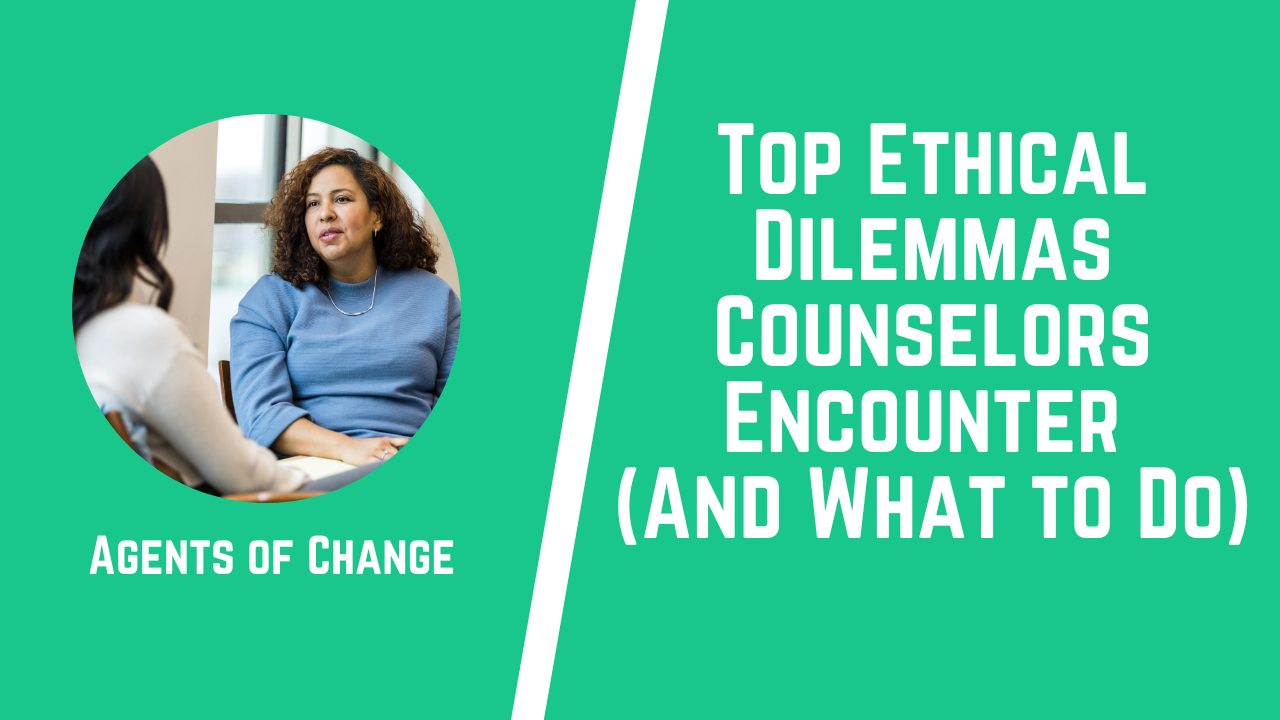
Top Ethical Dilemmas Counselors Encounter (And What to Do)
Top Ethical Dilemmas Counselors Encounter (And What to Do)
 

Counseling is a profession built on trust, empathy, and responsibility. Every session invites clients to share vulnerable parts of their lives, often revealing experiences shaped by pain, fear, hope, and uncertainty. Within those moments, counselors are asked to hold space while making decisions that can have lasting impact. Ethical dilemmas are not rare disruptions to the work. They are woven into everyday practice, sometimes appearing quietly and other times demanding immediate action.

Many ethical challenges do not arrive with clear answers or step-by-step instructions. Instead, they show up as competing responsibilities, internal tension, and difficult conversations. A counselor may feel torn between protecting confidentiality and ensuring safety, honoring a client’s autonomy while recognizing potential harm, or respecting cultural differences while staying grounded in professional standards. These moments can feel isolating, especially when the “right” choice is not obvious.

This blog explores common ethical dilemmas with honesty and practical insight. Rather than offering rigid rules, it focuses on thoughtful decision-making, reflection, and real-world strategies that support ethical growth. Whether you are new to the field or years into practice, understanding how to navigate ethical complexity can strengthen your confidence, protect your clients, and reinforce the integrity of your work.

Did you know? Agents of Change Continuing Education offers Unlimited Access to 150+ ASWB and NBCC-approved CE courses and 12+ Live Events per year for one low annual fee to meet your state’s requirements for Continuing Education credits and level up your career.

We’ve helped tens of thousands of Social Workers, Counselors, and Mental Health Professionals with Continuing Education, learn more here about Agents of Change and claim your 5 free CEUs.

1) Understanding Ethical Dilemmas in Counseling

a counselor struggling with an ethical dilemma

Ethical dilemmas in counseling are rarely black and white. They live in the gray areas where professional responsibilities, human emotion, legal obligations, and personal values intersect. Most counselors do not struggle because they lack concern for ethics. They struggle because they care deeply and want to do what is right, even when “right” feels complicated.

Understanding what ethical dilemmas are, why they happen, and how they show up in practice creates a foundation for ethical confidence. When counselors recognize these situations early, they are better equipped to respond with clarity rather than panic.

What Makes a Situation an Ethical Dilemma?

An ethical dilemma occurs when two or more ethical principles conflict and choosing one means compromising another. These situations are different from simple mistakes or policy questions. They require thoughtful judgment rather than quick fixes.

Common characteristics of ethical dilemmas include:

  • No option feels completely correct

  • Each choice carries potential risk or harm

  • Professional values appear to compete with one another

  • Emotional reactions such as anxiety or doubt arise quickly

  • Consultation or reflection feels necessary

If a decision feels heavy or uncomfortable, that discomfort is often a signal that ethical principles are involved.

Core Ethical Principles in Counseling

Most counseling, therapy, and social work ethical codes are built around a shared set of core principles. Ethical dilemmas usually emerge when these principles collide in real-world practice.

Key principles include:

  • Autonomy: Respecting a client’s right to make their own choices

  • Beneficence: Acting in ways that promote a client’s well-being

  • Nonmaleficence: Avoiding actions that could cause harm

  • Justice: Treating clients fairly and without discrimination

  • Fidelity: Maintaining trust, boundaries, and professional commitments

  • Veracity: Being honest and transparent with clients

Understanding these principles helps counselors name what is at stake when ethical tension arises.

Why Ethical Dilemmas Are So Common in Counseling

Counseling involves human lives, not controlled environments. Clients bring complex histories, unpredictable emotions, and changing circumstances into the therapeutic space. Counselors, in turn, bring their own values, experiences, and limitations.

Ethical dilemmas tend to arise because:

  • Clients’ needs evolve over time

  • Legal requirements and ethical guidelines do not always align perfectly

  • Cultural values may differ between counselor and client

  • Technology introduces new boundaries and risks

  • Counselors are asked to balance care with responsibility

Rather than seeing ethical dilemmas as failures, it helps to view them as natural outcomes of meaningful clinical work.

Ethical Awareness as a Professional Skill

Ethical decision-making is not a one-time achievement. It is a skill that develops through experience, reflection, and education. Counselors who understand ethical dilemmas are more likely to notice warning signs early and respond thoughtfully.

Developing ethical awareness involves:

  • Staying familiar with professional ethical codes

  • Reflecting on personal values and biases

  • Seeking supervision or consultation when unsure

  • Engaging in ongoing ethics-focused education

  • Documenting ethical decision-making carefully

When counselors approach ethics with curiosity rather than fear, dilemmas become opportunities for growth rather than sources of paralysis.

Learn more about Agents of Change Continuing Education. We’ve helped hundreds of thousands of Social Workers, Counselors, and Mental Health Professionals with their continuing education, and we want you to be next!

2) Top Ethical Dilemmas Counselors Encounter (And What to Do)
This section explores the most common ethical challenges counselors face today and offers grounded, practical responses. These are not theoretical puzzles. They happen in offices, clinics, schools, and private practices every day.

1. Confidentiality vs. Duty to Protect

Confidentiality is one of the most sacred elements of the counseling relationship. Clients open up because they believe their disclosures will be respected and protected. This expectation of privacy allows trust to form and therapeutic work to move forward. However, confidentiality is not absolute, and ethical tension arises when keeping information private may place the client or others in serious danger.

The Dilemma

Ethical conflict emerges when a client shares thoughts of suicide, threats of violence toward others, or information about ongoing abuse or neglect. In these moments, the counselor must weigh the client’s right to privacy against legal and ethical obligations to protect life and prevent harm. The pressure can feel intense, especially when breaking confidentiality may strain or even damage the therapeutic relationship.

What to Do

  • Become familiar with the specific laws and ethical standards that apply in your state or country, including duty to warn and mandatory reporting requirements.

  • Clearly explain the limits of confidentiality during informed consent, using language that clients can understand and remember.

  • When safety concerns arise, conduct a thorough risk assessment rather than relying on assumptions or fear.

  • Document all assessments, consultations, and decisions carefully to demonstrate ethical reasoning.

  • Seek supervision or consultation whenever possible, especially in high risk situations.

  • Take action that prioritizes safety while communicating transparently and respectfully with the client whenever feasible.

When handled without care, these situations can erode trust. When handled with clarity and compassion, they can reinforce the counselor’s role as both a supportive presence and a responsible professional.


2. Dual Relationships and Boundary Crossings

Counselors do not exist in isolation. They live in communities, attend events, and maintain social and professional networks. Because of this, boundaries are tested more often than many professionals expect. Ethical dilemmas arise when roles overlap in ways that could compromise objectivity or client well-being.

The Dilemma

A counselor realizes their client is also a neighbor, a coworker’s spouse, or their child’s teacher. A former client sends a social media request. A current client offers a gift that feels meaningful but raises concern. These situations often feel awkward and emotionally charged, especially when declining contact feels personal rather than professional.

What to Do

  • Understand the difference between boundary crossings and boundary violations. Some boundary crossings may be clinically appropriate, while violations pose clear risk.

  • Avoid dual relationships when they increase the likelihood of harm, exploitation, or impaired professional judgment.

  • Address boundary concerns openly with clients when appropriate, explaining the reasoning behind limits rather than avoiding the topic.

  • Document all discussions and decisions related to boundaries to protect both client and counselor.

  • Consult ethical codes and trusted colleagues when uncertainty arises.

Boundaries are not about creating emotional distance. They exist to protect the integrity of the therapeutic relationship and ensure clarity, safety, and trust.


3. Cultural Competence and Ethical Humility

Clients bring their whole identities into the counseling space. Culture, race, religion, gender identity, sexual orientation, socioeconomic status, disability, and lived experience all shape how individuals understand mental health and healing. Ethical counseling requires more than awareness of differences. It requires humility and a commitment to learning.

The Dilemma

A counselor may realize that their own values conflict with a client’s beliefs or that they lack sufficient cultural understanding to fully support the client. Unchecked assumptions or blind spots can unintentionally cause harm, even when intentions are good.

What to Do

  • Engage in ongoing education focused on cultural competence and responsiveness.

  • Reflect honestly on personal biases without defensiveness or self-criticism.

  • Seek supervision or consultation when cultural differences create uncertainty or discomfort.

  • Refer clients when necessary while ensuring the referral process is respectful and supportive.

  • Remain open to feedback from clients about what feels helpful or harmful in the therapeutic process.

Ethical counseling acknowledges that no professional knows everything. Growth begins with recognizing limits and committing to continuous learning. Continuing education plays a vital role here. Platforms like Agents of Change Continuing Education offer more than 150 ASWB and NBCC-approved courses designed to strengthen cultural awareness and ethical decision making through real world application.


4. Informed Consent That Is Truly Informed

Informed consent is often treated as a form to be signed at intake, but ethically, it is an ongoing process. Clients deserve to understand what counseling involves, what to expect, and what their rights and responsibilities are throughout treatment.

The Dilemma

Clients may agree to treatment terms without fully understanding them. Later, they express confusion or frustration about fees, session structure, confidentiality limits, or treatment approaches. This confusion can lead to ruptures in trust or misunderstandings that could have been prevented.

What to Do

  • Use plain, accessible language instead of legal or clinical jargon.

  • Revisit informed consent regularly, especially when treatment goals, methods, or circumstances change.

  • Invite questions and check for understanding rather than assuming clarity.

  • Document informed consent discussions thoroughly and consistently.

When clients feel informed and respected, ethical practice becomes a collaborative partnership rather than a transactional agreement.


5. Managing Competence and Scope of Practice

Counselors often feel a strong desire to help, especially when clients are struggling. However, ethical practice requires recognizing the limits of one’s training and expertise. Stretching beyond those limits can place clients at risk, even when intentions are compassionate.

The Dilemma

A client presents with issues that fall outside a counselor’s training or experience. The counselor feels torn between wanting to support the client and knowing that continued treatment may not be appropriate or effective.

What to Do

  • Conduct an honest self-assessment of competence without minimizing or exaggerating abilities.

  • Pursue additional training if the issue is within reach and appropriate to your role.

  • Refer clients to specialists when needs exceed your scope of practice.

  • Collaborate with other professionals when integrated care would benefit the client.

Ethical strength includes knowing when stepping back is the most responsible form of care.


6. Documentation and Record Keeping

Documentation may feel like a routine administrative task, but it carries significant ethical and legal responsibility. Records shape continuity of care, legal protection, and how a client’s story is represented.

The Dilemma

Counselors may struggle with how much detail to include, what language to use, or how to balance clinical accuracy with client privacy. Concerns often arise about how records could be interpreted if accessed by courts, insurance companies, or other providers.

What to Do

  • Write notes that are objective, factual, and clinically relevant.

  • Avoid speculative language, unnecessary personal opinions, or excessive detail.

  • Follow all legal and ethical guidelines related to documentation and record retention.

  • Write records with the understanding that they may be reviewed by others.

Thoughtful documentation protects clients, supports ethical accountability, and safeguards the counselor.


7. Technology, Telehealth, and Digital Boundaries

Technology has expanded access to counseling and increased flexibility for both clients and providers. At the same time, it has introduced new ethical questions around privacy, boundaries, and availability.

The Dilemma

Clients may send frequent messages outside of sessions, expect immediate responses, or blur professional boundaries through digital communication. Telehealth sessions may also expose parts of a counselor’s personal space, complicating professional presence.

What to Do

  • Establish clear expectations around communication methods and response times.

  • Use secure, compliant platforms for telehealth and electronic communication.

  • Address technology use and digital boundaries in informed consent.

  • Stay updated on evolving ethical standards related to digital practice.

As technology evolves, ethical practice requires counselors to adapt thoughtfully rather than reactively.


8. Termination and Abandonment

The end of therapy is not a neutral event. It carries emotional, ethical, and clinical significance for both client and counselor. Ending treatment responsibly is just as important as beginning it well.

The Dilemma

A counselor may feel therapy is no longer effective while the client wants to continue. In other cases, job changes, illness, or burnout may require the counselor to end services sooner than planned. These situations raise concerns about abandonment and client well-being.

What to Do

  • Discuss termination openly and with compassion, allowing space for client reactions.

  • Provide appropriate referrals and transition planning.

  • Avoid abrupt endings unless safety or legal requirements demand it.

  • Document termination discussions and planning thoroughly.

Ethical endings respect the therapeutic work that has occurred and support clients as they move forward.


Ethical Decision-Making Models That Actually Help

When emotions run high, a structured approach can ground ethical choices.

A Simple Ethical Decision-Making Framework

  1. Identify the ethical issue clearly.

  2. Review relevant ethical codes and laws.

  3. Consider the client’s perspective and welfare.

  4. Reflect on your own values and biases.

  5. Consult with supervisors or peers.

  6. Explore possible courses of action.

  7. Choose the option that minimizes harm.

  8. Document the process thoroughly.

No model guarantees comfort, but structure brings clarity.

Agents of Change has helped hundreds of thousands of Social Workers, Counselors, and Mental Health Professionals with Continuing Education, learn more here about Agents of Change and claim your 5 free CEUs!

3) Summary of Core Themes

thinking through a dilemma

Ethical dilemmas in counseling are not isolated events. They reflect deeper themes that run through the profession and shape daily practice. When these themes are understood clearly, counselors are better prepared to respond with intention rather than reaction.

One central theme is balance. Counselors are constantly balancing client autonomy with safety, compassion with boundaries, and professional judgment with humility. Ethical challenges often arise when these balances shift unexpectedly. Recognizing that tension is normal helps counselors avoid self-blame and stay grounded in thoughtful decision-making.

Another key theme is responsibility. Ethical practice requires counselors to take responsibility not only for their actions, but for their awareness, growth, and limits. This includes knowing when to seek consultation, when to pursue additional training, and when to refer a client to another professional. Responsibility also shows up in documentation, informed consent, and transparent communication with clients.

Finally, ongoing reflection and education tie everything together. Ethics are not static rules to memorize and forget. They evolve alongside societal changes, technology, and professional standards. Counselors who commit to reflection and continued learning strengthen their ethical resilience and confidence. At its core, ethical counseling is less about having perfect answers and more about staying engaged, curious, and accountable throughout the work.

4) FAQs – Top Ethical Dilemmas Counselors Encounter

Q: How can counselors tell when a situation is an ethical dilemma rather than a simple clinical challenge?

A: An ethical dilemma usually involves competing ethical principles rather than a single clinical decision. If a counselor feels pulled in two directions, worries about potential harm regardless of the choice made, or notices strong emotional reactions like anxiety or self-doubt, ethics are likely involved. These situations often require consultation, careful documentation, and reference to ethical codes, rather than relying on clinical intuition alone.

Q: What should a counselor do first when faced with an ethical dilemma?

A: The first step is to pause and clearly identify the ethical issue at hand. From there, counselors should review relevant ethical codes and legal requirements, consider the client’s well-being, and reflect on any personal values that may influence decision-making. Seeking supervision or consultation early is strongly encouraged. Acting too quickly without reflection can increase risk, while thoughtful slowing down supports ethical clarity and confidence.

Q: Can continuing education really make a difference in handling ethical dilemmas?

A: Yes, continuing education plays a critical role in ethical practice. Ethics standards, laws, and best practices change over time, and ongoing education helps counselors stay current and prepared. Ethics-focused courses also offer real-world case examples that sharpen decision-making skills. Consistent learning strengthens a counselor’s ability to recognize ethical issues early and respond in ways that protect clients, the profession, and themselves.

5) Conclusion

Ethical dilemmas are an unavoidable part of counseling work, not because something has gone wrong, but because the work itself carries real responsibility and emotional weight. Each decision a counselor makes can affect a client’s safety, trust, and growth. When ethical challenges arise, they ask counselors to slow down, reflect, and act with care rather than certainty. Approaching these moments thoughtfully reinforces the foundation of the therapeutic relationship.

Navigating ethical complexity becomes more manageable when counselors recognize that they are not meant to do it alone. Consultation, supervision, continuing education, and ethical reflection all serve as supports rather than signs of weakness. Over time, these practices build confidence and strengthen professional judgment. Ethical competence grows through experience, curiosity, and a willingness to learn from uncertainty instead of avoiding it.

By staying engaged, informed, and reflective, counselors protect both their clients and themselves. Ethical practice is not about perfection. It is about integrity, accountability, and showing up with intention even when the answers are not simple.

————————————————————————————————————————————————

► Learn more about the Agents of Change Continuing Education here: https://agentsofchangetraining.com

About the Instructor, Dr. Meagan Mitchell: Meagan is a Licensed Clinical Social Worker and has been providing Continuing Education for Social Workers, Counselors, and Mental Health Professionals for more than 10 years. From all of this experience helping others, she created Agents of Change Continuing Education to help Social Workers, Counselors, and Mental Health Professionals stay up-to-date on the latest trends, research, and techniques.

#socialwork #socialworker #socialwork #socialworklicense #socialworklicensing #continuinged #continuingeducation #ce #socialworkce #freecesocialwork #lmsw #lcsw #counselor #NBCC #ASWB #ACE

Disclaimer: This content has been made available for informational and educational purposes only. This content is not intended to be a substitute for professional medical or clinical advice, diagnosis, or treatment

Share:

Discover more from Agents of Change

Subscribe now to keep reading and get access to the full archive.

Continue reading