What is Change Talk in Motivational Interviewing?
What is Change Talk in Motivational Interviewing?
 

Change doesn’t usually arrive in dramatic moments. More often, it slips into conversation quietly, wrapped in uncertainty, hope, or frustration. In counseling and therapy settings, those subtle moments can shape everything that follows. That’s where Motivational Interviewing comes in, offering a way to listen for the language that hints at readiness, even when clients aren’t fully aware of it themselves.

At the center of this approach is a concept that sounds simple but carries real depth. What is Change Talk in Motivational Interviewing? It refers to the words clients use that move in the direction of growth, healing, or positive change. These statements may be tentative or confident, emotional or practical, but they all point toward something different from the status quo. When recognized and supported, they often become the spark that turns reflection into action.
Understanding Change Talk helps professionals slow down and listen more intentionally. Instead of pushing advice or solutions, clinicians learn to amplify what clients are already saying about change. This shift transforms sessions from problem-focused conversations into collaborative explorations, where motivation is drawn out rather than imposed. Over time, those small verbal cues can lead to meaningful and lasting change.

Did you know? Agents of Change Continuing Education offers Unlimited Access to 150+ ASWB and NBCC-approved CE courses and 12+ Live Events per year for one low annual fee to meet your state’s requirements for Continuing Education credits and level up your career.

We’ve helped hundreds of thousands of Social Workers, Counselors, and Mental Health Professionals with Continuing Education, learn more here about Agents of Change and claim your 5 free CEUs.

1) Understanding the Heart of Motivational Interviewing

Motivational Interviewing, often shortened to MI, is less about technique and more about mindset. It’s a way of being with clients that prioritizes respect, collaboration, and curiosity. At its heart, MI assumes that people already carry the seeds of change within them. The role of the practitioner is to help those seeds get light and air.

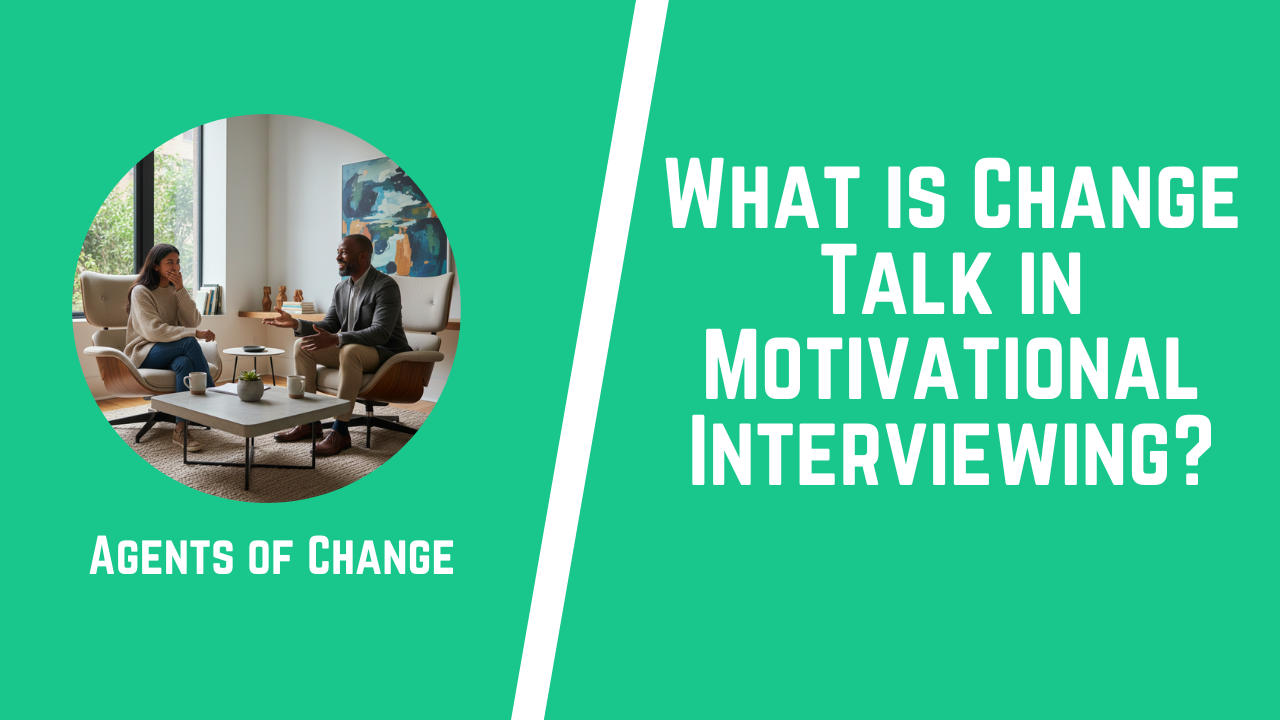
a diverse client and therapist having a breakthrough and making positive progress in a warm interesting office setting.

Below are several core elements that shape the spirit and structure of Motivational Interviewing.

A Collaborative, Not Authoritative, Approach

MI moves away from the idea that professionals must act as experts who fix problems. Instead, it treats the client as the expert on their own life.

Key features of this collaborative stance include:

  • Working with clients rather than working on them

  • Sharing power in the conversation

  • Inviting clients to explore their own values and goals

  • Respecting autonomy, even when choices feel risky or uncomfortable

This collaboration creates safety. When people don’t feel judged or pushed, they’re more likely to speak honestly, which opens the door for Change Talk to emerge naturally.

Evocation Over Education

One of the most distinctive aspects of Motivational Interviewing is its focus on evocation. Rather than providing answers, MI seeks to draw out what clients already know, feel, and believe about change.

Evocation often involves:

  • Asking open-ended questions instead of giving advice

  • Reflecting client statements to deepen insight

  • Exploring ambivalence without trying to resolve it too quickly

  • Trusting that motivation grows stronger when it comes from within

Education still has a place, but in MI, it’s offered carefully and with permission. The emphasis stays on the client’s voice, not the clinician’s agenda.

Compassion as a Clinical Skill

Compassion in Motivational Interviewing isn’t just kindness. It’s an intentional commitment to the client’s well-being. This means prioritizing their needs, experiences, and perspectives throughout the process.

Compassion shows up when clinicians:

  • Validate struggles without minimizing responsibility

  • Acknowledge fear, shame, or frustration openly

  • Avoid arguing or correcting language that sounds resistant

  • Stay curious, even when progress feels slow

This compassionate stance helps clients feel understood rather than evaluated, which strengthens engagement and trust.

The Role of Ambivalence

Ambivalence isn’t a barrier in Motivational Interviewing. It’s expected. People often feel torn between wanting change and wanting comfort or familiarity.

MI treats ambivalence as a normal human experience by:

  • Allowing both sides of the struggle to be voiced

  • Reflecting mixed feelings without judgment

  • Helping clients hear their own arguments for change

  • Gently guiding attention toward statements that favor growth

When ambivalence is respected instead of challenged, clients become less defensive and more reflective.

How These Elements Support Change Talk

All of these components work together to support Change Talk. Collaboration creates safety. Evocation invites self-exploration. Compassion builds trust. Respect for ambivalence reduces resistance.

When these conditions are present, clients are more likely to say things like:

  • “I don’t want things to stay this way.”

  • “Part of me thinks I could handle this differently.”

  • “I’m starting to see why this matters.”

Those moments are the heartbeat of Motivational Interviewing. They signal that change is no longer just an idea. It’s becoming personal.

Learn more about Agents of Change Continuing Education. We’ve helped hundreds of thousands of Social Workers, Counselors, and Mental Health Professionals with their continuing education, and we want you to be next!

2) What Is Change Talk in Motivational Interviewing?

Change Talk is the language of possibility. It’s how clients express, in their own words, movement toward growth, healing, or a different way of living. In Motivational Interviewing, these statements are not treated as casual remarks. They’re viewed as meaningful indicators of readiness and internal motivation.

 a diverse client and therapist having a breakthrough and making positive progress in a warm interesting office setting.

A Clear Definition in Simple Terms

Change Talk refers to any client statement that favors change. That’s the key criterion. The statement doesn’t need to be confident, polished, or fully committed. It simply needs to lean in the direction of change rather than staying the same.

Change Talk can appear as:

  • A wish or longing for something different

  • A belief that change might be possible

  • A recognition of the benefits of change

  • A sense of urgency or necessity

  • A declaration of intent or action

Even brief or hesitant statements count. “I guess I’m tired of this” is often more important than it sounds.

The Psychology Behind Change Talk

Change Talk works because people are influenced by their own words. When clients verbalize reasons for change, they begin to hear themselves as someone who wants something different. That internal shift can be more powerful than external encouragement.

From a psychological perspective, Change Talk supports:

  • Increased self-efficacy

  • Stronger emotional investment in goals

  • Reduced defensiveness

  • Greater alignment between values and behavior

As clients hear their own motivations reflected back, those motivations tend to grow stronger and more defined.

The Core Categories of Change Talk

Clinicians often organize Change Talk into specific categories to make it easier to recognize during sessions. These categories are commonly remembered using the acronym DARN-CAT.

Desire

Desire statements express wanting or wishing for change.

Examples include:

  • “I want to feel better.”

  • “I wish I could stop avoiding this.”

These statements often reveal values and emotional needs.

Ability

Ability language reflects confidence or belief in one’s capacity to change, even if that belief is tentative.

Examples include:

  • “I think I could handle this if I tried.”

  • “I’ve done hard things before.”

Ability statements point to strengths and past resilience.

Reasons

Reasons connect change to outcomes or benefits.

Examples include:

  • “If I made this change, my stress might go down.”

  • “It would help my relationships.”

These statements show growing insight into consequences.

Need

Need statements communicate urgency or importance.

Examples include:

  • “Something has to change.”

  • “I can’t keep going like this.”

They often appear during emotionally charged moments.

Commitment

Commitment language reflects intention or decision-making.

Examples include:

  • “I’m going to talk to my partner about this.”

  • “I’ve decided to start therapy.”

These statements signal readiness to move forward.

Taking Steps

This category involves actions already taken toward change.

Examples include:

  • “I skipped my usual habit yesterday.”

  • “I looked up some resources.”

Change is no longer theoretical here. It’s happening.

How Change Talk Sounds in Real Conversations

Change Talk doesn’t always arrive in neat sentences. It can sound messy, conflicted, or incomplete. Tone and timing matter just as much as content.

You might hear Change Talk when a client:

  • Pauses and reflects before answering

  • Contrasts past behavior with current feelings

  • Expresses frustration with patterns that no longer fit

  • Wonders out loud about different possibilities

These moments often appear unexpectedly, which is why attentive listening is essential.

Why Change Talk Is Central to Motivational Interviewing

Change Talk isn’t just one component of MI. It’s the engine that drives it. The more clients voice their own motivations for change, the more likely they are to act on them.

Motivational Interviewing aims to:

  • Elicit Change Talk intentionally

  • Strengthen it through reflection and affirmation

  • Avoid arguing against Sustain Talk

  • Support clients in moving from words to action

When Change Talk increases, resistance tends to decrease. Sessions feel more collaborative, and progress feels more authentic.

Agents of Change has helped hundreds of thousands of Social Workers, Counselors, and Mental Health Professionals with Continuing Education, learn more here about Agents of Change and claim your 5 free CEUs!

3) Common Mistakes When Working With Change Talk and How to Avoid Them

Even with solid training and good intentions, working with Change Talk can be tricky. Because it often appears in subtle, fleeting ways, it’s easy to mishandle or miss altogether. Below are five of the most common mistakes clinicians make when responding to Change Talk, along with practical ways to avoid them.

Mistake 1: Moving Too Quickly Into Action Planning

When Change Talk shows up, it can feel like a green light to jump straight into goals, strategies, or homework. While action planning is important, rushing into it can overwhelm clients or shut down further exploration.

How to avoid it:
Slow things down. Before shifting into planning, reflect the Change Talk you heard and explore it more deeply. Ask follow-up questions that help clients clarify their motivation, such as “What makes this feel important right now?” This allows commitment to strengthen naturally rather than being forced.

Mistake 2: Ignoring Sustain Talk Completely

In an effort to stay focused on change, some clinicians tune out Sustain Talk or redirect away from it too quickly. This can leave clients feeling unheard or misunderstood.

How to avoid it:
Acknowledge both sides of ambivalence. Reflect Sustain Talk with the same respect you give Change Talk. When clients feel their concerns are taken seriously, they’re more willing to explore change without becoming defensive.

Mistake 3: Over-Affirming or Sounding Insincere

Affirmations are a core MI skill, but overusing them or delivering them mechanically can come across as patronizing or hollow.

How to avoid it:
Keep affirmations specific and grounded in what the client actually said or did. Focus on effort, values, or strengths you genuinely observe. Authenticity matters more than frequency.

Mistake 4: Turning Reflections Into Questions

It’s common to unintentionally turn a reflection into a question by raising your tone at the end of the sentence. This can make clients feel tested rather than understood.

How to avoid it:
Practice making clear, confident reflections. State what you hear without asking for confirmation every time. This helps clients feel heard and often encourages them to expand on their thoughts.

Mistake 5: Arguing for Change More Than the Client Does

When clinicians advocate more strongly for change than the client, resistance tends to increase. The conversation can shift into persuasion rather than collaboration.

How to avoid it:
Let the client do the arguing for change. Your role is to evoke and reflect Change Talk, not to supply it. If you notice yourself pushing, pause and return to curiosity. Ask open-ended questions that invite the client to explore their own reasons again.


Working effectively with Change Talk requires patience, self-awareness, and ongoing practice. By avoiding these common pitfalls, clinicians can create conversations that feel supportive rather than pressured, allowing motivation to grow in a way that feels genuine and sustainable.

4) FAQs – What is Change Talk in Motivational Interviewing?

Q: How is Change Talk different from simply agreeing with the therapist?

A: Change Talk comes from the client’s own internal motivation, not from a desire to please the therapist or go along with suggestions. While agreement can sound similar on the surface, Change Talk reflects personal values, concerns, or goals that matter to the client. When someone is engaging in Change Talk, they are expressing a genuine pull toward change rather than compliance or politeness.

Q: Can Change Talk happen even when a client feels unsure or resistant?

A: Yes, and this is one of the most important aspects of Motivational Interviewing. Change Talk often appears alongside doubt, fear, or hesitation. A client can express both sides at once, such as wanting things to improve while feeling uncertain about their ability to change. These mixed statements still count as Change Talk and provide valuable opportunities for reflection and exploration.

Q: Do clinicians need formal training to work effectively with Change Talk?

A: While it’s possible to notice Change Talk intuitively, formal training helps clinicians recognize it more consistently and respond skillfully. Motivational Interviewing training teaches how to listen beneath the surface, reflect language accurately, and avoid common missteps that can shut down motivation. Ongoing education strengthens these skills and helps them feel more natural in everyday practice.

5) Conclusion

Change Talk sits at the core of meaningful and lasting change because it honors the client’s own voice. When people hear themselves speak about wanting something different, even in small or uncertain ways, motivation becomes more personal and real. Motivational Interviewing creates the conditions where those moments can surface without pressure, allowing change to grow from within rather than being imposed from the outside.

Learning to recognize and respond to Change Talk requires patience and practice. It asks clinicians to slow down, listen carefully, and trust the process instead of rushing toward solutions. Over time, these skills shift conversations from problem-focused to possibility-focused, helping clients move from reflection to action at a pace that feels safe and sustainable.

————————————————————————————————————————————————

► Learn more about the Agents of Change Continuing Education here: https://agentsofchangetraining.com

About the Instructor, Dr. Meagan Mitchell: Meagan is a Licensed Clinical Social Worker and has been providing Continuing Education for Social Workers, Counselors, and Mental Health Professionals for more than 10 years. From all of this experience helping others, she created Agents of Change Continuing Education to help Social Workers, Counselors, and Mental Health Professionals stay up-to-date on the latest trends, research, and techniques.

#socialwork #socialworker #socialwork #socialworklicense #socialworklicensing #continuinged #continuingeducation #ce #socialworkce #freecesocialwork #lmsw #lcsw #counselor #NBCC #ASWB #ACE

Disclaimer: This content has been made available for informational and educational purposes only. This content is not intended to be a substitute for professional medical or clinical advice, diagnosis, or treatment

Share:

Discover more from Agents of Change

Subscribe now to keep reading and get access to the full archive.

Continue reading

New LIVE CE event - Therapeutic Interventions for the Treatment of Clients with Chronic Pain - Get 3 CE credits