Welcome to the world of human psychology, where the line between right and wrong often blurs, giving rise to what is known as moral disengagement. It’s a term that sounds straight out of a psychology textbook, yet its presence weaves through our daily lives, often unnoticed.
From justifying a lie for a seemingly good cause to ignoring the consequences of one’s actions, moral disengagement allows individuals to sidestep their moral convictions. This blog post isn’t just a deep dive into the dark corners of moral disengagement; it’s also a beacon of hope, highlighting the pivotal role of Social Workers in guiding society back to the path of ethical righteousness.
Social Workers often find themselves on the front lines combating moral disengagement head-on. Armed with empathy, knowledge, and a relentless drive to make a difference, these professionals employ a range of strategies from education and counseling to advocacy, all aimed at rekindling the moral compass within individuals and communities alike. Their work is not just about addressing the symptoms of moral disengagement but also tackling its root causes, ensuring a healthier societal fabric woven with threads of integrity and accountability.
Did you know? Agents of Change Continuing Education offers Unlimited Access to 150+ CE courses for one low annual fee to meet your state’s requirements for Continuing Education credits and level up your career.
We’ve helped thousands of Social Workers with Continuing Education, learn more here about Agents of Change and claim your 5 free CEUs.
1) What Exactly is Moral Disengagement?

Moral disengagement serves as a psychological mechanism that allows individuals to justify unethical actions, bypassing their internal moral standards and facilitating behaviors that they would otherwise consider wrong.
This complex process, often unfolding subconsciously, plays a pivotal role in various societal issues, from minor infractions to significant ethical dilemmas.
The Theoretical Underpinnings
At its core, moral disengagement is rooted in the theory of cognitive dissonance—a state of mental discomfort arising from holding two conflicting beliefs simultaneously. When actions don’t align with personal moral values, individuals may adjust their perceptions of morality to reduce this discomfort, leading to moral disengagement.
This concept was extensively explored by Albert Bandura, who identified several mechanisms through which this disengagement occurs, effectively allowing individuals to “disconnect” their moral self-sanctions from their conduct.
The Mechanisms of Moral Disengagement
Moral disengagement doesn’t have a one-size-fits-all approach; it manifests through various mechanisms, each serving as a unique pathway to justify immoral actions. These include:
- Moral Justification: Convincing oneself that unethical actions serve a noble purpose, thus making them acceptable. For instance:
- “This is for the greater good.”
- “It’s necessary to achieve a positive outcome.”
- Euphemistic Labeling: Using neutral or positive language to describe negative actions to make them seem less harmful.
- “It’s not cheating; it’s just finding a shortcut.”
- “We’re not lying; we’re just bending the truth.”
- Advantageous Comparison: Comparing one’s misconduct with more severe actions to make it seem trivial.
- “At least I didn’t do what they did.”
- “It could have been much worse.”
- Displacement of Responsibility: Attributing one’s unethical actions to the influence or orders of an authority figure.
- “I was just following orders.”
- “They told me to do it.”
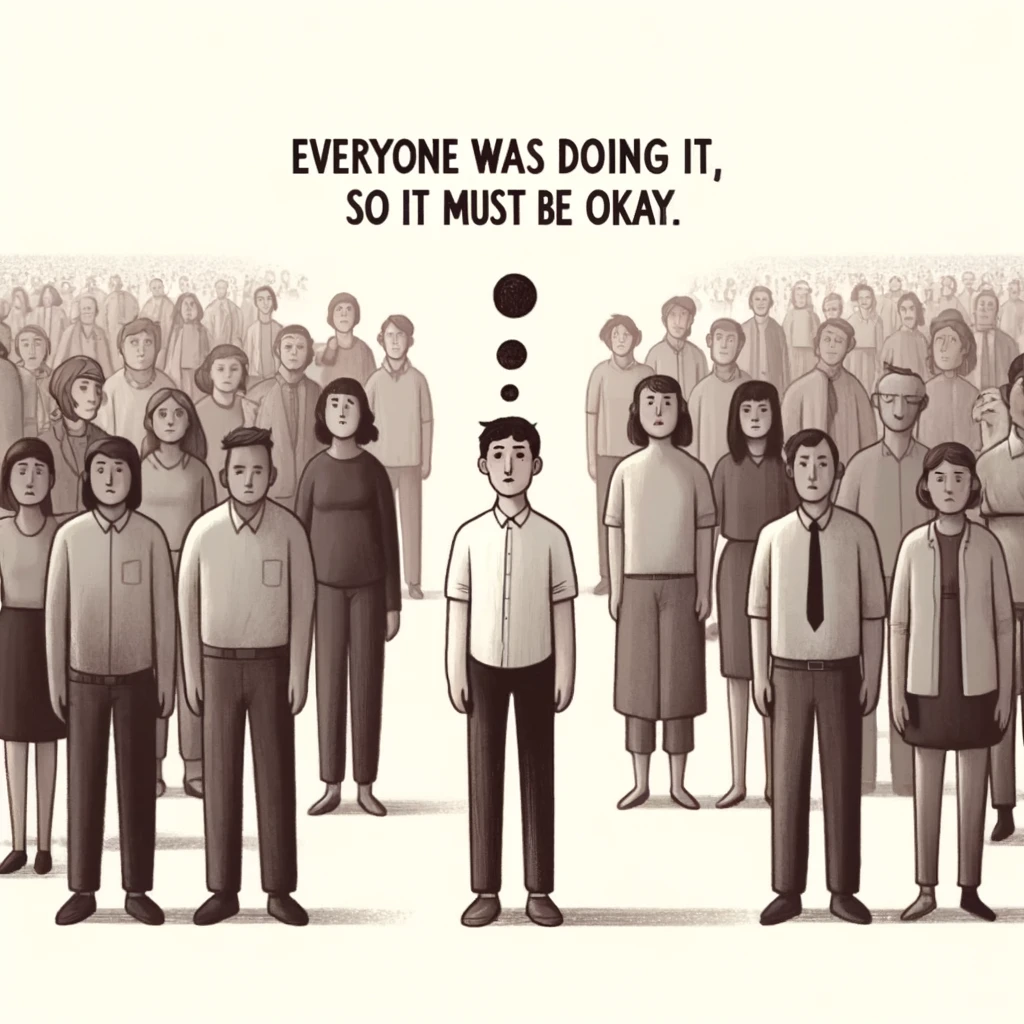
- Diffusion of Responsibility: Believing that because many people are involved in an action, the personal responsibility of each individual is diminished.
- “Everyone was doing it, so it must be okay.”
- “I’m not the only one responsible here.”
- Distorting Consequences: Downplaying the negative outcomes of one’s actions to make them seem less significant.
- “No one got hurt, so it’s fine.”
- “The impact was minimal.”
- Dehumanization: Perceiving victims as less than human or deserving of maltreatment, thus justifying unethical actions against them.
- “They’re not like us, so it doesn’t matter.”
- “They deserved what happened to them.”
- Attribution of Blame: Shifting blame to the victim or circumstances to justify one’s actions.
- “They were asking for it.”
- “If they hadn’t provoked me, I wouldn’t have reacted that way.”
The Role of Context in Moral Disengagement
The context in which moral disengagement occurs significantly influences its manifestation and severity. Factors such as societal norms, peer influence, cultural beliefs, and the immediate environment can either exacerbate or mitigate the process. For example, in a culture that emphasizes collective success over individual morality, moral justification and diffusion of responsibility might be more prevalent.
The digital age has introduced new contexts for moral disengagement, such as online anonymity and social media echo chambers, where dehumanization and diffusion of responsibility can flourish unchecked. The impersonal nature of digital interactions often amplifies moral disengagement mechanisms, making ethical lapses more common in online settings.
Learn more about Agents of Change Continuing Education. We’ve helped thousands of Social Workers with their Continuing Education and want you to be next!
2) The Role of Social Workers in Combating Moral Disengagement

Social Workers operate at the intersection of society’s most pressing ethical dilemmas and the individuals most affected by them. Their role in addressing moral disengagement is critical, bridging the gap between theoretical ethics and practical application.
Educators of Ethical Awareness
One of the primary roles of Social Workers in the context of moral disengagement is that of educators. Through awareness campaigns, workshops, and individual counseling, they illuminate the often subtle processes of moral disengagement. Their educational efforts include:
- Developing Curricula that integrate ethical reasoning with daily decision-making.
- Organizing Workshops and Seminars that engage the community in discussions about moral values and the consequences of ethical lapses.
- Providing Resources for continuous learning, such as access to platforms like Agents of Change Continuing Education, which offers courses on ethics and morality.
Advocates for Social Justice
Social Workers both educate on and advocate for policies and practices that reduce opportunities for moral disengagement. Their advocacy work often involves:
- Lobbying for Legislative Changes that address root causes of unethical behavior, such as poverty, discrimination, and lack of education.
- Creating Awareness Campaigns that highlight the societal impacts of moral disengagement and promote ethical standards.
- Forming Coalitions with other professionals and organizations to amplify their advocacy efforts.
Counselors for Moral Re-engagement
In their one-on-one interactions, Social Workers act as counselors, guiding individuals through the process of moral re-engagement. This involves:
- Identifying Signs of Moral Disengagement in clients’ reasoning and behavior.
- Engaging in Reflective Dialogue that encourages individuals to confront their justifications for unethical actions.
- Developing Personalized Strategies for individuals to realign their actions with their moral values.
Building Community Resilience
Beyond individual interactions, Social Workers strive to build communities that inherently resist moral disengagement through:
- Fostering Community Cohesion by promoting inclusivity, empathy, and mutual support.
- Establishing Ethical Norms within communities that reinforce accountability and transparency.
- Empowering Community Members to take active roles in ethical decision-making and leadership.
Collaborating with Educational Institutions
Social Workers often collaborate with educational institutions to integrate ethical education into the curriculum, providing young people with the tools to navigate moral dilemmas. This collaboration includes:
- Training Educators on how to address moral disengagement in the classroom.
- Developing Interactive Learning Materials that challenge students to think critically about ethics.
- Facilitating School-wide Initiatives that promote a culture of integrity and respect.
The Importance of Continuous Education
The landscape of moral dilemmas and societal challenges is ever-evolving, requiring Social Workers to continuously update their knowledge and strategies. Platforms like Agents of Change Continuing Education ensure that Social Workers remain at the forefront of ethical education and intervention, equipped with the latest insights and tools to combat moral disengagement.
We’ve helped thousands of Social Workers with Continuing Education, learn more here about Agents of Change and claim your 5 free CEUs!
3) Strategies for Personal Moral Re-engagement: A Guide for Individuals

In a world where the lines between right and wrong can sometimes seem blurred, it’s essential to have a compass that guides us back to our moral center. Moral re-engagement is the process of realigning our actions with our ethical beliefs, ensuring that we live lives that are not only lawful but also virtuous.
Self-Reflection: The Starting Point
The journey to moral re-engagement begins with introspection, a deep dive into one’s values, beliefs, and actions to identify where disengagement may have occurred. This process involves:
- Identifying Triggers: Recognize situations where you’re more likely to justify unethical behavior.
- Understanding Rationalizations: Pinpoint the excuses you make to justify actions that don’t align with your moral beliefs.
- Evaluating Consequences: Consider the impact of your actions on others and yourself, both immediate and long-term.
Cultivating Empathy: Seeing Through Others’ Eyes
Empathy plays a crucial role in moral re-engagement, as it allows us to understand and share the feelings of others, thus recognizing the true impact of our actions. Strategies to enhance empathy include:
- Active Listening: Engage in conversations with the intention to understand others’ perspectives fully.
- Diverse Experiences: Seek out stories and experiences different from your own to broaden your understanding of others’ lives.
- Empathy Exercises: Practice putting yourself in someone else’s shoes, imagining their thoughts and feelings in various situations.
Accountability: Owning Your Actions
Taking responsibility for one’s actions is a cornerstone of moral re-engagement. Accountability can be fostered through:
- Acknowledging Mistakes: Admit when you’re wrong and take steps to make amends.
- Seeking Feedback: Ask for honest feedback from others about your behavior and its impact.
- Setting Personal Standards: Define clear ethical guidelines for yourself and commit to adhering to them.
Developing Critical Thinking Skills
Critical thinking is essential for evaluating situations, making ethical decisions, and understanding the consequences of our actions. To enhance critical thinking:
- Question Assumptions: Challenge your own beliefs and those of others to ensure they’re based on facts and ethical reasoning.
- Consider Multiple Perspectives: Look at situations from various angles to understand the full spectrum of ethical implications.
- Stay Informed: Educate yourself on moral philosophies and ethical dilemmas to enrich your understanding of ethics.
Seeking Guidance and Support
No one is an island, and seeking guidance from mentors, counselors, or educational resources can provide valuable insights into ethical living. Resources include:
- Mentorship: Find someone whose ethical judgment you respect and seek their advice on moral dilemmas.
- Continuing Education: Engage with courses and workshops, like those offered by Agents of Change Continuing Education, to deepen your ethical understanding.
- Support Groups: Join forums or groups focused on ethical living to share experiences and learn from others.
Practice and Persistence
Moral re-engagement is a continuous process that requires practice and commitment. Strategies for daily practice include:
- Daily Ethical Reflections: Spend time each day reflecting on your actions and their alignment with your values.
- Setting Intentions: Begin each day with a clear intention to act ethically in all situations.
- Journaling: Keep a journal of ethical challenges you face, how you handled them, and what you learned.
4) FAQs – Moral Disengagement
Q: How can I recognize when I’m engaging in moral disengagement?
A: Recognizing moral disengagement in oneself requires keen self-awareness and honesty. Look for signs such as:
- Justifying unethical actions with reasons that make them seem less harmful or beneficial in some way.
- Minimizing the impact of your actions on others, or dismissing the consequences as insignificant.
- Blaming others for your decisions or believing you had no choice but to act unethically due to external pressures.
- Feeling disconnected from your actions, as if they don’t reflect your true self or values.
Regular self-reflection and seeking feedback from trusted individuals can help identify patterns of moral disengagement in your behavior.
Q: Can moral disengagement ever be a positive thing?
A: While moral disengagement primarily facilitates unethical behavior, the mechanisms behind it can sometimes serve adaptive purposes in very specific contexts.
For example, in high-stress professions like emergency services, certain aspects of moral disengagement might temporarily help individuals cope with decisions made under extreme pressure.
However, these are exceptional circumstances and do not justify habitual moral disengagement in everyday life. The key is ensuring that any temporary disengagement does not evolve into a permanent ethical stance.
Q: How can organizations and communities combat widespread moral disengagement?
A: Organizations and communities play a crucial role in promoting ethical behavior and reducing moral disengagement. Strategies include:
- Establishing clear ethical guidelines and expectations for behavior, emphasizing the importance of integrity and accountability.
- Creating a culture of openness and honesty, where ethical dilemmas can be discussed without fear of retribution.
- Providing education and training on ethical decision-making, highlighting the consequences of moral disengagement.
- Encouraging and rewarding ethical behavior, making it clear that integrity is valued and recognized.
- Implementing systems for reporting unethical behavior without fear of backlash, ensuring that concerns can be raised and addressed appropriately.
Through these concerted efforts, organizations, and communities can foster environments where ethical behavior is the norm and moral disengagement is neither necessary nor tolerated.
5) Conclusion
Understanding and addressing moral disengagement is paramount for both individuals and societies striving to navigate the murky waters of ethical dilemmas. Through this exploration, we’ve examined the nuances of moral disengagement, underscored the critical role of Social Workers in guiding the collective conscience, and highlighted strategies for personal and communal moral re-engagement.
It’s clear that the journey toward ethical integrity isn’t a solitary one; it’s a collective endeavor that requires commitment, education, and the willingness to confront uncomfortable truths about ourselves and the world around us.
As we navigate our daily lives, faced with choices that test our moral compass, let us strive to engage more deeply with our ethical beliefs and the impact of our actions on the world around us. Let’s embrace the role of educators, advocates, and counselors in our own lives and in our communities, working tirelessly to weave a fabric of society that values and practices ethical integrity.
Learn more about Agents of Change Continuing Education. We’ve helped thousands of Social Workers with their Continuing Education and want you to be next!
————————————————————————————————————————————————
► Learn more about the Agents of Change Continuing Education here: https://agentsofchangetraining.com
About the Instructor, Meagan Mitchell: Meagan is a Licensed Clinical Social Worker and has been providing Continuing Education for Social Workers for more than 8 years. From all of this experience helping others pass their exams, she created Agents of Change Continuing Education to help Social Workers stay up-to-date on the latest trends, research, and techniques.
#socialwork #socialworker #socialwork #socialworklicense #socialworklicensing #continuinged #continuingeducation #ce #socialworkce #freecesocialwork #lmsw #lcsw
Disclaimer: This content has been made available for informational and educational purposes only. This content is not intended to be a substitute for professional medical or clinical advice, diagnosis, or treatment