Marriage and Family Therapy Continuing Education Courses
Marriage and Family Therapy Continuing Education Courses
Staying effective as a therapist in today’s world takes more than experience and intuition. Families are changing, relationships are evolving, and the challenges clients bring into sessions often look very different from what they did even a few years ago. Because of that, continuing education isn’t just a requirement to maintain your license; it’s a key part of staying relevant and confident in your work.

That’s where Marriage and Family Therapy Continuing Education comes in. These courses give you the chance to refresh your skills, explore new approaches, and deepen your understanding of the complex systems your clients are navigating every day. Whether you’re working with couples, parents, or entire family units, ongoing learning helps you respond with greater clarity and effectiveness.

At the same time, finding the right courses can feel overwhelming. Between cost, time constraints, and quality concerns, it’s easy to put continuing education on the back burner. This guide is here to make that process easier by showing you what to look for, what to avoid, and how to choose learning opportunities that genuinely support your growth as a clinician.

Did you know? Agents of Change Continuing Education offers Unlimited Access to 150+ ASWB and NBCC-approved online CE courses and 15+ Live Events per year for one low annual fee to meet your state’s requirements for Continuing Education credits and level up your career.

We’ve helped hundreds of thousands of Social Workers, Counselors, and Mental Health Professionals with Continuing Education, learn more here about Agents of Change and claim your 7.5 free CEUs.

1) Why Marriage and Family Therapy Continuing Education Courses Matter
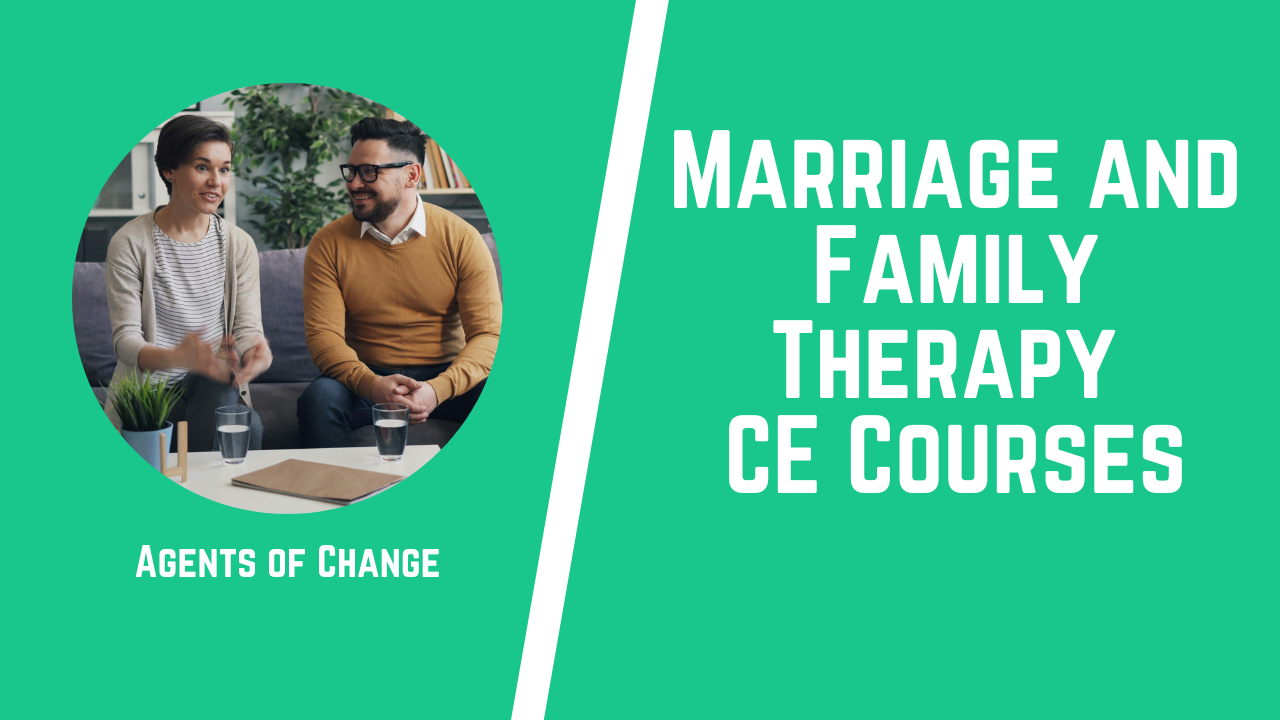
a marriage and family therapist working with a diverse couple in a warm welcoming environment

Keeping Your Clinical Skills Sharp

Therapy isn’t a static profession. What worked five years ago might still be useful, but it probably needs refining. New research, evolving best practices, and shifting client needs mean you have to stay mentally flexible.

Marriage and Family Therapy Continuing Education Courses help you:

  • Strengthen foundational techniques
  • Learn updated therapeutic models
  • Refine your clinical judgment in complex cases
  • Stay aligned with current standards of care

Sometimes it’s not about learning something completely new. It’s about seeing familiar concepts from a different angle and realizing, “I could approach this differently.”


Understanding Today’s Families

Families don’t look the same as they used to, and honestly, they never really fit into one mold anyway. Still, modern dynamics bring new layers of complexity.

You might be working with:

  • Blended families navigating boundaries
  • Long-distance parenting arrangements
  • Families impacted by social media and technology
  • Multicultural households with differing values

Continuing education helps you better understand these dynamics without making assumptions. It gives you tools to meet families where they are, instead of where older models expect them to be.


Meeting Licensing Requirements Without Stress

Let’s not ignore the practical side. You need CEUs to maintain your license. That’s just part of the job.

But here’s the thing. When approached intentionally, continuing education doesn’t have to feel like a last-minute scramble.

Benefits of staying ahead:

  • Avoid rushing to complete credits before deadlines
  • Choose courses that actually interest you
  • Spread learning out over time for better retention
  • Reduce stress during renewal periods

Instead of cramming, you can build a steady rhythm of learning that feels manageable.


Building Confidence in Challenging Sessions

Every therapist has moments where a session feels stuck or uncertain. Maybe a couple keeps circling the same conflict. Maybe a parent feels overwhelmed and unsure how to move forward.

That’s where continuing education really shows its value.

It helps you:

  • Expand your intervention strategies
  • Respond more effectively to resistance
  • Navigate high-conflict dynamics
  • Feel more grounded when things get emotionally intense

When you know you have a wider toolkit, you show up differently. You’re calmer, more present, and more confident.


Preventing Burnout Through Ongoing Growth

Burnout doesn’t always come from working too much. Sometimes it comes from feeling stuck or stagnant.

Learning something new can re-energize your practice.

Continuing education can:

  • Reignite your curiosity about the work
  • Introduce fresh perspectives that break routine
  • Help you feel more engaged with clients
  • Provide a sense of professional progress

Even a single course can shift how you think about your work. And that shift can make a big difference in how you feel day to day.


Expanding Career Opportunities

Continuing education doesn’t just improve your current practice. It can open doors you hadn’t considered before.

With the right courses, you can:

  • Specialize in areas like trauma, parenting, or military families
  • Move into supervisory or leadership roles
  • Offer new services to clients
  • Increase your professional credibility

Over time, these small learning steps can lead to bigger career changes.


Staying Ethically and Culturally Competent

Ethical standards evolve, and cultural awareness is more important than ever. Therapists are expected to provide care that is informed, respectful, and responsive to diverse experiences.

Continuing education helps you:

  • Stay updated on ethical guidelines
  • Understand cultural nuances in family systems
  • Avoid unintentional bias in your practice
  • Provide more inclusive and effective care

And honestly, this isn’t just about compliance. It’s about doing the work responsibly and thoughtfully.


Turning Requirements Into Meaningful Growth

At first glance, CEUs might seem like just another box to check. But when you choose courses intentionally, they become something much more valuable.

They become a way to:

  • Stay curious
  • Keep improving
  • Support your clients more effectively

Marriage and Family Therapy Continuing Education matters because they keep you evolving. And in a field where growth directly impacts the people you serve, that evolution isn’t optional. It’s essential.

Learn more about Agents of Change Continuing Education. We’ve helped hundreds of thousands of Social Workers, Counselors, and Mental Health Professionals with their online continuing education and CEUs, and we want you to be next!

2) Exploring Marriage and Family CE Course Topics That Matter

When you’re choosing continuing education, it’s easy to fall into a routine. You pick something quick, something convenient, something that checks the box. And sure, that works in a pinch. But if you’re investing your time anyway, why not make it count?

The truth is, the most valuable Marriage and Family Therapy Continuing Education courses are the ones that connect directly to what you see in your sessions every week. The conversations that feel stuck. The patterns that keep repeating. The moments where you think, “I wish I had a better approach for this.”

Let’s take a closer look at course topics that actually move the needle.


Supporting Clients Through Divorce and Separation

Divorce isn’t just a legal transition. It’s emotional, relational, and often deeply disorienting for everyone involved.

Clients navigating separation may struggle with:

  • Grief and identity shifts
  • Co-parenting conflicts
  • Loyalty binds for children
  • Financial and lifestyle changes

Courses like Divorce and Separation: Helping Clients Cope focus on helping therapists guide clients through these transitions with clarity and compassion.

You’ll learn how to:

  • De-escalate high-conflict interactions
  • Help parents prioritize children’s emotional needs
  • Support clients in rebuilding stability

And honestly, these are skills you’ll use constantly if you work with families.


Working Effectively with Military Families

Military families bring a unique set of experiences that can be easy to overlook if you haven’t had specific training.

Think about it. Frequent relocations, long separations, and the stress of deployment all shape family dynamics in powerful ways.

Courses such as:

Help you better understand:

  • Reintegration challenges after deployment
  • Communication barriers within military households
  • The emotional impact on children

Without this knowledge, it’s easy to misinterpret behaviors or miss important context. With it, you’re able to show up with greater sensitivity and insight.


Addressing Parental Estrangement and Family Cutoffs

Estrangement can feel like one of the most difficult topics to navigate in therapy. There’s often pain on both sides, and the path forward isn’t always clear.

The course Parental Estrangement explores this complexity in a way that’s both practical and nuanced.

You’ll gain insight into:

  • Common causes of estrangement
  • The role of boundaries versus reconciliation
  • Supporting clients through unresolved grief

Sometimes clients want to repair relationships. Other times, they need help accepting distance. Knowing how to support both outcomes is essential.


Strengthening Parenting Interventions

Parenting concerns show up in almost every area of family therapy. Even when the presenting issue seems unrelated, parenting dynamics often sit just beneath the surface.

Courses like Parenting Strategies for Positive Outcomes offer tools you can use immediately.

These include:

  • Age-appropriate discipline strategies
  • Communication techniques that reduce conflict
  • Approaches that build emotional resilience in children

And let’s be real, many parents walk into therapy feeling overwhelmed or unsure. Having structured, evidence-based guidance helps you support them without adding to that pressure.


Navigating School Systems and Family Stress

School-related challenges often spill into family life. Academic struggles, behavioral issues, and special education needs can create ongoing stress for both parents and children.

Courses such as:

Help you understand how to:

  • Advocate for children within educational systems
  • Support parents navigating complex school processes
  • Strengthen collaboration between families and schools

When you understand both sides, you’re better equipped to reduce tension and promote solutions.


Ethical Considerations When Working with Youth

Working with children and teens introduces layers of ethical complexity that can feel tricky to manage.

Questions come up like:

  • How much should you share with parents?
  • What happens when a teen asks for confidentiality?
  • How do you handle consent in evolving situations?

The course Ethical Considerations When Working with Kids and Teens addresses these challenges directly.

You’ll learn how to:

  • Navigate dual responsibilities to minors and caregivers
  • Stay compliant with ethical standards
  • Make decisions that protect both trust and safety

This kind of knowledge isn’t just helpful, it’s critical.


Choosing Topics That Align With Your Caseload

Here’s something that often gets overlooked. The best courses for you aren’t necessarily the most popular ones. They’re the ones that match your actual work.

Ask yourself:

  • What issues come up repeatedly in my sessions?
  • Where do I feel less confident or uncertain?
  • What populations do I want to serve more effectively?

Then choose courses that align with those answers.

For example:

  • If you work with couples, focus on conflict resolution and communication
  • If you see many children, prioritize parenting and developmental topics
  • If you support diverse populations, look for cultural competency training

When your learning connects directly to your practice, the impact is immediate.


Why Variety Matters in Continuing Education

It’s tempting to stay within your comfort zone. You might gravitate toward topics you already understand because they feel easier.

But growth usually happens when you stretch a little.

A balanced CE plan might include:

  • One course that deepens an existing skill
  • One course that introduces a new specialty area
  • One course focused on ethics or professional standards

This mix keeps your learning both relevant and challenging.


Making the Most of Accessible Learning Platforms

Finding all these topics in one place makes a big difference. That’s where Agents of Change Continuing Education becomes especially useful.

With over 150 ASWB and NBCC-approved courses and more than 15 live events each year, you can explore a wide range of topics without jumping between platforms. And with a $99/year subscription, it’s one of the most affordable ways to stay on track with your CEUs while actually learning something meaningful.

Instead of limiting yourself to one or two courses, you can explore multiple areas and build a more well-rounded skill set.


Turning Learning Into Real Change

At the end of the day, the goal isn’t just to complete a course. It’s to apply what you’ve learned in a way that benefits your clients.

When you choose topics that truly matter:

  • Your sessions become more effective
  • Your interventions feel more intentional
  • Your confidence grows naturally

And that’s really the point. Continuing education shouldn’t feel disconnected from your work. It should feel like an extension of it.

Because when your learning evolves, your practice evolves too.

Agents of Change has helped hundreds of thousands of Social Workers, Counselors, and Mental Health Professionals with Continuing Education, learn more here about Agents of Change and claim your 7.5 free CEUs!

3) How to Fit Continuing Education Into a Busy Schedule

Let’s be honest. Between sessions, documentation, emails, and everything else life throws your way, finding time for continuing education can feel like one more thing on an already full plate. It’s easy to push it off and tell yourself you’ll “get to it later.” Then suddenly, deadlines are close and you’re scrambling.

a therapist sitting behind a computer at a desk visibly busy and trying to get a lot done

The good news is that fitting Marriage and Family Therapy Continuing Education courses into your schedule doesn’t have to feel overwhelming. With a few intentional adjustments, you can make learning part of your routine instead of a last-minute task.


1. Break Learning Into Small, Manageable Chunks

You don’t need hours of uninterrupted time to make progress. In fact, shorter learning sessions are often more effective.

Instead of thinking, “I need to complete this entire course,” try shifting to:

  • 20 to 30 minutes before your first session
  • One module during a lunch break
  • A short lesson at the end of your workday

These small blocks add up quickly. And honestly, they’re easier to stick with because they don’t feel overwhelming.


2. Pair Learning With Existing Habits

One of the easiest ways to stay consistent is to attach continuing education to something you’re already doing.

For example:

  • Watch a course while having your morning coffee
  • Listen to the course material during your commute
  • Complete a module right after finishing notes for the day

When learning becomes part of an existing routine, it feels less like an extra task and more like a natural extension of your day.


3. Use Flexible, On-Demand Platforms

Not all continuing education is created with busy professionals in mind. Some formats just don’t fit real schedules.

That’s why flexible platforms like Agents of Change Continuing Education make such a difference.

With access to over 150 ASWB and NBCC-approved courses and more than 15 live events each year, you can:

  • Start and stop courses whenever you need
  • Choose topics that match your immediate needs
  • Learn at your own pace without pressure

And with a $99/year subscription, you’re not worrying about wasting money if you take your time.


Fitting continuing education into your life isn’t about finding more time. It’s about using the time you already have more intentionally. Once you find a rhythm that works, staying on top of your CEUs feels a lot less stressful and a lot more manageable.

4) The Future of Marriage and Family Therapy Continuing Education Courses

The field of marriage and family therapy is constantly evolving, shaped by cultural shifts, new research, and changes in how people live and connect. What worked a decade ago might still have value, but the context has changed in meaningful ways. Families are more diverse, communication happens across digital spaces, and expectations around mental health support continue to grow.

If you’re practicing today or planning your next steps, it helps to look ahead. Understanding where the field is going can guide how you approach your work, the skills you build, and the clients you serve. Here are five important trends to keep an eye on.


1. Greater Emphasis on Cultural Humility and Inclusion

Therapists are increasingly expected to move beyond basic cultural awareness and toward true cultural humility. Clients are bringing complex identities into the therapy room, shaped by race, culture, gender, socioeconomic status, and more.

This means:

  • Being open to learning from clients’ lived experiences
  • Challenging your own assumptions and biases
  • Adapting interventions to fit diverse family structures

Therapy is becoming less about applying a standard model and more about meeting people where they are, with curiosity and respect.


2. Integration of Technology Into Therapy

Technology is changing how therapy is delivered and experienced. Telehealth is now a standard option, and digital tools are becoming part of everyday practice.

You’ll likely see:

  • Increased use of virtual therapy platforms
  • Digital tools for tracking progress and communication
  • More hybrid models that combine in-person and online sessions

While this adds convenience, it also requires therapists to think carefully about boundaries, ethics, and client engagement in virtual spaces.


3. Focus on Preventative and Early Intervention Work

Traditionally, many clients seek therapy when problems have already escalated. That’s starting to shift.

There is growing interest in:

  • Preventative support for couples and families
  • Parenting education before major challenges arise
  • Early intervention with children and adolescents

This trend opens opportunities for therapists to work proactively rather than reactively, helping families build resilience before crises develop.


4. Increased Attention to Systemic and Social Factors

More therapists are recognizing that individual and family struggles don’t exist in isolation. Social, economic, and systemic factors play a significant role in mental health.

This shift includes:

  • Addressing issues like inequality, access to resources, and community support
  • Understanding how external stressors impact family dynamics
  • Advocating for clients within broader systems

Therapy is expanding beyond the room, acknowledging the larger context that shapes people’s lives.


5. Specialization Within Marriage and Family Therapy

As the field grows, therapists are increasingly choosing to specialize in specific areas rather than staying general.

Common areas of focus include:

  • Trauma and attachment
  • High-conflict couples
  • Blended families
  • Parenting and child development
  • Military or first responder families

Specialization allows you to deepen your expertise and provide more targeted support, while also helping you stand out professionally.


Looking Ahead

The future of marriage and family therapy is dynamic, responsive, and deeply connected to the realities of modern life. As these trends continue to develop, therapists who stay adaptable and committed to growth will be best positioned to support their clients effectively.

Staying informed, building new skills, and remaining open to change will help you navigate this evolving landscape with confidence.

5) FAQs – Marriage and Family Therapy Continuing Education

Q: How do I choose the best Marriage and Family Therapy Continuing Education Courses for my practice?

A: Choosing the right courses starts with looking at your current caseload and identifying where you need the most support. Ask yourself what challenges come up repeatedly in your sessions and where you feel less confident. From there, prioritize courses that offer practical strategies you can apply right away.

It also helps to make sure the courses are accredited by organizations like ASWB or NBCC so your credits count toward licensure. Platforms like Agents of Change Continuing Education simplify this process by offering a wide range of approved courses in one place.

Q: Are online Marriage and Family Therapy Continuing Education Courses as effective as in-person training?

A: Yes, online courses can be just as effective, especially when they are well-structured and include real-world applications. Many professionals actually prefer online learning because it allows them to move at their own pace and revisit material when needed.

In addition, some providers offer live virtual events, which combine flexibility with real-time interaction. For example, Agents of Change Continuing Education hosts more than 15 live continuing education events each year, giving you the opportunity to engage, ask questions, and stay connected while still learning remotely.

Q: What is the most cost-effective way to complete my CEU requirements?

A: The most cost-effective approach is usually a subscription-based model rather than paying per course. Instead of worrying about individual course fees, you gain access to a full library of content for a flat rate. For instance, Agents of Change Continuing Education offers a $99/year subscription that includes access to over 150 ASWB and NBCC-approved courses, along with 15+ live events annually. This allows you to explore multiple topics, complete your required CEUs, and continue learning throughout the year without exceeding your budget.

6) Conclusion

Continuing education is often seen as something you have to do, but it can become something you actually look forward to when approached with intention. The right Marriage and Family Therapy Continuing Education courses can strengthen your skills, expand your perspective, and help you feel more confident in the work you do every day. Instead of rushing through requirements, you can use this time to grow in ways that directly benefit both you and your clients.

As the field continues to evolve, staying current is more important than ever. New challenges, shifting family dynamics, and emerging therapeutic approaches all require you to keep learning and adapting. When you choose courses that align with your real-world experience, the impact becomes immediate. You start to notice changes in how you approach sessions, how you respond to complex situations, and how you support the families you work with.

————————————————————————————————————————————————

► Learn more about the Agents of Change Continuing Education here: https://agentsofchangetraining.com

About the Instructor, Dr. Meagan Mitchell: Meagan is a Licensed Clinical Social Worker and has been providing Continuing Education for Social Workers, Counselors, and Mental Health Professionals for more than 10 years. From all of this experience helping others, she created Agents of Change Continuing Education to help Social Workers, Counselors, and Mental Health Professionals stay up-to-date on the latest trends, research, and techniques.

#socialwork #socialworker #socialwork #socialworklicense #socialworklicensing #continuinged #continuingeducation #ce #socialworkce #freecesocialwork #lmsw #lcsw #counselor #NBCC #ASWB #ACE

Disclaimer: This content has been made available for informational and educational purposes only. This content is not intended to be a substitute for professional medical or clinical advice, diagnosis, or treatment

Note: Certain images used in this post were generated with the help of artificial intelligence.

Share:

Discover more from Agents of Change

Subscribe now to keep reading and get access to the full archive.

Continue reading

SOCIAL WORK MONTH SPECIAL: Unlimited CE + Live Events for $49. Spots are limited!