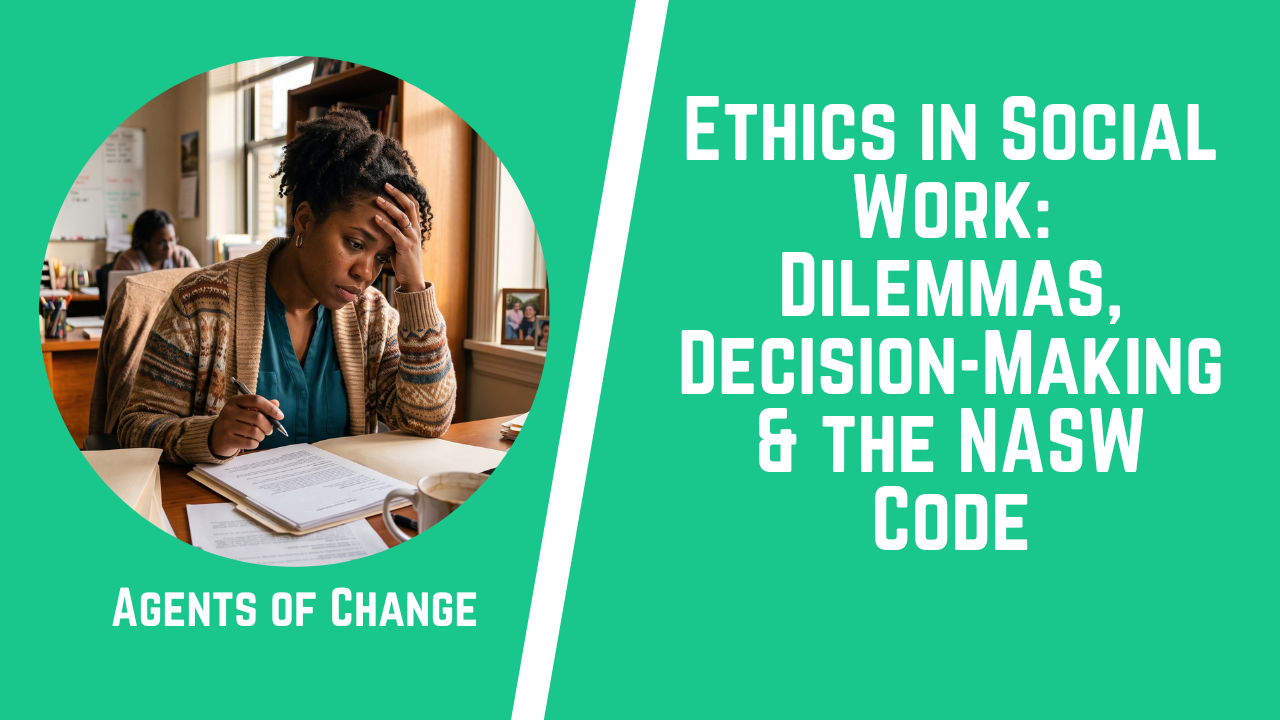
Ethics in Social Work: Dilemmas, Decision-Making & the NASW Code

Ethics in Social Work: Dilemmas, Decision-Making & the NASW Code

A client tells you something concerning and asks you not to share it. A former client sends you a friend request. A parent wants details about a teenager’s therapy session. Your agency expects you to use a new AI documentation tool, but you’re not completely sure what happens to the information entered into it.

Welcome to ethics in Social Work, where the hardest situations rarely arrive with a flashing sign that says, “ETHICAL DILEMMA.” More often, something simply feels complicated. Two responsibilities seem to pull in opposite directions. A choice that protects one important value may compromise another. Even experienced Social Workers can find themselves staring at a situation and thinking, “I know the Code, but what am I actually supposed to do here?”

That’s exactly why ethical practice requires more than memorizing rules. The NASW Code of Ethics provides the profession’s ethical foundation, but good decision-making also requires context, professional judgment, cultural humility, knowledge of applicable laws, consultation, documentation, and a willingness to examine your own assumptions. NASW itself explains that the Code guides decision-making without prescribing one required response for every possible situation.

This guide to Ethics in Social Work: Dilemmas, Decision-Making & the NASW Code brings those pieces together. We’ll look at what actually makes something an ethical dilemma, how the NASW Code of Ethics should guide practice, which dilemmas Social Workers encounter most often, and a practical framework you can return to when the answer isn’t immediately obvious.

Did you know? Agents of Change Continuing Education offers Unlimited Access to 200+ ASWB and NBCC-approved online CE courses and 25+ Live Events per year for one low annual fee to meet your state’s requirements for Continuing Education credits and level up your career.

We’ve helped hundreds of thousands of Social Workers, Counselors, and Mental Health Professionals with Continuing Education, learn more here about Agents of Change and claim your 7.5 free CEUs.

1) What Does Ethics in Social Work Actually Mean?

Ethics in Social Work refers to the values, principles, professional standards, and decision-making responsibilities that shape how Social Workers practice. Ethics influences the obvious situations, like protecting confidentiality or avoiding exploitation, but it also reaches into thousands of smaller decisions professionals make every week.

How much information should you disclose when coordinating care? What happens when your professional judgment conflicts with agency policy? Should you accept a gift from a client whose culture places significant meaning on gift-giving? How do you preserve client autonomy when you’re genuinely worried about someone’s choices?

ethical dilemma causing a social worker stress mid 30s female black in warm office environment photorealistic

Ethical practice is the process of working through those questions responsibly.

The NASW Code of Ethics identifies six core values that form the foundation of the Social Work profession:

  • Service
  • Social justice
  • Dignity and worth of the person
  • Importance of human relationships
  • Integrity
  • Competence

Those values sound straightforward until two of them seem to point in different directions. A Social Worker may deeply value a client’s dignity and right to make decisions while simultaneously recognizing a professional responsibility to respond to serious safety concerns. A clinician may value human relationships while knowing that maintaining an appropriate professional boundary protects that very relationship.

That’s where ethics becomes less about memorization and more about judgment.

What Is an Ethical Dilemma?

An ethical dilemma occurs when two or more legitimate ethical responsibilities, professional values, rights, or obligations conflict and there isn’t a perfectly clean solution.

That’s an important distinction. Something can be difficult, uncomfortable, or emotionally charged without actually being an ethical dilemma.

For example, if a Social Worker simply doesn’t like an agency policy, that’s not automatically an ethical dilemma. If that policy appears to conflict with client welfare, professional ethics, equitable access, or another legitimate obligation, however, an ethical dilemma may be developing.

A useful question is:

What are the two responsibilities I’m trying to honor at the same time?

You might answer:

  • “I’m trying to protect confidentiality while responding appropriately to a serious safety concern.”
  • “I’m trying to respect this client’s self-determination while determining whether impaired capacity affects their ability to make this decision.”
  • “I’m trying to remain culturally responsive while maintaining a professional boundary.”
  • “I’m trying to follow agency policy while advocating against a practice that may disadvantage clients.”
  • “I’m trying to use technology efficiently while protecting confidential client information.”

If you want a more detailed breakdown of the definition and resolution process, Agents of Change has a companion guide on What Is an Ethical Dilemma in Mental Health Practice? Definitions, Examples, and a Framework for Resolution. That resource works especially well as a deeper dive after readers understand the broader ethical landscape covered here.

Learn more about Agents of Change Continuing Education. We’ve helped hundreds of thousands of Social Workers, Counselors, and Mental Health Professionals with their online continuing education and CEUs, and we want you to be next!

2) The NASW Code of Ethics: Your Foundation, Not an Answer Key

The official NASW Code of Ethics is the central ethical reference for Social Workers in the United States. It applies across practice settings and includes a preamble, discussion of the Code’s purpose, ethical principles, and detailed ethical standards.

One of the most useful things to understand about the Code is what it doesn’t claim to do.

The NASW Code acknowledges that ethical responsibilities can conflict and that reasonable Social Workers may sometimes reach different conclusions. Ethical decision-making requires informed professional judgment, consideration of the circumstances, and attention to relevant standards, laws, regulations, policies, research, and consultation.

In other words, the Code isn’t a giant flowchart where every possible situation has already been solved.

The Six Areas of Ethical Responsibility

The Code’s specific ethical standards are organized around six major areas:

  1. Social Workers’ ethical responsibilities to clients
  2. Social Workers’ ethical responsibilities to colleagues
  3. Social Workers’ ethical responsibilities in practice settings
  4. Social Workers’ ethical responsibilities as professionals
  5. Social Workers’ ethical responsibilities to the Social Work profession
  6. Social Workers’ ethical responsibilities to the broader society

Many practitioners spend most of their time thinking about responsibilities to clients, especially confidentiality, consent, boundaries, and self-determination. Yet ethical practice is broader than the therapy room or case management meeting.

The Code addresses relationships with colleagues, workplace conduct, professional competence, discrimination, integrity of the profession, social welfare, public participation, and advocacy. Ethics in Social Work is ultimately about how professionals use their roles and power across systems, organizations, communities, and individual relationships.

Looking for a NASW Code of Ethics Printable Version?

People frequently search for a NASW Code of Ethics printable because having the Code nearby can be genuinely useful. Supervisors may reference it during consultation, students may annotate sections during training, and practicing Social Workers may want a quick reference when ethical questions arise.

The safest approach is to start with the current Code of Ethics directly from NASW. You can print the official online version through your browser or save it as a PDF for personal reference. NASW also offers printed copies through NASW Press.

Be cautious about downloading an old third-party PDF simply because it appears first in search results. The Code has changed over time, including updates that took effect in 2021 addressing professional self-care and strengthening language related to cultural competence.

If you’re looking for a code of ethics for Social Workers, the current NASW source should be your starting point.

Ethics, Law, Agency Policy, and Clinical Judgment Are Different Things

One reason ethical dilemmas become confusing is that several different systems can influence the same decision.

A Social Worker may need to consider:

  • The NASW Code of Ethics
  • Federal law
  • State law
  • Licensing-board regulations
  • Agency policies
  • Court orders
  • Professional standards of care
  • Clinical judgment
  • Client preferences and rights
  • Cultural and community context

These sources frequently overlap, but they aren’t interchangeable.

A policy can be legal and still raise ethical concerns. An ethically preferable response may be limited by a legal requirement. A licensing board may have requirements that go beyond what a professional ethics code discusses. Laws can also vary substantially between jurisdictions.

When these responsibilities appear to conflict, don’t rely on memory or instinct alone. The NASW Code specifically identifies consultation with supervisors, colleagues, ethics committees, regulatory bodies, and legal counsel as potential resources when ethical conflicts become difficult to resolve.

Agents of Change has helped hundreds of thousands of Social Workers, Counselors, and Mental Health Professionals with Continuing Education, learn more here about Agents of Change and claim your 7.5 free CEUs!

3) The Most Common Ethical Dilemmas in Social Work

Ethical dilemmas change with practice settings and populations, but several themes appear repeatedly across Social Work.

For a scenario-heavy exploration of these issues, see Top Ethical Dilemmas Social Workers Encounter (And What to Do) and Top Ethical Challenges in Social Work Practice Today.

ethical dilemma causing a social worker stress mid 30s female black in warm office environment photorealistic

1. Confidentiality vs. Safety

Confidentiality is fundamental to trust. Clients disclose trauma, relationships, health concerns, substance use, fears, behaviors, family conflict, and other deeply personal information because they expect professionals to protect it.

Yet confidentiality isn’t absolute.

Situations involving potential harm, abuse, neglect, court involvement, mandated reporting, or other legal responsibilities can require Social Workers to determine whether information must be disclosed. NASW’s standards around privacy and confidentiality emphasize protecting information while recognizing circumstances in which disclosure may become necessary.

The ethical question is rarely just, “Can I disclose this?”

Better questions include:

  • Is disclosure actually required or permitted?
  • What law or ethical standard applies?
  • What level of risk is present?
  • Who needs the information?
  • What is the minimum information necessary?
  • How can I remain transparent with the client when appropriate?
  • Who should I consult before acting?

Careful assessment matters because overreacting can damage trust while underreacting can create serious consequences.

2. Self-Determination vs. Protection

Clients routinely make choices their Social Workers wouldn’t make themselves. They decline treatment, stay in difficult relationships, reject referrals, change goals, stop medications, refuse services, or choose options professionals perceive as risky.

Disagreement alone doesn’t eliminate self-determination.

NASW Standard 1.02 emphasizes respecting and promoting clients’ right to self-determination while recognizing circumstances involving serious, foreseeable, and imminent risk.

That distinction matters. Helping isn’t the same as taking control.

Before overriding or restricting a client’s choices, ask whether you’re responding to genuine risk, impaired capacity, coercion, or another legitimate concern, or whether you’re responding to discomfort because the client has chosen differently than you would.

Agents of Change explores this tension further in its resource on self-determination in Social Work ethics.

3. Professional Boundaries and Dual Relationships

A client wants to give you an expensive gift. You discover that your children attend the same school. A former client follows your business account. Someone from your small community wants services from you because you’re the only clinician nearby.

Professional boundaries aren’t always as simple as “never interact outside the office.”

Some dual relationships can create conflicts of interest, exploitation, confusion, or harm. Others may be difficult or impossible to avoid, particularly in rural communities, schools, faith communities, specialized populations, and other interconnected settings.

Context matters.

The central question is whether the relationship could impair professional judgment, increase the risk of exploitation, confuse roles, or harm the client. When overlap is unavoidable, thoughtful boundaries, consultation, informed discussion, and documentation become especially important.

Readers who want more examples can continue with Different Types of Boundary Setting for Social Workers or Boundary Crossing vs. Boundary Violation.

4. Informed Consent That Isn’t Really Informed

A signature doesn’t automatically equal informed consent.

Clients need to understand what they’re agreeing to, including the nature of services, relevant risks, limitations, costs when applicable, alternatives, confidentiality expectations, and their ability to ask questions. Communication may need to be adjusted for age, language, literacy, disability, cognitive ability, developmental level, culture, or other factors.

This becomes particularly complex when working with:

  • Children and adolescents
  • Guardians
  • Involuntary clients
  • Couples and families
  • Clients with impaired decision-making capacity
  • Clients using telehealth
  • Clients whose services involve technology or recording

Consent should be treated as an ongoing process rather than paperwork completed during intake.

For a closer look, see Agents of Change’s resource on Informed Consent and Social Work Ethics.

5. Personal Values vs. Professional Responsibilities

Social Workers are human beings with histories, beliefs, identities, political perspectives, cultural backgrounds, religious or spiritual beliefs, fears, and biases.

Those don’t disappear when work begins.

Ethical problems emerge when personal values begin influencing professional decisions in ways that limit clients’ autonomy, access to care, dignity, or opportunities. Sometimes the influence is obvious. More often, it sneaks into assumptions about what a “good” parent should do, what recovery should look like, which relationships seem healthy, or which goals appear worthwhile.

Ethical self-awareness means regularly asking, “Whose values are guiding this decision?”

Cultural humility becomes especially important here. Social Workers need enough curiosity to recognize when a client’s worldview differs from their own without immediately interpreting that difference as pathology, resistance, irresponsibility, or poor judgment.

6. Technology, Telehealth, Social Media, and AI

Some of today’s fastest-changing ethical dilemmas weren’t part of everyday practice a generation ago.

Should you Google a client? Can you text appointment information? What happens when a client sends a message through Instagram? Can an AI transcription tool listen to a therapy session? Is it appropriate to paste de-identified notes into a generative AI platform? What happens if an AI-written note includes something the client never said?

NASW explicitly recognizes technology as an area that can create challenges involving confidentiality, informed consent, competence, boundaries, recordkeeping, and other ethical responsibilities.

Technology doesn’t suspend the Code. The same ethical obligations still apply, but the context becomes more complicated.

Agents of Change has several resources worth connecting here, including Navigating Ethical Dilemmas with Technology and the newer CE-focused article The Ethics of AI Documentation in Mental Health Practice. Social Workers who want formal training can also complete Ethics and Boundaries with Technology or Ethics of AI, Tech, Telehealth, and Social Media through Agents of Change Continuing Education.

7. Resource Scarcity and System-Level Ethics

Imagine knowing what a client needs while also knowing your system can’t provide it.

There may be a six-month waiting list. Insurance may deny coverage. Your organization may have restrictive eligibility criteria. Transportation may be unavailable. A client may live somewhere without specialized services.

These situations can create ethical distress because the limitation isn’t always caused by the Social Worker. Still, Social Workers have responsibilities related to advocacy, access, social justice, and the broader systems affecting their clients.

Ethical practice may involve documenting barriers, advocating internally, identifying alternatives, collaborating with community resources, challenging inequitable policies, or participating in broader systems change.

The ethical question becomes bigger than, “What can I personally do?”

Sometimes it’s, “What responsibility does the profession have to challenge the conditions creating this problem?”

4) A 7-Step Ethical Decision-Making Framework for Social Workers

When you’re in the middle of an ethical dilemma, complicated theory isn’t always useful. You need a process that slows your thinking down without making decision-making impossible.

Here’s a practical seven-step framework.

Step 1: Name the Actual Dilemma

Put the conflict into a single sentence.

Try:

“I’m trying to balance ______ with ______ while considering ______.”

If you can’t describe what’s competing, you probably aren’t ready to solve the problem yet.

Step 2: Check for Immediate Safety or Legal Obligations

Before spending an hour debating competing values, determine whether something requires immediate action.

Ask:

  • Is anyone in immediate danger?
  • Is there a mandated reporting obligation?
  • Is there a court order?
  • Is there another time-sensitive legal responsibility?
  • Is someone’s decision-making capacity in question?

Urgency shouldn’t automatically erase thoughtful ethical reasoning, but it may change the order in which decisions must happen.

Step 3: Gather the Facts

Ethical decisions often go wrong because someone acts on an assumption.

Separate what you know from what you think.

Who said what? What happened? When did it happen? What has the client consented to? What releases exist? What does the client understand? What policies actually apply? What information is missing?

The emotional intensity of a situation can make assumptions feel like facts. Slow that process down.

Step 4: Identify the Relevant Ethical Standards

Don’t vaguely think, “The Code probably says something about this.”

Look it up.

You may need to examine standards related to confidentiality, informed consent, conflicts of interest, competence, self-determination, technology, consultation, records, termination, colleagues, discrimination, or another area.

Multiple standards may apply simultaneously. That’s often what makes the situation an ethical dilemma in the first place.

Step 5: Examine Law, Policy, Culture, and Your Own Bias

Now widen the lens.

What laws or licensing rules apply? What does your agency require? Does cultural context change how the situation should be understood? Are you assuming that your preferred outcome is inherently better?

Ask yourself:

  • Am I trying to reduce the client’s discomfort or my own?
  • Would I interpret this behavior differently with another client?
  • Is power affecting this interaction?
  • Have I considered the client’s cultural framework?
  • Am I making assumptions because I’m afraid of liability?
  • Am I avoiding action because I’m afraid of conflict?

Ethical reflection can be uncomfortable. That’s part of its value.

Step 6: Consult and Consider Reasonable Options

Consultation isn’t evidence that you don’t know what you’re doing. It’s part of competent professional practice.

Depending on the situation, consultation might involve:

  • A supervisor
  • An experienced Social Worker
  • An ethics committee
  • Your professional liability carrier
  • Legal counsel
  • A licensing board
  • Another discipline
  • A specialist with relevant cultural or clinical expertise

Then identify realistic options and consider the likely consequences of each one.

Ask who benefits, who could be harmed, which rights are affected, what precedent the decision creates, and whether you’d be comfortable explaining your reasoning during supervision or professional review.

Step 7: Decide, Document, and Follow Up

Eventually, ethical reflection has to lead to action.

Document the relevant facts, consultation obtained, standards considered, decisions made, actions taken, and rationale. Avoid writing a defensive essay into the clinical record, but create enough documentation to show that your decision was thoughtful and professionally grounded.

Then follow up.

Did the decision affect the therapeutic relationship? Does the client need additional explanation? Did the intervention work as intended? Has the situation changed? Ethical decision-making isn’t always finished when the immediate crisis ends.

What Ethical Decision-Making Looks Like in Real Life

Theory becomes clearer when you apply it.

Consider a teenager who tells a Social Worker about risky behavior and asks that their parent never be told. The Social Worker shouldn’t automatically disclose everything or automatically promise secrecy. They need to assess the specific risk, review confidentiality limits and applicable laws, consider the young person’s rights, consult when needed, and communicate transparently.

Now consider a client who sends their therapist a social media friend request. There’s probably no emergency requiring a six-person ethics consultation. Still, the clinician should apply an established social media policy, protect confidentiality, maintain professional boundaries, and consider discussing the request directly if doing so would benefit the therapeutic relationship.

Or picture an agency that introduces an AI tool for documentation. The fact that management purchased the software doesn’t resolve questions about privacy, informed consent, data use, accuracy, professional judgment, and confidentiality. Ethical responsibility doesn’t disappear because technology is convenient.

Different ethical dilemmas require different levels of response. The common thread is having a process rather than relying on instinct alone.

5) Why Continuing Education Matters for Ethical Practice

Graduate school can’t prepare Social Workers for every ethical dilemma they’ll encounter across an entire career.

Practice changes. Laws change. Technology changes quickly. New models of care appear. Professionals move into supervision or leadership. Social media platforms emerge. AI becomes embedded in documentation, assessment, communication, and organizational decision-making.

Continuing education creates an opportunity to revisit ethics with the experience you didn’t have as a student.

Agents of Change Continuing Education provides more than 200 ASWB and NBCC-approved courses and more than 25 live continuing education events annually for Social Workers, Therapists, Counselors, and Mental Health Professionals. Professionals looking specifically for ethics credits can start with Navigating Ethical Dilemmas: Free CEUs for Social Workers, Therapists, and Counselors, then explore the full Agents of Change Continuing Education library.

Because ethics requirements vary by state and license type, always confirm what your licensing board requires. If you’ve ever found yourself wondering, “Do I still need ethics hours?” or “Does this live course count?”, the free Agents of Change CE Tracker can help organize state-specific requirements, completed credits, remaining hours, and renewal planning.

Ethics Isn’t About Never Making a Mistake

There’s a version of professional ethics that can become overly focused on fear.

Don’t get reported. Don’t violate a rule. Don’t get sued. Don’t make the wrong decision.

Risk management matters, of course. But ethical Social Work should be larger than avoiding punishment.

Ethical practice asks Social Workers to think intentionally about power, relationships, dignity, justice, competence, client rights, professional responsibility, and the consequences of their actions. It encourages consultation when professionals don’t know something, accountability when mistakes happen, and continued learning as practice evolves.

A clinician who never feels uncertain isn’t necessarily more ethical.

Sometimes recognizing uncertainty is what prompts the consultation, reflection, and careful thinking that ethical practice requires.

6) FAQs – Ethics in Social Work: Dilemmas, Decision-Making & the NASW Code

Q: What is the most common ethical dilemma in Social Work?

A: There isn’t one ethical dilemma that appears in every setting, but confidentiality versus safety is among the most common. Social Workers also frequently encounter dilemmas involving self-determination, professional boundaries, informed consent, dual relationships, conflicts of interest, technology, and limited resources.

Q: What is the NASW Code of Ethics?

A: The NASW Code of Ethics is a professional framework outlining the values, ethical principles, and standards that guide Social Work conduct and decision-making. It includes six core values and standards covering responsibilities to clients, colleagues, practice settings, the profession, professionals themselves, and broader society.

Q: Does the NASW Code of Ethics tell Social Workers exactly what to do?

A: No. NASW explicitly recognizes that ethical standards and responsibilities may conflict and that the Code can’t prescribe a single response for every situation. Social Workers are expected to use informed professional judgment, review relevant standards and laws, consider context, and seek consultation when needed.

Q: Where can I find a NASW Code of Ethics printable copy?

A: Start with the official NASW Code of Ethics online so you know you’re referencing the current version. You can print the online Code or save it as a PDF through your browser, and NASW also sells printed copies through NASW Press.

Q: What are the six core values in the Social Work Code of Ethics?

A: The six core values are service, social justice, dignity and worth of the person, importance of human relationships, integrity, and competence. These values provide the foundation for the ethical principles and standards contained within the NASW Code of Ethics.

Q: What should a Social Worker do when two ethical principles conflict?

A: First, clearly identify the competing responsibilities and gather enough facts to understand the situation. Then review the NASW Code, applicable laws and regulations, agency policies, cultural considerations, and potential consequences, while seeking appropriate consultation and documenting the decision-making process.

Q: Are ethics and laws the same thing in Social Work?

A: No. Ethical standards, laws, regulations, licensing rules, and agency policies can overlap, but they are different sources of professional responsibility. When they conflict or the appropriate response isn’t clear, consultation with supervisors, professional organizations, regulatory bodies, or qualified legal counsel may be appropriate.

7) Conclusion

Ethical dilemmas aren’t evidence that something has gone wrong. They’re often evidence that Social Work is exactly as complex as the people, relationships, institutions, and communities the profession serves.

The goal isn’t to memorize a perfect response to every situation. It’s to recognize when competing responsibilities are present, understand the NASW Code of Ethics, gather the right information, distinguish ethics from law and policy, examine your assumptions, consult wisely, make a defensible decision, and document your reasoning.

The NASW Code gives Social Workers a professional foundation, but ethical practice happens when those values are thoughtfully applied to real people in complicated circumstances.

And because the ethical landscape keeps changing, learning can’t stop after licensure. Agents of Change Continuing Education offers a growing library of 200+ ASWB and NBCC-approved courses, 25+ live events per year, ethics-focused trainings, and additional resources for Social Workers, Therapists, Counselors, and Mental Health Professionals. At $99/year for Unlimited CE, it’s designed to make ongoing professional education and required CEUs as affordable and accessible as possible while giving clinicians practical training they can actually use in their work.

————————————————————————————————————————————————

► Learn more about the Agents of Change Continuing Education here: https://agentsofchangetraining.com

About the Lead Instructor, Dr. Meagan Mitchell: Meagan is a Licensed Clinical Social Worker and has been providing Continuing Education for Social Workers, Counselors, and Mental Health Professionals for more than 10 years. From all of this experience helping others, she created Agents of Change Continuing Education to help Social Workers, Counselors, and Mental Health Professionals stay up-to-date on the latest trends, research, and techniques.

#socialwork #socialworker #socialwork #socialworklicense #socialworklicensing #continuinged #continuingeducation #ce #socialworkce #freecesocialwork #lmsw #lcsw #counselor #NBCC #ASWB #ACE

Disclaimer: This content has been made available for informational and educational purposes only. This content is not intended to be a substitute for professional medical or clinical advice, diagnosis, or treatment

Note: Certain images used in this post were generated with the help of artificial intelligence.

Share:

Discover more from Agents of Change

Subscribe now to keep reading and get access to the full archive.

Continue reading

Best Price of The Year — Unlock Unlimited CE + Live Events for $49.