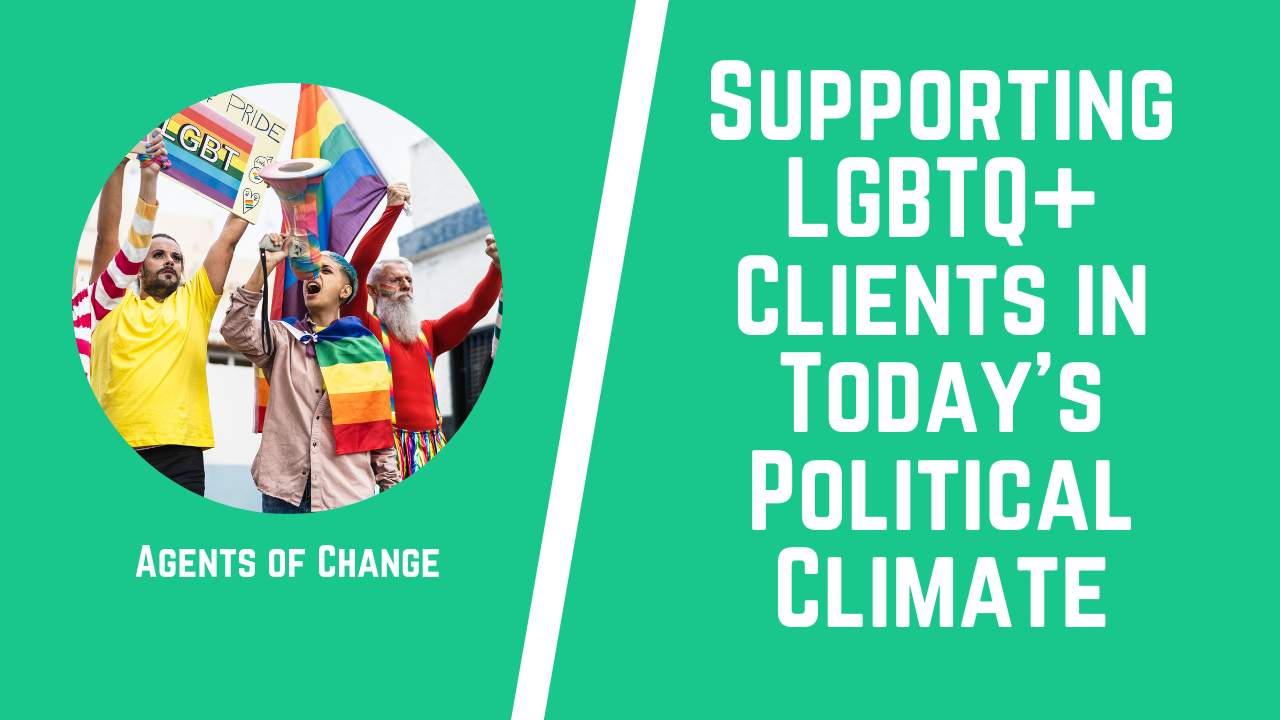
Supporting LGBTQ+ Clients in Today’s Political Climate: Creating Affirming Spaces
Supporting LGBTQ+ Clients in Today’s Political Climate: Creating Affirming Spaces
The world outside the therapy room has become louder, more polarized, and at times deeply unsettling for LGBTQ+ individuals. Political debates are no longer distant conversations happening in government buildings. They are personal, often shaping how safe someone feels in their own community, workplace, or even home. For mental health professionals, this reality shows up in subtle and direct ways, from heightened anxiety to questions about identity, safety, and belonging.

Creating a space where LGBTQ+ clients feel genuinely supported requires more than basic acceptance. It calls for intentional, informed, and compassionate care that acknowledges the broader context influencing their lives. Clients are not only bringing their personal struggles into sessions, they are also carrying the weight of societal pressures, shifting policies, and ongoing uncertainty. Recognizing this connection allows professionals to respond with greater empathy and relevance.

This blog explores what it truly means to support LGBTQ+ clients in today’s environment, focusing on practical ways to create affirming spaces that foster trust and resilience. From understanding the impact of the political climate to strengthening inclusive practices, the goal is to help professionals feel more confident and prepared. When done well, this work has the power to transform not just individual experiences, but the overall sense of safety and validation clients carry with them beyond each session.

Did you know? Agents of Change Continuing Education offers Unlimited Access to 150+ ASWB and NBCC-approved online CE courses and 15+ Live Events per year for one low annual fee to meet your state’s requirements for Continuing Education credits and level up your career.

We’ve helped hundreds of thousands of Social Workers, Counselors, and Mental Health Professionals with Continuing Education, learn more here about Agents of Change and claim your 7.5 free CEUs.

1) Understanding the Political Climate and Its Impact

The political climate isn’t just something clients observe from a distance. It seeps into daily life, relationships, and emotional well-being in ways that can feel overwhelming and, at times, unpredictable. For LGBTQ+ individuals, political conversations often center on their rights, identities, and access to care. That level of scrutiny can create a constant undercurrent of stress that doesn’t simply switch off when the news cycle ends.

a diverse therapist working with an LGBTQ+ client in an affirming space but with the client displaying emotional worry

For mental health professionals, understanding this broader context is essential. Without it, it’s easy to misinterpret symptoms, overlook stressors, or unintentionally minimize what clients are going through.

How Political Rhetoric Shapes Emotional Health

Language matters, especially when it’s amplified through media and policy discussions. Public discourse about LGBTQ+ issues can quickly shift from abstract debate to deeply personal impact.

Clients may internalize messages they hear repeatedly, leading to:

  • Increased self-doubt or shame
  • Heightened anxiety about the future
  • Fear of discrimination or rejection
  • Emotional exhaustion from constant vigilance

Even when clients appear outwardly resilient, ongoing exposure to negative rhetoric can wear down their sense of safety over time. It’s not always obvious, but it’s there.

Policy Changes and Real-Life Consequences

Legislation and policy decisions have a direct influence on access to resources, healthcare, and legal protections. These changes can feel destabilizing, especially when they happen quickly or without clear communication.

Some common concerns clients may bring into sessions include:

  • Worries about access to gender-affirming care
  • Concerns about workplace protections
  • Fear related to housing or legal rights
  • Uncertainty about travel or relocation safety

When policies shift, clients often feel like their stability is at risk. That uncertainty can show up as anxiety, irritability, or difficulty concentrating.

The Impact on Identity Development

For many LGBTQ+ individuals, identity development is already a complex and deeply personal process. A tense political climate can make that process even more challenging.

Clients might experience:

  • Hesitation in coming out or sharing their identity
  • Pressure to hide aspects of themselves in certain environments
  • Confusion when societal messages conflict with personal truth
  • Grief over lost opportunities for self-expression

In these moments, therapy can become one of the few places where clients feel free to explore who they are without fear.

Social Relationships and Community Strain

Political divides don’t stay in the public sphere. They often show up in families, friendships, and workplaces.

This can lead to:

  • Conflict with family members who hold opposing views
  • Loss of support systems after coming out
  • Difficulty navigating conversations in professional settings
  • Isolation from communities that once felt safe

Clients may feel torn between maintaining relationships and protecting their well-being. That tension can be emotionally draining and difficult to resolve.

Signs the Political Climate Is Affecting Your Clients

Sometimes the impact is clear. Other times, it’s more subtle.

Watch for patterns such as:

  • Sudden increases in anxiety or depressive symptoms
  • Avoidance of social situations or public spaces
  • Obsessive checking of news or social media
  • Sleep disturbances or changes in appetite
  • Expressions of hopelessness or helplessness

These signs don’t always point directly to political stress, but they can be important clues when viewed in context.

Why Awareness Matters for Practitioners

Recognizing the influence of the political climate allows professionals to respond more effectively and compassionately. It helps shift the focus from “What’s wrong with this client?” to “What’s happening around this client?”

That shift changes everything.

It encourages deeper empathy, more relevant interventions, and stronger therapeutic relationships. And in a time when many LGBTQ+ individuals feel uncertain about where they belong, that kind of understanding can make a meaningful difference.

Learn more about Agents of Change Continuing Education. We’ve helped hundreds of thousands of Social Workers, Counselors, and Mental Health Professionals with their online continuing education and CEUs, and we want you to be next!

2) Supporting LGBTQ+ Clients: Creating Affirming Spaces in Practice

Understanding the challenges LGBTQ+ clients face is only the beginning. The real work happens in how that understanding translates into everyday interactions, decisions, and therapeutic environments. Creating affirming spaces is not a one-time adjustment. It’s an ongoing, intentional practice that shows up in both small details and wider clinical choices.

an LGBTQ+ affirming therapy room

Let’s break this down into practical strategies, with clear examples that reflect what this looks like in real-world settings.


Creating a Welcoming First Impression

Before a client even sits down, your environment is already communicating something. The question is, what?

Affirming practices might include:

  • Intake forms that include options beyond “male” and “female”
  • Space for clients to list chosen names and pronouns
  • Inclusive language on your website and marketing materials
  • Visible signs of support, such as pride flags or affirming statements

Example:
A new client arrives and notices your intake form asks, “What name would you like us to use?” instead of “Legal Name.” That small shift signals respect and awareness. It reduces the need for correction later and immediately builds trust.


Using Language That Affirms Identity

Language is one of the most powerful tools you have. It can either reinforce safety or create distance.

Key practices:

  • Consistently use correct pronouns and names
  • Gently ask when unsure rather than assuming
  • Mirror the language clients use for themselves
  • Avoid outdated or clinical terms unless necessary and explained

Example:
A client shares they use they/them pronouns. Later in the session, you refer to them correctly without hesitation. That consistency shows attentiveness. On the other hand, repeatedly making mistakes without acknowledgment can feel dismissive, even if unintentional.

If you do make a mistake, a simple correction works best:
“Sorry, I meant they.” Then move forward. Over-apologizing can shift focus away from the client.


Inviting Conversations About Identity and Context

Some clients want to talk openly about their identity. Others may be more hesitant. The goal is to create space without pressure.

Ways to open the door:

  • “Is your identity something you’d like to explore in our work together?”
  • “How have recent events been affecting you personally?”
  • “Are there parts of your experience that feel important for me to understand?”

Example:
A client presents with anxiety. Instead of assuming the cause, you ask open-ended questions. They eventually share that recent political developments have made them fear losing access to healthcare. That connection might not have surfaced without intentional inquiry.


Responding to Political Stress in Real Time

Ignoring the political climate can make clients feel unseen. Addressing it thoughtfully can deepen the therapeutic relationship.

Helpful approaches:

  • Validate emotional responses without minimizing
  • Normalize stress reactions to external events
  • Help clients identify what is within their control
  • Explore coping strategies that feel realistic and sustainable

Example:
A client says, “I feel like everything could change overnight.”
An affirming response might be:
“It makes sense that you’re feeling unsettled. There’s a lot of uncertainty right now. Let’s talk about what’s been weighing on you the most.”

This keeps the focus on their experience rather than debating the situation itself.


Adapting Interventions to Be Inclusive

Traditional therapeutic approaches can still be effective, but they need to be applied with awareness.

Considerations include:

  • Avoid heteronormative assumptions in examples or role plays
  • Recognize that family dynamics may differ significantly
  • Be mindful of trauma related to discrimination or rejection
  • Incorporate community and identity as strengths

Example:
In cognitive behavioral therapy, when discussing relationships, avoid defaulting to heterosexual scenarios. Instead of saying, “Imagine your boyfriend or girlfriend,” try, “Imagine a partner or someone important to you.” This keeps the space open and inclusive.


Supporting Clients Facing Discrimination or Rejection

Unfortunately, many LGBTQ+ clients encounter rejection from family, workplaces, or communities. Therapy often becomes a space to process that pain.

Ways to support include:

  • Validating grief and loss without rushing to solutions
  • Exploring boundaries and safety planning
  • Identifying supportive relationships or chosen family
  • Reinforcing the client’s sense of self-worth

Example:
A client shares they were excluded from a family event after coming out. Rather than immediately suggesting reconciliation strategies, you might say:
“That sounds incredibly painful. It makes sense that you’re feeling hurt. What has this experience been like for you?”

This centers their emotional reality before moving toward next steps.


Building Trust Through Consistency

Affirming care isn’t about one perfect session. It’s about consistency over time.

This looks like:

  • Remembering and respecting identity details across sessions
  • Following through on commitments
  • Being reliable and present
  • Continuously checking in about the client’s experience

Example:
If a client shares something important about their identity in one session, bringing it up appropriately in future sessions shows that you’re paying attention. For instance, “Last time you mentioned feeling more comfortable expressing yourself at work. How has that been going?”

That continuity strengthens trust.


Continuing Education and Skill Development

No one starts out knowing everything. Staying informed is part of ethical and effective practice.

Engaging in structured learning can help professionals:

  • Understand evolving terminology and best practices
  • Gain confidence in addressing complex issues
  • Learn from real case examples and expert insights

Programs like Agents of Change Continuing Education make this process more accessible. With more than 150 ASWB and NBCC-approved courses, professionals can deepen their knowledge while earning required CE credits. The platform also offers over 15 live continuing education events each year, creating opportunities for real-time learning and discussion.

Example:
A therapist who completes a course on gender-affirming care may feel more prepared when a client begins exploring their gender identity. Instead of feeling uncertain, they can approach the conversation with clarity and confidence.


Creating a Space That Evolves With Your Clients

Affirming spaces are not static. They grow and shift as clients’ needs change.

This might involve:

  • Checking in regularly about what feels supportive
  • Adjusting approaches based on feedback
  • Staying open to learning from clients themselves

Example:
A client initially prefers not to focus on their identity in therapy. Months later, they begin to explore it more deeply. Being flexible allows you to meet them where they are, rather than sticking to a fixed approach.


Final Thoughts on Practice

Creating affirming spaces is about intention, awareness, and action. It’s found in the way you ask questions, the assumptions you challenge, and the consistency you bring to each session.

Clients notice these things. They feel them.

And when done well, these practices don’t just support LGBTQ+ clients. They help create a therapeutic environment where authenticity, safety, and trust can genuinely thrive.

Agents of Change has helped hundreds of thousands of Social Workers, Counselors, and Mental Health Professionals with Continuing Education, learn more here about Agents of Change and claim your 7.5 free CEUs!

3) Ethical Considerations in a Shifting Climate

Ethical practice has always been the foundation of effective mental health care. Yet, in a rapidly changing political environment, those ethical principles can feel more complex to navigate. Supporting LGBTQ+ clients requires more than simply following a code of ethics. It involves actively interpreting those standards in ways that protect, affirm, and empower clients in real time.

When policies shift and social tensions rise, therapists and counselors may find themselves facing new questions. What does client safety look like right now? How do you balance neutrality with advocacy? Where do professional responsibilities begin and end?

Focusing on a few core ethical considerations can help bring clarity.


1. Protecting Confidentiality in an Uncertain Environment

Confidentiality is a cornerstone of therapeutic trust. For LGBTQ+ clients, it can carry even greater weight, especially when being “out” in certain environments may lead to discrimination, rejection, or harm.

Why this matters now:
In a shifting political climate, privacy concerns can intensify. Clients may worry about who has access to their information, how records are stored, or whether their identity could be disclosed without consent.

Key practices to uphold confidentiality:

  • Clearly explain privacy policies in accessible language
  • Be transparent about the limits of confidentiality from the start
  • Use discretion when documenting sensitive identity information
  • Ensure secure storage of records, especially digital files

Example:
A teen client shares that they are questioning their gender identity but are not out to their family. In this case, careful documentation and clear communication about what will and will not be shared with guardians becomes essential. Even small missteps could lead to unintended disclosure.

Protecting confidentiality isn’t just about following rules. It’s about creating a space where clients feel safe enough to be honest.


2. Practicing Within Your Scope of Competence

Good intentions are not a substitute for competence. Supporting LGBTQ+ clients effectively requires ongoing learning and self-awareness.

Why this matters now:
As language, identities, and political realities evolve, staying current is critical. Outdated knowledge can lead to misunderstandings or unintentional harm.

Ways to maintain and strengthen competence:

  • Engage in continuing education focused on LGBTQ+ topics
  • Seek supervision or consultation when needed
  • Stay updated on best practices and terminology
  • Reflect on personal biases and knowledge gaps

Example:
A clinician unfamiliar with nonbinary identities might unintentionally misgender a client or struggle to understand their experience. By pursuing targeted training, that same clinician can develop the skills needed to provide affirming, respectful care.


3. Balancing Neutrality and Advocacy

Therapists are often trained to remain neutral, but neutrality can feel complicated when clients are directly affected by social and political issues.

Why this matters now:
When policies or societal attitudes threaten a client’s well-being, staying completely neutral may feel invalidating. At the same time, imposing personal beliefs can cross ethical boundaries.

Finding the balance involves:

  • Centering the client’s experience rather than your own opinions
  • Validating emotional responses to external events
  • Supporting client autonomy in decision-making
  • Engaging in advocacy outside of sessions when appropriate

Example:
A client expresses fear about losing access to healthcare due to new legislation. Instead of dismissing the concern or shifting into a political debate, you respond by acknowledging their fear and exploring ways to cope and access support.

In some cases, advocacy might extend beyond the therapy room, such as supporting inclusive policies within your organization or connecting clients with affirming resources. The key is to ensure that any action taken aligns with ethical guidelines and prioritizes the client’s well-being.


Bringing Ethics Into Everyday Practice

Ethical considerations are not separate from clinical work. They are woven into every interaction, every decision, and every response. In a shifting climate, these principles act as a guide, helping professionals navigate uncertainty with integrity and care.

By prioritizing confidentiality, maintaining competence, and thoughtfully balancing neutrality with advocacy, therapists can create spaces that feel both safe and empowering. And for LGBTQ+ clients facing an unpredictable world, that kind of ethical grounding can make all the difference.

4) Common Mistakes to Avoid

Even with the best intentions, mental health professionals can make missteps when working with LGBTQ+ clients. The goal isn’t perfection. It’s awareness, accountability, and a willingness to grow. By recognizing common pitfalls, you can avoid unintentionally creating discomfort or harm and instead strengthen the trust you’re working so hard to build.

Here are five of the most common mistakes, along with clear ways to avoid them in practice.


1. Making Assumptions About Identity or Experience

It’s easy to assume you understand a client’s identity based on appearance, language, or initial disclosures. However, LGBTQ+ identities are diverse and deeply personal.

What this can look like:

  • Assuming someone’s pronouns without asking
  • Presuming relationship dynamics
  • Believing all LGBTQ+ clients share similar struggles

How to avoid it:

  • Ask open-ended, respectful questions
  • Let clients define their identity in their own words
  • Stay curious rather than certain

Example:
Instead of saying, “Do you have a boyfriend?” try, “Are you in a relationship with anyone?” This keeps the conversation inclusive and avoids assumptions.


2. Avoiding Conversations About Identity

Sometimes, out of fear of saying the wrong thing, professionals avoid discussing LGBTQ+ identity altogether. While this may feel safer, it can actually create distance.

What this can look like:

  • Skipping over identity-related topics
  • Redirecting when clients bring up LGBTQ+ experiences
  • Treating identity as irrelevant to the client’s concerns

How to avoid it:

  • Gently invite discussion without pressure
  • Acknowledge identity as one part of the client’s experience
  • Follow the client’s lead while remaining open

Example:
If a client mentions feeling uncomfortable at work due to their identity, don’t shift away from it. Instead, respond with, “Can you tell me more about what that’s been like for you?”


3. Overemphasizing Identity

On the flip side, focusing too heavily on a client’s LGBTQ+ identity can feel just as invalidating. Not every issue a client faces is tied to their identity.

What this can look like:

  • Linking every concern back to identity
  • Assuming identity is the primary source of distress
  • Ignoring other aspects of the client’s life

How to avoid it:

  • Treat identity as one part of a whole person
  • Explore multiple factors influencing the client’s experience
  • Let the client decide how central identity is to the discussion

Example:
A client seeks help for workplace burnout. While their identity may play a role, it’s important to also explore workload, boundaries, and stress management rather than focusing exclusively on LGBTQ+ factors.


4. Using Incorrect or Outdated Language

Language evolves, and staying current is essential. Using outdated or incorrect terms can feel invalidating, even if unintentional.

What this can look like:

  • Misgendering a client
  • Using terms that are no longer appropriate
  • Failing to correct mistakes when they happen

How to avoid it:

  • Stay informed about evolving terminology
  • Ask clients what language they prefer
  • Correct yourself quickly and move forward

Example:
If you use the wrong pronoun, a simple correction works best:
“Sorry, I meant she.” Then continue the conversation without making it overly uncomfortable.

Ongoing learning helps here. Engaging in continuing education, such as courses offered through Agents of Change Continuing Education, can keep professionals updated on language and best practices while building confidence in real-world interactions.


5. Failing to Stay Educated and Self-Aware

Assuming you already know enough is one of the biggest barriers to providing affirming care. The landscape is constantly evolving, and so should your understanding.

What this can look like:

  • Relying on outdated training or assumptions
  • Avoiding further education on LGBTQ+ topics
  • Overlooking personal biases

How to avoid it:

  • Commit to ongoing professional development
  • Seek supervision or consultation when needed
  • Reflect regularly on your own beliefs and blind spots

Example:
A clinician who hasn’t updated their knowledge in years may unintentionally miss important nuances in gender identity. By engaging in updated training, they can provide more accurate and affirming support.

Platforms like Agents of Change Continuing Education make this easier by offering over 150 ASWB and NBCC-approved courses and more than 15 live events each year. Staying informed doesn’t have to feel overwhelming when resources are accessible and structured.


Final Thoughts on Avoiding Common Mistakes

Mistakes are part of the learning process. What matters most is how you respond. Being open to feedback, willing to adjust, and committed to growth goes a long way in building meaningful, affirming relationships with clients.

When you approach your work with curiosity, humility, and consistency, you create space for clients to feel seen and respected. And in today’s climate, that kind of care is more important than ever.

5) FAQs – Supporting LGBTQ+ Clients in Today’s Political Climate

Q: How can mental health professionals stay effective when supporting LGBTQ+ clients in a constantly changing political climate?

A: Staying effective requires a balance of awareness, adaptability, and ongoing education. The political climate can shift quickly, so it’s important to remain informed about issues that directly impact LGBTQ+ clients without becoming overwhelmed by every headline. Focus on how these changes affect your clients emotionally and practically, and create space in sessions to process those experiences.

It also helps to engage in continuing education to strengthen your skills and confidence. Resources like Agents of Change Continuing Education provide access to over 150 ASWB and NBCC-approved courses, along with 15+ live events each year, making it easier to stay current while earning required CE credits. Consistent learning allows you to respond thoughtfully rather than reactively.

Q: What should I do if I make a mistake when working with an LGBTQ+ client?

A: Mistakes happen, even for experienced professionals. What matters most is how you handle them. If you use the wrong pronoun or make an incorrect assumption, acknowledge it briefly, correct yourself, and move forward. Avoid over-apologizing, as that can shift the focus away from the client and onto your discomfort.

More importantly, take time to reflect on what led to the mistake and how you can prevent it in the future. This might involve seeking additional training, consulting with colleagues, or simply becoming more mindful in your language and approach. Clients often appreciate authenticity and effort over perfection.

Q: How can I create an affirming space if I work in a setting with limited control over policies or environment?

A: Even if you don’t control the entire environment, there are still many ways to create a more affirming experience for LGBTQ+ clients. Start with what you can influence directly, such as your language, your approach, and how you build rapport. Simple actions like asking for pronouns, using inclusive language, and validating client experiences can make a meaningful difference.

You can also advocate for change within your organization by suggesting updates to forms, policies, or training opportunities. If larger changes aren’t immediately possible, consistency in your own practice still helps establish a sense of safety. Over time, small efforts can contribute to broader shifts in workplace culture.

6) Conclusion

Supporting LGBTQ+ clients in today’s political climate requires intention, awareness, and a commitment to growth. The challenges clients face are not isolated experiences but are shaped by broader social and political forces that can deeply affect their sense of safety and well-being. By recognizing these influences, mental health professionals can provide care that feels relevant, validating, and grounded in a real-world context.

Creating affirming spaces is not about getting everything right all the time. It is about showing up consistently with respect, curiosity, and a willingness to listen. Small actions, such as using inclusive language, inviting open conversations, and staying informed, can have a lasting impact on how clients experience therapy. Over time, these efforts build trust and allow clients to explore their identities and challenges in a space that feels genuinely supportive.

————————————————————————————————————————————————

► Learn more about the Agents of Change Continuing Education here: https://agentsofchangetraining.com

About the Instructor, Dr. Meagan Mitchell: Meagan is a Licensed Clinical Social Worker and has been providing Continuing Education for Social Workers, Counselors, and Mental Health Professionals for more than 10 years. From all of this experience helping others, she created Agents of Change Continuing Education to help Social Workers, Counselors, and Mental Health Professionals stay up-to-date on the latest trends, research, and techniques.

#socialwork #socialworker #socialwork #socialworklicense #socialworklicensing #continuinged #continuingeducation #ce #socialworkce #freecesocialwork #lmsw #lcsw #counselor #NBCC #ASWB #ACE

Disclaimer: This content has been made available for informational and educational purposes only. This content is not intended to be a substitute for professional medical or clinical advice, diagnosis, or treatment

Note: Certain images used in this post were generated with the help of artificial intelligence.

Share:

Discover more from Agents of Change

Subscribe now to keep reading and get access to the full archive.

Continue reading