How to Track Your Continuing Education (CE) Progress for Social Workers, Therapists, and Counselors

How to Track Your Continuing Education (CE) Progress for Social Workers, Therapists, and Counselors

Keeping up with Continuing Education can feel like one of those professional responsibilities that sounds simple until you’re actually doing it. You take a course here, attend a live training there, download a certificate, save something to your desktop, and promise yourself you’ll organize it later. Then renewal season sneaks up, and suddenly you’re searching through emails, folders, and half-remembered course names trying to figure out what counts, what’s missing, and where that one ethics certificate went.

For Social Workers, Therapists, and Counselors, CE tracking isn’t just about staying organized. It’s about protecting your license, meeting state and board requirements, and making sure the professional development you complete actually supports your renewal. Between required topic areas, approval types, live versus self-paced credits, and different rules for different licenses, it’s easy for even the most responsible clinician to feel a little scattered.

That’s why learning how to easily track your CE progress can make the entire renewal process feel calmer and more manageable. With the right system, you can see what you’ve completed, what you still need, where your certificates are stored, and which courses match your license requirements. Instead of scrambling at the last minute, you can build a simple, steady rhythm that keeps your CE progress clear all year long.

Did you know? Agents of Change Continuing Education offers Unlimited Access to 200+ ASWB and NBCC-approved online CE courses and 20+ Live Events per year for one low annual fee to meet your state’s requirements for Continuing Education credits and level up your career.

We’ve helped hundreds of thousands of Social Workers, Counselors, and Mental Health Professionals with Continuing Education, learn more here about Agents of Change and claim your 7.5 free CEUs.

1) Why CE Tracking Gets So Messy So Fast

CE tracking usually starts with the best intentions. You take a course, download the certificate, and think, “I’ll organize this later.” Then later becomes next month, next quarter, or right before your renewal deadline. By then, you’re sorting through email attachments, random downloads, course portals, and screenshots, trying to figure out what you completed and what still counts.

social worker who is looking a bit stressed trying to pull together all her paperwork for a license renewal

The messy part isn’t usually the learning itself. Social Workers, Therapists, and Counselors are used to ongoing professional growth. The problem is that CE tracking involves several small details that all matter at the same time.

There Are Too Many Moving Pieces

Licensing boards don’t simply ask for “some CE hours.” They require a specific number of total credits, plus certain topic areas, approval types, or formats.

You may need to track:

  • Total CE credits completed
  • Ethics hours
  • Live or interactive credits
  • State-specific requirements
  • ASWB-approved or NBCC-approved courses
  • Renewal cycle dates
  • Certificate locations
  • Courses that count for one license but not another

That’s a lot to hold in your head, especially when you’re also seeing clients, writing notes, managing referrals, and keeping up with daily life.

Certificates Get Lost Easily

Another common issue is certificate storage. One certificate may be in your email. Another might be in your downloads folder. A third might live inside a CE platform account you haven’t logged into in months.

Before long, you’re dealing with files named things like:

  • certificate.pdf
  • download-3.pdf
  • CEU-final.pdf
  • ethics_training_certificate.pdf

Helpful? Not exactly.

Requirements Can Be Confusing

A course may be clinically useful and still not meet the exact requirement you need. For example, a trauma course might count toward general clinical hours but not toward ethics. A self-paced course may be approved, but your board might require some live hours. If you’re licensed in more than one state or hold more than one credential, the confusion multiplies quickly.

That’s why CE tracking gets messy so fast. It’s not because professionals are careless. It’s because the system asks you to monitor deadlines, categories, approvals, certificates, and renewal rules all at once. A clear tracker turns that chaos into something manageable.

Learn more about Agents of Change Continuing Education. We’ve helped hundreds of thousands of Social Workers, Counselors, and Mental Health Professionals with their online continuing education and CEUs, and we want you to be next!

2) How to Easily Track Your CE Progress – Step by Step

Tracking your Continuing Education progress doesn’t have to feel like a second job. The trick is to create one simple system that tells you what you’ve finished, what you still need, and where your certificates are stored. Here’s an easy step-by-step approach you can use throughout your renewal cycle.

a diverse 20 something social worker sitting by a computer confident and smiling

Step 1: Confirm Your License Renewal Date

Start with your license renewal deadline. This is the date everything else works backward from. Add it to your calendar, your planner, and your CE tracker.

Then, create reminder alerts for:

  • 6 months before renewal
  • 3 months before renewal
  • 1 month before renewal
  • 2 weeks before renewal

That way, your CE progress stays on your radar before things get stressful. If you are an Agents of Change subscriber, we’ll remind you automatically as your license renewal approaches!

Step 2: Write Down Your Exact CE Requirements

Next, look up your current state and license-specific CE requirements. Don’t rely on memory or what a colleague needed last year. Requirements can vary by profession, license level, state, and renewal cycle.

Be sure to track:

  • Total CE hours required
  • Required topic areas, such as ethics, supervision, telehealth, or cultural competency
  • Live versus self-paced requirements
  • Accepted approval types, such as ASWB or NBCC
  • Any special renewal rules for your license

This gives you a clear checklist instead of a vague “I need some CE credits” feeling.

Step 3: Use a CE Requirements Tracker

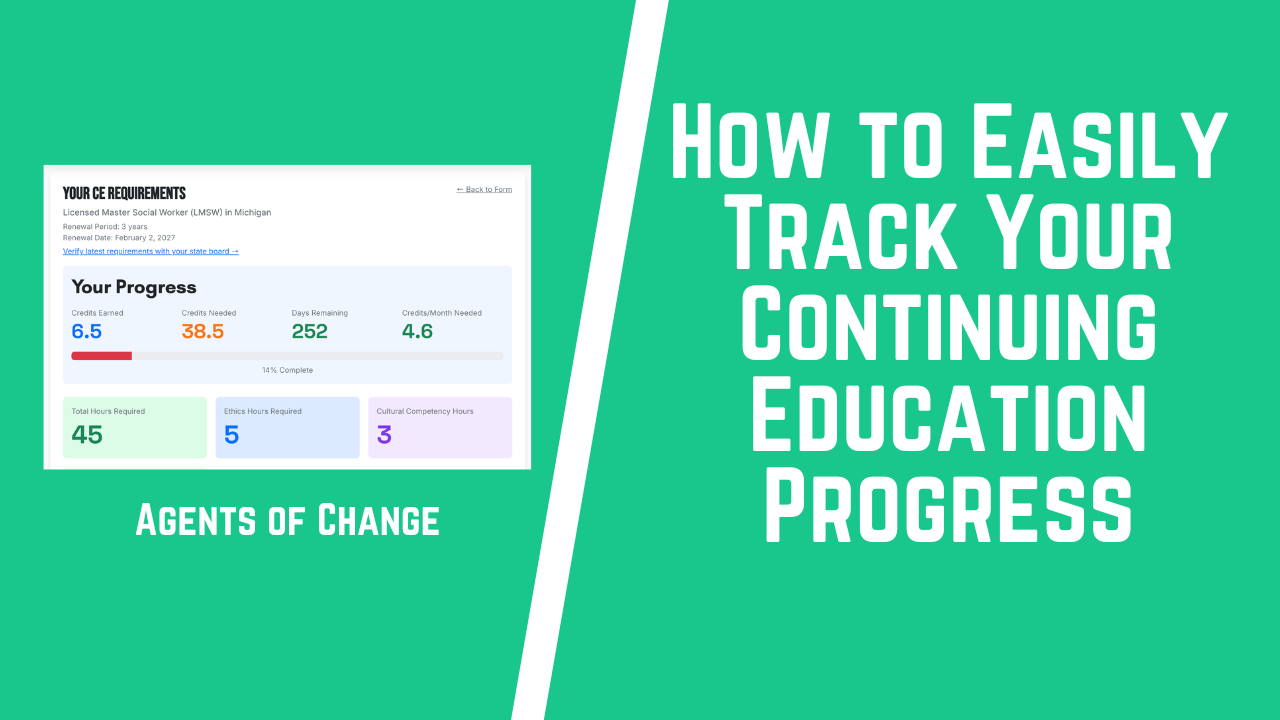
Once you know your requirements, put them in one place. Agents of Change offers a helpful Free CE Requirements Tracker that can help Social Workers, Therapists, Counselors, and Mental Health Professionals organize their CE progress and renewal needs.

Your tracker should include:

  • Course title
  • Provider name
  • Date completed
  • Number of credits earned
  • Credit type or topic category
  • Approval type
  • Certificate location
  • Notes about which requirement the course satisfies

The goal is simple: at any point in the year, you should be able to open your tracker and know exactly where you stand.

Step 4: Save Every Certificate Immediately

After you finish a course, download the certificate right away. Don’t leave it sitting in a course portal or buried in your inbox.

Create a digital folder called something like:

CE Certificates 2026-2028 Renewal Cycle

Then use a consistent file name, such as:

2026-06-15 Ethics in Telehealth Agents of Change 2 Credits

This makes certificates much easier to find if your board asks for documentation later.

Step 5: Choose Courses Based on What You Still Need

Before signing up for another course, check your tracker. Do you need ethics hours? Live credits? A specific approval type? General clinical hours?

Agents of Change has a sortable, filterable, and searchable course library of 200+ courses so you can find courses by topic, credit type, and professional need. That makes it much easier to choose CE that actually helps you meet your renewal requirements.

Step 6: Review Your Progress Monthly

Set aside 10 minutes once a month to review your CE progress. During that check-in, ask yourself:

  • How many credits have I completed?
  • Which required categories are finished?
  • What am I still missing?
  • Are my certificates saved?
  • Do I need any live credits?
  • What course should I complete next?

A short monthly review can prevent a last-minute scramble later.

Step 7: Let Your CE Platform Do More of the Work

The easiest tracking system is one that reduces manual work. Agents of Change Continuing Education subscriptions include tracking of your completed certificates, automatic license renewal reminders, and personalized recommended courses to meet your state and license-specific requirements.

That means you’re not starting from scratch every time you need to check your progress. Instead, you have a clearer path from “What do I still need?” to “I’m ready to renew.”

Agents of Change has helped hundreds of thousands of Social Workers, Counselors, and Mental Health Professionals with Continuing Education, learn more here about Agents of Change and claim your 7.5 free CEUs!

3) Common CE Tracking Mistakes to Avoid

Even careful Social Workers, Therapists, and Counselors can run into CE tracking problems. Usually, it’s not because they’re ignoring their requirements. It’s because CE details pile up quietly until renewal season arrives. Here are five common mistakes to watch for, plus simple ways to avoid them.

1. Only Tracking Total CE Hours

It’s easy to focus on the big number. If your board requires 30 hours, you may assume you’re fine once you hit 30. But many licenses require specific categories within that total.

You may need hours in areas like:

  • Ethics
  • Supervision
  • Telehealth
  • Cultural competency
  • Pain management
  • Suicide prevention
  • Human trafficking
  • Mandated reporting

How to avoid it:
Track both your total hours and your required categories. In your CE tracker, create separate columns for credit amount, topic area, and which requirement the course satisfies. That way, you’ll know whether you’re truly done or just close.

2. Waiting Until the Last Minute

Trying to organize CE credits right before renewal is stressful. You may discover that you’re missing a required topic, need live credits, or can’t find certificates from courses you completed months ago. Scrambling also makes it easier to choose courses based on speed instead of usefulness.

How to avoid it:
Review your CE progress once a month or once a quarter. Set calendar reminders at 6 months, 3 months, and 1 month before renewal. A small check-in throughout the year is much easier than a frantic search at the end.

3. Losing Certificates or Saving Them Randomly

A completed course only helps you if you can prove you completed it. Certificates often get lost because they’re saved in different places, such as email, downloads, desktop folders, or separate course platforms.

How to avoid it:
Create one digital folder for each renewal cycle. Use clear file names that include the date, course title, provider, and number of credits. For example:

2026-05-12 Ethics in Clinical Practice 2 CE Credits

This makes certificates much easier to find if your licensing board requests documentation.

4. Assuming Every Course Counts for Your License

A course can be interesting, relevant, and clinically helpful without meeting your specific renewal requirements. The approval type matters. The topic category matters. The format may matter too, especially if your board requires live or interactive hours.

How to avoid it:
Before starting a course, check whether it matches your license requirements. Look for approval types such as ASWB or NBCC when applicable, and confirm whether the course counts toward a required category or general CE hours.

5. Not Separating Multiple Licenses or Renewal Cycles

If you hold more than one license, practice in more than one state, or track multiple credentials, CE organization gets complicated fast. One course may count for one license but not another. Different renewal cycles can overlap, which makes things even messier.

How to avoid it:
Create a separate section in your tracker for each license, state, or credential. Include the renewal date, total hours required, required categories, and completed courses for each one. If a course counts toward more than one license, note that clearly so you don’t accidentally overcount or miss a requirement.

The goal isn’t to create a perfect system. It’s to create a system you’ll actually use. When your CE tracking is clear, current, and easy to update, renewal becomes much less stressful.

4) FAQs – How to Track Your Continuing Education (CE) Progress for Social Workers, Therapists, and Counselors

Q: What is the easiest way to track Continuing Education (CE) progress?

A: The easiest way to track CE progress is to use one centralized system instead of spreading information across email, downloads, course portals, and memory. At a minimum, your tracker should include the course title, provider, completion date, number of credits, approval type, topic category, renewal cycle, and certificate location. This gives you a clear snapshot of what you’ve completed and what you still need.

For Social Workers, Therapists, and Counselors, it’s especially important to track more than total hours. Many licensing boards require specific topics, such as ethics, supervision, cultural competency, telehealth, suicide prevention, or mandated reporting. A strong tracker helps you separate general CE hours from required categories so you don’t accidentally reach your total credit number while still missing something essential.

A tool like the Agents of Change Free CE Requirements Tracker can make this process easier because it gives you a structured place to organize your progress. The less you have to rebuild your system every renewal cycle, the better.

Q: How often should Social Workers, Therapists, and Counselors update their CE tracker?

A: Ideally, you should update your CE tracker immediately after completing each course. That means downloading the certificate, saving it in the correct folder, entering the course into your tracker, and noting which requirement it satisfies. It usually takes just a few minutes when you do it right away, but it can take hours if you wait until renewal season.

It’s also helpful to review your progress monthly or quarterly. During that check-in, look at your total completed credits, required categories, certificate storage, and upcoming renewal deadline. This rhythm helps you catch gaps early, especially if you still need live credits or a specific topic area.

A simple monthly review can prevent the classic last-minute CE scramble. Instead of asking, “What do I still need?” two weeks before renewal, you’ll already know where you stand and what course to take next.

Q: How do I know which CE courses count toward my license renewal?

A: To know whether a CE course counts toward renewal, start with your licensing board’s current requirements. Check your total required hours, required topics, accepted approval types, and rules about live versus self-paced learning. Don’t assume that a course counts just because it sounds relevant to your work.

Look closely at the course approval information. For example, Social Workers may need ASWB-approved courses, while Counselors may look for NBCC-approved courses. Some boards accept multiple approval types, while others are more specific. Also, remember that a course may count for general CE hours without satisfying a required topic like ethics or supervision.

Using a searchable course library can help you find courses that match your needs more quickly. Agents of Change offers a sortable, filterable, and searchable course library of 200+ courses so you can look for the topic and credit type you need before enrolling. That extra step can save a lot of frustration when renewal time arrives.

5) Conclusion

Tracking Continuing Education progress may not be the most exciting part of being a Social Worker, Therapist, or Counselor, but it can make renewal season so much easier. When you know your deadline, understand your exact requirements, save your certificates, and update your tracker consistently, CE stops feeling like a scattered pile of tasks and starts becoming a clear professional routine.

The biggest shift is moving from “I’ll figure it out later” to “I know where everything is.” A simple tracker can help you see which credits you’ve completed, which required categories are still missing, and which courses count toward your license. That kind of clarity protects your time, reduces stress, and helps you avoid the last-minute scramble that so many professionals know too well.

If you want a smoother way to manage it all, Agents of Change Continuing Education offers helpful tools and affordable CE options in one place, including a free CE Requirements Tracker, a searchable library of 200+ ASWB and NBCC-approved courses, certificate tracking, renewal reminders, personalized course recommendations, and 20+ live events each year. With the right system, you can stay focused on your clients and your growth while keeping your license renewal fully on track.

————————————————————————————————————————————————

► Learn more about the Agents of Change Continuing Education here: https://agentsofchangetraining.com

About the Lead Instructor, Dr. Meagan Mitchell: Meagan is a Licensed Clinical Social Worker and has been providing Continuing Education for Social Workers, Counselors, and Mental Health Professionals for more than 10 years. From all of this experience helping others, she created Agents of Change Continuing Education to help Social Workers, Counselors, and Mental Health Professionals stay up-to-date on the latest trends, research, and techniques.

#socialwork #socialworker #socialwork #socialworklicense #socialworklicensing #continuinged #continuingeducation #ce #socialworkce #freecesocialwork #lmsw #lcsw #counselor #NBCC #ASWB #ACE

Disclaimer: This content has been made available for informational and educational purposes only. This content is not intended to be a substitute for professional medical or clinical advice, diagnosis, or treatment

Note: Certain images used in this post were generated with the help of artificial intelligence.

Share:

Discover more from Agents of Change

Subscribe now to keep reading and get access to the full archive.

Continue reading