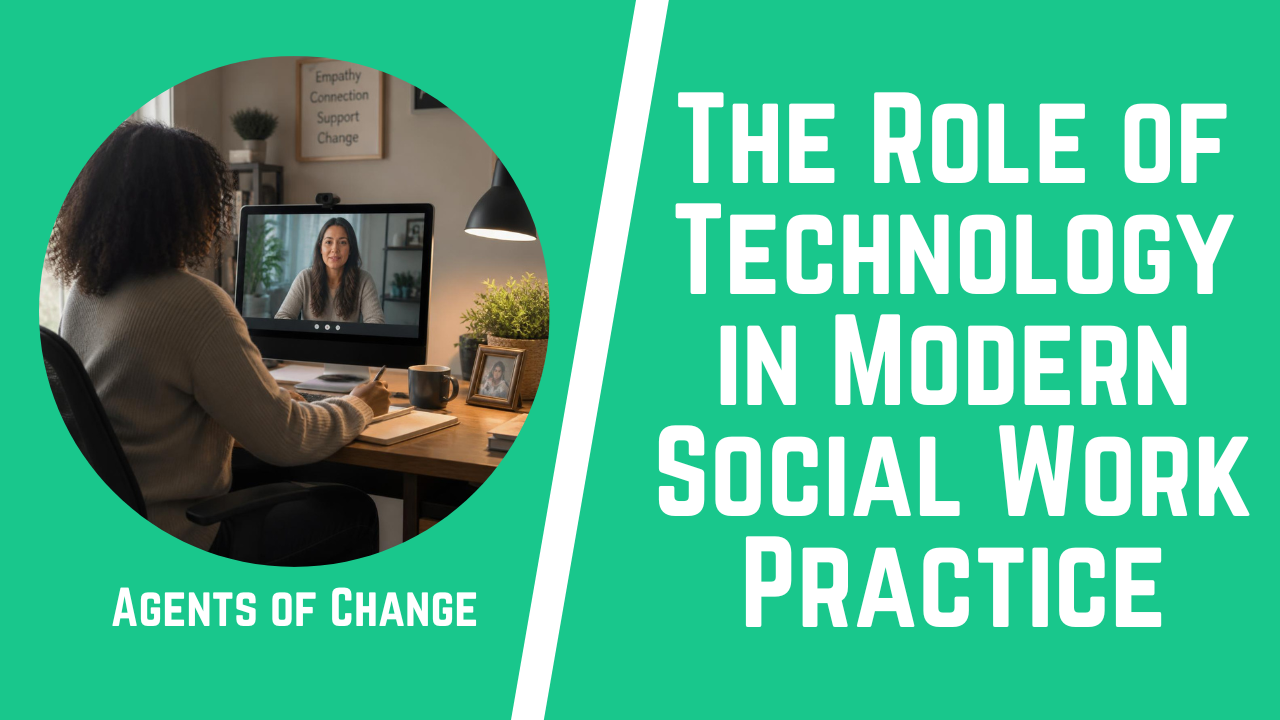
Technology is now part of everyday social work practice. Social Workers use telehealth platforms, electronic health records, secure messaging, mobile apps, data systems, social media, and increasingly, artificial intelligence.
These tools can make some parts of social work more accessible and efficient. A client may attend therapy from home, a hospital Social Worker may coordinate care through an electronic record, or a community organization may use data to identify gaps in services. Technology can also reduce time spent on some administrative tasks and make it easier to communicate across teams.
At the same time, using technology in social work creates new questions about:
* Client privacy and confidentiality
* Informed consent
* Telehealth across state lines
* Digital boundaries with clients
* Artificial intelligence and clinical documentation
* Bias in algorithms and automated decision-making
* Data security
* The digital divide and unequal access to technology
* Professional competence when using new tools
Social Workers do not need to use every new technology that becomes available. They do need to understand how technology affects clients, organizations, and professional practice.
The NASW, ASWB, CSWE, and CSWA Standards for Technology in Social Work Practice emphasize that Social Workers should use technology competently and ethically while considering confidentiality, informed consent, professional boundaries, access, and the needs of the people they serve.
In this guide, we will look at the role of technology in modern social work practice, including:
* Telehealth and virtual social work services
* Electronic records and case management systems
* Artificial intelligence in social work
* Digital communication with clients
* Data collection and program evaluation
* Technology in community and macro social work
* Ethical risks and privacy concerns
* The digital divide
* How Social Workers can build technology competence
Technology will continue to change how social work is practiced. The challenge is not simply learning how to use new tools, but deciding when they are appropriate, what risks they create, and how to use them without losing professional judgment or the human relationships at the center of social work.
Did you know? Agents of Change Continuing Education offers Unlimited Access to 200+ ASWB and NBCC-approved online CE courses and 20+ Live Events per year for one low annual fee to meet your state’s requirements for Continuing Education credits and level up your career.
We’ve helped hundreds of thousands of Social Workers, Counselors, and Mental Health Professionals with Continuing Education, learn more here about Agents of Change and claim your 7.5 free CEUs.
1) The Digital Revolution in Social Work
Technology in social work is no longer limited to telehealth or electronic records. Digital tools now affect how Social Workers communicate with clients, document services, coordinate care, evaluate programs, access training, and make decisions.
The most significant change is that technology has become part of the infrastructure of everyday practice. A Clinical Social Worker may move between a telehealth platform, electronic health record, secure messaging system, scheduling software, and AI-assisted documentation tool in the same day. A macro Social Worker may use data dashboards, mapping tools, digital surveys, and social media to understand community needs or support advocacy efforts.
The question is no longer whether Social Workers will use technology. It is how they can use it in ways that are effective, ethical, and appropriate for the people and communities they serve.
Telehealth Is Now an Established Part of Social Work Practice
Telehealth expanded rapidly during the COVID-19 pandemic, but it is no longer simply a temporary alternative to in-person services. Many Social Workers now provide therapy, case management, consultation, supervision, and other services through video, phone, and digital platforms.
Telehealth can reduce some barriers to care, particularly for clients who:
- Live far from available providers
- Have transportation difficulties
- Have disabilities or medical conditions that make travel difficult
- Need greater flexibility because of work or caregiving responsibilities
- Feel more comfortable receiving services from home
At the same time, virtual services are not automatically more accessible for everyone. Some clients may lack reliable internet, private space, appropriate devices, or confidence using technology.
Social Workers providing virtual services also need to think about:
- Where the client is physically located
- Whether the Social Worker is permitted to practice in that jurisdiction
- How emergencies will be handled remotely
- Whether the client has a private place to participate
- What technology will be used
- How confidentiality and security will be protected
- Whether telehealth is appropriate for the client’s needs
For more on this topic, review our guide to telehealth trends and online therapy.
Digital Communication Has Changed Client Relationships
Social Workers and clients may now communicate through:
- Patient portals
- Secure messaging
- Text messages
- Video platforms
- Scheduling systems
- Social media
These options can make communication easier, but they also create new boundary questions.
For example:
- How quickly should a Social Worker respond to messages?
- What should a client do during a crisis?
- Can clients text a personal phone number?
- What happens when a client sends a friend request on social media?
- Should sensitive information be discussed over email?
- How are messages documented in the client record?
These expectations should not be left to chance. Social Workers need clear policies about digital communication, response times, emergencies, privacy, and professional boundaries.
Read more about managing digital boundaries in social work practice.
Electronic Records and Case Management Systems
Electronic health records and digital case management systems are now common across hospitals, mental health organizations, schools, government agencies, and community programs.
Depending on the setting, these systems may be used to:
- Document assessments and progress notes
- Track treatment goals
- Coordinate services across providers
- Manage referrals
- Schedule appointments
- Monitor program outcomes
- Complete billing and insurance documentation
- Store consent forms and other records
These systems can make information easier to organize and retrieve, but they do not remove the Social Worker’s responsibility for accurate documentation.
A drop-down menu, template, or automated suggestion should not replace professional judgment. Social Workers still need to make sure the record accurately reflects the client, the service provided, and the reasoning behind important decisions.
Artificial Intelligence Is the Newest Major Shift
Artificial intelligence is one of the fastest-changing areas of technology in social work and mental health practice.
Social Workers and organizations are beginning to use AI tools for tasks such as:
- Drafting or organizing documentation
- Summarizing information
- Creating educational materials
- Conducting research
- Supporting administrative tasks
- Translating or simplifying information
- Analyzing large amounts of data
- Identifying patterns in programs or service delivery
Some of these uses may save time. They also create serious questions.
Before using AI, Social Workers should consider:
- Is client information being entered into the tool?
- Where is that information stored?
- Could the data be used to train the system?
- Has the client been informed about how AI is being used?
- Is the output accurate?
- Could the system reproduce bias?
- Who is responsible when the AI produces an error?
- Is a qualified professional reviewing the final work?
AI-generated information should not be assumed to be accurate simply because it sounds confident or professional. Social Workers remain responsible for the quality of their documentation, assessments, recommendations, and professional decisions.
Learn more in our guide to ethics in artificial intelligence and mental health.
Technology Can Support Data-Informed Social Work
Technology also plays an important role beyond direct clinical practice.
Social Workers and organizations can use data tools to:
- Track service utilization
- Identify gaps in care
- Evaluate whether programs are meeting their goals
- Understand community needs
- Monitor differences in outcomes across populations
- Inform funding decisions
- Support policy and advocacy efforts
For example, an organization might use program data to see which clients are leaving services early, identify neighborhoods with limited access to resources, or evaluate whether a new intervention is improving outcomes.
Data can provide useful information, but it does not explain everything. Social Workers still need to consider context, lived experience, culture, structural barriers, and information that may not be captured in a database.
Mobile Apps and Digital Mental Health Tools
Clients may also use apps and online tools for:
- Mood tracking
- Medication reminders
- Meditation and mindfulness
- Sleep
- Symptom monitoring
- Safety planning
- Peer support
- Finding community resources
Social Workers should avoid recommending an app simply because it is popular or easy to download.
Before suggesting a digital tool, consider:
- Who created it?
- What evidence supports it?
- What client data does it collect?
- How is that data used or shared?
- Is the app accessible to people with disabilities?
- Does it require a paid subscription?
- Is it appropriate for the client’s age, language, culture, and needs?
- What happens if the client relies on the app during a crisis?
A mental health app can support care, but it should not automatically be treated as private, effective, or clinically appropriate.
The Digital Divide Remains a Social Work Issue
Technology can increase access for some people while creating new barriers for others.
Clients may have difficulty using digital services because of:
- Limited internet access
- Cost of devices or data plans
- Low digital literacy
- Language barriers
- Disability-related accessibility needs
- Lack of private space
- Distrust of technology or surveillance
- Age-related differences in comfort with digital tools
Social Workers should not assume that offering a virtual option makes a service accessible.
Sometimes the most appropriate solution may still be:
- An in-person appointment
- A phone call
- A paper form
- A translated document
- Help learning to use a digital system
- Access to a community computer or internet connection
Good technology practice includes knowing when not to use technology.
Social Workers Need Technology Competence, Not Expertise in Every Tool
Social Workers do not need to become software developers or adopt every new platform. They do need enough knowledge to make informed decisions about the technology they use.
The Standards for Technology in Social Work Practice, developed by NASW, ASWB, CSWE, and CSWA, address areas such as competence, informed consent, confidentiality, boundaries, access, records, and the use of technology to provide services.
As technology changes, Social Workers should continue asking:
- What problem is this tool supposed to solve?
- Does it actually improve the service?
- What information does it collect?
- What risks does it create?
- Who may be excluded by it?
- Can I explain its use clearly to a client?
- Am I still using my own professional judgment?
The goal is not to use more technology. It is to use technology intentionally, understand its limits, and make sure that efficiency does not come at the expense of privacy, access, professional judgment, or the relationship between the Social Worker and client.
Learn more about Agents of Change Continuing Education. We’ve helped hundreds of thousands of Social Workers with their Continuing Education and want you to be next!
2) Educational Advancements
Technology has changed not only how Social Workers practice, but also how they learn. Social work education now extends far beyond traditional classrooms, textbooks, and occasional in-person conferences.
Students and practicing professionals can learn through:
- Online degree programs
- Live virtual classes and webinars
- On-demand continuing education
- Podcasts and audio learning
- Virtual case discussions
- Digital communities
- Interactive simulations
- AI-assisted learning tools
- Online supervision and consultation
These options can make professional development more flexible and accessible, but more technology does not automatically mean better education. Social Workers still need to consider the quality of the training, the expertise of the instructor, whether the information is current, and whether a course meets licensing or continuing education requirements.
Online Continuing Education Is Now a Major Part of Professional Development
For many Social Workers, online continuing education has become the easiest way to maintain a license and build new skills.
Online learning may include:
- Self-paced courses
- Recorded presentations
- Live webinars
- Multi-session trainings
- Audio content
- Downloadable resources
- Case-based learning
- Interactive discussion
The flexibility can be especially helpful for Social Workers balancing full caseloads, family responsibilities, irregular work schedules, or limited access to in-person training.
Agents of Change Continuing Education currently offers more than 200 online courses and over 20 live events each year for Social Workers and other Mental Health Professionals. Topics include ethics, clinical practice, artificial intelligence, technology, treatment approaches, ADHD, substance use, family therapy, and other areas of mental health practice.
Social Workers looking for no-cost options can also explore free continuing education courses from Agents of Change.
Before completing any course for credit, check:
- Whether the provider is accepted by your licensing board
- Whether the course topic meets a specific requirement
- Whether your state limits the number of online or self-paced hours
- Whether live attendance is required for certain credits
- Whether the course qualifies for ethics, cultural competence, mandated reporting, or another special category
A course can be educational without necessarily counting toward license renewal. The regulatory board has the final authority over what it accepts.
Live Virtual Learning Can Offer More Interaction
Self-paced courses are useful, but not every topic is best learned alone.
Live virtual workshops can give Social Workers opportunities to:
- Ask questions
- Discuss case examples
- Hear different professional perspectives
- Practice applying new concepts
- Participate in polls or exercises
- Connect with other professionals
This format can be especially useful for topics that involve judgment rather than memorization.
For example, a training on artificial intelligence may be more useful when participants can work through questions such as:
- Can client information be entered into this tool?
- Should the client be told that AI is being used?
- How should a clinician review AI-generated documentation?
- What happens when the tool produces inaccurate information?
- How might bias affect the output?
The goal is not simply to learn what a new tool does. Social Workers need opportunities to think through when and how it should be used.
AI Is Changing How Social Workers Learn
Artificial intelligence is becoming part of social work education as well as social work practice.
AI tools may be used to:
- Generate practice scenarios
- Create study questions
- Explain unfamiliar concepts
- Provide immediate feedback
- Simulate client conversations
- Personalize study plans
- Help learners identify areas that need more review
One of the most interesting developments is the use of AI-powered client simulations. Instead of only reading a case study, a learner may be able to practice a difficult conversation with a simulated client and receive feedback on how they responded.
These tools could be useful for practicing situations such as:
- Suicide risk assessment
- Motivational interviewing
- De-escalation
- Difficult conversations with families
- Cultural humility
- Ethical decision-making
- Crisis response
AI simulations are not a replacement for field education, supervision, or work with real people. They may, however, give learners additional opportunities to practice before entering a high-stakes situation.
Social Workers also need training on the risks of AI itself. Agents of Change offers an AI for Mental Health Professionals ethics course and a separate course on ChatGPT and AI for Social Workers and Mental Health Professionals.
Social Work Education Needs to Include Technology Ethics
Learning how to operate a platform is not enough.
Social Workers also need to understand how technology affects:
- Confidentiality
- Informed consent
- Professional boundaries
- Documentation
- Client access
- Data security
- Bias
- Accessibility
- Clinical judgment
A Social Worker may know how to use an AI documentation tool without understanding where the information is stored. A clinician may offer telehealth without knowing what to do if the client is located in another state. A student may communicate with clients through social media without recognizing the boundary issues involved.
Technology competence includes knowing what questions to ask before using a tool.
The Standards for Technology in Social Work Practice emphasize that Social Workers who use technology should maintain competence through continuing education, consultation, supervision, and training.
For more on technology-related ethics, review our guides to:
- Ethics in Artificial Intelligence and Mental Health
- Managing Digital Boundaries in Social Work Practice
- Telehealth Trends and Online Therapy
Shorter and More Flexible Learning Formats Are Growing
Professional education does not always need to involve a full-day workshop.
Social Workers increasingly learn through shorter formats such as:
- Brief videos
- Podcasts
- Audio lessons
- Email courses
- Recorded demonstrations
- Case discussions
- Short live trainings
These formats can make it easier to learn in smaller amounts of time.
A Social Worker might listen to an audio lesson during a commute, complete a short ethics course between workdays, or watch a recorded case demonstration before supervision.
The important question is whether the format fits the learning goal.
A short video may be enough to introduce a concept. Developing competence in a complex clinical intervention may require more extensive education, supervised practice, consultation, and feedback.
Digital Communities Can Support Peer Learning
Technology has also changed how Social Workers learn from one another.
Online professional communities can give Social Workers a place to:
- Ask practice questions
- Discuss career decisions
- Share resources
- Learn about new research
- Find continuing education
- Connect with professionals outside their immediate workplace
This can be especially valuable for Social Workers who work independently, live in rural areas, or have limited access to colleagues in the same specialty.
Digital communities still require professional judgment. Social Workers should avoid sharing identifiable client information and remember that advice from an online group does not replace appropriate supervision, consultation, or legal guidance.
Agents of Change Continuing Education members also have access to a professional community focused on skill development and connection with other Mental Health Professionals.
Supervision and Consultation Have Become More Flexible
Technology has also expanded access to supervision and professional consultation.
Depending on state law and licensing requirements, Social Workers may be able to participate in supervision or consultation through secure video platforms. This can make it easier to connect with:
- Supervisors with specific clinical expertise
- Consultants outside the local area
- Peer consultation groups
- Professionals who work with specialized populations
This can be particularly helpful when a Social Worker needs guidance in an area that is not well represented in their immediate community.
However, Social Workers pursuing licensure should confirm that virtual supervision is permitted by their licensing board and meets any requirements related to:
- Supervisor qualifications
- Individual versus group hours
- Documentation
- Location
- Technology
- Frequency of supervision
Technology can make supervision easier to access, but it does not override licensing rules.
Social Workers Need to Evaluate the Quality of Digital Education
The amount of online content available to Social Workers has grown quickly. Quality varies.
Before investing time or money in a training, consider:
- Who created the content?
Look at the instructor’s education, license, experience, and expertise in the topic. - How current is the information?
This is especially important for technology, artificial intelligence, telehealth, ethics, and law. - Does the course distinguish evidence from opinion?
Popularity does not make a practice evidence-based. - Does the training include application?
Case examples, discussion, practice, and feedback may be more useful than passive content alone. - Will the course count for continuing education credit?
Verify the provider and requirements before assuming the hours will apply to your license. - Does the format fit what you are trying to learn?
An introductory webinar and an advanced clinical training serve different purposes.
Agents of Change also offers a free CE Requirements Planner to help Social Workers and other Mental Health Professionals understand and track state-specific renewal requirements.
The Future of Social Work Education Will Be More Flexible, but It Still Needs Human Judgment
Technology can make education easier to access, more interactive, and better suited to different learning styles. Social Workers can now learn from instructors across the country, participate in live events without traveling, practice scenarios through simulation, and access information when they need it.
But professional education should not become a race to complete more courses or use the newest tools.
The goal is to choose learning experiences that improve knowledge, strengthen judgment, and help Social Workers practice more effectively. Whether the format involves an online course, live workshop, AI simulation, digital community, or virtual consultation, the same questions still matter: Is the information accurate? Is the source credible? Does it apply to my work? And can I use what I learned responsibly?
We’ve helped hundreds of thousands of Social Workers with Continuing Education, learn more here about Agents of Change and claim your 7.5 free CEUs!
3) Benefits and Challenges of Technology in Social Work
Technology can make social work services easier to access, improve communication, reduce some administrative work, and provide new ways to understand client and community needs. It can also create serious concerns related to privacy, bias, professional boundaries, unequal access, and overreliance on automated systems.
The benefits and challenges of technology in social work are often connected. A tool that makes services more convenient may also collect sensitive data. An AI platform that saves time on documentation may also produce inaccurate information. Telehealth may expand access for one client while creating a barrier for another who lacks reliable internet or private space.
The goal is not to decide whether technology is good or bad. Social Workers need to evaluate how a specific tool affects clients, practice, and professional responsibilities.
Benefits of Technology in Social Work
1. Greater Access and Flexibility
Technology can make some services easier to reach.
Telehealth, secure messaging, online support groups, and digital resources may help clients who:
- Live far from available services
- Have transportation difficulties
- Have disabilities or health conditions that make travel harder
- Have work or caregiving responsibilities
- Need providers with specialized expertise
- Prefer some services to be delivered remotely
Virtual services can also help Social Workers connect with colleagues, supervisors, and consultants outside their immediate geographic area.
However, increased access is not automatic. Technology only improves access when the client has the devices, internet connection, privacy, skills, and support needed to use it.
2. More Efficient Administrative Work
Social Workers spend a significant amount of time on documentation, scheduling, communication, care coordination, and other administrative tasks.
Technology may help with:
- Appointment scheduling and reminders
- Electronic forms
- Secure communication
- Referral tracking
- Case management
- Billing
- Organizing information
- Drafting or structuring documentation
Artificial intelligence is also being used for tasks such as note organization, summarization, research, and creating client education materials.
These tools may reduce some repetitive work, but efficiency should not come at the expense of accuracy or professional responsibility. A Social Worker is still responsible for reviewing documentation, correcting errors, and making sure the final record accurately reflects the client and the service provided.
For a closer look at this issue, read our guide to the ethics of artificial intelligence in mental health.
3. Better Communication and Care Coordination
Electronic records and secure communication systems can make it easier for professionals to share relevant information and coordinate services.
Depending on the setting, technology may help:
- Track referrals
- Communicate across treatment teams
- Monitor follow-up needs
- Share care plans
- Reduce duplicate work
- Identify missed services
- Coordinate with schools, healthcare providers, or community agencies
Better access to information can support continuity of care.
At the same time, more people having access to a record can create additional privacy concerns. Social Workers should still follow applicable confidentiality requirements, obtain appropriate consent, and limit disclosures to what is necessary.
4. More Data for Program Evaluation and Community Planning
Technology gives organizations new ways to collect and analyze information.
Social Workers may use data to:
- Identify gaps in services
- Track program outcomes
- Understand who is and is not accessing care
- Monitor differences across populations
- Evaluate whether an intervention is working
- Support grant applications
- Inform policy and advocacy efforts
For example, a community agency may identify neighborhoods where clients have difficulty accessing services or determine that one group is leaving a program at a higher rate than others.
Data can point to important patterns, but it needs context. Numbers alone may not explain why a problem exists or what should be done about it. Social Workers still need to consider lived experience, community knowledge, culture, history, and structural barriers.
5. More Opportunities for Education and Professional Development
Technology has expanded access to:
- Online continuing education
- Live virtual workshops
- Digital communities
- Remote consultation
- Virtual supervision
- Podcasts and audio learning
- Interactive case discussions
- AI-assisted simulations
Social Workers can learn from instructors and experts who may be located anywhere in the country.
Agents of Change Continuing Education offers online courses and live events for Social Workers and other Mental Health Professionals, including training related to artificial intelligence, ethics, technology, and clinical practice.
Social Workers interested in learning more about AI can also access a free continuing education course on ChatGPT and AI.
6. New Ways to Engage and Support Clients
Some clients may benefit from technology that supports work between sessions or helps them participate more actively in services.
Examples may include:
- Appointment reminders
- Mood or symptom tracking
- Digital worksheets
- Medication reminders
- Safety planning tools
- Resource directories
- Secure communication
- Educational materials
These tools can support care, but they should not be recommended simply because they are convenient or popular.
Social Workers should consider whether a tool is appropriate for the individual client, what data it collects, whether it is accessible, and what happens if the client relies on it during an emergency.
Challenges of Technology in Social Work
1. Privacy, Confidentiality, and Cybersecurity
Social Workers regularly handle highly sensitive information. Technology creates more places where that information may be stored, transmitted, copied, or accessed.
Risks may include:
- Data breaches
- Lost or stolen devices
- Weak passwords
- Phishing attacks
- Unsecured email or text messages
- Unauthorized access to records
- Information entered into AI platforms
- Third-party vendors using or retaining client data
Before using a digital tool, Social Workers should understand:
- What information the tool collects
- Where the information is stored
- Who can access it
- Whether the data is shared with other companies
- How long the information is retained
- What happens if there is a security breach
A privacy policy should not automatically be treated as proof that a tool is appropriate for confidential social work practice.
Learn more in our guide to cybersecurity and client data protection in social work.
2. AI Can Produce Inaccurate or Biased Information
AI tools can produce convincing answers that are incomplete, inaccurate, or entirely fabricated.
They may also reproduce bias found in:
- Training data
- The way a problem is defined
- The information entered into the system
- Organizational practices
- The way humans interpret the output
This matters when technology is used in areas such as:
- Risk assessment
- Diagnosis
- Documentation
- Eligibility decisions
- Resource allocation
- Hiring
- Child welfare
- Criminal legal systems
A Social Worker should not assume that a recommendation is neutral or accurate because it came from an algorithm.
Questions to ask include:
- How was this system developed?
- What information is it using?
- Has it been evaluated with the populations we serve?
- What types of errors does it make?
- Can the decision be explained?
- Can a person challenge or appeal the result?
- Who is responsible when the system is wrong?
Artificial intelligence can support professional work, but it should not replace independent judgment.
Agents of Change offers additional training on ChatGPT and AI for Social Workers and Mental Health Professionals for professionals who want to better understand both the uses and limitations of these tools.
3. The Digital Divide Can Increase Inequality
Technology can expand services for some people while excluding others.
Clients may face barriers related to:
- Cost of devices
- Internet access
- Data plans
- Digital literacy
- Disability
- Language
- Age
- Geographic location
- Lack of private space
- Distrust of technology
- Fear of surveillance
An online-only intake process may be convenient for an organization but difficult for a client who has limited literacy or no reliable internet access.
A telehealth option may help a client in a rural community but be unusable for someone living in a crowded home without privacy.
Social Workers should ask who benefits from a new technology and who may be left out.
Sometimes accessibility means offering more technology. Sometimes it means keeping a phone number, paper form, in-person appointment, or human point of contact available.
4. Digital Communication Can Blur Professional Boundaries
Email, text messaging, social media, patient portals, and other platforms can make communication easier, but they can also create confusion.
Questions may include:
- How quickly is the Social Worker expected to respond?
- What should a client do in a crisis?
- Can clients text a personal phone?
- What happens when a client sends a social media request?
- Should the Social Worker search for information about a client online?
- How should digital communication be documented?
Without clear expectations, clients and Social Workers may have very different ideas about availability and privacy.
Policies should explain:
- Which communication methods are used
- Expected response times
- What to do during an emergency
- What types of information should not be sent electronically
- Whether messages become part of the clinical record
Read more about managing digital boundaries in social work practice.
5. Technology Can Create More Work Instead of Less
A new platform does not always save time.
Social Workers may have to manage:
- Multiple electronic systems
- Duplicate documentation
- Frequent software updates
- New passwords and security requirements
- Automated alerts
- Portal messages
- Technical problems
- Training requirements
Technology can also create the expectation that workers should always be reachable.
Organizations should evaluate whether a tool actually improves the work rather than assuming that digitizing a process makes it more efficient.
6. Telehealth Creates Licensing and Practice Questions
Virtual services allow Social Workers and clients to connect from different locations, but professional rules still apply.
Depending on the type of service and jurisdiction, Social Workers may need to consider:
- Where the client is physically located
- Whether the Social Worker is authorized to practice there
- How emergencies will be handled
- What local resources are available
- Whether the technology meets privacy requirements
- Whether telehealth is appropriate for the client’s needs
Social Workers should not assume that being licensed in one state automatically allows them to provide clinical services to clients located anywhere in the country.
7. Organizations May Adopt Technology Faster Than Policies Can Keep Up
A Social Worker may be given access to a new AI tool, documentation platform, or communication system before the organization has answered basic questions about its use.
Organizations need clear policies addressing:
- Approved tools
- Client information
- Informed consent
- Human review
- Documentation
- Data retention
- Vendor relationships
- Security incidents
- Staff training
- Accountability
Individual Social Workers should not be left to make every technology decision on their own.
At the same time, “my employer gave me the tool” is not enough reason to use it without question. Social Workers still have professional responsibilities related to confidentiality, competence, informed consent, and the quality of their work.
8. Overreliance on Technology Can Weaken Professional Judgment
One of the biggest risks is not that technology will replace Social Workers completely. It is that professionals may gradually stop questioning the recommendations technology gives them.
This can happen when:
- Templates replace individualized documentation
- Automated scores are treated as facts
- AI-generated text is copied without review
- Algorithms influence decisions without explanation
- Workers follow prompts rather than thinking through the case
Technology can organize information and identify patterns. It cannot fully understand a client’s history, culture, relationships, priorities, or lived experience.
Social Workers should remain responsible for asking questions, noticing context, challenging assumptions, and making professional decisions.
How Can Social Workers Balance the Benefits and Challenges of Technology?
Before adopting a new tool, ask:
- What problem are we trying to solve?
Do not adopt technology simply because it is new. - Who benefits from this tool?
Consider clients, workers, organizations, and vendors. - Who may be excluded or harmed?
Think about access, disability, language, cost, privacy, and bias. - What information does the tool collect?
Know where data goes and who can access it. - How accurate is the tool?
Consider what happens when it makes a mistake. - Can the client understand how it is being used?
Transparency and informed consent may be important. - Is a qualified person reviewing the output?
Automation should not remove human accountability. - Does the tool actually improve the service?
Efficiency should be measured rather than assumed.
The Standards for Technology in Social Work Practice provide a useful framework for considering competence, informed consent, confidentiality, boundaries, accessibility, and other professional responsibilities.
Technology can support strong social work practice, but it should not drive the practice. Social Workers need to remain active decision-makers who understand the tools they use, recognize their limitations, and continue to put client needs, professional ethics, and human judgment first.
4) FAQs – Technology in Modern Social Work Practice

Q: How Is Technology Used in Social Work Practice?
A: Social Workers use technology for telehealth, electronic records, secure communication, case management, data analysis, continuing education, and increasingly, artificial intelligence. These tools can improve access and efficiency, but they also create responsibilities related to privacy, informed consent, accessibility, and professional judgment. The best use of technology depends on the client, setting, and purpose of the tool.
Q: What Are the Biggest Ethical Concerns About AI in Social Work?
A: The main concerns include client privacy, inaccurate information, algorithmic bias, lack of transparency, and overreliance on automated recommendations. Social Workers should understand what data an AI tool collects, carefully review its output, and avoid entering confidential information into systems that have not been approved for that use. AI may support professional work, but the Social Worker remains responsible for the final decision.
Q: Can Technology Replace Social Workers?
A: Technology can automate some administrative tasks and help Social Workers organize information, identify patterns, and communicate more efficiently. It cannot fully understand a client’s relationships, culture, environment, priorities, or lived experience. Social Workers still provide the judgment, context, advocacy, and human connection that technology cannot replace.
5) Conclusion
Technology is now part of nearly every area of social work practice, from telehealth and electronic records to continuing education, data analysis, and artificial intelligence. These tools can improve access, communication, and efficiency, but they also create new responsibilities related to privacy, bias, accessibility, informed consent, and professional boundaries.
Social Workers do not need to adopt every new platform or become experts in every emerging technology. They do need enough knowledge to ask the right questions, understand the risks, and decide whether a tool actually improves services for clients and communities. Technology should support professional judgment rather than replace it.
As technology continues to change, Social Workers will need ongoing education, clear organizational policies, and a willingness to reconsider how digital tools affect practice. The goal is not to use more technology simply because it is available, but to use it thoughtfully, ethically, and in ways that keep client needs and human relationships at the center of social work.
————————————————————————————————————————————————
► Learn more about the Agents of Change Continuing Education here: https://agentsofchangetraining.com
About the Lead Instructor, Dr. Meagan Mitchell: Meagan is a Licensed Clinical Social Worker and has been providing Continuing Education for Social Workers, Counselors, and Mental Health Professionals for more than 10 years. From all of this experience helping others, she created Agents of Change Continuing Education to help Social Workers, Counselors, and Mental Health Professionals stay up-to-date on the latest trends, research, and techniques.
#socialwork #socialworker #socialwork #socialworklicense #socialworklicensing #continuinged #continuingeducation #ce #socialworkce #freecesocialwork #lmsw #lcsw #counselor #NBCC #ASWB #ACE
Disclaimer: This content has been made available for informational and educational purposes only. This content is not intended to be a substitute for professional medical or clinical advice, diagnosis, or treatment