License renewal can feel distant right up until it becomes urgent. One month, you’re attending a training because the topic genuinely interests you. A few months later, you’re searching your inbox for a missing certificate, trying to remember whether the course counted toward ethics, and wondering exactly when your license expires.
It doesn’t have to work that way.
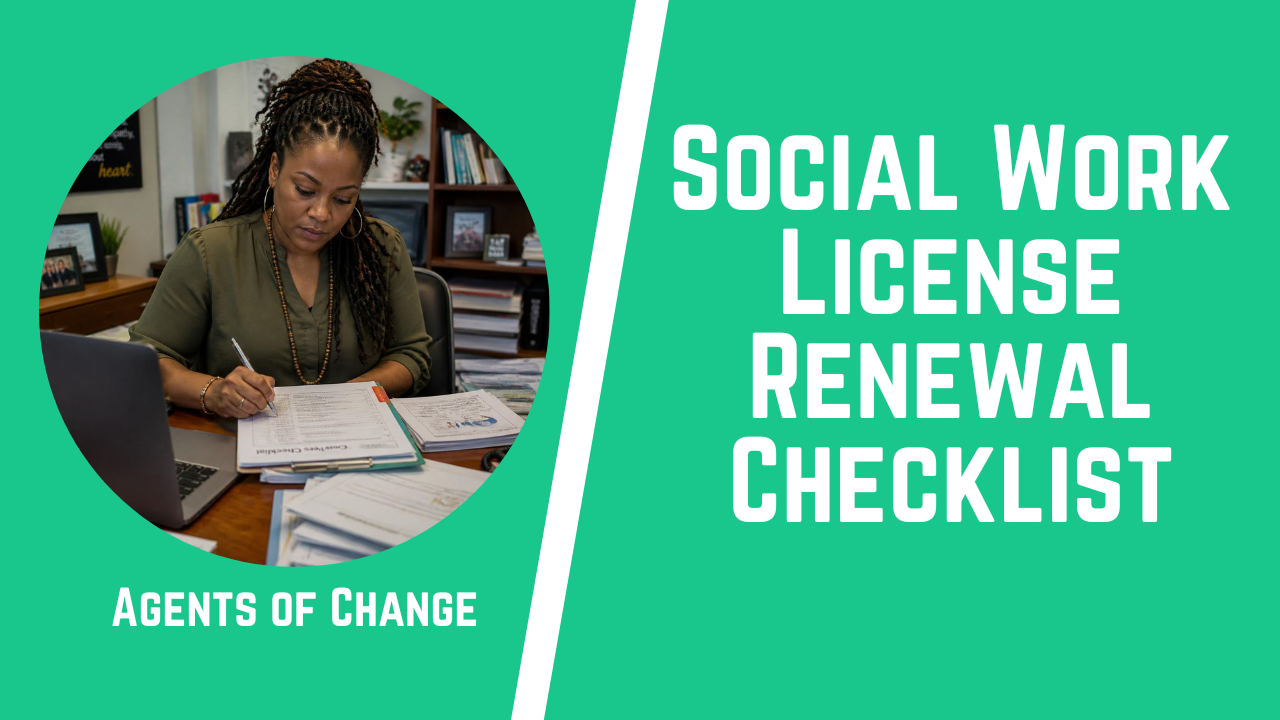
This social work license renewal checklist is designed to turn renewal into a manageable workflow. Instead of relying on memory, scattered emails, or a folder full of files with names like “certificate-final-2.pdf,” you’ll create one reliable system for understanding your requirements, tracking your progress, and proving completion if your licensing board requests documentation.
The key is to treat renewal as a process rather than a single deadline. You’ll confirm the rules, calculate what you need, choose qualifying courses, save the right records, and complete a final review before submitting your renewal.
A little organization now can prevent a great deal of stress later. Let’s get your renewal under control!
Did you know? Agents of Change Continuing Education offers Unlimited Access to 200+ CE courses and 25+ live events for one low annual fee to meet your state’s requirements for Continuing Education credits.
We’ve helped thousands of Social Workers, Therapists, and Counselors with Continuing Education, learn more here about Agents of Change and claim your 7.5 free CEUs.
1) Why Social Work License Renewal Requires More Than Counting Hours

Agents of Change Continuing Education offers Unlimited Access to 200+ CE courses and 25+ live events for one low annual fee to meet your state’s requirements for Continuing Education.
2) Step by Step Checklist to Social Work License Renewal
Step 1: Confirm Your License, State, and Renewal Cycle
Before registering for another course, identify the exact license you’re renewing. Requirements can differ for an LBSW, LMSW, LCSW, LICSW, or another jurisdiction-specific credential. They can also differ between provisional and independent licenses.
Write down:
- Your full license type
- Your license number
- The state or jurisdiction that issued it
- Your license expiration date
- The beginning and end of your current CE reporting period
- Whether this is your first renewal
- Whether you hold licenses in multiple jurisdictions
If you’re licensed in more than one state, create a separate requirement summary for each license. Some courses may satisfy both states, but that should be confirmed rather than assumed.
The Agents of Change state requirements resource is a helpful starting point for reviewing social work CE expectations across jurisdictions. Because licensing rules can change, confirm the final details with your licensing board’s current website before making decisions.
Know Which Date Actually Controls Your Renewal
Several dates may appear in your records:
- The date your current license was issued
- The date your license expires
- The final day of your CE reporting period
- The renewal application deadline
- The date late fees begin
- The date an incomplete license becomes inactive or lapses
These dates aren’t always identical. Your board might allow you to submit an application before the expiration date while still requiring all CE activities to be completed by a separate cutoff.
Add each applicable date to your calendar. Then create reminders at least:
- Six months before the deadline
- Three months before the deadline
- One month before the deadline
- Two weeks before the deadline
Waiting for a single reminder on the expiration date is risky. If you discover a missing course category that day, your choices may be limited.
Step 2: Translate the Rules Into a Personal CE Credit Plan
Once you’ve found the requirements, convert them into a checklist that reflects your individual situation.
For example:
- 30 total hours required
- 3 hours of ethics
- 2 hours of implicit bias
- 1 hour of suicide prevention
- No more than 15 hours of self-study
- At least 15 hours through live or interactive instruction
Next, subtract the credits you’ve already earned during the current reporting period.
| Requirement | Required | Completed | Still Needed |
|---|---|---|---|
| Total CE hours | 30 | 18 | 12 |
| Ethics | 3 | 3 | 0 |
| Implicit bias | 2 | 0 | 2 |
| Suicide prevention | 1 | 1 | 0 |
| Live or interactive | 15 | 8 | 7 |
This simple comparison catches problems that a total-hour count can miss. In the example above, the social worker needs 12 more overall hours, but at least two must address implicit bias and at least seven must qualify as live or interactive learning.
CE Credits, Contact Hours, and CEUs: Are They the Same?
People often use “CE credits,” “CE hours,” “contact hours,” and “CEUs” interchangeably. Licensing boards and education providers may use these terms differently.
In some educational contexts, one formal CEU equals 10 contact hours. In everyday professional licensing conversations, however, people often say “CEUs” when they mean individual continuing education hours.
Use the terminology found in your board’s regulations, and verify how a provider calculates its credits. If your state requires 30 contact hours, don’t assume a certificate labeled “3 CEUs” represents three contact hours without checking.
Step 3: Choose Courses That Match the Requirement You Need
A compelling course title isn’t enough. Before enrolling, ask:
- Is the provider accepted by my licensing board?
- Does the course award the type of credit I need?
- Is the course live, interactive, asynchronous, or self-study?
- Does my board limit this learning format?
- Does the course qualify for a required topic?
- How many credits will I receive?
- What must I do to earn the certificate?
- Does the course need to be completed within a certain timeframe?
- Is partial credit available?
- What documentation will I receive?
Save the course description or approval information when you register. If a board later questions whether a course qualified for ethics, supervision, cultural competence, or another category, the description can help establish what the program covered.
For a broader explanation of available formats, read The Different Types of Social Work Continuing Education.
Build a Balanced CE Schedule
Try to avoid earning every credit during the final week of your reporting period. A better approach is to divide the requirement across the renewal cycle.

For a two-year cycle requiring 30 hours, you might aim for:
- 7 to 8 hours during each six-month period
- One required-topic course during the first quarter
- One live event every few months
- A final compliance review six months before renewal
This pacing gives you room to respond if a course is canceled, a certificate is delayed, or your board clarifies a requirement.
Agents of Change Continuing Education offers more than 200 ASWB and NBCC-approved courses for social workers, therapists, counselors, and other mental health professionals. The course library includes multiple learning formats and topics, making it easier to build a schedule around your practice interests and licensing needs.
Step 4: Track Every Course as Soon as You Complete It
The best time to document a CE activity is immediately after completing it. A certificate left sitting in your downloads folder won’t be easy to find two years from now.
For every course, record:
- Course title
- Provider
- Instructor or presenter
- Completion date
- Number of credits earned
- Credit category
- Learning format
- Approval type or provider number
- Certificate filename
- Storage location
- Notes about state-specific eligibility
You can use the free Agents of Change CE tracker to monitor completed credits, renewal requirements, and outstanding needs. A dedicated tracker is especially helpful if you have more than one license or need to separate general hours from topic-specific requirements.
You can also review How to Earn and Track Your CEU Credits in Social Work for additional planning strategies.
Use Consistent Certificate File Names
A clear naming system makes documentation much easier to retrieve.
Try this format:
Year-Month-Day_Provider_CourseTitle_Credits_Category.pdf
For example:
2026-05-14_AgentsOfChange_EthicsAndTechnology_3CE_Ethics.pdf
With this structure, certificates sort chronologically and remain recognizable without being opened.
Avoid filenames such as:
- certificate.pdf
- download-4.pdf
- course-complete.pdf
- final-certificate-new.pdf
Those names may seem harmless today, but they create confusion during renewal or an audit.
Step 5: Create an Audit-Ready Documentation Folder
Licensing boards may require you to attest that you completed the necessary education without uploading every certificate during the routine renewal process. That doesn’t mean the documentation is optional. It means you may be asked to produce it later.
Create a folder for each renewal cycle:
Social Work License Renewal 2026-2028
Inside it, create subfolders for:
- Certificates
- Course descriptions
- Provider approvals
- Payment receipts
- Renewal application
- Renewal confirmation
- Board correspondence
- Requirement summaries
- Audit materials
Keep a backup in a secure cloud location or external drive. If your only copies are stored on an employer-issued computer, you could lose access when changing jobs.
What Should Each Certificate Include?
A useful completion certificate generally includes:
- Your full name
- The course title
- The provider’s name
- The completion date
- The number of credits awarded
- The instructional format, when applicable
- The provider’s approval information
- The instructor’s name, when required
Review each certificate as soon as you receive it. If your name is misspelled, the credit total is missing, or the date is incorrect, contact the provider while the course is still fresh.
Should You Keep Receipts?
Yes. A receipt usually doesn’t replace a certificate, since payment alone doesn’t prove completion. Still, receipts can be useful supporting records. They may help establish the provider, purchase date, course name, or registration details if another document is lost.
Course descriptions and learning objectives are also worth saving for specialized credits. If the title doesn’t clearly indicate that a program addressed ethics or another required topic, the description may provide the necessary context.
Your Social Work License Renewal Checklist: CE Credits, Certificates, Deadlines, and Documentation
Use this master checklist throughout your renewal cycle.
Six to Twelve Months Before Renewal
- Confirm your license expiration date.
- Review your licensing board’s current renewal rules.
- Identify the beginning and end of your CE reporting period.
- Calculate your total required hours.
- List every topic-specific requirement.
- Check limits on online, self-study, or asynchronous education.
- Confirm whether live or interactive hours are required.
- Determine which provider approvals your board accepts.
- Review special first-renewal rules.
- Compare completed hours with remaining requirements.
- Schedule any missing live or topic-specific courses.
After Every CE Course
- Complete the attendance or participation requirements.
- Pass the post-test if one is required.
- Submit the course evaluation.
- Download the certificate.
- Verify your name, completion date, and credit total.
- Confirm the correct credit category.
- Rename the certificate consistently.
- Upload it to your renewal folder.
- Enter the course in your CE tracker.
- Save the course description if the category could be questioned.
One to Three Months Before Renewal
- Recheck the board’s requirements for updates.
- Add all completed courses to your tracking record.
- Compare your totals with every required category.
- Confirm you haven’t exceeded limits for self-study credits.
- Verify that all courses fall within the correct reporting period.
- Retrieve missing or corrected certificates.
- Complete any remaining requirements.
- Review the renewal application instructions.
- Confirm your login information for the licensing portal.
- Check the renewal fee and accepted payment methods.
When Submitting Your Renewal
- Read every attestation carefully.
- Enter your CE totals accurately.
- Upload certificates if requested.
- Confirm your current legal name and contact information.
- Update employment or supervision information if required.
- Pay the renewal fee.
- Save a copy of the completed application.
- Save the payment receipt.
- Capture or download the submission confirmation.
- Record the date you submitted the renewal.
After Renewal
- Verify that the board processed your application.
- Confirm the new expiration date.
- Download or print the renewed license.
- Update your employer, liability insurer, credentialing profiles, and professional directories as needed.
- Retain the previous cycle’s documentation for the period required by your board.
- Create a new tracking folder for the next cycle.
- Add future renewal reminders to your calendar.
Step 6: Plan for Required Ethics and Specialized Topics Early
General clinical education is usually easy to find. Specialized requirements can be less predictable.
Ethics, suicide prevention, cultural competence, human trafficking, mandated reporting, and implicit bias courses may need specific content or approval language to qualify. Some boards require these subjects during every renewal cycle, while others impose them only for certain licenses or renewal years.
Complete specialized requirements early when possible. Doing so prevents the frustrating situation of having enough total hours but missing one required category.
If ethics hours are part of your renewal plan, Navigating Ethical Dilemmas: Free CEUs for Social Workers offers additional guidance on evaluating ethics education.
Step 7: Use Live and On-Demand Learning Strategically
Live learning can be especially useful when your board requires interactive participation. It also gives you opportunities to ask questions, hear how colleagues approach practice challenges, and engage directly with presenters.
On-demand courses provide flexibility. You can complete them around clinical work, family responsibilities, teaching, supervision, and other commitments.
A strong renewal plan may combine both:
- Live webinars for interactive requirements
- Reading-based courses for focused study
- Video courses for visual and auditory learning
- Podcast-style education for schedule flexibility
- Research-based courses for evidence-informed practice
- Specialized trainings for mandated content areas
Agents of Change Continuing Education offers more than 25 live continuing education events each year, which means subscribers typically have access to more than one live event per month. That steady schedule makes it easier to earn interactive credits gradually instead of scrambling for an eligible webinar at the end of the renewal cycle.
Step 8: Review Your Progress Quarterly
A quarterly review can take less than 10 minutes.
Ask yourself:
- How many total hours have I completed?
- Which required categories are finished?
- Are any certificates missing?
- Have I entered every activity in my tracker?
- Do I need more live hours?
- Are all completed courses within the correct reporting period?
- Have any board requirements changed?
- Am I on pace to finish at least one month early?
Updating your tracker four times a year is far easier than reconstructing two years of education from your inbox.
3) Common License Renewal Mistakes to Avoid
4) FAQs – Social Work License Renewal Checklist: CE Credits, Certificates, Deadlines, and Documentation
Q: How do I know which continuing education courses count toward my social work license renewal?
A: Start by reviewing your licensing board’s current rules for approved providers, course topics, delivery formats, and credit limits. Then compare those requirements with the approval information provided for each course. The Agents of Change state requirements resource can help you begin your research, but your licensing board should remain your final authority. If anything is unclear, request written guidance from the board before enrolling.
Q: What documentation should I keep in case I’m selected for an audit?
A: Keep each completion certificate, the course description, provider approval information, and any documentation showing the course’s format or specialty category. Your certificate should include your name, the course title, completion date, provider, and number of credits earned. Store these records in a folder organized by renewal cycle, with a secure backup in another location. Retain everything for at least as long as your licensing board requires.
Q: What should I do if my renewal deadline is approaching and I’m missing CE credits?
A: First, compare your completed courses with every requirement, including total hours, specialized topics, and live or interactive learning. Prioritize requirements that may be harder to schedule, such as live events or state-mandated topics, before completing flexible general credits. Use the free Agents of Change CE tracker to organize your remaining needs and verify each course before registering. Complete your requirements as soon as possible so you still have time to obtain certificates and correct documentation errors.
5) Conclusion
————————————————————————————————————————————————
► Learn more about the Agents of Change Continuing Education here: https://agentsofchangetraining.com
About the Instructor, Meagan Mitchell: Meagan is a Licensed Clinical Social Worker and has been providing Continuing Education for Social Workers for more than 10 years. From all of this experience helping others pass their exams, she created Agents of Change Continuing Education to help Social Workers stay up-to-date on the latest trends, research, and techniques.
#socialwork #socialworker #socialwork #socialworklicense #socialworklicensing #continuinged #continuingeducation #ce #socialworkce #freecesocialwork #lmsw #lcsw
Disclaimer: This content has been made available for informational and educational purposes only. This content is not intended to be a substitute for professional medical or clinical advice, diagnosis, or treatment