ADHD Burnout in Adults: Clinical Signs and Treatment Considerations
ADHD Burnout in Adults: Clinical Signs and Treatment Considerations
ADHD burnout in adults can be hard to recognize because it often hides behind competence. Many adults with ADHD keep showing up, answering messages, caring for others, meeting deadlines, and managing responsibilities while privately feeling completely depleted. From the outside, they may look productive or “fine.” On the inside, everyday tasks can start to feel impossibly heavy.

This kind of burnout is more than ordinary stress or needing a good night’s sleep. It often develops after years of executive functioning overload, masking ADHD symptoms, pushing through emotional exhaustion, and trying to meet expectations that were never designed for how ADHD brains actually work. The result can be a painful mix of task paralysis, irritability, shame, sensory overwhelm, avoidance, and deep fatigue.

Understanding ADHD burnout in adults is essential for therapists, social workers, counselors, and mental health professionals who want to offer accurate, compassionate care. When clinicians can identify patterns of masking, executive functioning strain, and emotional depletion, they can help clients move away from self-blame and toward practical support, recovery, and more sustainable ways of living.

Did you know? Agents of Change Continuing Education offers Unlimited Access to 200+ ASWB and NBCC-approved online CE courses and 20+ Live Events per year for one low annual fee to meet your state’s requirements for Continuing Education credits and level up your career.

We’ve helped hundreds of thousands of Social Workers, Counselors, and Mental Health Professionals with Continuing Education, learn more here about Agents of Change and claim your 7.5 free CEUs.

1) What Is ADHD Burnout in Adults?

ADHD burnout in adults is a state of deep mental, emotional, and physical exhaustion that can develop after long periods of managing life with limited executive functioning capacity. It’s more than feeling stressed or needing a weekend off. It often happens when an adult with ADHD has been pushing through responsibilities, masking symptoms, compensating for difficulties, and trying to meet expectations that require constant effort.

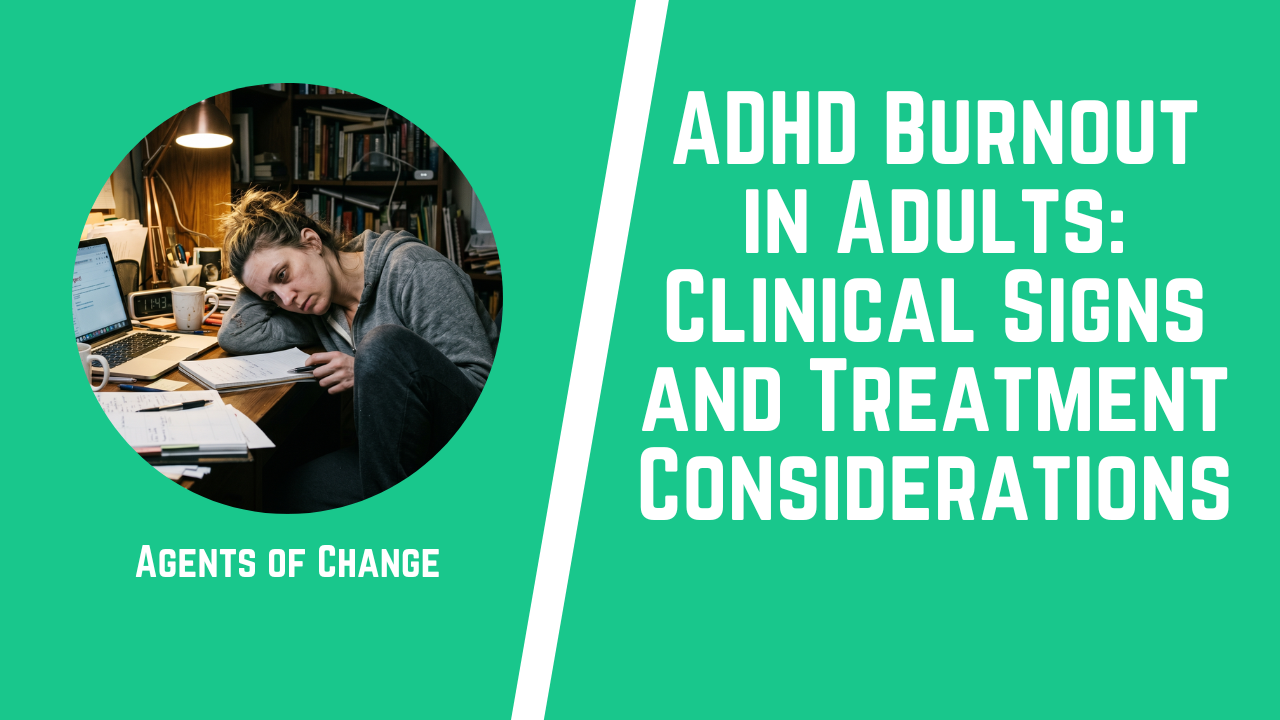
an adult experiencing ADHD burnout in a home environment

For many adults, ADHD burnout builds slowly. They may keep functioning on the outside while privately feeling scattered, depleted, ashamed, or unable to recover. Eventually, even basic tasks can feel too heavy.

How ADHD Burnout Develops

ADHD burnout often develops when daily life repeatedly demands more planning, organization, emotional regulation, time management, and task initiation than the person can sustain.

Common contributors include:

  • Chronic executive functioning overload
  • Years of masking ADHD symptoms
  • High-pressure work or school demands
  • Parenting or caregiving responsibilities
  • Sensory overwhelm
  • Poor sleep or inconsistent routines
  • Perfectionism and fear of disappointing others
  • Repeated criticism or shame around productivity
  • Lack of accommodations or support

Over time, the adult may rely on urgency, anxiety, or last-minute pressure to get things done. That strategy can work temporarily, but it’s exhausting. Eventually, the brain and body push back.

What ADHD Burnout Can Feel Like

Adults experiencing ADHD burnout may describe feeling “fried,” “stuck,” “done,” or “unable to function.” They may still care about their responsibilities, relationships, and goals, but they can’t access the energy or focus needed to follow through.

ADHD burnout may include:

  • Task paralysis
  • Emotional exhaustion
  • Irritability or tearfulness
  • Avoidance of messages, chores, or work
  • Increased sensitivity to noise, clutter, or social demands
  • Difficulty making decisions
  • Loss of motivation
  • Shame after falling behind
  • Feeling overwhelmed by simple tasks
  • Needing more recovery time than usual

This can be confusing for clients because they may think, “I know what I need to do, so why can’t I just do it?”

Why It’s Often Misunderstood

ADHD burnout is often mistaken for laziness, lack of discipline, depression, or poor motivation. In reality, many adults with ADHD have spent years trying extremely hard. They may have learned to appear competent while using enormous energy behind the scenes.

This is especially true for clients who mask well. They may look organized, calm, or successful while internally struggling to hold everything together.

A Clinical Reframe

A helpful clinical reframe is that ADHD burnout is not a personal failure. It is often a signal that the person’s current demands, supports, routines, and recovery patterns are out of balance.

Treatment should focus less on asking, “Why can’t you keep up?” and more on asking, “What would make this life more sustainable for your brain?”

Learn more about Agents of Change Continuing Education. We’ve helped hundreds of thousands of Social Workers, Counselors, and Mental Health Professionals with their online continuing education and CEUs, and we want you to be next!

2) Why ADHD Burnout Is Often Missed

ADHD burnout in adults is often missed because it doesn’t always look like collapse. Many adults with ADHD keep functioning long after they’re depleted. They may continue working, parenting, caregiving, studying, or managing responsibilities while privately feeling like they’re barely holding things together.

a diverse person in a work environment experiencing ADHD burnout

From the outside, they may seem capable. Inside, though, the effort required to maintain that appearance can be enormous.

It Can Look Like Anxiety or Depression

ADHD burnout often overlaps with symptoms of anxiety and depression, which can make it harder to identify. A client may report low motivation, fatigue, avoidance, irritability, sleep problems, or difficulty concentrating. Without careful assessment, these symptoms may be viewed only through a mood or anxiety lens.

The distinction matters because the client may still care deeply about their life, goals, and relationships. They’re not necessarily uninterested. They may be overloaded, ashamed, and unable to access the executive functioning needed to act.

Masking Hides the Severity

Many adults with ADHD become skilled at masking. They learn to hide disorganization, emotional intensity, forgetfulness, restlessness, or task paralysis. They may overprepare, apologize quickly, work late, use humor to deflect, or appear calm while internally panicking.

This can lead clinicians, employers, partners, and even the client themselves to underestimate the level of strain.

Masking can sound like:

  • “I’m fine, I just need to get better at managing things.”
  • “Everyone is overwhelmed, right?”
  • “I don’t want to make excuses.”
  • “I should be able to handle this.”

High Achievement Can Be Misleading

Some adults with ADHD are highly accomplished. They may have advanced degrees, demanding careers, leadership roles, or strong creative abilities. Because they have succeeded in visible ways, others may assume their struggles cannot be that serious.

But high achievement does not mean low impairment. In many cases, achievement has been fueled by urgency, perfectionism, anxiety, late-night work, and intense self-pressure. Eventually, those strategies can stop working.

The Language of Burnout Is Often Vague

Clients may not come in saying, “I’m experiencing ADHD burnout.” More often, they say:

  • “I’m exhausted.”
  • “I can’t make myself do anything.”
  • “Everything feels too loud.”
  • “I’m behind on everything.”
  • “I don’t know why simple tasks feel impossible.”

These statements can be easy to normalize unless the clinician listens for patterns of executive functioning overload, masking, emotional exhaustion, and shame.

Clinicians May Focus Too Quickly on Skills

When ADHD burnout is missed, treatment may jump straight to planners, routines, and productivity strategies. Those tools can help, but only if the client has enough capacity to use them.

A more helpful first step is asking what demands need to be reduced, what supports are missing, and where the client has been spending energy pretending they’re okay.

Agents of Change has helped hundreds of thousands of Social Workers, Counselors, and Mental Health Professionals with Continuing Education, learn more here about Agents of Change and claim your 7.5 free CEUs!

3) ADHD Burnout in Adults: Clinical Signs and Treatment Considerations
ADHD burnout in adults often appears when a person’s coping systems have been stretched beyond what they can sustain. This can happen after years of masking, overcompensating, managing executive functioning demands, and trying to keep pace with work, family, school, relationships, and daily life. The adult may still be “functioning” in visible ways, but internally, the cost of functioning has become too high.

Clinically, ADHD burnout is important because it can be misunderstood as laziness, resistance, depression, anxiety, poor motivation, or lack of discipline. A more accurate lens asks, “What has this person been carrying, and what supports have been missing?”

Functional Decline After Prolonged Overcompensation

One of the clearest signs of ADHD burnout is a noticeable decline in functioning after a long period of pushing through. The client may have been relying on urgency, fear, perfectionism, people-pleasing, or last-minute pressure to meet expectations. Eventually, those strategies stop working.

This decline may show up as:

  • Missing deadlines that would normally be met at the last minute
  • Avoiding emails, texts, bills, or paperwork
  • Forgetting appointments or important tasks
  • Struggling to begin basic chores
  • Feeling unable to return to routines after disruption
  • Falling behind at work, school, or home
  • Experiencing intense shame about unfinished responsibilities

The key clinical detail is that the person often still cares. They may desperately want to follow through but feel unable to initiate, organize, or sustain the effort required.

Executive Functioning Overload

Executive functioning overload is central to ADHD burnout. Adults with ADHD often spend enormous energy planning, remembering, shifting attention, regulating emotions, estimating time, prioritizing tasks, and forcing themselves to start activities that don’t provide immediate interest or urgency.

When demands exceed capacity, the brain may respond with shutdown, avoidance, irritability, or paralysis. The person may stare at a task they understand perfectly and still feel unable to begin.

Common signs of executive functioning overload include:

  • “I know what I need to do, but I can’t make myself do it.”
  • Difficulty deciding where to start
  • Feeling overwhelmed by multi-step tasks
  • Losing track of time or underestimating task length
  • Jumping between tasks without completing them
  • Needing intense pressure to activate
  • Becoming emotionally flooded by ordinary responsibilities

Treatment should focus on reducing cognitive load, externalizing supports, and breaking tasks into smaller, more concrete steps. Insight alone is rarely enough. The client may need visible cues, body doubling, environmental changes, reminders, scripts, and simplified routines.

Masking and Hidden Exhaustion

Many adults with ADHD become skilled at masking their symptoms. They may appear calm, organized, socially engaged, or professionally competent while privately feeling scattered, overstimulated, anxious, or depleted.

Masking can include:

  • Suppressing restlessness or emotional reactions
  • Pretending to understand instructions
  • Over-preparing to avoid mistakes
  • Working late to compensate for lost time
  • Hiding disorganization from others
  • Apologizing repeatedly for delays or forgetfulness
  • Using humor to deflect embarrassment
  • Saying yes when they do not have capacity

Over time, masking can become exhausting because it requires constant self-monitoring. Clinically, this matters because the client’s presentation in session may not reflect their actual level of impairment. A polished, articulate client may still be in significant distress.

Helpful clinical questions include:

  • “Where do you feel like you have to perform being okay?”
  • “What ADHD-related struggles do you work hardest to hide?”
  • “What does it cost you to appear organized or calm?”
  • “Who sees the most exhausted version of you?”

These questions can help uncover the hidden energy drain behind the client’s outward functioning.

Emotional Exhaustion and Irritability

ADHD burnout often includes emotional exhaustion. The client may describe feeling more reactive, tearful, numb, impatient, or easily overwhelmed. Small demands may trigger outsized responses because the nervous system has little reserve left.

Emotional exhaustion may appear as:

  • Irritability with partners, children, coworkers, or friends
  • Crying over tasks that usually feel manageable
  • Feeling numb or disconnected
  • Avoiding social contact
  • Increased rejection sensitivity
  • Low frustration tolerance
  • Shame after emotional reactions
  • Feeling “done” or unable to care in the usual way

This should not be treated as a simple attitude problem. Emotional regulation depends on available capacity. When that capacity is drained, even minor stressors can feel impossible.

Therapeutically, it can help to normalize the client’s emotional responses as signals of overload while still supporting accountability, repair, and regulation skills.

Sensory Overwhelm and Environmental Stress

Burnout can increase sensitivity to sensory input. Adults with ADHD may become more bothered by noise, clutter, bright lights, interruptions, clothing textures, social demands, or crowded spaces. The environment may start to feel like another source of pressure.

Clients may say things like:

  • “Everything feels too loud.”
  • “The clutter makes me feel like I can’t breathe.”
  • “I can’t focus if people keep interrupting me.”
  • “By the end of the day, I don’t want anyone touching me or talking to me.”

Treatment considerations may include sensory modifications, scheduled decompression, noise reduction, visual simplification, and protected transitions between roles. For some clients, reducing sensory input is not a luxury. It is a clinical need.

Shame, Self-Blame, and the Failure Narrative

Shame is often woven through ADHD burnout. Many adults with ADHD have years of painful feedback behind them. They may have been called lazy, messy, irresponsible, dramatic, careless, or inconsistent. When burnout occurs, those old narratives can become louder.

A client may interpret burnout as proof that they are failing rather than as evidence that their current system is unsustainable.

Common shame-based thoughts include:

  • “I should be able to handle this.”
  • “Everyone else can do basic things.”
  • “I’m ruining my life.”
  • “I’m just making excuses.”
  • “I always mess things up.”
  • “I’m too much for people.”

Clinicians can help clients separate identity from impairment. Instead of reinforcing the idea that the client needs more willpower, treatment can focus on accommodations, nervous system recovery, environmental fit, and realistic supports.

A useful reframe is: “This is not a failure of character. This is a mismatch between demand, capacity, and support.”

Differential Assessment Considerations

ADHD burnout can overlap with several clinical presentations. Careful assessment is important, especially when symptoms include fatigue, withdrawal, sleep changes, low motivation, irritability, or reduced functioning.

Consider screening for:

  • Major depressive disorder
  • Generalized anxiety disorder
  • Trauma-related symptoms
  • Autistic burnout
  • Substance use concerns
  • Sleep disorders
  • Chronic pain or medical conditions
  • Hormonal changes
  • Medication side effects
  • Caregiver burnout
  • Workplace stress or exploitation

The point is not to reduce every problem to ADHD. Instead, clinicians should assess how ADHD interacts with the client’s body, environment, relationships, identity, and current demands.

Treatment Planning: Reduce Before You Rebuild

A common mistake is adding too many strategies too quickly. A burned-out client may need fewer demands before they can benefit from new routines.

Early treatment may focus on:

  • Reducing optional commitments
  • Identifying urgent versus non-urgent tasks
  • Simplifying routines
  • Creating low-demand supports
  • Stabilizing sleep and food patterns
  • Encouraging medical or medication consultation when appropriate
  • Increasing recovery time
  • Reducing masking where safe
  • Building shame-resistant systems

The question is not, “How do we make this client more productive immediately?” A better clinical question is, “What would help this client recover enough capacity to function sustainably?”

Practical Supports That Often Help

Interventions should be realistic, concrete, and easy to restart after disruption. Adults with ADHD often benefit from systems that do not depend entirely on memory, motivation, or emotional energy.

Helpful supports may include:

  • Visual reminders in places the client already looks
  • Timers for task initiation and transitions
  • Body doubling for avoided tasks
  • Pre-written scripts for emails and texts
  • Task lists limited to three priorities
  • Auto-pay and automatic refills when possible
  • A “minimum viable day” plan
  • Sensory breaks between demanding activities
  • Weekly reset routines with built-in flexibility
  • Environmental changes that reduce visual clutter

The best systems are not perfect. They are returnable. If the client can come back to the system after a hard day without feeling like they failed, it is more likely to last.

Clinical Stance: Compassionate, Practical, and Collaborative

The clinician’s stance matters. Adults with ADHD burnout often arrive expecting criticism, even when they are seeking help. A warm, practical, non-shaming approach can reduce defensiveness and increase engagement.

Helpful therapist language may include:

  • “Let’s make this easier, not more impressive.”
  • “You are not lazy. Something about this task is overloaded.”
  • “We can build a plan for low-capacity days.”
  • “The goal is not perfect consistency. The goal is being able to return.”
  • “Your symptoms make sense in the context of what you’ve been carrying.”

When treatment honors both the client’s strengths and their limits, ADHD burnout becomes less of a personal failure story and more of a solvable support problem. That shift can be deeply relieving for adults who have spent years trying to hide how hard they are working.

4) Practical Clinical Interventions

Effective treatment for ADHD burnout in adults should be concrete, collaborative, and realistic. Clients experiencing burnout are often already overwhelmed, so interventions need to reduce cognitive load rather than add more pressure. The goal is not to help the client become perfectly productive. The goal is to help them recover capacity, rebuild trust in themselves, and create support systems that still work on low-energy days.

1. The Minimum Viable Day Plan

The Minimum Viable Day Plan helps clients identify the smallest set of actions needed to maintain basic stability during burnout. This intervention is especially useful for clients who become trapped in all-or-nothing thinking, where they either try to “catch up on everything” or shut down completely.

To implement this with fidelity, begin by explaining that the plan is not a productivity routine. It is a burnout safety net. Ask the client, “On a really low-capacity day, what are the few things that would help prevent tomorrow from being worse?” Keep the list short, specific, and realistic.

A Minimum Viable Day Plan might include:

  • Take prescribed medication.
  • Drink water before noon.
  • Eat one protein-containing meal or snack.
  • Attend one essential appointment or send one necessary message.
  • Put dirty dishes in one place, even if they are not washed.
  • Go to bed without trying to “fix” the whole day at midnight.

The fidelity piece is restraint. Clinicians should avoid allowing the plan to become too ambitious. If the client lists ten items, help them narrow it to three to five. Each item should be observable and doable in a depleted state. “Take care of myself” is too vague. “Eat one snack before 2 p.m.” is better.

Review the plan weekly. Ask what worked, what felt unrealistic, and what needs to be simplified. The client should leave with the message, “I can have a hard day without abandoning myself completely.”

2. Executive Function Externalization

Adults with ADHD often burn out from trying to hold too much information in working memory. Executive Function Externalization moves tasks, reminders, steps, and decisions out of the client’s head and into the environment.

To implement this with fidelity, choose one high-friction task rather than trying to organize the client’s whole life. Start with a task that repeatedly causes distress, avoidance, or shame. Examples might include paying bills, responding to emails, leaving the house on time, taking medication, or preparing for therapy sessions.

Then break the task into three parts:

  1. Trigger: What will remind the client to start?
  2. Steps: What are the smallest visible steps?
  3. Support: What tool, person, or environmental cue will reduce effort?

For example, if the target is taking medication, the plan might be:

  • Keep medication beside the coffee maker.
  • Set a daily phone alarm labeled “meds plus water.”
  • Use a weekly pill container.
  • Track completion with a simple checkmark on a visible calendar.

If the target is responding to email, the plan might be:

  • Open email only during two scheduled windows.
  • Use three pre-written response templates.
  • Sort messages into “today,” “later,” and “ignore/archive.”
  • Use a timer for 15 minutes and stop when it ends.

The fidelity issue here is simplicity. A beautiful color-coded system that requires daily maintenance may fail quickly. The best system is visible, low-effort, and easy to restart after disruption.

3. The Masking and Energy Audit

Many adults with ADHD are exhausted from constantly appearing more organized, calm, socially available, or emotionally regulated than they feel. The Masking and Energy Audit helps clients identify where they are spending energy on performance rather than authentic functioning.

To implement this with fidelity, ask the client to identify three settings where they feel most depleted. These might include work meetings, parenting routines, social events, school, extended family interactions, or therapy itself.

For each setting, explore:

  • What am I trying to hide?
  • What am I afraid would happen if people noticed?
  • How much energy does this take?
  • What is one small, safe way I could reduce the masking?
  • What support or accommodation might help?

For example, a client may realize they mask heavily in staff meetings by forcing eye contact, suppressing movement, and pretending to process verbal instructions in real time. A small intervention could be asking for written follow-up, using a quiet fidget, or taking notes without needing to look engaged every second.

This intervention should be paced carefully. Unmasking does not mean oversharing or removing all social filters. The goal is selective, safe reduction of unnecessary performance. Clinicians should help clients consider context, privacy, power dynamics, and emotional safety.

4. Shame-Resistant Task Triage

When clients are burned out, every task can feel equally urgent and morally loaded. Shame-Resistant Task Triage helps clients sort responsibilities without turning the process into self-criticism.

To implement this with fidelity, ask the client to list everything currently taking up mental space. Then sort items into four categories:

  • Urgent and necessary: Must be handled soon to prevent serious consequences.
  • Important but delayable: Matters, but can wait.
  • Simplify or delegate: Needs to happen, but not in the most elaborate way.
  • Release for now: Can be dropped, paused, or intentionally ignored.

The clinician’s role is to help the client challenge urgency distortion. A burned-out ADHD brain may label everything as “now.” Slow the process down. Ask, “What actually happens if this waits three days?” or “Is this task important, or is it loud because it carries shame?”

Fidelity also requires ending with action. Choose one next step from the urgent category and make it concrete. For example, “Call the insurance company” becomes “Open the insurance card, dial the number, and ask one question.” The smaller the first step, the better.

5. Recovery Scheduling Before Productivity Scheduling

Many adults with ADHD plan tasks but do not plan recovery. In burnout treatment, recovery must be scheduled before adding new productivity goals.

To implement this with fidelity, help the client identify what genuinely restores energy rather than what simply helps them escape. Recovery may include quiet time, movement, sensory reduction, sleep support, low-demand connection, time outside, creative activity, or protected transition time after work.

Then place recovery into the week as a non-negotiable support. Keep it brief at first. For example:

  • Ten minutes alone after work before parenting tasks.
  • A no-phone wind-down routine three nights per week.
  • A quiet lunch without multitasking twice per week.
  • A 15-minute body doubling session to reset the home.
  • Noise-reducing headphones during high-stimulation chores.

The fidelity marker is whether recovery is treated as clinically necessary, not as a reward for finishing tasks. Burned-out clients often believe they must “earn” rest. Treatment should challenge that belief directly.

A helpful therapist phrase is: “Rest is part of the intervention, not the prize at the end.”

When these interventions are implemented with care, they help clients move from shame-driven survival to sustainable support. ADHD burnout recovery is usually gradual, but small, repeatable changes can help clients rebuild capacity without demanding that they pretend to be fine.

5) FAQs – ADHD Burnout in Adults

Q: What are the most common signs of ADHD burnout in adults?

A: Common signs of ADHD burnout in adults include deep exhaustion, task paralysis, emotional overwhelm, irritability, avoidance, increased sensitivity to noise or clutter, decision fatigue, and difficulty completing responsibilities that once felt manageable.

Many adults describe knowing exactly what they need to do but feeling unable to start or follow through. A key clinical clue is that the person often still cares about their work, relationships, and responsibilities, but their executive functioning system, emotional capacity, and recovery resources have been overextended for too long.

Q: How is ADHD burnout different from depression or anxiety?

A: ADHD burnout can overlap with depression and anxiety, but it is often more directly connected to chronic executive functioning overload, masking, sensory overwhelm, and the exhaustion of trying to keep up with demands that exceed capacity.

An adult with ADHD may feel anxious because they are behind on tasks, but they may be behind because planning, prioritizing, task initiation, and follow-through have become overloaded. Careful assessment matters because ADHD burnout, depression, anxiety, trauma, sleep problems, medical conditions, and medication factors can coexist.

Q: What helps adults recover from ADHD burnout?

A: Recovery from ADHD burnout usually begins with reducing demands and rebuilding capacity rather than adding a more complicated productivity system. Helpful interventions may include creating a minimum viable day plan, externalizing executive functioning with reminders and visual supports, using body doubling, simplifying routines, reducing unnecessary commitments, improving sleep and nutrition rhythms, addressing masking, and building in real recovery time.

The goal is not perfect consistency, but helping the adult with ADHD create systems they can return to after hard days.

6) Conclusion

ADHD burnout in adults is often misunderstood because it can hide behind competence, humor, achievement, and years of practiced masking. Many adults with ADHD are not failing because they do not care. They are often exhausted from caring so much while trying to manage executive functioning demands, emotional intensity, sensory stress, and daily responsibilities with too little support.

For clinicians, recognizing ADHD burnout means looking beyond productivity and asking better questions about capacity, context, shame, and sustainability. Treatment should focus on reducing overload, externalizing executive functioning, addressing masking, supporting emotional recovery, and building systems that clients can actually return to after difficult days. The goal is not perfect follow-through. The goal is a life that requires less constant self-punishment.

When adults with ADHD are met with curiosity and practical support, burnout can become a signal rather than a sentence. It can point toward what needs to change, what needs to be simplified, and where compassion has been missing. With the right clinical lens, clients can begin moving from survival mode toward steadier, more sustainable ways of living.

————————————————————————————————————————————————

► Learn more about the Agents of Change Continuing Education here: https://agentsofchangetraining.com

About the Instructor, Dr. Meagan Mitchell: Meagan is a Licensed Clinical Social Worker and has been providing Continuing Education for Social Workers, Counselors, and Mental Health Professionals for more than 10 years. From all of this experience helping others, she created Agents of Change Continuing Education to help Social Workers, Counselors, and Mental Health Professionals stay up-to-date on the latest trends, research, and techniques.

#socialwork #socialworker #socialwork #socialworklicense #socialworklicensing #continuinged #continuingeducation #ce #socialworkce #freecesocialwork #lmsw #lcsw #counselor #NBCC #ASWB #ACE

Disclaimer: This content has been made available for informational and educational purposes only. This content is not intended to be a substitute for professional medical or clinical advice, diagnosis, or treatment

Note: Certain images used in this post were generated with the help of artificial intelligence.

Share:

Discover more from Agents of Change

Subscribe now to keep reading and get access to the full archive.

Continue reading

Limited Availability: Only 72 Spots Left — Unlock Unlimited CE + Live Events for $75.