Why Validation Matters in Trauma Treatment

Why Validation Matters in Trauma Treatment

Trauma can leave clients questioning their memories, emotions, reactions, and even their right to feel hurt. A person may enter therapy saying things like, “It wasn’t that bad,” “I should be over this,” or “Maybe I’m just too sensitive.” Underneath those statements is often a deep fear that their experience will be minimized again. For many trauma survivors, invalidation has become part of the wound.

That is why validation matters in trauma treatment. Before clients can safely process painful experiences, they often need to feel believed, understood, and emotionally met. Validation helps communicate that their reactions make sense in the context of what they have lived through. It does not mean agreeing with every thought or avoiding clinical challenge. It means helping clients recognize that their nervous system, coping strategies, and protective responses developed for a reason.

When therapists use validation skillfully, they create a foundation for trust, safety, and deeper healing. Clients can begin to move away from shame and toward curiosity. Instead of seeing themselves as broken, dramatic, or difficult, they can start to understand their responses as adaptations. From there, trauma treatment becomes less about fixing a flawed person and more about helping a survivor build new choices, new meanings, and a more compassionate relationship with themselves.

Did you know? Agents of Change Continuing Education offers Unlimited Access to 200+ ASWB and NBCC-approved online CE courses and 20+ Live Events per year for one low annual fee to meet your state’s requirements for Continuing Education credits and level up your career.

We’ve helped hundreds of thousands of Social Workers, Counselors, and Mental Health Professionals with Continuing Education, learn more here about Agents of Change and claim your 7.5 free CEUs.

1) Why Validation Matters in Trauma Treatment
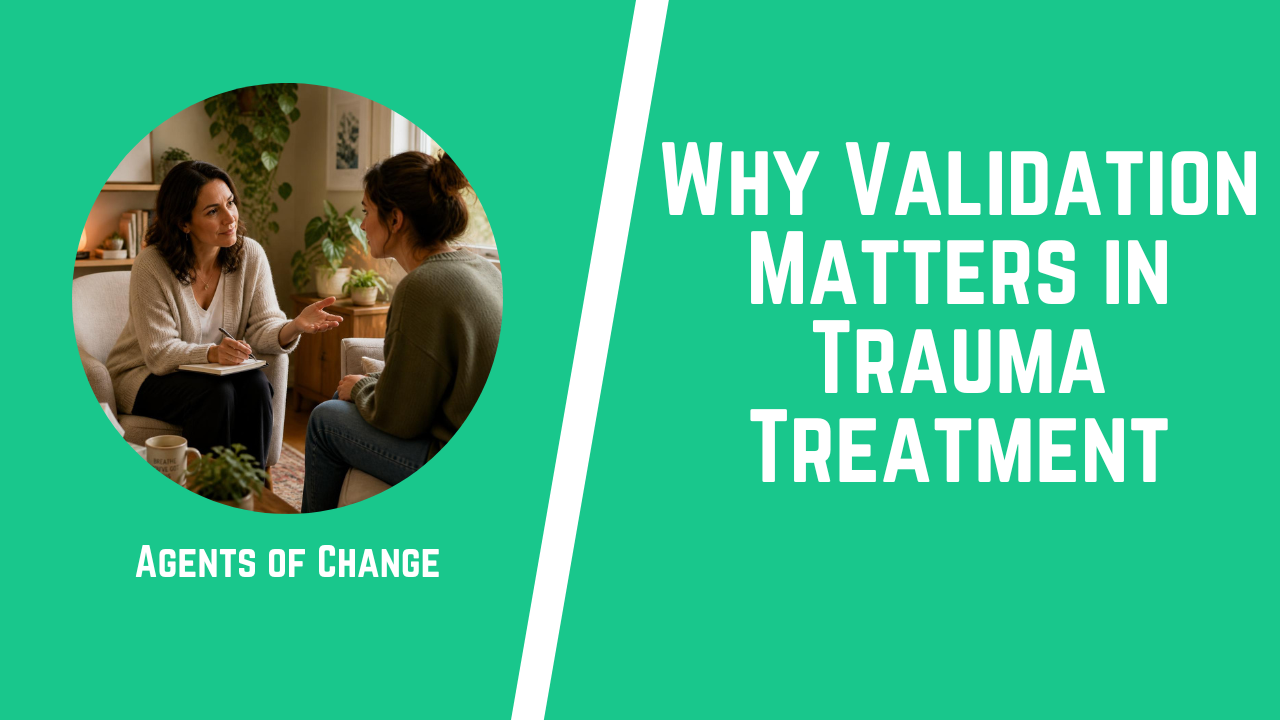
Validation is one of the most important clinical tools in trauma work because trauma often leaves clients feeling confused, ashamed, or disconnected from their own reality. Many survivors have had their experiences minimized, denied, or misunderstood. By the time they enter therapy, they may already believe their reactions are “too much,” their memories are unreliable, or their pain needs to be justified before it can be taken seriously.

Validation helps interrupt that pattern. It tells the client, in a grounded and clinically thoughtful way, “Your response makes sense in the context of what you’ve been through.”

Validation Builds Emotional Safety

Trauma treatment requires safety before deeper processing can happen. Clients are more likely to explore painful memories, body sensations, and protective patterns when they feel the therapist is emotionally with them rather than judging them from the outside.

A validating response might sound like:

  • “Of course your body reacts that way after what happened.”
  • “It makes sense that trust feels complicated.”
  • “That response helped you survive, even if it’s exhausting now.”

These statements don’t rush the client. They create room for the client’s nervous system to soften, even a little.

Validation Reduces Shame

Shame is one of the biggest barriers in trauma treatment. Clients may think, “I should’ve done more,” “I should be over this,” or “Something is wrong with me.” Without validation, therapy can accidentally reinforce those beliefs if it moves too quickly into fixing, reframing, or challenging.

Validation shifts the frame from “What’s wrong with me?” to “What happened to me, and how did I adapt?” That shift can be powerful. It helps clients see their symptoms as survival responses rather than personal failures.

Validation Supports Nervous System Regulation

Trauma responses often show up in the body before they show up in words. A client may freeze, shut down, become hyperverbal, dissociate, or feel suddenly overwhelmed. When therapists validate these responses, clients can begin to understand their bodies instead of fearing them.

For example, saying, “Your system may be trying to protect you right now,” can help a client feel less embarrassed by a trauma response. Feeling understood can reduce threat and support regulation.

Validation Makes Change More Possible

Some clinicians worry that validation means approving of every behavior or belief. It doesn’t. Validation and change can exist together. A therapist can honor why a coping strategy developed while still helping the client build new choices.

For example: “Avoiding conflict helped you stay safer growing up, and now it may be keeping you from asking for what you need.”

That kind of validation is compassionate and forward-moving. It respects the survivor’s history while gently opening the door to healing.

Learn more about Agents of Change Continuing Education. We’ve helped hundreds of thousands of Social Workers, Counselors, and Mental Health Professionals with their online continuing education and CEUs, and we want you to be next!

2) Practical Ways to Use Validation in Trauma Treatment

Validation is more than saying, “That makes sense.” In trauma treatment, it’s an intentional clinical skill that helps clients feel understood, less alone, and more willing to engage in the hard work of healing. Used well, validation can soften shame, strengthen trust, and help clients make sense of reactions they may have spent years judging.

validation of a client's feelings in a therapy session

Here are five practical ways therapists can use validation in trauma treatment.

1. Validate the Feeling Before Exploring the Story

When a client shares a painful memory or intense reaction, it can be tempting to immediately ask for details, clarify facts, or move into clinical assessment. But first, pause and validate the emotional experience.

A client who says, “I know this sounds stupid, but I still panic when someone slams a door,” may need to hear, “That doesn’t sound stupid. Your body is responding to something that once felt dangerous.”

This helps the client feel less judged and more emotionally safe. Once the feeling is validated, the client may be more able to explore the story behind it.

2. Connect the Response to the Client’s History

Trauma responses often seem confusing when viewed only in the present. Avoidance, shutdown, anger, perfectionism, people-pleasing, and hypervigilance may look like “symptoms,” but they usually developed for a reason.

Therapists can validate by gently connecting the response to the client’s lived experience:

  • “It makes sense that you learned to stay quiet if speaking up led to conflict.”
  • “Of course you scan people’s moods when unpredictability was part of your childhood.”
  • “That need to be perfect may have helped you avoid criticism or punishment.”

This kind of validation helps clients move from self-blame to self-understanding.

3. Validate Protective Strategies Without Glorifying Them

Many trauma responses helped the client survive, but they may no longer be helping in the same way. Therapists can validate the protective function while still making room for change.

For example: “Avoiding hard conversations helped you stay safe before, and now it may be keeping you from getting support.”

This approach honors the wisdom of the original coping strategy without pretending it has no cost. Clients are often more willing to change patterns when they don’t feel shamed for having them in the first place.

4. Validate the Body’s Response

Trauma often shows up physically. A client may freeze, shake, feel numb, become nauseous, lose words, or feel suddenly exhausted. These body responses can feel embarrassing or frightening, especially when clients don’t understand what’s happening.

Validation can help normalize the nervous system’s role:

  • “Your body may be trying to protect you right now.”
  • “That numbness could be your system’s way of creating distance from something overwhelming.”
  • “The tightness in your chest makes sense if your body is sensing threat.”

By validating the body, therapists help clients relate to their nervous system with curiosity instead of fear.

5. Validate the Pace of Healing

Many trauma survivors feel frustrated by how long healing takes. They may say, “I should be over this by now,” or “Why am I still reacting this way?” These moments are important opportunities for validation.

A therapist might say, “Healing from trauma often takes time because your system had to work so hard to protect you. Going slowly doesn’t mean you’re failing.”

Validating the pace helps clients build patience and compassion for themselves. It also reinforces that trauma treatment doesn’t need to be rushed to be effective. Sometimes moving carefully is exactly what allows deeper healing to happen.

Agents of Change has helped hundreds of thousands of Social Workers, Counselors, and Mental Health Professionals with Continuing Education, learn more here about Agents of Change and claim your 7.5 free CEUs!

3) Validation Across Different Trauma Treatment Models

Validation is not limited to one clinical approach. In fact, it shows up across many trauma treatment models because it supports the foundation nearly all trauma work depends on: safety, trust, emotional regulation, and a strong therapeutic relationship. Whether a therapist is using CBT, DBT, EMDR, somatic therapy, narrative therapy, or parts work, validation helps clients feel less ashamed of their responses and more willing to engage in the work.

The language may shift depending on the model, but the core message is often the same: “Your response makes sense, and we can work with it.”

Validation in Cognitive Behavioral Therapy

In trauma-focused CBT, clients often examine thoughts, beliefs, and assumptions connected to traumatic experiences. They may carry beliefs like “I’m unsafe,” “It was my fault,” or “I can’t trust anyone.” While these beliefs may be painful or inaccurate in the present, they often developed from real experiences.

Validation helps therapists avoid jumping too quickly into challenging the thought. Instead of immediately asking, “Is that belief true?” a therapist might say, “It makes sense that your brain learned to expect danger after what happened.”

From there, the client may feel safer exploring whether that belief still fits their current life. Validation softens defensiveness and helps cognitive work feel less like correction and more like collaboration.

Validation in Dialectical Behavior Therapy

DBT places validation at the center of treatment. It balances acceptance and change, which is especially helpful for trauma survivors who may feel intense emotions, struggle with relationships, or move quickly into shame.

A DBT-informed therapist might validate the client’s emotional response while still supporting skill use. For example: “Of course you wanted to shut down when the conversation felt threatening. And let’s look at what skill might help you stay grounded next time.”

This approach communicates that the client is understandable and capable of change. That balance can be incredibly powerful for clients who are used to being blamed, dismissed, or labeled as “too much.”

Validation in EMDR

In EMDR therapy, validation is important during preparation, resourcing, processing, and closure. Clients may worry that their reactions during processing are strange, wrong, or embarrassing. They may feel overwhelmed by images, sensations, emotions, or body memories.

A validating therapist can help normalize these responses by saying, “Your brain and body are working through something intense right now,” or “We can slow this down. Your system may need more support before going further.”

Validation helps clients stay connected to the process without feeling pressured to push past their limits. It also reinforces that pacing is part of effective trauma work, not a sign of failure.

Validation in Somatic and Nervous System-Based Therapies

Somatic approaches focus heavily on body sensations, autonomic responses, and nervous system states. In this work, validation helps clients understand that their bodies are communicating, not betraying them.

A therapist might say, “That tightness in your chest makes sense if your body is detecting threat,” or “The numbness may be your system’s way of protecting you from overwhelm.”

This kind of validation can reduce fear and shame around physical symptoms. Instead of viewing their body as broken or dramatic, clients begin to see it as adaptive, responsive, and worthy of care.

Validation in Parts Work

In parts-based approaches, such as Internal Family Systems-informed therapy, validation helps clients relate to different parts of themselves with curiosity rather than judgment. A client may have a protective part that avoids conflict, a critical part that pushes perfectionism, or a younger part that carries fear and grief.

Rather than trying to eliminate these parts, the therapist validates their protective intent. For example: “That part of you learned to criticize first so no one else could hurt you as badly.”

This helps clients build compassion for inner experiences they may have hated or feared. Over time, validation can help protective parts soften and allow new choices to emerge.

Validation in Narrative Therapy

Narrative therapy helps clients separate themselves from problem-saturated stories and make meaning of their experiences. Validation is especially useful here because trauma often convinces clients that their symptoms define who they are.

A narrative therapist might validate by saying, “It makes sense that survival became the main story for a long time,” while also helping the client notice other stories of courage, resistance, care, identity, and hope.

This helps clients understand that trauma shaped parts of their life, but it does not get to be the whole story.

The Common Thread Across Models

Across trauma treatment models, validation helps clients feel less alone inside their own experience. It supports emotional safety, reduces shame, and creates a bridge between acceptance and change. No matter the modality, validation reminds clients that their responses developed in context, their pain is understandable, and healing does not require rejecting the parts of themselves that helped them survive.

4) Common Therapist Mistakes With Validation

Validation sounds simple, but it takes real clinical skill to do well. In trauma treatment, a validating response can help a client feel safer, less ashamed, and more willing to stay connected to the work. At the same time, validation can miss the mark when it becomes too vague, too rushed, or too disconnected from the client’s actual experience.

Here are five common therapist mistakes with validation and how to avoid them.

1. Moving Too Quickly Into Problem-Solving

Many therapists want to help, so they jump straight into coping strategies, reframes, grounding tools, or action steps. While those interventions may be useful, they can feel invalidating if the client has not yet felt understood.

For example, if a client says, “I completely froze when my partner raised their voice,” responding with “Next time, try deep breathing” may skip over the emotional meaning of the moment.

To avoid this, validate before offering tools. A more trauma-informed response might be, “That freeze response makes sense. Your body may have recognized raised voices as a sign of danger before you even had time to think.” After that, the therapist can explore regulation strategies with more safety and trust in place.

2. Using Generic Validation

Statements like “That must be hard” or “Your feelings are valid” can be supportive, but they may not go deep enough for trauma work. Clients often need validation that is specific to their story, their body response, and the protective function of their behavior.

Generic validation can feel polite but emotionally distant. It may leave the client thinking, “Do they really get it?”

To avoid this, connect validation to context. Instead of saying, “That sounds hard,” try, “It makes sense that you felt trapped in that conversation, especially given how often you had to stay quiet to avoid conflict growing up.” Specific validation helps the client feel truly seen.

3. Accidentally Validating Harmful Beliefs

Therapists sometimes worry that validation means agreeing with a client’s painful or distorted beliefs. This can lead to confusion, especially when clients say things like, “It was my fault,” “I ruin everything,” or “I’m unsafe everywhere.”

The goal is to validate the emotion and the origin of the belief without confirming the belief as fact.

To avoid this mistake, separate the feeling from the conclusion. A therapist might say, “I can understand why your mind goes to self-blame. You were put in a situation where you had very little control, and blaming yourself may have been one way your brain tried to make sense of it.” This validates the internal experience while gently making room for a different understanding.

4. Sounding Scripted or Overly Clinical

Trauma survivors are often highly attuned to tone, facial expression, pacing, and authenticity. If validation sounds rehearsed, overly polished, or disconnected from the moment, the client may not trust it.

A scripted response like “Your nervous system is having a trauma response due to prior adverse experiences” may be accurate, but it might not feel emotionally connecting.

To avoid sounding scripted, use natural language that fits the client’s words and your own voice. For example, “Your body is trying really hard to protect you right now” may land more gently than a technical explanation. Clinical language has a place, but validation often works best when it feels human.

5. Validating Without Supporting Change

Validation is powerful, but it should not become a place where therapy gets stuck. If a therapist only validates and never helps the client build new choices, clients may feel understood but still trapped in old patterns.

For example, a client’s avoidance may make sense because it once protected them. Still, avoidance might now be limiting relationships, work, parenting, or daily life.

To avoid this, pair validation with possibility. A therapist might say, “Avoiding those conversations helped you feel safer for a long time, and it makes sense that your system still wants to do that. We can honor why it developed while also helping you practice new ways to stay present.” This keeps the work compassionate and forward-moving.

Validation is most effective when it is specific, grounded, and connected to both acceptance and change. In trauma treatment, the goal is not to convince clients that every response should stay the same. The goal is to help them understand why their responses developed, reduce shame around those adaptations, and create enough safety for something new to become possible.

5) FAQs – Why Validation Matters in Trauma Treatment

Q: Is validation the same as agreeing with everything a client says?

A: No. Validation does not mean agreeing with every belief, conclusion, or behavior a client brings into therapy. In trauma treatment, validation means helping clients understand that their emotional reactions, body responses, and coping strategies make sense in the context of what they have lived through. For example, a therapist can validate that a client’s fear of conflict developed for a reason without agreeing that every conflict is dangerous.

This distinction matters because trauma survivors often carry painful beliefs like “It was my fault” or “I’m unsafe everywhere.” A skilled therapist validates the fear, shame, or protective response while gently helping the client question beliefs that may no longer serve them.

Q: Why is validation so important for trauma survivors?

A: Validation is important because many trauma survivors have experienced invalidation alongside the trauma itself. They may have been ignored, blamed, dismissed, pressured to move on, or told their reactions were too much. Over time, this can lead clients to doubt their own memories, emotions, instincts, and needs.

Validation helps repair some of that relational harm by communicating, “Your response makes sense, and you don’t have to defend your pain to be taken seriously.” When clients feel understood, they are often more able to stay present, explore difficult material, and approach their symptoms with curiosity instead of shame.

Q: Can validation help clients change, or does it keep them stuck?

A: When used well, validation supports change rather than preventing it. Clients are often more willing to examine old patterns when they do not feel judged for having them. For example, avoidance may have helped a client survive overwhelming situations in the past, but it may now be limiting their relationships, work, or daily life.

A therapist can say, “Avoidance helped you feel safer when you had fewer choices, and now we can work on building new options.” This kind of validation honors the protective function of the response while still helping the client move toward growth, flexibility, and healing.

6) Conclusion

Validation may seem like a simple clinical response, but in trauma treatment, it can become one of the most powerful parts of the healing process. Many trauma survivors arrive in therapy carrying years of self-doubt, shame, and confusion about why they react the way they do. When therapists validate their emotions, body responses, and protective strategies, clients can begin to understand that their reactions developed for a reason.

This does not mean validation replaces deeper trauma work. Instead, it creates the conditions that make deeper work possible. When clients feel believed and emotionally understood, they are often more willing to explore painful memories, notice old patterns, and practice new ways of responding. Validation helps clients move from “What’s wrong with me?” to “What happened to me, and how can I care for myself now?”

At its best, validation gives clients something many trauma survivors have gone without for far too long: a sense that their experience makes sense. From there, healing can become less about forcing change and more about building safety, compassion, and choice. For therapists, learning to validate well is not just a soft skill. It is a core part of trauma-informed care.

————————————————————————————————————————————————

► Learn more about the Agents of Change Continuing Education here: https://agentsofchangetraining.com

About the Instructor, Dr. Meagan Mitchell: Meagan is a Licensed Clinical Social Worker and has been providing Continuing Education for Social Workers, Counselors, and Mental Health Professionals for more than 10 years. From all of this experience helping others, she created Agents of Change Continuing Education to help Social Workers, Counselors, and Mental Health Professionals stay up-to-date on the latest trends, research, and techniques.

#socialwork #socialworker #socialwork #socialworklicense #socialworklicensing #continuinged #continuingeducation #ce #socialworkce #freecesocialwork #lmsw #lcsw #counselor #NBCC #ASWB #ACE

Disclaimer: This content has been made available for informational and educational purposes only. This content is not intended to be a substitute for professional medical or clinical advice, diagnosis, or treatment

Note: Certain images used in this post were generated with the help of artificial intelligence.

Share:

Discover more from Agents of Change

Subscribe now to keep reading and get access to the full archive.

Continue reading

Limited Availability: 200 Spots Only — Unlock Unlimited CE + Live Events for $75.