ASWB Exam for International Social Workers: Eligibility, Challenges & Tips
ASWB Exam for International Social Workers: Eligibility, Challenges & Tips
Starting a Social Work career in a new country is both exciting and overwhelming. For internationally educated professionals, the journey toward licensure in the United States often centers on one critical milestone: the ASWB exam. The process can feel complex at first glance, but with the right information, it becomes far more manageable.

International Social Workers bring valuable experience, diverse cultural insight, and strong professional foundations. Still, transitioning into the U.S. system requires more than experience alone. Licensing regulations, credential evaluations, and exam preparation standards may differ significantly from what you have encountered before. Questions naturally arise. Are your academic credentials equivalent? Will your supervised experience count? How should you prepare for an exam built around U.S.-specific policies and ethical frameworks?

This guide was created to answer those questions clearly and practically. By breaking down eligibility requirements, common obstacles, and effective preparation strategies, we aim to provide clarity and confidence. Whether you are just beginning the application process or actively studying for the exam, understanding the eligibility, unique challenges, and tips for International Social Workers will help you move forward with purpose and direction.

Learn more about the ASWB exam and create a personalized ASWB study plan with Agents of Change. We’ve helped hundreds of thousands of Social Workers pass their ASWB exams and want to help you be next!

1) Understanding the ASWB Exam for International Social Workers: Eligibility

Before registering for the ASWB exam, internationally educated Social Workers must meet specific eligibility requirements set by individual state licensing boards. While the ASWB develops and administers the exam, each state decides who qualifies to take it. This means eligibility can vary depending on where you plan to practice, but the core components remain similar across most states.

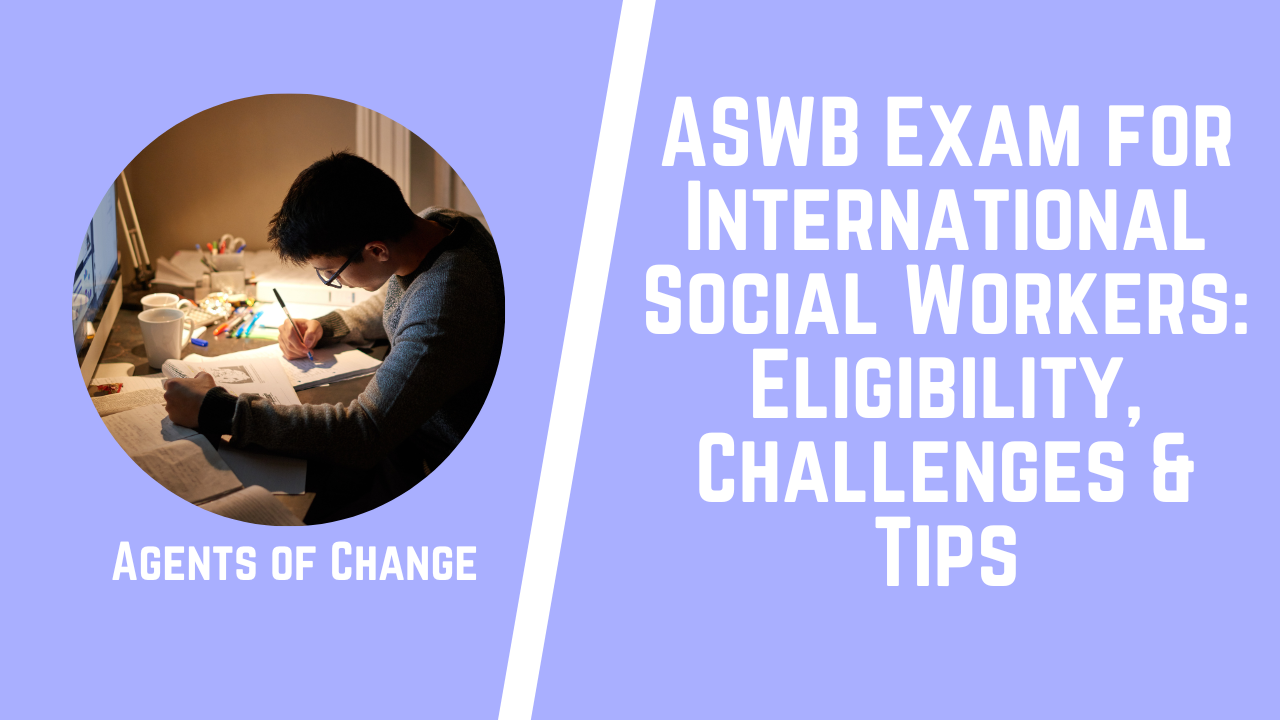
an international social worker studying for an exam in a warm home setting

Understanding these requirements early can save you time, money, and frustration. Missing one document or misunderstanding a credential requirement can delay your approval by weeks or even months. With careful preparation, though, the process becomes much more predictable.


Educational Credential Evaluation

One of the first and most important steps is verifying that your Social Work degree meets U.S. standards. Most state boards require internationally educated Social Workers to complete a credential evaluation through an approved agency.

This evaluation determines whether your degree is equivalent to a degree from a CSWE-accredited Social Work program in the United States.

You will typically need to provide:

  • Official transcripts from your university

  • Proof of degree completion (diploma or certificate)

  • Course descriptions or syllabi

  • Certified English translations of documents if originally issued in another language

The evaluation agency reviews your academic history and sends an official report to the licensing board. This report plays a major role in determining whether you qualify to move forward.


Degree Equivalency and CSWE Standards

In the United States, Social Work education follows guidelines set by the Council on Social Work Education (CSWE). Licensing boards use these standards as a benchmark when reviewing international degrees.

Your degree must generally include coursework in key areas such as:

  • Human behavior and the social environment

  • Social Work ethics and professional values

  • Clinical or practice methods

  • Research methods

  • Field education or supervised practicum

If your program does not fully align with CSWE standards, the licensing board may require additional coursework. While this can feel discouraging, it is designed to ensure consistency in professional training.


State Licensing Board Approval

After your credentials are evaluated, you must submit an application to the licensing board in the state where you intend to work. This step is mandatory before you can register for the ASWB exam.

The application process often includes:

  • Completed application forms

  • Credential evaluation reports

  • Application fees

  • Proof of identity

  • Background check or fingerprinting

Once the board reviews and approves your application, it will grant permission for you to register for the appropriate ASWB exam level.


Choosing the Correct ASWB Exam Level

Eligibility also depends on selecting the exam that matches your education and career goals. The ASWB offers several exam levels, but international Social Workers most commonly pursue one of the following:

  • Master’s Exam
    Required for entry-level licensed Master’s Social Workers in many states.

  • Clinical Exam
    Required for licensed clinical Social Workers who provide psychotherapy and mental health services independently.

Your licensing board determines which exam you are eligible to take based on your education and supervised experience.


Supervised Experience Requirements

For those pursuing clinical licensure, supervised experience is an essential component of eligibility. Most states require Social Workers to complete a set number of supervised practice hours after earning their degree.

These requirements may include:

  • A specific number of total supervised hours

  • Supervision by a licensed Clinical Social Worker

  • Documentation of supervision sessions

  • Verification forms completed by supervisors

Some states may accept supervised experience completed outside the United States, while others require supervision within the U.S. Always confirm with your state board.


English Language Proficiency Requirements

If your Social Work degree was completed in a non-English speaking country, some licensing boards may require proof of English proficiency. This helps ensure that Social Workers can communicate effectively with clients, colleagues, and agencies.

Accepted forms of proof may include:

  • TOEFL exam scores

  • IELTS exam scores

  • Completion of an English-language academic program

Requirements vary widely, and some states waive this requirement depending on your background.


Key Eligibility Checklist for International Social Workers

To simplify the process, here is a quick checklist of the most common eligibility steps:

  • Obtain a credential evaluation from an approved agency

  • Ensure your degree meets CSWE equivalency standards

  • Submit the application to your state licensing board

  • Complete any required background checks

  • Provide proof of supervised experience if required

  • Demonstrate English proficiency if requested

  • Receive official approval before registering for the ASWB exam

Completing each of these steps carefully moves you closer to exam eligibility.


Why Understanding Eligibility Early Matters

Many international Social Workers feel eager to start studying right away, but eligibility confirmation should come first. Studying without knowing your approved exam level can lead to wasted time and unnecessary stress. Once eligibility is confirmed, you can move forward with confidence, focusing fully on preparation. With clear requirements, structured study plans, and reliable resources, the ASWB exam becomes far more manageable and less intimidating.

Agents of Change packages include 30+ ASWB topics, 2 free study groups per month, and hundreds of practice questions so you’ll be ready for test day!

2) The Unique Challenges International Social Workers Face

International Social Workers bring resilience, adaptability, and a depth of perspective that enriches the profession. Still, preparing for licensure in the United States introduces challenges that go beyond learning exam content. These obstacles can affect confidence, preparation time, and overall performance. Recognizing these challenges early allows you to respond with intention rather than frustration.

an international social worker studying for an exam in a warm home setting

Below are five of the most common challenges and practical ways to respond to each one.


1. Navigating Unfamiliar Social Work Systems

Even experienced Social Workers can feel disoriented when introduced to a new country’s legal, healthcare, and social service systems. While core Social Work values remain consistent, the structure and terminology in the U.S. may differ significantly from what you’ve known.

You may encounter unfamiliar concepts such as:

  • Managed care systems

  • Mandatory reporting laws specific to U.S. states

  • Insurance-driven treatment limitations

  • U.S.-based service delivery models

How to respond:

Start by learning how Social Work operates within the U.S. framework. Focus on understanding systems rather than memorizing isolated facts. Pay special attention to client rights, confidentiality laws, and ethical responsibilities. Using structured study resources and participating in live study groups, like those offered through Agents of Change, can help clarify how these systems function in real-world practice and exam scenarios.


2. Adjusting to the ASWB Exam Question Style

The ASWB exam does not simply test knowledge. It evaluates how you apply professional judgment in specific situations. Questions often ask what a Social Worker should do first, next, or best.

This format can feel unfamiliar, especially if your previous exams focused more on theory or direct recall.

Common difficulties include:

  • Identifying subtle differences between answer choices

  • Understanding scenario-based ethical reasoning

  • Managing time while carefully reading each question

How to respond:

Practice with realistic exam questions as early as possible. The more exposure you have to ASWB-style questions, the more natural the structure becomes. Pay close attention to answer rationales. Over time, patterns will emerge, helping you recognize how the exam prioritizes safety, ethics, and client-centered care.


3. Language Processing and Testing Speed

Even fluent English speakers may experience a slower reading speed when working in their second language. During a timed exam, this can increase anxiety and reduce confidence.

You may find yourself:

  • Re-reading questions multiple times

  • Struggling with subtle wording differences

  • Running out of time before finishing all questions

How to respond:

Practice timed exams regularly to build reading speed and comprehension. Focus on understanding the meaning of questions rather than translating word-for-word. Flashcards, practice tests, and repeated exposure help your brain process information more efficiently. With consistent practice, your speed and confidence will improve naturally.


4. Credential and Licensing Uncertainty

Eligibility requirements can feel confusing, especially when state regulations differ. Waiting for credential evaluations, verifying supervised experience, and understanding licensing pathways can create stress and delay preparation.

This uncertainty can lead to questions like:

  • Am I eligible for the Master’s or Clinical exam?

  • Will my international experience count?

  • Should I start studying now or wait for approval?

How to respond:

Contact your state licensing board early and confirm your eligibility status. Once you know which exam level you will take, you can begin studying with clarity. Choosing a study program that provides long-term access, such as Agents of Change, ensures you can start preparing without worrying about timing. Since access continues until you pass, you won’t lose valuable resources if your approval takes longer than expected.


5. Emotional Pressure and Self-Doubt

Relocating to a new country often involves career disruption, financial strain, and personal adjustment. Adding exam preparation to that mix can intensify stress. Even highly qualified Social Workers sometimes question their abilities during this process.

You might experience:

  • Fear of failing the exam

  • Frustration with unfamiliar content

  • Isolation from professional peers

  • Pressure to reestablish your career quickly

How to respond:

Recognize that these feelings are normal and temporary. Create a realistic study schedule that balances preparation with rest. Connecting with other Social Workers through live study groups or professional communities can reduce isolation. Seeing steady progress through practice exams reinforces your readiness and rebuilds confidence.


Moving Forward with Awareness and Strategy

These challenges are real, but they are manageable. International Social Workers have successfully navigated this path before, and with the right preparation, you can too. Each challenge presents an opportunity to strengthen your understanding, sharpen your clinical reasoning, and adapt to a new professional environment.

With structured study plans, consistent practice, and supportive resources, what once felt overwhelming gradually becomes familiar. Confidence grows. Clarity replaces uncertainty. And step by step, you move closer to achieving licensure and continuing your Social Work career in the United States.

3) Practical Tips to Pass the ASWB Exam for International Social Workers

Preparing for the ASWB exam as an internationally educated Social Worker requires more than reviewing textbooks. It involves adapting to a new testing style, understanding U.S.-specific frameworks, and building confidence in your clinical reasoning. While the process can feel intimidating at first, the right strategies make it far more manageable.

Here are five practical, proven tips that can help you prepare effectively and improve your chances of passing.


1. Focus on How the ASWB Exam Thinks, Not Just What It Knows

Many international Social Workers already have strong theoretical knowledge and professional experience. However, the ASWB exam tests decision-making and prioritization rather than simple memorization.

The exam often asks questions such as:

  • What should the Social Worker do first?

  • What is the best next step?

  • What is the most appropriate intervention?

To succeed, you need to understand how the exam prioritizes:

  • Client safety

  • Ethical responsibility

  • Professional boundaries

  • Client self-determination

How to apply this tip:
When studying practice questions, focus on why the correct answer is right, not just what the answer is. Pay attention to reasoning patterns and ethical priorities.


2. Use Full-Length Practice Exams Early and Often

Practice exams are one of the most effective preparation tools available. They help you become familiar with the structure, pacing, and mental endurance required for test day.

Full-length practice exams allow you to:

  • Improve time management

  • Build confidence with the question format

  • Identify weak areas that need more attention

  • Reduce anxiety by making the experience familiar

Agents of Change offers realistic full-length practice exams designed to mirror the actual ASWB exam experience. Combined with detailed answer explanations, these exams help you understand how to approach questions strategically rather than guessing.

How to apply this tip:
Schedule regular practice exams and track your progress. Improvement over time is a strong indicator that your preparation is working.


3. Follow a Structured Study Plan to Stay Consistent

Without a clear study plan, it is easy to feel overwhelmed or unsure where to focus. Jumping between topics randomly can slow your progress and reduce retention.

Structured study plans help you:

  • Break preparation into manageable steps

  • Cover all exam content areas systematically

  • Stay consistent with your schedule

  • Maintain motivation through clear milestones

All Agents of Change programs include study plans specifically designed to guide Social Workers through exam preparation. These plans remove guesswork and help you stay on track, even when balancing work and personal responsibilities. Another key advantage is that Agents of Change provides access until you pass your exam. This means you never have to worry about starting too early or losing access if your exam date changes.

How to apply this tip:
Set weekly goals and follow a structured schedule. Consistency matters more than studying for long hours occasionally.


4. Strengthen Your Understanding of U.S.-Specific Social Work Practices

Even experienced international Social Workers may encounter unfamiliar policies, terminology, or service delivery models in the U.S. exam content. Understanding these differences is essential.

Focus your study on areas such as:

  • U.S. Social Work ethics and professional standards

  • Confidentiality and mandated reporting laws

  • Clinical intervention models used in U.S. practice

  • Professional roles and responsibilities

Participating in live study groups, such as the two monthly sessions offered by Agents of Change, can help clarify confusing topics. These sessions allow you to learn from experienced instructors and ask questions in real time.

How to apply this tip:
Make a list of unfamiliar concepts and review them regularly until they feel comfortable and familiar.


5. Practice Active Learning Instead of Passive Reading

Reading textbooks alone is rarely enough to prepare for the ASWB exam. Active learning helps your brain process and retain information more effectively.

Effective active learning methods include:

  • Using flashcards to reinforce key concepts

  • Taking practice quizzes regularly

  • Reviewing answer rationales carefully

  • Explaining concepts out loud to yourself

Agents of Change provides flashcards, practice exams, and interactive resources that support active learning. These tools help strengthen your recall and improve your ability to apply knowledge in exam scenarios.

How to apply this tip:
Test yourself frequently rather than simply reviewing notes. Active engagement improves retention and builds confidence.


Building Confidence Through Preparation

Passing the ASWB exam is achievable with the right approach. International Social Workers already possess valuable knowledge and experience. The key is adapting that knowledge to the exam format and expectations.

By understanding exam logic, practicing consistently, following a structured plan, learning U.S.-specific frameworks, and using active learning techniques, you place yourself in a strong position for success. With comprehensive preparation resources like Agents of Change and steady, focused effort, the path toward licensure becomes clearer and more attainable.

4) Common Mistakes International Social Workers Make

Preparing for the ASWB exam in a new country comes with a steep learning curve. International Social Workers often bring years of education, training, and hands-on experience, yet certain avoidable mistakes can slow progress or lower exam performance. Recognizing these common pitfalls early gives you the opportunity to adjust your strategy and move forward with confidence.

Here are the five most common mistakes international Social Workers make and practical ways to avoid them.


1. Assuming Professional Experience Alone Is Enough

Many internationally educated Social Workers have extensive experience working with diverse populations. That experience is valuable and strengthens your clinical judgment. However, the ASWB exam focuses on specific testing logic and U.S.-based professional standards.

The mistake happens when candidates assume their background alone will carry them through the exam without targeted preparation.

Why this creates problems:

  • The exam uses structured, scenario-based questions

  • U.S.-specific ethical and legal frameworks may differ from your previous country

  • Exam questions prioritize specific response sequences and professional reasoning

How to avoid this mistake:

Treat the exam as a specialized test with its own rules. Supplement your experience with focused preparation, practice exams, and structured study materials. Programs like Agents of Change provide realistic practice questions that help you adapt your existing knowledge to the exam format.


2. Underestimating the Importance of Practice Exams

Some candidates focus heavily on reading textbooks or reviewing notes but avoid taking full-length practice exams. While reading builds knowledge, it does not fully prepare you for the timing, pacing, and pressure of the real exam.

Without practice exams, candidates often struggle with:

  • Time management

  • Question interpretation

  • Mental stamina during long testing sessions

How to avoid this mistake:

Incorporate regular practice exams into your study routine. Full-length exams help simulate the real experience and reduce anxiety on test day. Reviewing answer explanations carefully also strengthens your understanding of exam reasoning.

Agents of Change offers full-length practice exams designed to mirror the ASWB exam structure, helping you build familiarity and confidence before your actual test date.


3. Studying Without a Clear Plan

It’s easy to feel overwhelmed by the volume of material covered on the ASWB exam. Without a structured plan, many candidates jump between topics, revisit familiar material repeatedly, or avoid challenging areas.

This scattered approach often leads to:

  • Incomplete content coverage

  • Poor retention of key information

  • Increased stress and uncertainty

How to avoid this mistake:

Follow a structured study plan that organizes content into manageable steps. A clear plan ensures balanced coverage of all exam domains and keeps your preparation on track.

All Agents of Change programs include detailed study plans that guide you through the preparation process. These plans help you stay organized, focused, and consistent from start to finish.


4. Ignoring U.S.-Specific Social Work Practices and Terminology

International Social Workers may be highly skilled but unfamiliar with certain U.S.-specific policies, laws, or terminology. Ignoring these differences can lead to confusion during the exam.

Common unfamiliar areas include:

  • U.S. confidentiality and reporting requirements

  • Healthcare and insurance systems

  • Ethical standards and documentation expectations

How to avoid this mistake:

Make U.S.-specific Social Work frameworks a priority in your study process. Focus on ethics, client safety, and professional roles within the U.S. system. Flashcards, practice exams, and live study sessions can help reinforce these concepts.

Agents of Change offers flashcards and live study groups twice per month, providing opportunities to strengthen your understanding and clarify unfamiliar topics.


5. Starting Too Late or Losing Momentum

Some candidates delay studying because they feel unsure about eligibility or believe they need to wait until their exam date is confirmed. Others begin studying but lose consistency over time.

This can lead to:

  • Rushed preparation

  • Increased anxiety

  • Lower exam performance

How to avoid this mistake:

Start preparing as early as possible, even if your exam date is not finalized. Consistent, steady preparation is far more effective than last-minute cramming.

One major advantage of Agents of Change is that you receive access until you pass your exam. This means you can begin studying without worrying about timing. You won’t lose access if your exam is delayed, and you can continue reviewing materials until you succeed.


Turning Mistakes Into Momentum

Every mistake in exam preparation is an opportunity to adjust your approach. International Social Workers already possess strong professional foundations. By combining that experience with structured preparation, realistic practice, and consistent effort, you can avoid common pitfalls and move forward with confidence.

Success in capturing your license does not happen by accident. It happens through preparation, strategy, and persistence. By recognizing and avoiding these common mistakes, you place yourself on a clear and achievable path toward passing the ASWB exam.

5) FAQs – ASWB Exam for International Social Workers

Q: Can international Social Workers take the ASWB exam without earning a new Social Work degree in the United States?

A: Yes, many international Social Workers can take the ASWB exam without earning a new U.S. degree, but their original degree must first be evaluated for equivalency. Most state licensing boards require a credential evaluation to confirm that your Social Work education meets standards similar to programs accredited by the Council on Social Work Education (CSWE).

This process involves submitting transcripts, degree certificates, and sometimes course descriptions. Once the evaluation is complete and the licensing board approves your application, you can register for the appropriate ASWB exam level. Requirements vary by state, so it is important to verify eligibility with the specific licensing board where you plan to practice.

Q: How should international Social Workers prepare differently for the ASWB exam compared to U.S.-educated candidates?

A: International Social Workers often need to spend additional time learning U.S.-specific Social Work laws, ethical standards, and service delivery systems. While core Social Work values are universal, the exam focuses on how those values are applied within the U.S. professional and legal framework. This means understanding confidentiality rules, mandated reporting procedures, and clinical decision-making standards in the United States.

Using structured preparation resources can make a significant difference. Programs like Agents of Change offer comprehensive study materials, full-length practice exams, flashcards, and two live study groups each month. These tools help international Social Workers adapt to the exam format and build confidence. Since access continues until you pass, you can study at your own pace without worrying about losing access.

Q: How long does it typically take to prepare for and pass the ASWB exam as an international Social Worker?

A: Preparation time varies depending on your familiarity with U.S. Social Work systems, exam-taking experience, and personal schedule. Many candidates prepare for two to four months with consistent study, though some may need more time to fully adjust to the exam format and content. The key is consistency rather than speed. Following a structured study plan helps ensure you cover all exam areas without feeling overwhelmed.

Agents of Change programs include guided study plans designed to keep you on track, helping you build knowledge gradually while reinforcing key concepts. With steady preparation, realistic practice exams, and focused review, international Social Workers can successfully pass the ASWB exam and advance their professional careers.

6) Conclusion

Pursuing licensure in the United States as an internationally educated Social Worker is a significant professional milestone. While the process involves credential evaluations, eligibility verification, and careful exam preparation, each step brings you closer to practicing legally and confidently in your new environment. Understanding the ASWB exam structure, recognizing the unique challenges international candidates face, and preparing with intention can transform what initially feels overwhelming into a clear and manageable journey.

Success on the ASWB exam does not depend on where you were educated, but on how effectively you prepare and adapt to the expectations of the exam. With structured study plans, realistic practice exams, and consistent effort, you can strengthen your clinical reasoning and become comfortable with U.S.-specific Social Work frameworks. Resources like Agents of Change provide comprehensive materials, live study groups, flashcards, and ongoing access until you pass, ensuring you have the support and tools needed throughout your preparation.


► Learn more about the Agents of Change course here: https://agentsofchangeprep.com

About the Instructor, Dr. Meagan Mitchell: Meagan is a Licensed Clinical Social Worker and has been providing individualized and group test prep for the ASWB for over 11 years. From all of this experience helping others pass their exams, she created the Agents of Change course to help you prepare for and pass the ASWB exam!

Find more from Agents of Change here:

► Facebook Group: https://www.facebook.com/groups/aswbtestprep

► Podcast: https://podcasters.spotify.com/pod/show/agents-of-change-sw

#socialwork #testprep #aswb #socialworker #socialwork #socialworktest #socialworkexam #exam #socialworktestprep #socialworklicense #socialworklicensing #licsw #lmsw #lcsw #aswbexam #aswb #lcswexam #lmswexam #aswbtestprep #aswbtest #lcswtestprep #lcswtest #lmswtestprep #lmswtest #aswbcourse #learningstyles #learningstyle

Disclaimer: This content has been made available for informational and educational purposes only. This content is not intended to be a substitute for professional medical or clinical advice, diagnosis, or treatment.

Note: Certain images used in this post were generated with the help of artificial intelligence.

Share:

Discover more from Agents of Change

Subscribe now to keep reading and get access to the full archive.

Continue reading