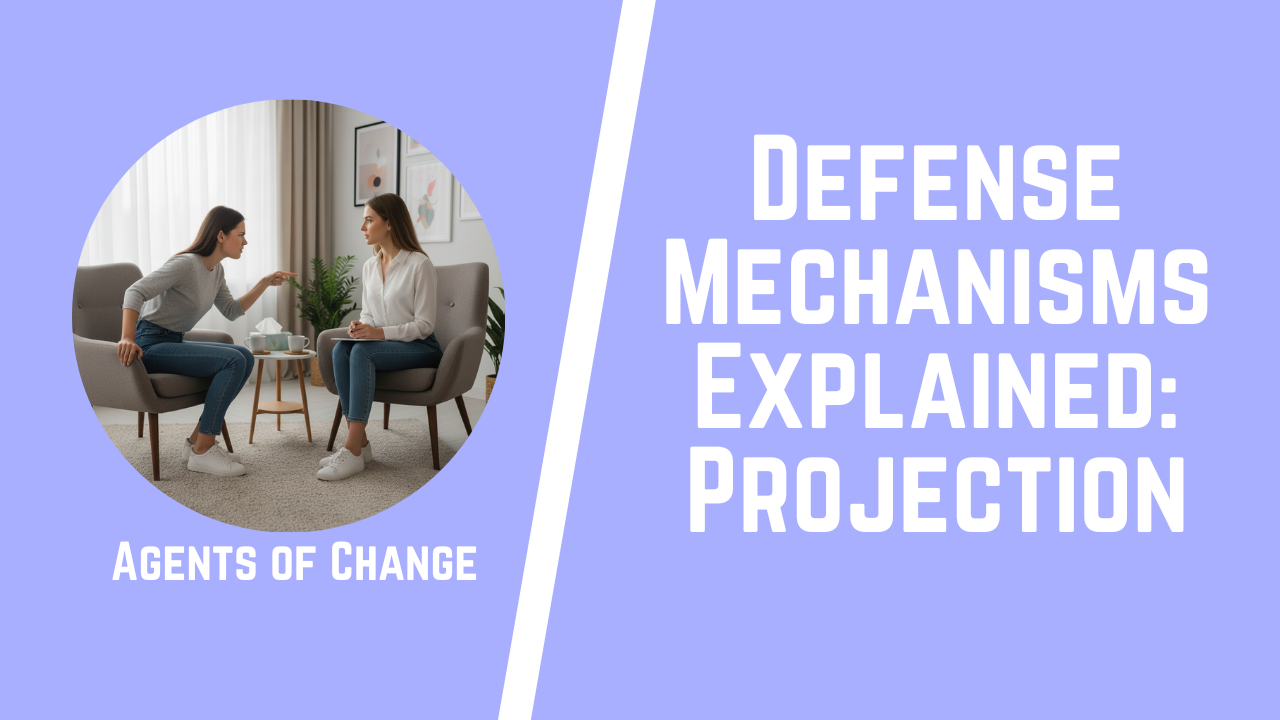
Defense Mechanisms Explained: Projection

Defense Mechanisms Explained: Projection
Preparing for the ASWB exam can feel like standing at the edge of a very full bookshelf, unsure which concept will jump out at you on test day. Defense mechanisms are one of those areas that seem simple at first glance but quickly become layered once real-world scenarios enter the picture. Among them, projection often appears, sometimes subtly, sometimes at the center of a question. Understanding how projection works is essential for any future Social Worker who wants to feel confident and grounded going into the exam.

Projection is more than a textbook definition or a single example you memorize the night before testing. It is a window into how people manage uncomfortable emotions and protect their sense of self. When clients assign their own feelings, thoughts, or impulses to others, they are often trying to cope with anxiety, fear, or shame they cannot yet name. Recognizing this process helps Social Workers respond with empathy rather than confusion, and it also helps test takers identify what the ASWB exam is truly asking.

This blog post is designed to make projection feel clear, approachable, and practical. You will learn how to recognize projection in clinical scenarios, distinguish it from similar defense mechanisms, and apply that knowledge to ASWB-style questions. With the right explanations and exam-focused insight, this topic becomes far less intimidating and much easier to remember when it matters most.

Learn more about the ASWB exam and create a personalized ASWB study plan with Agents of Change. We’ve helped hundreds of thousands of Social Workers pass their ASWB exams and want to help you be next!

1) Understanding Defense Mechanisms in Social Work

Defense mechanisms are a foundational concept in Social Work theory and practice. They help explain how individuals cope with internal conflict, emotional distress, and perceived threats to their self-image. While they are often discussed in exam prep materials, defense mechanisms are not just academic ideas.

create a picture of a 30-something therapy client expressing the projection defense mechanism in a warm therapy office

They show up daily in clinical settings, case management conversations, and even in organizational dynamics. For the ASWB exam and beyond, understanding how these processes function allows Social Workers to respond thoughtfully rather than reactively.


What Are Defense Mechanisms?

Defense mechanisms are unconscious psychological strategies used to manage anxiety and protect the ego from emotional pain. They operate automatically, meaning clients are usually unaware they are using them. Rather than addressing distressing thoughts or feelings directly, the mind finds ways to soften or redirect the impact.

In Social Work practice, defense mechanisms often appear during moments of vulnerability, such as discussions about trauma, loss, identity, or interpersonal conflict. Recognizing these patterns helps Social Workers better understand what a client is struggling to express.


Why Defense Mechanisms Matter in Social Work

Defense mechanisms are not signs of resistance or manipulation. They are coping tools that were developed for a reason. Viewing them through a compassionate lens allows Social Workers to build stronger therapeutic alliances and avoid power struggles.

Defense mechanisms matter because they:

  • Provide insight into a client’s emotional world

  • Signal areas of unresolved conflict or distress

  • Influence communication and relationship dynamics

  • Shape how clients perceive others and themselves

On the ASWB exam, questions often test whether you can recognize these functions without labeling the client as “difficult” or “uncooperative.”


Common Defense Mechanisms Social Workers Encounter

While there are many defense mechanisms, some appear more frequently in Social Work settings and on licensing exams. Becoming familiar with them helps sharpen assessment skills.

Frequently Seen Defense Mechanisms

  • Denial
    Refusing to acknowledge reality or facts that cause distress.

  • Projection
    Attributing one’s own unacceptable feelings or thoughts to someone else.

  • Rationalization
    Creating logical explanations to justify behavior driven by emotional discomfort.

  • Displacement
    Redirecting emotions toward a safer or less threatening target.

  • Intellectualization
    Focusing on facts and logic to avoid emotional engagement.


Defense Mechanisms Across Practice Settings

Defense mechanisms do not look the same in every environment. Context matters, and Social Workers must adapt their interpretations accordingly.

Examples by Setting

  • Clinical and Therapy Settings
    Clients may use projection or denial when discussing trauma or relationship conflict.

  • Child Welfare and Family Services
    Caregivers may rationalize harmful behaviors or displace anger onto systems or workers.

  • Medical Social Work
    Patients may intellectualize diagnoses to avoid fear or grief.

  • School Social Work
    Students may deny academic struggles or project feelings of inadequacy onto peers.

Understanding the setting helps determine how a defense mechanism is serving the client in that moment.


How Defense Mechanisms Guide Social Work Interventions

Recognizing a defense mechanism is only the first step. The next step is choosing an appropriate response that supports growth without increasing defensiveness.

Effective Social Work responses often include:

  • Reflecting emotions rather than challenging beliefs

  • Asking open-ended questions

  • Normalizing emotional reactions

  • Supporting insight at the client’s pace

For the ASWB exam, the best answer is usually the one that demonstrates empathy, patience, and respect for the client’s coping process rather than immediate confrontation.


Defense Mechanisms and Professional Self-Awareness

Social Workers are not immune to defense mechanisms. Awareness of one’s own reactions is essential to ethical and effective practice.

Common professional considerations include:

  • Monitoring countertransference

  • Seeking supervision when reactions feel strong

  • Remaining curious rather than judgmental

The ASWB exam often emphasizes supervision and self-reflection as appropriate responses when emotional dynamics become complex.


Understanding defense mechanisms strengthens both exam performance and real-world practice. When Social Workers can identify these patterns with clarity and compassion, they are better equipped to support clients through difficult emotional terrain while maintaining professional balance and effectiveness.

Agents of Change packages include 30+ ASWB topics, 2 free study groups per month, and hundreds of practice questions so you’ll be ready for test day!

2) Defense Mechanisms Explained: Projection

Projection is one of the most commonly tested defense mechanisms on the ASWB exam and one of the most frequently observed in Social Work practice. While the basic definition is straightforward, the way projection shows up in real-life interactions can be subtle and emotionally charged.

a 30-something therapy client expressing the projection defense mechanism in a warm therapy office

Understanding projection means learning to look beneath the surface of what a client is saying and recognizing what may actually be happening internally.


What Is Projection?

Projection occurs when an individual attributes their own unacceptable thoughts, feelings, or impulses to another person. Instead of recognizing these experiences as internal, the person experiences them as coming from the outside.

In simple terms, projection allows someone to say, “This feeling is not mine, it belongs to you,” even though the feeling originated within themselves. Because this process is unconscious, the person genuinely believes their perception is accurate.


Why Projection Develops

Projection often develops as a way to manage emotions that feel threatening to a person’s self-image. When feelings such as anger, jealousy, shame, or fear become overwhelming, projecting them outward can provide temporary emotional relief.

Common reasons projection emerges include:

  • Difficulty tolerating strong emotions

  • Fear of judgment or rejection

  • Low self-esteem or fragile self-concept

  • Past experiences where expressing emotions felt unsafe

From a Social Work perspective, projection is less about blame and more about understanding what the client is trying to protect.


How Projection Shows Up in Social Work Practice

Projection can appear in many forms, depending on the setting and the client’s circumstances. It often appears in language that ascribes intent, blame, or emotion to others without clear evidence.

Examples of projection include:

  • A client insisting that others dislike them when they are experiencing deep self-doubt

  • A parent accusing a child of being angry when the parent is feeling overwhelmed and frustrated

  • A client stating that the Social Worker is judging them when discussing sensitive topics

Recognizing these patterns allows Social Workers to respond with curiosity rather than defensiveness.


Projection Versus Similar Defense Mechanisms

Projection can be confused with other defense mechanisms, especially on the ASWB exam. Knowing how to differentiate them is critical.

Key Distinctions

  • Projection vs Denial
    Denial involves refusing to acknowledge a feeling or reality, while projection acknowledges the feeling but assigns it to someone else.

  • Projection vs Displacement
    Displacement shifts emotions to a safer target, while projection attributes the emotion to another person entirely.

  • Projection vs Transference
    Transference involves redirecting feelings from a past relationship onto the Social Worker, whereas projection places one’s own feelings onto others more broadly.


Projection in ASWB Exam Questions

The ASWB exam rarely labels projection directly. Instead, it presents scenarios where a client’s statements or behaviors suggest that uncomfortable emotions are being externalized.

Clues that projection may be present include:

  • Strong accusations without clear evidence

  • Repeated assumptions about others’ intentions

  • Emotional certainty paired with anxiety or defensiveness

When answering exam questions, the best response usually involves exploring the client’s feelings rather than correcting their perceptions.


Responding to Projection as a Social Worker

Effective responses to projection prioritize empathy and emotional safety. Direct confrontation often increases defensiveness and shuts down communication.

Helpful intervention strategies include:

  • Reflecting the underlying emotion

  • Asking open-ended, nonjudgmental questions

  • Validating the client’s emotional experience

  • Encouraging insight over time

On the ASWB exam, answers that emphasize reflection, exploration, and rapport-building are typically the strongest.


Why Projection Matters for Social Work Practice

Understanding projection enhances assessment skills, improves client relationships, and supports ethical decision-making. It helps Social Workers see behavior as communication rather than opposition.

Whether you are preparing for the ASWB exam or working directly with clients, mastering projection strengthens your ability to respond thoughtfully, maintain boundaries, and support meaningful change.

3) Commonly Confused Defense Mechanisms with Projection

Projection is often misunderstood because it shares surface-level similarities with other defense mechanisms. On the ASWB exam, these similarities are intentional. Questions are designed to test whether you can identify the function of the behavior rather than latch onto familiar language. Understanding how projection differs from other defenses helps you slow down, analyze the scenario, and choose the most accurate answer.

Below are the three defense mechanisms most commonly confused with projection, along with practical ways to determine which one is actually at play.


Projection vs Denial

Denial and projection both involve avoiding uncomfortable emotions, but they do so in very different ways.

How Denial Works

Denial occurs when a person refuses to acknowledge a reality, emotion, or experience altogether. The feeling or situation is pushed out of awareness.

Example:
A client who has received a serious medical diagnosis insists nothing is wrong and refuses to discuss treatment.

How Projection Differs

With projection, the emotion or thought is acknowledged, but it is attributed to someone else instead of oneself.

Example:
A client who feels angry insists that everyone around them is hostile and aggressive.

How to Determine the Correct Defense Mechanism

Ask yourself:

  • Is the person refusing to recognize the feeling or situation? That points to denial.

  • Is the person recognizing the feeling but saying it belongs to someone else? That points to projection.


Projection vs Displacement

Projection and displacement both involve shifting emotions, which makes them easy to confuse on exam questions.

How Displacement Works

Displacement occurs when emotions are redirected from a threatening source to a safer or more acceptable target.

Example:
A client feels angry at their supervisor but goes home and yells at their partner instead.

How Projection Differs

Projection does not redirect the emotion outward through behavior. Instead, it assigns the emotion to another person.

Example:
A client feels angry but insists their partner is the one who is constantly angry and aggressive.

How to Determine the Correct Defense Mechanism

Ask yourself:

  • Is the emotion being acted out on a safer target? That suggests displacement.

  • Is the emotion being attributed to another person? That suggests projection.


Projection vs Transference

Projection and transference both involve interpersonal dynamics, which can make them especially tricky in Social Work scenarios.

How Transference Works

Transference occurs when a client unconsciously redirects feelings from a past relationship onto the Social Worker.

Example:
A client reacts to the Social Worker as if they are a controlling parent or critical authority figure from their past.

How Projection Differs

Projection does not rely on past relationships. Instead, it involves placing one’s own feelings onto others in the present.

Example:
A client accuses the Social Worker of being judgmental when discussing difficult topics, even though the Social Worker has remained neutral.

How to Determine the Correct Defense Mechanism

Ask yourself:

  • Are the emotions tied to a past relationship being replayed in the present? That suggests transference.

  • Are the client’s own feelings being assigned to another person in the moment? That suggests projection.


A Simple Strategy for ASWB Exam Questions

When you feel stuck between projection and another defense mechanism, slow down and identify the emotional direction.

Use this checklist:

  • Where did the emotion originate?

  • Is the emotion being denied, redirected, or assigned?

  • Is the reaction rooted in the past or the present?

Answering these questions helps clarify what the client is doing psychologically, which leads you to the correct defense mechanism more consistently.

Understanding these distinctions strengthens both exam performance and clinical judgment, allowing Social Workers to respond with greater clarity and confidence.

4) How the Projection Defense Mechanism Shows Up on the ASWB Exam

Projection appears on the ASWB exam far more often than many test takers expect. It is rarely labeled directly and is usually embedded in clinical vignettes that require careful reading. The exam is less interested in whether you can recite a definition and more focused on whether you can recognize projection in action and choose an appropriate Social Work response. Understanding the patterns behind these questions can significantly improve both accuracy and confidence.


How Projection Is Tested on the ASWB Exam

Projection typically shows up in questions that involve strong emotional reactions, accusations, or assumptions about others’ intentions. These questions often describe a client who is distressed, defensive, or overwhelmed, and who attributes their internal experience to someone else.

Common testing formats include:

  • Identifying the defense mechanism being used

  • Selecting the most appropriate initial Social Work intervention

  • Determining what the client’s behavior suggests about their emotional state

The correct answer usually emphasizes emotional exploration rather than confrontation or reassurance.


Language Clues That Signal Projection

The ASWB exam frequently uses specific phrasing that hints at projection without naming it. Learning to recognize these cues helps you slow down and analyze what is actually happening.

Watch for statements such as:

  • “Everyone is against me”

  • “You think I’m a bad person”

  • “My coworkers are all angry with me”

  • “People are judging me”

These statements often reflect the client’s own fear, anger, or shame being assigned to others.


What the Exam Is Really Asking

When projection is present, the exam is testing whether you can:

  • Identify unconscious emotional processes

  • Avoid taking statements at face value

  • Respond in a way that maintains rapport and emotional safety

Answers that focus on correcting the client’s perception or providing evidence against their belief are rarely correct. Instead, the best answers usually involve reflection, clarification, or gentle exploration of feelings.


Practice ASWB Exam Question

Question:
A client tells a Social Worker, “My supervisor hates me and is trying to get me fired,” despite having no disciplinary actions or negative feedback at work. The client appears anxious and tearful during the session. Which defense mechanism is the client most likely using?

A. Denial
B. Displacement
C. Projection
D. Rationalization

Correct Answer:
C. Projection

Rationale:
The client is experiencing anxiety and fear related to their own self-doubt or insecurity and is attributing those feelings to their supervisor. The emotion is acknowledged but assigned to another person, which is characteristic of projection.

Denial would involve refusing to acknowledge the anxiety, displacement would involve redirecting the emotion toward a safer target, and rationalization would involve justifying behavior with logical explanations.


How to Approach Projection Questions on Test Day

When you encounter a question involving projection, pause and identify where the emotion is coming from. Ask yourself whether the client is placing their own internal experience onto someone else. This brief moment of analysis often makes the correct answer stand out clearly.

Mastering how projection appears on the ASWB exam allows Social Workers to approach these questions with calm, clarity, and confidence, even under time pressure.

5) FAQs – The Projection Defense Mechanism

Q: How can I quickly identify projection in an ASWB exam question?

A: The fastest way to identify projection on the ASWB exam is to focus on where the emotion is coming from and where it is being placed. If a client is clearly experiencing a strong emotion such as fear, anger, or shame but insists that someone else is the one feeling or expressing it, projection is likely present.

Pay close attention to accusatory language or assumptions about others’ intentions, especially when there is little evidence to support those claims. Slowing down and asking yourself whose feeling it really is can make the correct answer much clearer.

Q: What is the best Social Work response when a client is using projection?

A: In both exam scenarios and real practice, the best response to projection usually involves reflection and emotional exploration rather than confrontation. Social Workers are expected to acknowledge the client’s emotional experience without validating inaccurate assumptions about others.

Responses that invite the client to talk more about their feelings, such as fear or anxiety, tend to be the strongest choices on the ASWB exam. Directly correcting the client or offering reassurance without exploration is typically less effective.

Q: Why does the ASWB exam focus so heavily on defense mechanisms like projection?

A: The ASWB exam emphasizes defense mechanisms because they bridge theory and practice. Understanding projection demonstrates that a Social Worker can recognize unconscious coping strategies and respond ethically and therapeutically. These questions test clinical judgment, emotional insight, and the ability to maintain rapport under challenging circumstances. Mastery of projection shows readiness for real-world Social Work practice, not just theoretical knowledge.

6) Conclusion

Projection is one of those concepts that becomes much clearer once you understand its purpose rather than just its definition. When you can recognize how people assign their own uncomfortable emotions to others, clinical scenarios start to make more sense and ASWB exam questions feel far less intimidating. This awareness allows Social Workers to respond with empathy, curiosity, and professionalism instead of confusion or defensiveness.

For ASWB exam preparation, mastering projection is about pattern recognition and thoughtful analysis. The exam consistently rewards responses that focus on emotional exploration, rapport building, and ethical practice. By learning how projection differs from other defense mechanisms and how it appears in exam questions, you strengthen both your test-taking skills and your readiness for real Social Work practice.


► Learn more about the Agents of Change course here: https://agentsofchangeprep.com

About the Instructor, Dr. Meagan Mitchell: Meagan is a Licensed Clinical Social Worker and has been providing individualized and group test prep for the ASWB for over 11 years. From all of this experience helping others pass their exams, she created the Agents of Change course to help you prepare for and pass the ASWB exam!

Find more from Agents of Change here:

► Facebook Group: https://www.facebook.com/groups/aswbtestprep

► Podcast: https://podcasters.spotify.com/pod/show/agents-of-change-sw

#socialwork #testprep #aswb #socialworker #socialwork #socialworktest #socialworkexam #exam #socialworktestprep #socialworklicense #socialworklicensing #licsw #lmsw #lcsw #aswbexam #aswb #lcswexam #lmswexam #aswbtestprep #aswbtest #lcswtestprep #lcswtest #lmswtestprep #lmswtest #aswbcourse #learningstyles #learningstyle

Disclaimer: This content has been made available for informational and educational purposes only. This content is not intended to be a substitute for professional medical or clinical advice, diagnosis, or treatment.

Share:

Discover more from Agents of Change

Subscribe now to keep reading and get access to the full archive.

Continue reading