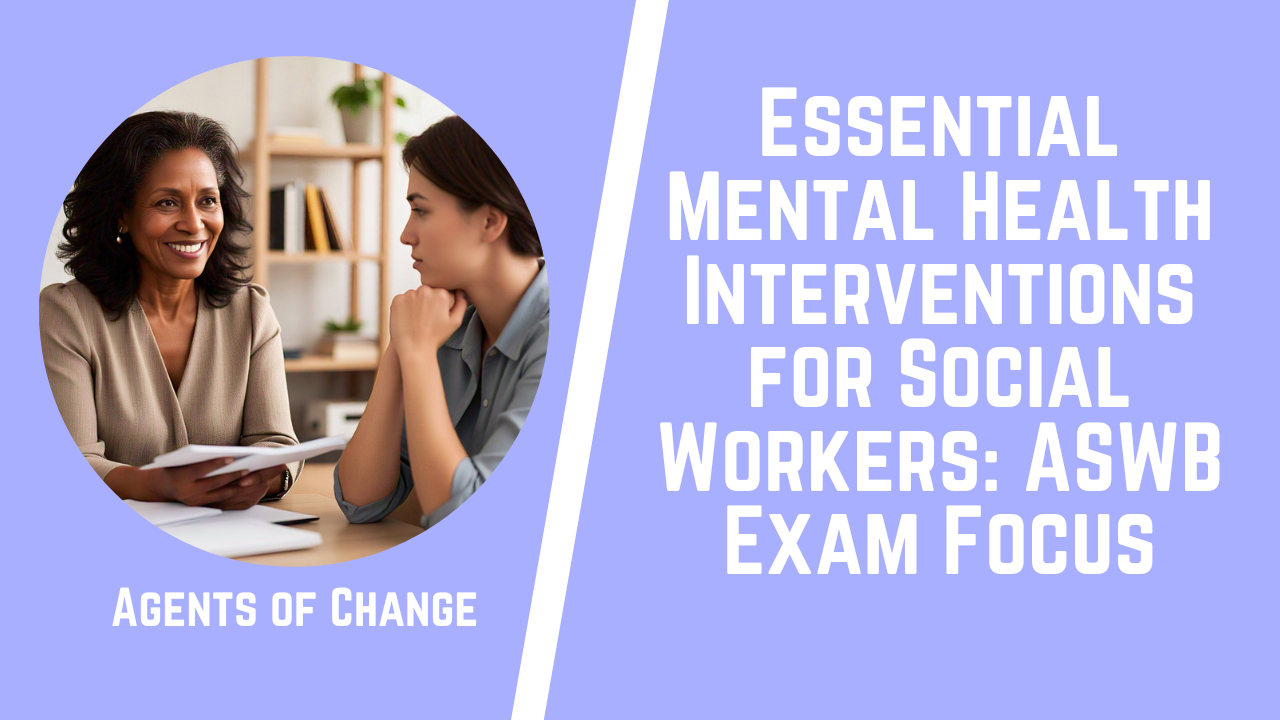
Essential Mental Health Interventions for Social Workers: ASWB Exam Focus
Essential Mental Health Interventions for Social Workers: ASWB Exam Focus
As Social Workers, the essence of our profession lies in our ability to connect with and assist individuals from all walks of life. It’s a career that demands not only a deep understanding of social issues but also the compassion and skills to address them effectively. This blog post delves into the core mental health interventions that are critical for social workers preparing for the ASWB exam, spotlighting the practical strategies that can be employed in real-world scenarios.

In this comprehensive overview, we will explore various evidence-based practices that have proven essential in the field of Social Work. From cognitive-behavioral techniques to crisis intervention methods, these interventions are the tools that empower social workers to offer the best support to their clients. Understanding and mastering these techniques not only prepares future social workers for their certification but also enriches their ability to make a profound difference in the lives they touch.

Moreover, this post aims to serve as a resource for both seasoned practitioners and aspiring professionals. Whether you are gearing up for the ASWB exam or seeking to enhance your practical knowledge, the insights shared here will provide valuable guidance on integrating effective mental health interventions into your practice. Join us as we unpack the key elements that every Social Worker needs to know for both exam success and career excellence in this challenging yet rewarding field.

Learn more about the ASWB exam and create a personalized ASWB study plan with Agents of Change. We’ve helped thousands of Social Workers pass their ASWB exams and want to help you be next!

1) Understanding Mental Health in Social Work

Mental health is a pivotal aspect of Social Work practice, involving the recognition, treatment, and management of psychological disorders within the community. Social Workers play a critical role in supporting individuals to achieve mental wellness through various therapeutic and systemic interventions.

This section breaks down the various components of mental health from a social work perspective, emphasizing the importance of a holistic approach.

a diverse social worker conducting a mental health assessment with a client in a more casual office setting.

The Role of Social Workers in Mental Health

Social Workers are often on the front lines of mental health care, offering support, resources, and therapy to individuals experiencing mental health challenges. Their roles include:

  • Assessment: Identifying symptoms and determining the severity and impact of mental health issues.
  • Intervention: Implementing strategies to manage and treat mental health conditions.
  • Advocacy: Ensuring that clients have access to necessary resources and services.
  • Education: Providing information to clients and their families about mental health conditions and coping mechanisms.

Key Concepts in Mental Health Care

Understanding these foundational concepts is essential for effective practice in the field of Social Work:

  • Biopsychosocial Model: This model assesses an individual’s mental health by considering biological, psychological, and social factors, recognizing that each aspect plays a crucial role in overall mental wellness.
  • Stigma and Mental Health: Addressing the stigma associated with mental illness is vital in encouraging individuals to seek help and participate in treatment plans.
  • Trauma-Informed Care: This approach involves understanding, recognizing, and responding to the effects of all types of trauma. It emphasizes physical, psychological, and emotional safety for both providers and survivors.

Assessing Mental Health Needs

Accurate assessment is the first step towards effective intervention. Social Workers utilize a variety of tools and approaches:

  • Interviews and Observations: Direct interaction with clients provides insights into their emotional state, thought patterns, and behavior.
  • Standardized Assessment Tools: Instruments such as the Beck Depression Inventory or the Anxiety and Depression Scale help quantify the severity of an individual’s condition.
  • Collateral Information: Gathering information from family, friends, and other professionals offers a broader view of the client’s mental health.

Interventions in Social Work

Intervention strategies are tailored to meet the unique needs of each client, with a focus on promoting self-sufficiency and wellness:

  • Therapeutic Techniques: Methods such as Cognitive Behavioral Therapy (CBT), Dialectical Behavior Therapy (DBT), and supportive counseling are commonly used.
  • Community Engagement: Encouraging clients to connect with community resources such as support groups, educational classes, and recreational activities.
  • Holistic Approaches: Incorporating aspects of physical health, spirituality, and community connections into the treatment plan.

Challenges and Opportunities

Social Workers often face several challenges in the field of mental health, including limited resources, high caseloads, and diverse client needs. However, these challenges also present opportunities for innovation and advocacy:

  • Policy Influence: Social Workers are uniquely positioned to advocate for policy changes that can improve access to mental health services.
  • Interdisciplinary Collaboration: Working with other health professionals to provide comprehensive care that addresses all aspects of a client’s life.
  • Continuous Learning: Engaging in ongoing education and training to stay informed about the latest research and techniques in mental health care.

Understanding mental health in Social Work requires a multifaceted approach, emphasizing continual learning and adaptability. By integrating these principles into their practice, Social Workers can effectively support their clients’ journey towards mental wellness, providing crucial interventions that make a lasting difference.

Agents of Change packages include 30+ ASWB topics, 2 free study groups per month, and hundreds of practice questions so you’ll be ready for test day!

2) Key Mental Health Interventions for the ASWB Exam

Preparing for the Association of Social Work Boards (ASWB) exam requires a comprehensive understanding of various mental health interventions that are fundamental to Social Work practice. This section delves into several key interventions that are likely to feature on the exam, providing a detailed look at their theoretical bases, practical applications, and the specific skills that Social Workers need to develop.

A diverse social worker (female) conducting a mental health session with a client in a relaxed outdoor setting.

Cognitive Behavioral Therapy (CBT)

Cognitive Behavioral Therapy is a staple in mental health intervention and an essential study area for the ASWB exam. CBT is based on the concept that an individual’s thoughts, feelings, and behaviors are interconnected, and that altering negative thought patterns can lead to changes in feelings and behaviors.

  • Core Components of CBT:

    • Identification of Distorted Thinking
    • Reformation of Cognitive Distortions
    • Development of New Behavioral Responses
  • Skills for Social Workers:

    • Conducting cognitive assessments to identify harmful thought patterns
    • Facilitating cognitive restructuring sessions with clients
    • Implementing behavioral experiments to reinforce positive change

Motivational Interviewing (MI)

Motivational Interviewing is a client-centered, directive method designed to enhance intrinsic motivation to change by exploring and resolving ambivalence. It is particularly effective in treating substance use disorders, among other behavioral challenges.

  • Key Techniques in MI:

    • Open-ended questions
    • Affirmations
    • Reflective listening
    • Summarization
  • Social Worker Practice Points:

    • Engaging clients in a dialogue that promotes their autonomy in decision-making
    • Encouraging exploration and resolution of mixed feelings towards behavioral change
    • Strengthening the client’s own motivations and commitments to change

Solution-Focused Brief Therapy (SFBT)

Solution-Focused Brief Therapy centers on helping clients develop and achieve their desired outcome through future-focused, goal-oriented therapeutic responses.

  • Principles of SFBT:

    • Setting specific, concise, realistic goals
    • Utilizing the miracle question to explore desired futures
    • Focusing on exceptions to problems
  • Application in Social Work:

    • Assisting clients in identifying their strengths and how these can be applied to achieve their goals
    • Encouraging clients to recognize moments when their problem does not occur
    • Building on past successes to develop effective solutions

Crisis Intervention

This intervention is crucial in situations where clients are experiencing acute distress that poses immediate risk. Social Workers need to act swiftly and effectively to stabilize their clients.

  • Steps in Crisis Intervention:

    • Assessing the severity of the crisis situation
    • Establishing rapport and effectively communicating with the client
    • Identifying immediate needs and resources
    • Developing a plan to address the crisis
  • Critical Skills for Social Workers:

    • Rapid assessment and decision-making under pressure
    • De-escalation techniques in high-tension situations
    • Coordination with other services for holistic support

Preparing for the Exam

a diverse social worker studying for an exam in a library setting.

As these interventions illustrate, mental health in social work encompasses a broad range of skills and knowledge areas. For ASWB exam preparation:

  • Study Recommendations:

  • Resources:

    • Official ASWB study guides and practice tests
    • Continuing education courses focusing on these therapies
    • Workshops and seminars offered by professional social work organizations

Understanding and mastering these key mental health interventions not only prepares Social Workers for the ASWB exam but also enhances their effectiveness in practice. By focusing on these areas, candidates can ensure they are well-prepared to meet the challenges of the exam and of professional practice in the field of Social Work.

3) Special Considerations and Integrating Mental Health Care in Social Work

Social Workers are uniquely positioned at the intersection of individual care and community well-being, where integrating mental health care requires an understanding of various special considerations. This nuanced approach allows for more effective and empathetic support of diverse client populations.

Cultural Competence in Mental Health Care

Cultural competence is essential for Social Workers to effectively address the mental health needs of clients from diverse backgrounds. It involves understanding and integrating clients’ cultural beliefs and practices into their care.

  • Key Aspects of Cultural Competence:

    • Awareness of one’s own cultural worldview
    • Attitude towards cultural differences
    • Knowledge of different cultural practices and worldviews
    • Skills for communication and interaction across cultures
  • Strategies for Social Workers:

    • Conducting cultural self-assessments to improve awareness and sensitivity
    • Engaging in continuous cultural competence training and education
    • Using culturally adapted assessment tools and intervention strategies

Ethical Considerations in Mental Health Practice

Ethics are at the core of Social Work practice, particularly in mental health, where clients may be vulnerable and at risk.

  • Core Ethical Concerns:

    • Confidentiality and privacy
    • Informed consent
    • Competence
    • Dual relationships and boundaries
  • Guidelines for Social Workers:

    • Regularly reviewing ethical standards as outlined by professional bodies such as the NASW (National Association of Social Workers)
    • Participating in peer consultations and supervisions to resolve ethical dilemmas
    • Keeping detailed records that reflect ethical considerations for all client interactions

Integrating Mental Health Care Across Disciplines

Social Workers often collaborate with professionals from various fields to provide comprehensive care. This interprofessional collaboration enhances the effectiveness of mental health interventions.

  • Benefits of Interdisciplinary Approaches:

    • Holistic client assessments that incorporate multiple perspectives
    • Coordinated care plans that address all aspects of client well-being
    • Enhanced resource sharing among healthcare, educational, and social service professionals
  • Collaborative Practices for Social Workers:

    • Developing communication channels and regular meetings with other professionals
    • Establishing clear roles and responsibilities to prevent service overlap
    • Creating integrated care protocols that include referral systems between different service providers

Continuous Professional Development

The field of mental health is dynamic, with new research and techniques continuously developing. Social Workers must commit to ongoing education to stay effective and responsive.

  • Professional Development Activities:
    • Attending workshops, seminars, and conferences on the latest mental health practices
    • Pursuing additional certifications in specialized areas of mental health care
    • Engaging in regular supervisory sessions to enhance skills and obtain feedback

Challenges in Integration

While integrating mental health care in social work is crucial, it poses certain challenges:

  • Resource Limitations: Financial constraints can limit access to necessary tools and training.
  • System Barriers: Navigational difficulties within health and social systems can complicate care coordination.
  • Stigma: Stigmatization of mental health issues can hinder client willingness to seek and continue care.

Overcoming Integration Barriers

To overcome these challenges, Social Workers can adopt innovative solutions and advocacy:

  • Advocacy for Policy Change: Championing policies that provide better funding and support for mental health services.
  • Community Engagement: Building partnerships with community organizations to broaden the support network for clients.
  • Utilizing Technology: Implementing telehealth services and online resources to expand access to care.

Integrating mental health care into social work not only enhances the quality of support offered to clients but also elevates the practice of Social Work itself. By considering cultural, ethical, and interdisciplinary factors, Social Workers can lead the charge in delivering compassionate, effective, and comprehensive mental health care.

4) FAQs – Essential Mental Health Interventions for Social Workers: ASWB Exam Focus

Q: What are the most effective study strategies for mastering mental health interventions for the ASWB exam?

A: Focused Learning: Concentrate on understanding theories and their applications rather than rote memorization. Use a variety of learning methods including flashcards, group discussions, and teaching others to reinforce your knowledge.

Practical Application: Engage in practical experiences like internships or volunteer positions in mental health settings. Applying theoretical knowledge in real-world scenarios can deepen your understanding and retention.

Mock Exams and Review Sessions: Regularly practice with simulated exams and review sessions to become familiar with the format and timing of the ASWB test. This will also help identify areas where further study is needed. Agents of Change offers 3 full-length practice exams.

Q: How can Social Workers integrate mental health care effectively in their practice?

A: Interdisciplinary Collaboration: Work closely with other healthcare professionals, educators, and community leaders to develop comprehensive care plans that address all aspects of a client’s life.

Continuing Education: Stay updated on the latest mental health research, trends, and techniques. Participating in workshops, seminars, and additional certifications can enhance your skills and effectiveness.

Client-Centered Approach: Tailor interventions to fit the unique cultural, socio-economic, and personal backgrounds of your clients. This personalized approach ensures that the mental health care provided is relevant and impactful.

Q: What role does cultural competence play in mental health interventions in Social Work, and how can it be developed?

A: Importance of Cultural Competence: Cultural competence allows Social Workers to better understand and meet the diverse needs of their clients, ensuring that interventions are appropriate and effective. It involves recognizing the client’s cultural beliefs, values, and behaviors as central components of their mental health and treatment.

Developing Cultural Competence:

  • Education and Training: Regularly participate in cultural competency training and education programs that focus on understanding various cultural backgrounds and how these affect mental health care.
  • Community Engagement: Immerse yourself in different communities to gain a first-hand understanding of cultural norms and values. This can also involve attending cultural events and building relationships with community leaders.
  • Self-Reflection: Continuously reflect on your own cultural biases and perceptions. Seek feedback from peers and supervisors to improve your practice and interactions with clients from diverse backgrounds.

5) Conclusion

As we conclude our exploration of essential mental health interventions for Social Workers preparing for the ASWB exam, it’s clear that the breadth and depth of knowledge required are substantial. However, the strategies, theories, and practical applications discussed not only prepare you for a successful examination but are also vital in shaping a compassionate, effective, and ethical practice. Understanding and integrating these interventions into your work will empower you to make a significant difference in the lives of those you serve.

The journey to becoming a proficient Social Worker is ongoing and demands dedication to continual learning and professional development. By embracing the comprehensive content covered in the ASWB exam, Social Workers can ensure they are well-equipped to meet the diverse needs of their clients. Whether it’s through mastering cognitive behavioral therapy, enhancing motivational interviewing skills, or integrating culturally competent practices, each step forward is a step toward more effective client outcomes.

Ultimately, the goal of every Social Worker should be to provide the highest quality of care. This means staying informed about the latest developments in mental health interventions, actively seeking out further education, and participating in a community of practice that values ethical standards and respects cultural differences. With these tools and a robust understanding of the essential mental health interventions discussed, Social Workers can look forward to a rewarding career filled with opportunities to foster change and promote mental wellness in their communities.


► Learn more about the Agents of Change course here: https://agentsofchangeprep.com

About the Instructor, Meagan Mitchell: Meagan is a Licensed Clinical Social Worker and has been providing individualized and group test prep for the ASWB for over 8 years. From all of this experience helping others pass their exams, she created the Agents of Change course to help you prepare for and pass the ASWB exam!

Find more from Agents of Change here:

► Facebook Group: https://www.facebook.com/groups/aswbtestprep

► Podcast: https://podcasters.spotify.com/pod/show/agents-of-change-sw

#socialwork #testprep #aswb #socialworker #socialwork #socialworktest #socialworkexam #exam #socialworktestprep #socialworklicense #socialworklicensing #licsw #lmsw #lcsw #aswbexam #aswb #lcswexam #lmswexam #aswbtestprep #aswbtest #lcswtestprep #lcswtest #lmswtestprep #lmswtest #aswbcourse #learningstyles #learningstyle

Disclaimer: This content has been made available for informational and educational purposes only. This content is not intended to be a substitute for professional medical or clinical advice, diagnosis, or treatment.

Share:

Discover more from Agents of Change

Subscribe now to keep reading and get access to the full archive.

Continue reading