Ethics and the ASWB Exam: 1.14 Clients Who Lack Decision-Making Capacity
Ethics and the ASWB Exam: 1.14 Clients Who Lack Decision-Making Capacity
Navigating the ethical terrain of Social Work can feel overwhelming, especially when your client isn’t fully capable of making their own decisions. Whether due to cognitive impairment, severe mental illness, or medical incapacitation, there are moments when clients can’t speak for themselves. In these cases, Social Workers must balance their professional responsibilities with compassion, legal awareness, and deep ethical grounding. For those studying for the ASWB exam, understanding this balance is absolutely essential.

One of the most critical and frequently tested areas of the NASW Code of Ethics is Section 1.14: Clients Who Lack Decision-Making Capacity. This section addresses what Social Workers should do when a client cannot provide informed consent or make sound choices about their treatment, services, or safety. While that might seem straightforward at first, real-world scenarios and exam questions often present messy, emotionally charged challenges. How do you honor client dignity while also safeguarding their well-being?

In this blog post, we will unpack the ethical, legal, and practical dimensions of working with clients who lack decision-making capacity. You will see how this concept appears on the ASWB exam, work through a sample question with rationale, and discover resources like Agents of Change that will help you study with purpose and clarity. By the end, you will not just be memorizing policies. You will understand how to apply them with integrity and confidence.

Learn more about the ASWB exam and create a personalized ASWB study plan with Agents of Change. We’ve helped tens of thousands of Social Workers pass their ASWB exams and want to help you be next!

1) What Is Section 1.14 Clients Who Lack Decision-Making Capacity?

Section 1.14 of the NASW Code of Ethics outlines how Social Workers should respond when clients are unable to make informed decisions. This guidance is essential because it defines both the responsibility to protect vulnerable individuals and the obligation to uphold their rights and dignity. When preparing for the ASWB exam, this section frequently appears in questions related to consent, guardianship, medical decisions, and ethical boundaries.

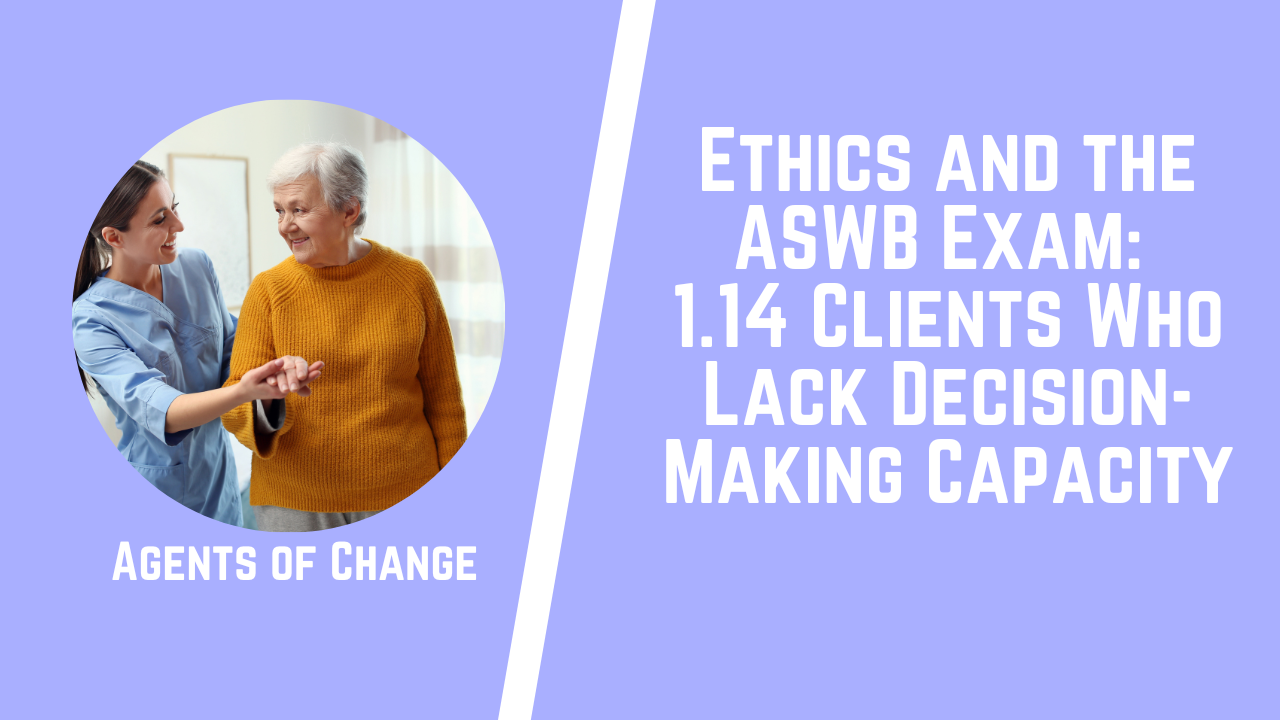
a social worker working with an older client who has dementia

Here is the complete official text from the NASW Code of Ethics:

1.14 Clients Who Lack Decision-Making Capacity
When social workers act on behalf of clients who lack the capacity to make informed decisions, social workers should take reasonable steps to safeguard the interests and rights of those clients.

Let’s break this down to understand what each part is really saying.


“When social workers act on behalf of clients who lack the capacity to make informed decisions…”

This part recognizes that there are situations in which a Social Worker must take a more active role. This should only happen when the client clearly cannot understand, evaluate, or express decisions about their care.

Reasons might include dementia, mental illness, developmental disability, severe trauma, or a medical emergency. The phrase “lack the capacity” is critical. You must confirm this with a professional assessment, not rely on assumptions or brief interactions.

What this means for the ASWB exam:
Never take action on behalf of a client unless there is clear and documented evidence of incapacity. A client refusing help or making poor choices is not the same as lacking decision-making capacity. Look for a step that involves confirmation or evaluation before acting.


“…social workers should take reasonable steps to safeguard the interests and rights of those clients.”

Once it is clear that a client cannot make informed decisions, the Social Worker is ethically required to protect both the client’s welfare and their rights. “Reasonable steps” might include consulting legal guardians, working with healthcare providers, using the least restrictive interventions, and honoring previously stated preferences whenever possible.

What this means in practice:

  • Always seek out any known client wishes or advance directives.

  • Choose options that prioritize the client’s dignity and freedom.

  • Involve legal representatives or family members only when appropriate.

  • Document your decisions thoroughly to show they are rooted in ethics and best practice.

What this means for the ASWB exam:
You will likely be asked what should be done first when a client appears incapable. The best answer usually involves confirming capacity or consulting an authorized party. Avoid jumping to conclusions or making decisions without proper support.


Why Section 1.14 Matters

This guideline may be brief, but it touches on some of the most serious responsibilities in Social Work. The role of a Social Worker includes protecting those who cannot protect themselves, while still treating them with respect and preserving their voice whenever possible. You may find this section of ethics at the center of complex case scenarios on the ASWB exam, particularly those that require balancing safety, legal process, and human dignity.

Key reminders:

  • Always verify incapacity through appropriate means.

  • Take actions that respect both safety and client autonomy.

  • Know when to involve third parties and how to document the process clearly.

This section is a powerful reminder that ethical practice is never about control. It is about guidance, advocacy, and respect.

Agents of Change packages include 30+ ASWB topics, 2 free study groups per month, and hundreds of practice questions so you’ll be ready for test day!

2) Why Understanding Clients Who Lack Decision-Making Capacity Matters on the ASWB Exam

The ASWB exam isn’t just about memorizing facts. It’s designed to test how you think, how you respond to ethical dilemmas, and whether you understand the values of Social Work in real-life scenarios.

a social worker working with an older client who has dementia

One of the most commonly misunderstood areas involves clients who cannot make informed decisions. This is exactly why Section 1.14 of the NASW Code of Ethics is more than just a few lines on paper. It is a high-stakes topic that shows up across all exam levels in subtle, layered ways.


1. Ethical Competence Is Core to Every Exam Level

Whether you’re taking the Bachelor’s, Master’s, Advanced Generalist, or Clinical level exam, ethics is part of every domain. Questions about clients with impaired decision-making capacity test your ability to apply principles like self-determination, protection, and advocacy.

Ethical competence includes:

  • Recognizing when a client may lack capacity

  • Knowing the correct process to confirm incapacity

  • Understanding when to involve legal or medical professionals

  • Balancing risk, rights, and best interests without overstepping

Failing to grasp these responsibilities can lead to selecting exam answers that are either too passive or too aggressive. The ASWB is testing your ability to walk that middle ground with confidence and professionalism.


2. Realistic Scenarios That Mirror Practice

ASWB exam questions are often based on complex case scenarios. You might see a client who recently suffered a traumatic brain injury, or one with severe psychosis who is refusing care. The question may not explicitly state that the client lacks capacity; you must infer this through clinical reasoning.

Expect to be asked things like:

  • What should the Social Worker do first?

  • Who has legal authority to make decisions?

  • How should the Social Worker advocate for the client?

  • What rights must still be respected?

These are more than academic questions. They mirror what Social Workers face daily in hospitals, aging services, mental health settings, and child welfare.


3. Decision-Making Capacity Questions Are Cross-Topic

This ethical standard doesn’t appear in isolation. It often overlaps with other tested areas, including:

  • Confidentiality and Informed Consent
    Can the client truly understand what they are agreeing to?

  • Professional Conduct and Boundaries
    Are you making decisions that legally require court involvement?

  • Client Rights and Advocacy
    Is the Social Worker respecting what the client would have wanted?

  • Interdisciplinary Collaboration
    Should you consult a medical team, legal representative, or guardian?

This means you might encounter Section 1.14 in questions that appear to be about other topics, but still hinge on your understanding of capacity and ethical responsibility.


4. Common Pitfalls to Avoid on the Exam

Many test-takers lose points on these questions by jumping to action too quickly or skipping essential steps. Knowing what not to do is just as important as knowing what to do.

Avoid these common mistakes:

  • Acting without a formal capacity assessment

  • Involving family without proper legal authority

  • Ignoring a client’s previously stated preferences

  • Assuming incapacity based on diagnosis alone

  • Making decisions independently without documentation or consultation

Each of these errors violates the standard set in Section 1.14 and could lead to the wrong answer on the exam—and serious ethical issues in practice.


5. What the ASWB Wants to See in Your Thinking

The exam doesn’t just want the “right” answer. It wants to see that you:

  • Start with the least intrusive or most respectful approach

  • Follow the legal and ethical process

  • Prioritize the client’s best interest and rights

  • Use clinical reasoning to assess the situation

  • Know when to refer or collaborate

If you can show that you know how to navigate ethically when a client is vulnerable, you will pass more than just that question; you will demonstrate readiness for the profession.


6. How to Study This Topic Effectively

Understanding this topic is critical, and Agents of Change offers the tools to help you master it with confidence. Their study programs include real-world examples, challenging practice questions, and live group sessions that often discuss ethics-related cases.

With Agents of Change, you get:

  • Practice questions with clear explanations

  • Flashcards that reinforce key terms and standards

  • Monthly live study groups where you can ask questions

  • Study plans that organize your prep from start to finish

  • Unlimited access until you pass, so you never run out of time

You’ll never feel like you started studying too early or got off track. The tools are designed to help you recognize situations involving clients with limited capacity and respond just like the exam expects you to.

Explore more at Agents of Change Course Selection

3) ASWB Practice Question: Clients Who Lack Decision-Making Capacity

A Social Worker at a long-term care facility is assigned to a 76-year-old resident who recently experienced a significant cognitive decline after a stroke. The resident now has difficulty understanding basic information about her care plan and appears disoriented during conversations. There is no legal guardian, healthcare proxy, or advance directive on file. The resident’s adult daughter insists on making all medical decisions for her mother.

What should the Social Worker do FIRST?

A. Contact the facility’s legal team to begin guardianship proceedings
B. Allow the daughter to make decisions as the presumed next of kin
C. Refer the resident for a formal assessment of decision-making capacity
D. Work with the care team to implement what the daughter believes is best for the resident


Correct Answer: C. Refer the resident for a formal assessment of decision-making capacity


Rationale:

C. Refer the resident for a formal assessment of decision-making capacity
✅ This is the correct answer because before anyone else can legally or ethically step in to make decisions, the client’s decision-making capacity must be formally evaluated. Even if the resident appears confused or disoriented, a Social Worker cannot assume incapacity. Ethical practice, as outlined in the NASW Code of Ethics Section 1.14, requires social workers to take reasonable steps to safeguard the rights and interests of clients. This begins with understanding their actual capacity through an appropriate clinical assessment.


Why the Other Answers Are Incorrect:

A. Contact the facility’s legal team to begin guardianship proceedings
❌ This step may be necessary later, but it is premature. Guardianship is a serious legal intervention and should only be pursued after a formal capacity assessment confirms that the resident cannot make informed decisions and that no other less restrictive options are available.

B. Allow the daughter to make decisions as the presumed next of kin
❌ While family members often advocate for loved ones, a daughter does not automatically have legal authority to make decisions unless legally designated (such as through a power of attorney or guardianship). Letting her decide without verifying capacity or legal authority puts the client’s rights at risk.

D. Work with the care team to implement what the daughter believes is best for the resident
❌ This option skips over essential ethical and legal procedures. Acting on the daughter’s input without confirming capacity or her legal status may violate the client’s autonomy and could result in inappropriate or unauthorized care.


Key Takeaway for the ASWB Exam:
When a client appears unable to make informed decisions, your first step should be to confirm capacity through a formal assessment, not to make assumptions or default to family input. This reflects both ethical Social Work practice and the expectations of Section 1.14 of the NASW Code of Ethics.

4) FAQs – Code of Ethics: 1.14 Clients Who Lack Decision-Making Capacity

Q: How can a Social Worker determine if a client truly lacks decision-making capacity?

A: A Social Worker cannot make this determination independently unless they are also a licensed clinical professional specifically trained to assess capacity. The first and most ethical step is to refer the client for a formal evaluation by a qualified medical, psychological, or psychiatric professional.

These assessments typically evaluate whether the client can comprehend information, understand the consequences of their choices, reason logically, and articulate a decision. Without this evaluation, Social Workers must proceed as if the client retains capacity, even if their behavior seems confused or inconsistent.

Q: What should a Social Worker do if a family member insists on making decisions for the client but doesn’t have legal authority?

A: Family members often mean well, but unless they hold legal authority (such as guardianship or power of attorney), they cannot override the client’s autonomy. The Social Worker should first seek a capacity assessment for the client.

If the client is found to lack decision-making capacity and has no appointed legal surrogate, the Social Worker may then work with the appropriate legal channels to establish guardianship or another substitute decision-maker. Throughout the process, it is critical to document every step and involve the client as much as possible, even if their decision-making is impaired.

Q: What if a client made clear wishes in the past, but now lacks capacity and can’t reaffirm them—should those prior wishes still be followed?

A: Yes, when a client has previously expressed clear, informed preferences, those should guide the Social Worker’s actions whenever possible. The NASW Code of Ethics encourages Social Workers to honor previously stated wishes when clients lack current decision-making capacity.

Whether those wishes were written in an advance directive or verbally expressed and documented, they represent the client’s autonomy and values. Ignoring them may violate ethical practice, especially if current decision-makers are acting in ways that contradict the client’s known beliefs or goals.

5) Conclusion

Understanding Section 1.14: Clients Who Lack Decision-Making Capacity is more than just memorizing a line from the NASW Code of Ethics. It’s about knowing how to act when a client can’t speak for themselves and making sure their dignity, safety, and rights remain protected. On the ASWB exam, these questions can be subtle and emotionally complex, but they are rooted in one core idea: Social Workers must respond with both compassion and ethical clarity.

The exam will challenge you to recognize when a client truly lacks decision-making capacity, when it’s appropriate to involve others, and how to proceed without violating professional boundaries. That means slowing down, assessing carefully, consulting when needed, and always keeping the client’s best interests at the center. These are the exact qualities the ASWB is trying to confirm in future Social Workers, and they’re the same qualities that lead to ethical, effective practice in the real world.


► Learn more about the Agents of Change course here: https://agentsofchangeprep.com

About the Instructor, Dr. Meagan Mitchell: Meagan is a Licensed Clinical Social Worker and has been providing individualized and group test prep for the ASWB for over 10 years. From all of this experience helping others pass their exams, she created the Agents of Change course to help you prepare for and pass the ASWB exam!

Find more from Agents of Change here:

► Facebook Group: https://www.facebook.com/groups/aswbtestprep

► Podcast: https://podcasters.spotify.com/pod/show/agents-of-change-sw

#socialwork #testprep #aswb #socialworker #socialwork #socialworktest #socialworkexam #exam #socialworktestprep #socialworklicense #socialworklicensing #licsw #lmsw #lcsw #aswbexam #aswb #lcswexam #lmswexam #aswbtestprep #aswbtest #lcswtestprep #lcswtest #lmswtestprep #lmswtest #aswbcourse #learningstyles #learningstyle

Disclaimer: This content has been made available for informational and educational purposes only. This content is not intended to be a substitute for professional medical or clinical advice, diagnosis, or treatment.

Share:

Discover more from Agents of Change

Subscribe now to keep reading and get access to the full archive.

Continue reading