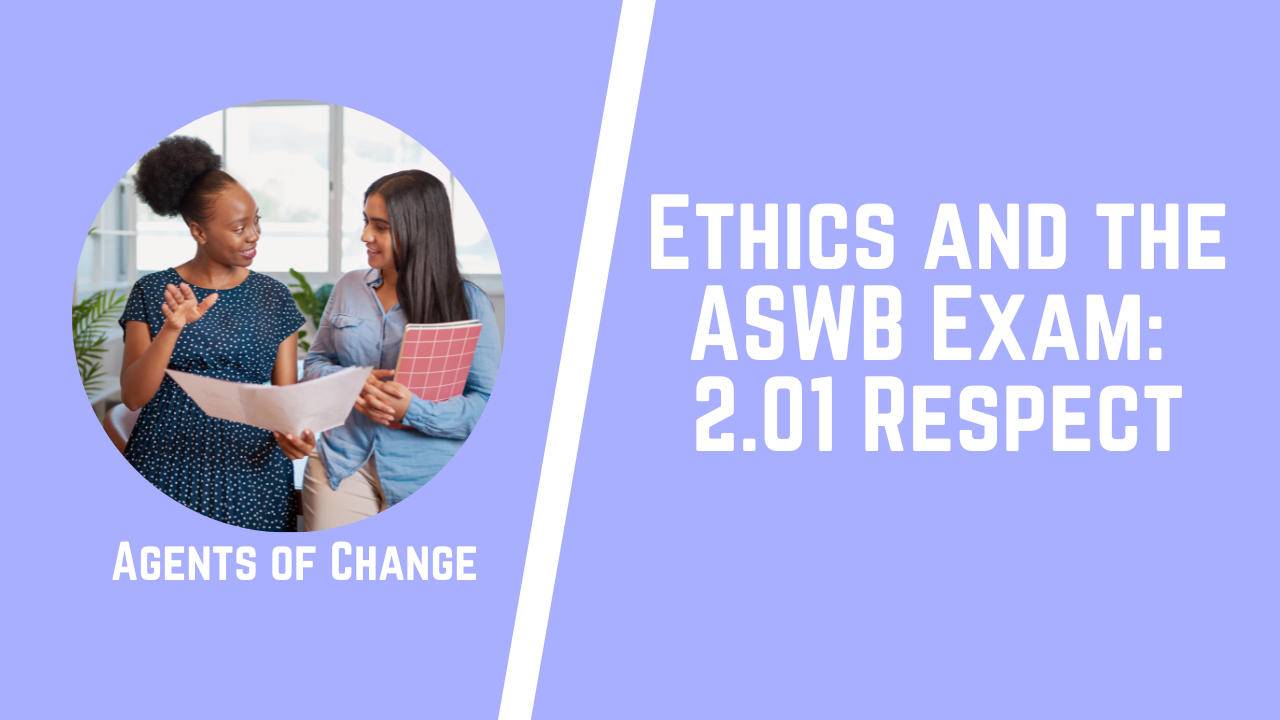
Ethics and the ASWB Exam: 2.01 Respect

Ethics and the ASWB Exam: 2.01 Respect
Studying for the ASWB exam means diving into the heart of Social Work values, and one of the most essential is “2.01 Respect.” This section of the NASW Code of Ethics may seem straightforward at first, but it embodies a profound commitment to professional integrity, fairness, and collaboration. Whether you’re working alongside colleagues from different disciplines or navigating tension in team dynamics, understanding this ethical standard is non-negotiable.

The ASWB exam doesn’t just test your ability to recall terms or interventions; it also assesses your understanding of the concepts behind them. It evaluates how you apply ethical principles in real-world scenarios, including those involving coworkers. That’s why 2.01 Respect matters so much. It’s about how you handle disagreements, how you represent others honestly, and how you stay grounded in dignity and fairness, even when situations get tough.

This blog post will explore the meaning of 2.01 Respect, its relevance to the exam, and how to approach questions on this topic with confidence. With the right tools, like those from Agents of Change, you’ll be equipped to tackle ethics questions and step into the profession with clarity and strength.

Learn more about the ASWB exam and create a personalized ASWB study plan with Agents of Change. We’ve helped tens of thousands of Social Workers pass their ASWB exams and want to help you be next!

1) What Is Section 2.01: Respect of the Code of Ethics?

Section 2.01 of the NASW Code of Ethics is titled Respect and falls under the broader category of Social Workers’ Ethical Responsibilities to Colleagues. This section emphasizes that respect among professionals isn’t optional; it’s a core expectation of ethical Social Work practice.

two mental health professional colleagues having a deep and purposeful conversation in a visually interesting interesting casual office environment

Whether we’re working on interdisciplinary teams, collaborating with community partners, or interacting with agency staff, how we treat others reflects directly on our profession.

Here’s the full text of Section 2.01: Respect from the NASW Code of Ethics:

2.01 Respect
(a) Social workers should treat colleagues with respect and should represent accurately and fairly the qualifications, views, and obligations of colleagues.
(b) Social workers should avoid unwarranted negative criticism of colleagues in communications with clients or with other professionals. Unwarranted negative criticism may include demeaning comments that refer to colleagues’ level of competence or to individuals’ attributes such as race, ethnicity, national origin, color, sex, sexual orientation, gender identity or expression, age, marital status, political belief, religion, immigration status, and mental or physical ability.
(c) Social workers should cooperate with social work colleagues and with colleagues of other professions when such cooperation serves the well-being of clients.

Now, let’s break down what each part means in day-to-day Social Work practice:

(a) Fair Representation and Professional Respect

This first part highlights the importance of respecting both the person and the professional identity of your colleagues. That includes how you talk about them, represent their ideas, and acknowledge their qualifications.

Whether you’re discussing a teammate’s role in a case or explaining a care plan to a client, your job is to be fair, honest, and clear about others’ contributions. It’s also about giving credit where it’s due and avoiding misrepresentations, intentional or not.

(b) Avoiding Unwarranted Criticism

This section gets into the heart of ethical communication. Social Workers are expected to steer clear of unnecessary negativity or harmful commentary about coworkers, especially in front of clients or other professionals. That doesn’t mean you can’t offer feedback or raise concerns, but it should be done constructively and without demeaning language.

Criticism based on identity traits (like race, gender, or disability) is especially harmful and directly violates this standard. The goal is to foster a safe, respectful, and professional climate that reflects the values of equity and inclusion.

(c) Promoting Cooperation Across Disciplines

Social Work doesn’t happen in a vacuum. This part of 2.01 requires intentional and ethical collaboration with both Social Work colleagues and professionals from other fields. Whether you’re working with doctors, teachers, or legal advocates, you’re expected to engage in cooperative relationships that support the client’s best interests. That means setting aside ego, embracing teamwork, and recognizing the value others bring to the table.

Each part of Section 2.01 reinforces a simple truth: ethical Social Work is relational. How you treat your colleagues impacts client outcomes, team dynamics, and your own professional credibility. And on the ASWB exam, being able to apply this section thoughtfully can make the difference between a right or wrong answer.

Agents of Change packages include 30+ ASWB topics, 2 free study groups per month, and hundreds of practice questions so you’ll be ready for test day!

2) Why Understanding Respect Matters on the ASWB Exam

When preparing for the ASWB exam, many test-takers focus heavily on direct client work, assessments, or crisis intervention. While those areas are important, they’re only part of the big picture.

Ethics questions make up a significant portion of the test, and within that category, Section 2.01: Respect shows up more often than many realize. Understanding this ethical standard is essential because it speaks to how Social Workers behave in real-world professional settings, with colleagues, on teams, and within systems.

two mental health professional colleagues having a deep and purposeful conversation in a visually interesting interesting casual office environment

Let’s explore why Section 2.01: Respect carries weight on the ASWB exam and what it looks like in action.


Upholding Professional Standards

The ASWB exam isn’t just about knowledge; it’s also about application. It’s about how you demonstrate ethical reasoning in complex, real-life situations. Respect is a core part of professional conduct, especially in interdisciplinary environments where Social Workers frequently engage with people from different backgrounds and disciplines.

Here’s why this matters:

  • Ethical practice reflects directly on the integrity of the Social Work profession

  • Respect builds trust among team members and strengthens collaborative care

  • Ethical violations involving colleagues can lead to disciplinary action or harm to clients

On the exam, questions may ask you to choose the best or most ethical response when interacting with coworkers, particularly when there’s conflict or concern. Section 2.01 helps guide those decisions.


Common Testing Themes Related to Respect

ASWB ethics questions are often scenario-based. They test your ability to respond appropriately in professional situations. Section 2.01 frequently appears in the following themes:

  • Addressing inappropriate comments or actions by colleagues

  • Avoiding gossip, bias, or assumptions about others’ abilities

  • Managing disagreements with professionalism and fairness

  • Maintaining confidentiality when discussing colleagues’ performance

  • Collaborating respectfully across disciplines

These topics aren’t just theoretical. They show up in agencies, schools, hospitals, and community programs every day. The exam aims to assess your ability to make informed judgment calls that prioritize fairness, accuracy, and cooperation.


Examples of How Section 2.01 May Appear on the Exam

To help you prepare, here are a few examples of how Section 2.01 might show up in multiple-choice form:

  • A colleague makes a culturally insensitive comment in a team meeting. How should you respond?

  • You disagree with how a fellow Social Worker handled a case. What is the most ethical way to raise your concerns?

  • A client complains that another staff member has been dismissive or disrespectful. What should you do first?

Each of these questions is anchored in how well you understand the principles of professional respect. They require you to think critically and ethically under pressure, just like in practice.


Quick Tips for Answering Respect-Based Questions

When facing questions that involve colleagues, try to:

  • Start with direct, respectful communication whenever it’s safe and appropriate

  • Avoid retaliation, gossip, or public criticism

  • Focus on collaboration and shared responsibility for client outcomes

  • Consult supervision or policies when direct discussion doesn’t resolve the issue

  • Always consider the impact on the client when weighing options

These strategies often align with the best answer choices on the exam. Ethics questions may not have a perfect solution, but the most ethical answer usually preserves professionalism, fairness, and the dignity of all involved.

3) ASWB Practice Question: Respect

A Social Worker on an interdisciplinary team hears a colleague repeatedly refer to another team member as “incompetent” during private conversations with staff. The Social Worker believes the comments are exaggerated and based more on personal dislike than professional concern. According to the NASW Code of Ethics, what is the MOST appropriate response?

A. Report the colleague’s behavior to the team supervisor for further investigation
B. Confront the colleague publicly during the next team meeting to discourage further gossip
C. Speak privately with the colleague to express concern about the critical comments
D. Ignore the situation unless the targeted team member reports feeling harassed


Correct Answer:
C. Speak privately with the colleague to express concern about the critical comments


Rationale:

Section 2.01(b) of the NASW Code of Ethics instructs Social Workers to avoid unwarranted negative criticism of colleagues. The most ethical response is to start with a private, respectful conversation, giving the colleague a chance to reflect and adjust their behavior. This approach respects professional boundaries while addressing harmful conduct directly and effectively.

Option A may be necessary if the behavior persists, but initiating dialogue aligns better with the values of fairness and accountability. Option B is confrontational and risks damaging team trust. Option D fails to uphold ethical responsibility to the work environment and may allow the behavior to continue unchecked.

4) FAQs – Code of Ethics: 2.01 Respect

Q: Is Section 2.01: Respect only relevant when working with other Social Workers?

A: No, Section 2.01 applies to all colleagues, not just fellow Social Workers. This includes professionals from other disciplines like nurses, physicians, teachers, case managers, therapists, and administrative staff.

The NASW Code of Ethics emphasizes respect in all professional relationships, especially when collaboration serves the well-being of clients. Respecting diverse perspectives, roles, and contributions is essential for ethical practice and directly impacts client outcomes. On the ASWB exam, you may be tested on scenarios involving colleagues from outside the Social Work field, so understanding that respect crosses all professional boundaries is key.

Q: If I see a colleague acting unethically, do I have to speak with them first before reporting it?

A: In most situations, yes. The NASW Code of Ethics encourages Social Workers to address concerns directly with the colleague when it’s safe and appropriate to do so. Section 2.01 supports open, respectful communication rather than immediate escalation.

However, if the unethical behavior involves serious harm to a client, ongoing risk, or if direct communication is unsafe, then reporting to a supervisor or licensing board may be necessary. On the ASWB exam, the best answer typically reflects a balanced approach: start with professional dialogue when possible, but always prioritize client safety and ethical responsibility.

Q: How can I study ethics sections like 2.01 Respect more effectively for the ASWB exam?

A: The best way to study ethical concepts like 2.01 Respect is through realistic practice and scenario-based learning. Memorizing the code isn’t enough; you need to apply it. That’s where Agents of Change is an invaluable resource. They offer targeted ASWB prep tools like flashcards, full-length practice exams, two live study groups per month, and clear rationales that help you think like a test writer.

Plus, every program includes a structured study plan and access until you pass, so you can start preparing as early as you’d like without worrying about timing. Understanding ethics isn’t just about passing the exam; it’s about stepping confidently into professional practice. Agents of Change helps you do both.

5) Conclusion

Understanding Section 2.01: Respect of the NASW Code of Ethics isn’t just about memorizing a rule. It’s about embracing a core value that guides every interaction you’ll have as a Social Worker. Whether you’re communicating with a colleague, navigating team dynamics, or managing a professional disagreement, respect remains a steady ethical compass. And when it comes to the ASWB exam, that principle shows up often, asking you to choose responses that balance honesty, professionalism, and collaboration.

As you prepare for the exam, don’t overlook ethics questions that focus on relationships with colleagues. They might seem less direct than client scenarios, but they’re just as important. Practicing how to respond ethically to criticism, conflict, or even subtle forms of disrespect will help you stand out, both on the test and in the real world. These aren’t just test questions. They are reflections of the decisions you’ll make every day as a professional.


► Learn more about the Agents of Change course here: https://agentsofchangeprep.com

About the Instructor, Dr. Meagan Mitchell: Meagan is a Licensed Clinical Social Worker and has been providing individualized and group test prep for the ASWB for over 10 years. From all of this experience helping others pass their exams, she created the Agents of Change course to help you prepare for and pass the ASWB exam!

Find more from Agents of Change here:

► Facebook Group: https://www.facebook.com/groups/aswbtestprep

► Podcast: https://podcasters.spotify.com/pod/show/agents-of-change-sw

#socialwork #testprep #aswb #socialworker #socialwork #socialworktest #socialworkexam #exam #socialworktestprep #socialworklicense #socialworklicensing #licsw #lmsw #lcsw #aswbexam #aswb #lcswexam #lmswexam #aswbtestprep #aswbtest #lcswtestprep #lcswtest #lmswtestprep #lmswtest #aswbcourse #learningstyles #learningstyle

Disclaimer: This content has been made available for informational and educational purposes only. This content is not intended to be a substitute for professional medical or clinical advice, diagnosis, or treatment.

Share:

Discover more from Agents of Change

Subscribe now to keep reading and get access to the full archive.

Continue reading