Ethics and the ASWB Exam: 2.07 Sexual Harassment
Ethics and the ASWB Exam: 2.07 Sexual Harassment
Preparing for the ASWB exam can feel like juggling ethics, theory, and real-life judgment calls all at once. One topic that frequently causes hesitation is sexual harassment. It’s not always overt, and that’s exactly what makes it tricky. The NASW Code of Ethics addresses this directly in section 2.07, and understanding what it says isn’t just about passing the test. It’s about practicing Social Work with integrity, accountability, and awareness.

Ethics and the ASWB Exam: 2.07 Sexual Harassment may not seem like a major focus at first glance, but it holds critical weight on the exam. The ASWB often presents ethical dilemmas that force you to think through complicated situations. This section teaches you to recognize inappropriate behaviors, respond appropriately, and uphold professional boundaries, even when the lines seem blurred. In short, you’ll need more than memorization to succeed here. You’ll need real-world judgment grounded in the core values of Social Work.

This article breaks down what section 2.07 is really about, why it matters on the ASWB exam, and how to spot those subtle yet serious red flags. We’ll also walk through example questions, offer practical strategies, and show you how a resource like Agents of Change can give you the edge you need. Whether you’re months into studying or just getting started, it’s never too early to build confidence in ethical decision-making.

Learn more about the ASWB exam and create a personalized ASWB study plan with Agents of Change. We’ve helped tens of thousands of Social Workers pass their ASWB exams and want to help you be next!

1) What Is Section 2.07 Sexual Harassment?

Section 2.07 of the NASW Code of Ethics focuses on sexual harassment and outlines the professional standards Social Workers must uphold in order to foster safe and respectful environments. While the language of the section is brief, its implications are powerful.

Here’s the full text of Section 2.07:

2.07 Sexual Harassment

Social workers should not sexually harass supervisees, students, trainees, colleagues, or research subjects. Sexual harassment includes sexual advances; sexual solicitation; requests for sexual favors; and other verbal, written, electronic, or physical contact of a sexual nature.

On the surface, this may seem clear enough, but the key lies in understanding how it applies across different settings and relationships within Social Work. Let’s break it down line by line:

“Social workers should not sexually harass supervisees, students, trainees, colleagues, or research subjects.”

This opening sentence clearly defines the scope of responsibility. Sexual harassment isn’t limited to clients. It includes anyone a Social Worker interacts with professionally, particularly in power-imbalanced relationships. That means the standard applies whether you’re supervising a graduate intern, collaborating with a coworker, or conducting research. The role doesn’t matter; ethical behavior is expected across all professional contexts.

“Sexual harassment includes sexual advances; sexual solicitation; requests for sexual favors; and other verbal, written, electronic, or physical contact of a sexual nature.”

Here, the definition broadens. Sexual harassment can take many forms. It might be a suggestive comment during supervision, a text message sent after hours, or an unwanted physical touch. The key is that the behavior is sexual in nature and unwelcome. Also important is the format, which encompasses more than just in-person interactions. Emails, social media, and messaging apps are all within scope.

Ultimately, Section 2.07 reminds Social Workers that professionalism means vigilance. It’s not enough to avoid overt misconduct. You’re also responsible for recognizing and preventing behaviors that could be interpreted as harassing or coercive. The power dynamics in Social Work are real, and this section ensures that power is never abused.

Agents of Change packages include 30+ ASWB topics, 2 free study groups per month, and hundreds of practice questions so you’ll be ready for test day!

2) Why Understanding 2.07 Sexual Harassment Matters on the ASWB Exam

Section 2.07 of the NASW Code of Ethics isn’t just a legal or academic guideline; it’s a reflection of the ethical foundation every Social Worker is expected to uphold. On the ASWB exam, this section shows up in ways that challenge your judgment, empathy, and professional responsibility.

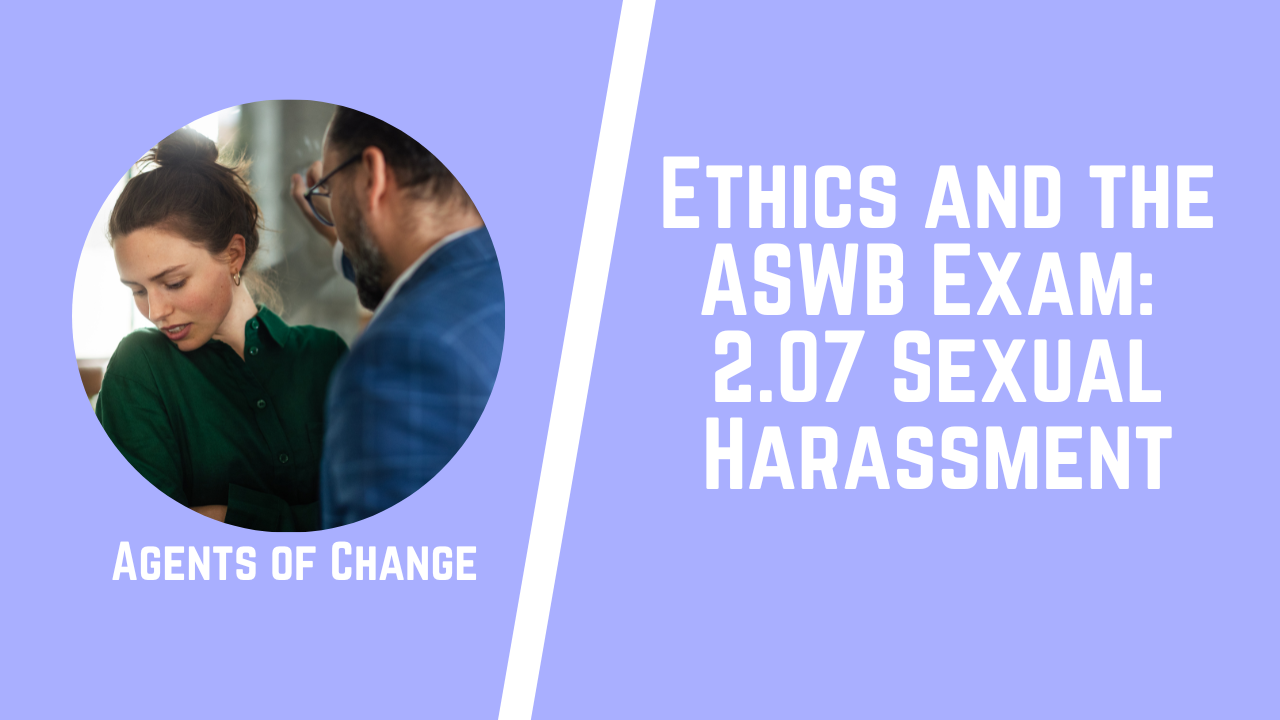
a colleague harassing a colleague

Let’s take a closer look at why this matters so much when you’re sitting for the test.


Protecting the Integrity of the Profession

The ASWB exam isn’t simply about knowing definitions. It tests how you’d act in real-world scenarios that require you to think like a professional Social Worker. Understanding Section 2.07 ensures you’re equipped to maintain the dignity and safety of every person you interact with.

When you understand what qualifies as harassment, even subtle or unintentional behavior, you demonstrate that you’re prepared to hold yourself and others to the highest ethical standards. The profession counts on that, and the exam is designed to measure whether you’re ready.


Responding Ethically Under Pressure

During the ASWB exam, you’ll face scenario-based questions that involve power dynamics, blurred boundaries, and vague emotional cues. Questions involving sexual harassment often aren’t straightforward. You might be asked what to do if:

  • A supervisor makes flirtatious comments to a supervisee

  • A colleague repeatedly tells sexual jokes in staff meetings

  • A client compliments a Social Worker in a way that makes them uncomfortable

  • A trainee texts a professor late at night with suggestive emojis

You won’t be graded on memorization. You’ll be graded on your ability to spot inappropriate behavior, assess risk, and choose responses that reflect NASW ethical standards, especially in gray areas.


Showing That You Understand Consent, Power, and Boundaries

Section 2.07 is also a test of how well you understand the invisible forces that shape professional relationships. Power and consent don’t always look like coercion. Sometimes, they’re hidden behind politeness or status.

The ASWB exam wants to know that you can:

  • Identify when someone’s consent might be compromised by a power imbalance

  • Recognize how tone, timing, or context can shift a comment from benign to inappropriate

  • Take responsibility when observing unethical behavior—even when it’s uncomfortable

  • Uphold boundaries clearly and respectfully, regardless of setting


Common Ethics Question Triggers Involving 2.07

Be prepared to respond confidently when you see questions with these triggers:

  • “A supervisee appears uncomfortable…”

  • “The client makes a comment about the worker’s appearance…”

  • “The Social Worker receives a flirtatious email…”

  • “A colleague brushes against another staff member and laughs it off…”

  • “The student says they don’t want to report it because it wasn’t ‘that bad’…”

Each of these situations requires an ethical response rooted in your understanding of 2.07. When you truly grasp this section, you’ll know that silence or inaction can also be a breach of ethics.


It’s Not Just a Rule—It’s a Value

At its core, Section 2.07 isn’t just about avoiding lawsuits or disciplinary action. It reflects the deeper values of Social Work: respect, dignity, safety, and justice. The ASWB exam is looking for professionals who don’t just know the rules, but who live the values behind them.

That’s why understanding this section gives you an edge on the exam. It helps you go beyond technical answers and move into ethical leadership, the kind the field of Social Work desperately needs.

3) ASWB Practice Question: Sexual Harassment

A licensed Social Worker overhears a colleague repeatedly making sexually suggestive jokes during staff meetings. Some team members laugh, but others appear visibly uncomfortable. No one has formally complained, and the Social Worker is unsure if anyone intends to. What is the BEST course of action for the Social Worker to take?

A. Confront the colleague immediately in front of the team to stop the behavior
B. Say nothing unless someone files a formal complaint
C. Document the behavior and consult with a supervisor or ethics committee
D. Send an anonymous note to the colleague asking them to stop


Correct Answer: C. Document the behavior and consult with a supervisor or ethics committee


Rationale:

This question tests your ability to apply Section 2.07 of the NASW Code of Ethics, which prohibits sexual harassment in all professional settings. Even if no formal complaint has been made, a Social Worker has an ethical obligation to take action when they witness behavior that could be harmful, inappropriate, or unethical.

Answer C is the BEST response because it involves proactive, professional, and ethical steps. By documenting the situation and seeking guidance from a supervisor or ethics committee, the Social Worker ensures the issue is addressed responsibly without escalating it prematurely.

Let’s look at why the other choices don’t meet ethical standards:

  • A risks public shaming, which could backfire and create defensiveness or workplace tension without resolving the core issue.

  • B suggests passivity and avoidance, which violates the Social Worker’s duty to promote safety and intervene when others may be harmed.

  • D lacks transparency and professionalism, and it doesn’t create a verifiable record or involve appropriate channels for ethical oversight.

Section 2.07 calls for ethical courage, not silence or anonymous gestures. This type of question is common on the ASWB exam and reflects the importance of knowing how to respond to unethical workplace behavior with clarity and responsibility.

4) FAQs – Code of Ethics: 2.07 Sexual Harassment

Q: How do I know if a behavior qualifies as sexual harassment under Section 2.07?

A: Sexual harassment under Section 2.07 of the NASW Code of Ethics includes any unwelcome sexual advance, solicitation, or contact, whether it’s verbal, physical, written, or electronic. It doesn’t have to be overt or aggressive. Even a “joke,” compliment, or gesture can qualify if it creates discomfort or a hostile environment.

What matters most is the impact on the other person, not the intention behind the action. If there’s uncertainty, it’s always safer to consult a supervisor, document the behavior, and follow ethical reporting channels.

Q: Will questions about sexual harassment on the ASWB exam mention Section 2.07 directly?

A: No, the exam won’t refer to Section 2.07 by name or number. Instead, you’ll encounter scenario-based questions that test your ability to recognize ethical boundaries, especially in complex or ambiguous situations.

You may need to identify what qualifies as harassment, determine appropriate responses, or understand your obligations when witnessing unethical behavior. That’s why it’s crucial to study the content of Section 2.07 and practice applying it in a variety of professional contexts, rather than just memorizing its wording.

Q: What should I do if I feel unprepared for ethics questions like those involving Section 2.07?

A: If you’re feeling unsure about ethics scenarios on the ASWB exam, you’re not alone—and you don’t have to go it alone either. Agents of Change is a top-tier study resource specifically designed for Social Work licensure preparation. Their program includes live study groups twice a month, detailed practice exams, flashcards, structured study plans, and unlimited access until you pass.

That means you can start studying as early as you want without worrying about running out of time or support. Ethics questions, especially ones related to boundaries and harassment, require thoughtful prep. Agents of Change helps you build the confidence and clarity to answer them correctly.

5) Conclusion

Understanding Section 2.07 of the NASW Code of Ethics is essential for more than just passing the ASWB exam. It reflects your commitment to creating a professional environment where respect, dignity, and safety are never compromised.

Sexual harassment can be subtle, and the exam is designed to test whether you can recognize those moments and respond in a way that upholds the values of the Social Work profession. When you’re confident in this area, you’re not just a better test-taker—you’re a more trustworthy and ethical practitioner.

The ASWB exam often includes questions that challenge your ability to balance professionalism with real-life complexity. That’s why it’s so important to study this topic with intention. Memorizing the code isn’t enough. You need to be able to apply it under pressure, interpret behavior through an ethical lens, and respond in ways that are both thoughtful and appropriate. Section 2.07 provides the framework to do just that, especially in settings where power dynamics and interpersonal boundaries are at play.


► Learn more about the Agents of Change course here: https://agentsofchangeprep.com

About the Instructor, Dr. Meagan Mitchell: Meagan is a Licensed Clinical Social Worker and has been providing individualized and group test prep for the ASWB for over 10 years. From all of this experience helping others pass their exams, she created the Agents of Change course to help you prepare for and pass the ASWB exam!

Find more from Agents of Change here:

► Facebook Group: https://www.facebook.com/groups/aswbtestprep

► Podcast: https://podcasters.spotify.com/pod/show/agents-of-change-sw

#socialwork #testprep #aswb #socialworker #socialwork #socialworktest #socialworkexam #exam #socialworktestprep #socialworklicense #socialworklicensing #licsw #lmsw #lcsw #aswbexam #aswb #lcswexam #lmswexam #aswbtestprep #aswbtest #lcswtestprep #lcswtest #lmswtestprep #lmswtest #aswbcourse #learningstyles #learningstyle

Disclaimer: This content has been made available for informational and educational purposes only. This content is not intended to be a substitute for professional medical or clinical advice, diagnosis, or treatment.

Share:

Discover more from Agents of Change

Subscribe now to keep reading and get access to the full archive.

Continue reading