Ethics and the ASWB Exam: 2.08 Impairment of Colleagues
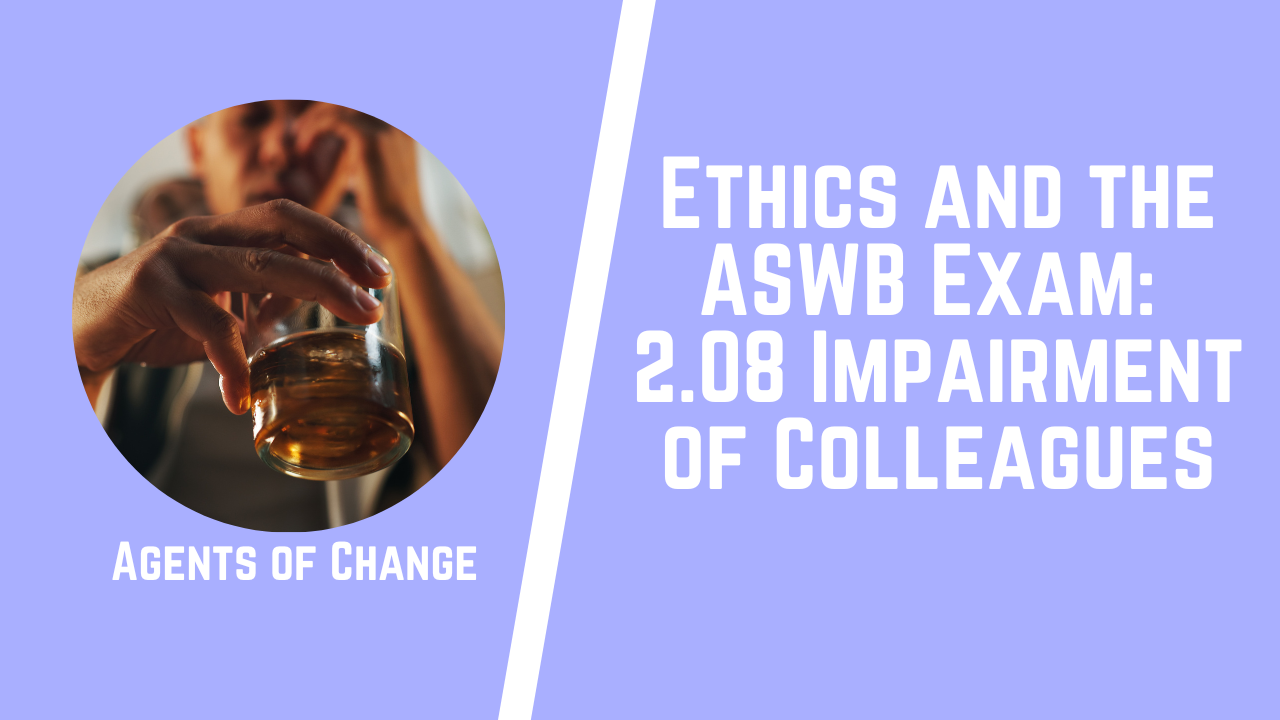
Ethics and the ASWB Exam: 2.08 Impairment of Colleagues
Ethics form the backbone of effective Social Work practice, shaping how professionals respond in challenging and often uncomfortable situations. Among these ethical expectations, 2.08 Impairment of Colleagues is a critical standard. It requires Social Workers to act when they notice a colleague whose ability to practice competently is compromised. While this may feel like a heavy responsibility, it is ultimately about safeguarding clients and maintaining the integrity of the profession.

For anyone preparing for the ASWB exam, understanding this section of the NASW Code of Ethics is essential. It is more than a rule to memorize. It is a practical guide that reflects what Social Workers encounter in real-world practice. The exam often presents scenario-based questions that demand you know not only what the standard says, but also how to apply it with sound judgment and compassion.

Fortunately, you do not have to tackle this topic alone. With clear explanations, realistic practice questions, and structured support from resources like Agents of Change, mastering this section becomes far more manageable. By approaching 2.08 with confidence and the right tools, you will be prepared for both the exam and the ethical challenges that come with professional practice.

Learn more about the ASWB exam and create a personalized ASWB study plan with Agents of Change. We’ve helped tens of thousands of Social Workers pass their ASWB exams and want to help you be next!

1) What Is Section 2.08 Impairment of Colleagues?

a colleague who appears impaired or under the influence

Below is the exact text from the NASW Code of Ethics covering impairment of colleagues:

2.08 Impairment of Colleagues
(a) Social workers who have direct knowledge of a social work colleague’s impairment that is due to personal problems, psychosocial distress, substance abuse, or mental health difficulties and that interferes with practice effectiveness should consult with that colleague when feasible and assist the colleague in taking remedial action.
(b) Social workers who believe that a social work colleague’s impairment interferes with practice effectiveness and that the colleague has not taken adequate steps to address the impairment should take action through appropriate channels established by employers, agencies, NASW, licensing and regulatory bodies, and other professional organizations.


Breakdown and Explanation

(a) Consult and Assist

  • What the phrase means: If you directly see that a colleague is struggling, maybe they’re showing signs of depression, addiction, extreme stress, or emotional distress, and it’s affecting their work, you should try to talk with them.

  • Why it’s included: This encourages a supportive, collegial approach. You’re invited to have a private, respectful conversation and offer help or resources.

  • Key emphasis: It’s about compassion and giving the colleague a chance to improve before escalating.

(b) Escalation When Necessary

  • What the phrase means: If the colleague hasn’t made changes after your conversation, or if your concern is serious enough that waiting might harm clients, you need to report the issue.

  • Appropriate channels include:

    • A supervisor or director at your agency

    • NASW or other professional organizations

    • State licensing and regulatory boards

  • Why it’s included: Client well‑being is primary. If a colleague’s impairment continues and threatens practice effectiveness, professionals are obligated to act through formal structures.


Why This Matters for the ASWB Exam

It’s essential to remember:

  • The first step is conversation and support

  • The second step is formal reporting, if necessary

That sequence is tested frequently in scenario questions, so knowing the exact text and applying it in the right order is critical to success on the ASWB exam.

Agents of Change packages include 30+ ASWB topics, 2 free study groups per month, and hundreds of practice questions so you’ll be ready for test day!

2) Why Understanding 2.08 Impairment of Colleagues Matters on the ASWB Exam

When preparing for the ASWB exam, some ethical standards feel straightforward. Others, like 2.08 Impairment of Colleagues, require a deeper understanding because they often appear in scenario-based questions.

a female colleague who appears impaired or under the influence

This section is one of the most tested parts of the NASW Code of Ethics because it touches on client safety, professional accountability, and the responsibility Social Workers hold toward each other.


Protecting Clients Comes First

The primary reason this standard is tested is simple: the welfare of clients always takes priority. If a colleague is impaired and their actions harm or could harm a client, Social Workers are ethically bound to act.

  • The exam expects you to recognize that ignoring an impaired colleague is never acceptable.

  • You’ll often be asked to choose between reporting immediately or first offering support.

  • The correct answer usually reflects a balance between compassion for colleagues and an unwavering focus on client protection.


Distinguishing Between Support and Reporting

Section 2.08 does not say you must report a colleague right away. In fact, the NASW Code of Ethics promotes helping a colleague when possible before escalating.

Here’s how this often translates to the exam:

  • Step 1: Address the issue privately with the colleague if it’s safe and feasible.

  • Step 2: Encourage them to get help or take corrective action.

  • Step 3: If the impairment continues or the risk to clients is serious, report to a supervisor or the appropriate authority.

This sequence is frequently built into exam scenarios, and understanding it helps you spot “trap answers” that skip steps.


Common Pitfalls on the Exam

Many test-takers lose points on questions related to 2.08 because they confuse the proper order of intervention or overlook client safety. Watch out for:

  • Jumping to reporting without trying consultation first (unless the situation is dangerous or urgent).

  • Prioritizing loyalty to a colleague over ethical obligations to clients.

  • Assuming that “minding your own business” is a safe option, it never is when clients could be at risk.


How the ASWB Exam May Present This Topic

Expect to see this standard in questions such as:

  • A scenario where a colleague’s personal struggles are affecting their professional judgment.

  • A situation where a colleague refuses help and continues to practice unsafely.

  • An ethics question asking you to identify the first or most appropriate action.

For example:

  • “What should the Social Worker do first?” usually points to consulting or offering support.

  • “What should the Social Worker do next?” often involves reporting through formal channels if the initial steps failed.

3) ASWB Practice Question: Impairment of Colleagues

A Social Worker notices that a colleague has been arriving late, appearing disoriented during meetings, and making frequent errors in client documentation. The Social Worker suspects the colleague may be struggling with substance use. What is the Social Worker’s best initial response according to Section 2.08 of the NASW Code of Ethics?

A) Report the colleague immediately to the state licensing board.
B) Document the colleague’s behavior and confront them during a staff meeting.
C) Speak privately with the colleague to express concern and offer support.
D) Avoid involvement because it is a personal matter for the colleague.


Correct Answer:

C) Speak privately with the colleague to express concern and offer support.


Rationale:

  • C is correct because Section 2.08(a) of the NASW Code of Ethics requires that Social Workers consult with an impaired colleague when feasible and assist them in taking remedial action. The emphasis is on addressing the situation respectfully and privately before escalating the issue.

  • A is incorrect because immediately reporting to a licensing board bypasses the step of attempting to consult with and support the colleague, unless the situation poses an immediate danger to clients.

  • B is incorrect because confronting the colleague in a public or group setting is unprofessional and violates the principle of handling these matters privately first.

  • D is incorrect because doing nothing neglects the Social Worker’s ethical obligation to protect clients and support professional accountability.


Key Takeaway for the Exam

The ASWB exam often tests the sequence of ethical action. Your first move is to privately approach the colleague if it’s safe and appropriate. Only if this fails or if client harm is urgent or imminent, should you escalate the matter to supervisors or licensing authorities.

4) FAQs – Code of Ethics: 2.08 Impairment of Colleagues

Q: What does “Impairment of Colleagues” really mean in the NASW Code of Ethics?

A: “Impairment of Colleagues” refers to situations where a Social Worker is aware that another Social Worker is struggling with personal problems, psychosocial distress, substance use, or mental health issues that interfere with their ability to practice effectively.

Section 2.08 of the NASW Code of Ethics directs Social Workers to first consult privately with the impaired colleague and offer support. If the colleague fails to address the impairment or clients are at risk, the Social Worker is ethically obligated to escalate the matter to supervisors, licensing boards, or other professional authorities.

This standard is about balancing compassion with accountability. It ensures that Social Workers protect clients while also giving colleagues a fair chance to seek help and correct the problem before formal action is taken.

Q: Why is Section 2.08 important for the ASWB exam?

A: The ASWB exam frequently tests your ability to apply Section 2.08 in real-world scenarios. This standard demonstrates ethical decision-making in steps. You need to know:

  • When to talk with a colleague first and offer support.

  • When client safety overrides informal action and requires reporting.

  • Which professional channels should be used for escalation if the problem persists

Understanding this sequence can help you identify the “best initial response” or “next step” in exam questions. These scenarios appear often because they test both your knowledge of the NASW Code of Ethics and your ability to apply it logically.

Q: How can I study this topic effectively for the ASWB exam?

A: A targeted study plan is key. One of the best resources for mastering topics like Ethics and the ASWB Exam: 2.08 Impairment of Colleagues is Agents of Change. Their program includes:

  • Comprehensive study materials that explain the Code of Ethics in depth.

  • Two live study groups every month where you can discuss tricky scenarios with experts.

  • Practice questions that mirror what you’ll see on the exam.

  • Flashcards to reinforce ethical standards.

  • Full access until you pass your exam, so you can’t buy “too soon.”

  • Step-by-step study plans to keep you organized and on track.

By working through realistic practice questions and using structured guidance, you’ll be ready to confidently tackle any ethics scenario on the ASWB exam.

5) Conclusion

Understanding 2.08 Impairment of Colleagues is more than memorizing a section of the NASW Code of Ethics. It is about recognizing your role as a Social Worker in protecting clients while maintaining the integrity of the profession. This standard tests your ability to take thoughtful, ethical action in the right order, and that is exactly what the ASWB exam is designed to measure.

When you learn how to navigate this topic, you gain more than just exam points. You strengthen your professional judgment and develop the confidence to handle real-world ethical challenges with care. Knowing when to support a colleague, when to consult, and when to escalate is essential for both safe practice and passing the test.


► Learn more about the Agents of Change course here: https://agentsofchangeprep.com

About the Instructor, Dr. Meagan Mitchell: Meagan is a Licensed Clinical Social Worker and has been providing individualized and group test prep for the ASWB for over 10 years. From all of this experience helping others pass their exams, she created the Agents of Change course to help you prepare for and pass the ASWB exam!

Find more from Agents of Change here:

► Facebook Group: https://www.facebook.com/groups/aswbtestprep

► Podcast: https://podcasters.spotify.com/pod/show/agents-of-change-sw

#socialwork #testprep #aswb #socialworker #socialwork #socialworktest #socialworkexam #exam #socialworktestprep #socialworklicense #socialworklicensing #licsw #lmsw #lcsw #aswbexam #aswb #lcswexam #lmswexam #aswbtestprep #aswbtest #lcswtestprep #lcswtest #lmswtestprep #lmswtest #aswbcourse #learningstyles #learningstyle

Disclaimer: This content has been made available for informational and educational purposes only. This content is not intended to be a substitute for professional medical or clinical advice, diagnosis, or treatment.

Share:

Discover more from Agents of Change

Subscribe now to keep reading and get access to the full archive.

Continue reading