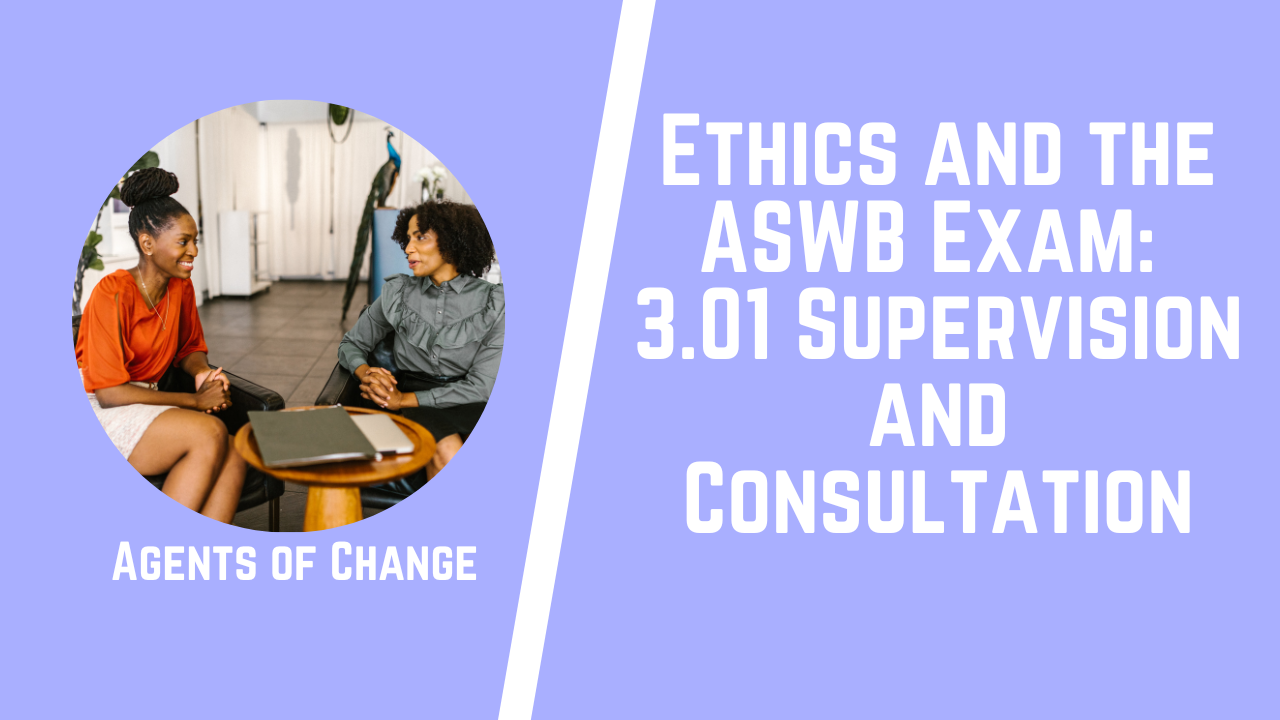
Ethics and the ASWB Exam: 3.01 Supervision and Consultation
Ethics and the ASWB Exam: 3.01 Supervision and Consultation
Preparing for the ASWB exam can feel like a monumental task, especially when it comes to understanding the ethical standards that shape the Social Work profession. Among these standards, Ethics and the ASWB Exam: 3.01 Supervision and Consultation stands out because it is the foundation for how Social Workers learn from one another, develop their skills, and ensure the best outcomes for clients. This section of the NASW Code of Ethics is more than a guideline. It is a reminder that no one practices alone and that guidance from competent professionals is essential.

Many exam candidates underestimate how often supervision and consultation appear in test scenarios. The ASWB exam does not simply check if you can recall definitions. It looks for evidence that you understand how to apply these principles when faced with complex situations involving clients, colleagues, and workplace challenges. Knowing how to approach questions on this topic can be the difference between second-guessing yourself and answering with confidence.

Learn more about the ASWB exam and create a personalized ASWB study plan with Agents of Change. We’ve helped tens of thousands of Social Workers pass their ASWB exams and want to help you be next!

1) What Is Section 3.01 Supervision and Consultation?

a therapist providing clinical supervision to another therapist in a safe waarm environment

Here is the full text of NASW Code of Ethics, Section 3.01 Supervision and Consultation:

(a) Social workers who provide supervision or consultation (whether in‑person or remotely) should have the necessary knowledge and skill to supervise or consult appropriately and should do so only within their areas of knowledge and competence.
(b) Social workers who provide supervision or consultation are responsible for setting clear, appropriate, and culturally sensitive boundaries.
(c) Social workers should not engage in any dual or multiple relationships with supervisees in which there is a risk of exploitation of or potential harm to the supervisee, including dual relationships that may arise while using social networking sites or other electronic media.
(d) Social workers who provide supervision should evaluate supervisees’ performance in a manner that is fair and respectful.


🔍 Breakdown of Each Subsection

(a) Competence and Scope

This piece means that any Social Worker who acts as a supervisor or consultant must know what they’re doing. If you’re supervising, you should stick to cases or topics where you’ve had training or real experience. That includes remote supervision too, so being tech‑savvy and confident online counts.

(b) Boundaries That Matter

Here, the focus is on boundaries that are clear and culturally sensitive. That means you talk through expectations up front: when supervision happens, how, and how feedback is given. It also includes being aware of cultural differences; what’s appropriate in one culture might not work in another.

(c) Avoiding Dual Relationships

This warns against mixing roles with supervisees—for example, being a friend, client, or romantic interest. That could harm the supervisee or impair judgment. It also highlights dual relationships that occur online, such as connecting on social media, so people don’t let platforms blur professional lines.

(d) Fair and Respectful Evaluation

When supervising or assessing someone’s work, you should treat them with respect; give honest feedback, point out strengths and growth areas, and avoid bias. It’s about maintaining professionalism, encouraging growth, and evaluating based on clear, fair criteria.


Why Each Part Matters for the ASWB Exam

  • Knowing subsection (a) helps you spot when a supervisor is overstepping or giving advice beyond their competence.

  • Understanding (b) helps with scenarios about setting appropriate supervision boundaries or managing cultural dynamics.

  • Recognizing (c) steers you toward the correct response when a supervisor tries to socialize or connect in ways that cross ethical lines.

  • Appreciating (d) ensures you can identify proper evaluation practices and know when something unfair or disrespectful is happening.

Together, these components form the essence of 3.01 Supervision and Consultation, a vital section for exam prep and solid Social Work practice.

Agents of Change packages include 30+ ASWB topics, 2 free study groups per month, and hundreds of practice questions so you’ll be ready for test day!

2) Why Understanding 3.01 Supervision and Consultation Matters on the ASWB Exam

3.01 Supervision and Consultation isn’t just another rule to memorize. It appears on the exam because it directly relates to real-world practice. If you can understand how this section applies to everyday scenarios, you’ll avoid confusion and pick the best answer every time.

Create a picture of a therapist providing clinical supervision to another therapist in a safe warm environment


1. It’s a High-Impact Ethics Area

The ASWB exam frequently tests ethical decision-making. Supervision and consultation questions check whether you:

  • Know how supervisors should act within their competence.

  • Recognize inappropriate dual relationships.

  • Understand how to maintain professional boundaries.

  • Identify what fair, respectful evaluation looks like.

Even if it’s just one or two questions, those points matter. A single question can be the difference between passing and retaking the test.


2. It Connects to Everyday Social Work Practice

This standard isn’t just theory. It mirrors what Social Workers encounter in agencies, clinics, and community programs. On the exam, you might see scenarios involving:

  • A supervisor offering advice in an area they don’t fully understand.

  • A conflict over cultural sensitivity in a supervision session.

  • A supervisee being asked to connect with a supervisor on social media.

  • Unfair feedback or unclear expectations during evaluations.

When you understand Section 3.01, you’ll recognize the ethical answer instantly because you’ve trained yourself to think like a Social Worker who puts professional responsibility first.


3. It Helps You Eliminate Wrong Answers

One of the most powerful tools on the exam is the ability to cut out bad options. Knowing 3.01 well lets you:

  • Rule out answers that blur professional boundaries.

  • Spot options that allow supervisors to act outside their competence.

  • Avoid answers that ignore cultural sensitivity.

  • Identify when evaluations lack fairness or respect.

By using 3.01 as a mental filter, you’ll focus only on the choices that fit the NASW Code of Ethics.


4. It’s Linked to Professional Growth and Client Protection

Supervision and consultation exist to protect clients and help Social Workers grow. That’s why the exam tests it. Understanding this section ensures you:

  • Recognize how competent supervision prevents harm.

  • See why ethical evaluation improves practice.

  • Understand the importance of maintaining safe professional relationships.

If you can explain these points clearly in your head during the exam, you’ll be much more confident in your reasoning.


5. Agents of Change Can Help You Master It

Memorizing Section 3.01 isn’t enough. You need to see it applied in realistic scenarios. That’s where Agents of Change comes in. Their program gives you:

  • Comprehensive study materials designed around the ASWB exam.

  • Practice questions that mirror real exam scenarios on supervision and consultation.

  • Two live study groups each month, where you can discuss tricky ethics topics.

  • Flashcards to reinforce key concepts.

  • Study plans that keep you focused and on track.

  • Unlimited access until you pass, so you never have to worry about starting “too soon.”

With that kind of support, Section 3.01 turns from an intimidating rule into a clear, testable concept you can handle with confidence.

3) ASWB Practice Question: Supervision and Consultation

A Social Worker is supervising a new graduate who is working with a client experiencing severe trauma symptoms. The supervisor has limited experience in trauma-focused interventions but has been encouraging the supervisee to use a specific treatment method that the supervisor has only read about briefly. Additionally, the supervisor frequently comments on the supervisee’s social media posts and occasionally invites them to personal events. According to the Code of Ethics, what is the supervisor’s primary ethical violation?

A) Failing to provide fair and respectful evaluation of the supervisee
B) Practicing outside their area of competence while also engaging in a dual relationship
C) Not providing clear, culturally sensitive boundaries in supervision
D) Using informal feedback instead of structured evaluation sessions


Correct Answer: B) Practicing outside their area of competence while also engaging in a dual relationship


Rationale:

  • B is correct: The supervisor is encouraging a treatment method they are not qualified to supervise, which violates 3.01(a) regarding competence. Additionally, by interacting socially and engaging with the supervisee’s personal social media, the supervisor is breaching 3.01(c) on dual relationships. These combined behaviors represent the most significant ethical violations.

  • A is incorrect: There’s no evidence that the supervisor has failed to evaluate the supervisee fairly or respectfully.

  • C is incorrect: While boundaries are indeed important, the issue here is not simply a lack of cultural sensitivity; it’s the dual relationship and lack of competence that stand out.

  • D is incorrect: Informal feedback isn’t prohibited by the Code of Ethics, as long as it’s respectful and fair. The scenario describes bigger ethical concerns than this.

4) FAQs – Code of Ethics: 3.01 Supervision and Consultation

Q: How often does 3.01 Supervision and Consultation appear on the ASWB exam?

A: While the ASWB exam doesn’t publish exact question counts, ethical standards like 3.01 appear frequently in both direct and indirect ways. You may see a question explicitly mentioning supervision, or it might be hidden in a scenario involving professional boundaries or competence.

Even if it’s only one or two questions, these topics can be critical to your passing score because they often test higher-level reasoning rather than simple memorization.

Q: Why is understanding 3.01 Supervision and Consultation important for everyday Social Work practice?

A: Section 3.01 goes beyond exam preparation. It reinforces how supervisors should act ethically to protect clients and support supervisees. When supervisors stay within their areas of competence, maintain clear professional boundaries, respect cultural differences, and give fair evaluations, they create an environment where Social Workers can grow without fear of exploitation or confusion.

This ethical foundation not only improves practice but also prevents ethical complaints and supports a healthier workplace culture. By fully understanding this section, you prepare yourself for real-world professional challenges, not just test questions.

Q: What’s the best way to study 3.01 Supervision and Consultation without getting overwhelmed?

A: The key is to break it into smaller, manageable parts. Start by reading the full text of Section 3.01 and understanding each subsection, focusing on competence, boundaries, cultural sensitivity, and fair evaluation. Then, apply that knowledge to realistic scenarios, since the ASWB exam loves situational questions.

Using Agents of Change can make this process much easier. Their platform organizes content into clear study plans, offers practice questions tied to 3.01, and even gives you access to live study groups where you can hear how other Social Workers think through these ethics questions. This structured approach keeps you from feeling lost and helps you stay motivated until test day.

5) Conclusion

Understanding 3.01 Supervision and Consultation is more than just memorizing a section of the NASW Code of Ethics. It is about recognizing how this standard shapes the way Social Workers interact with supervisees, colleagues, and ultimately, clients. By grasping its principles, such as competence, clear boundaries, cultural awareness, and fair evaluation, you build a strong ethical foundation that carries over into every part of your professional practice.

When preparing for the ASWB exam, this section can feel dense, but breaking it down into realistic scenarios and applying the knowledge step-by-step can make it far more approachable. That is where the right tools and resources matter. With Agents of Change, you get structured study plans, live study groups, and unlimited access until you pass, making it nearly impossible to start too early or fall behind.


► Learn more about the Agents of Change course here: https://agentsofchangeprep.com

About the Instructor, Dr. Meagan Mitchell: Meagan is a Licensed Clinical Social Worker and has been providing individualized and group test prep for the ASWB for over 10 years. From all of this experience helping others pass their exams, she created the Agents of Change course to help you prepare for and pass the ASWB exam!

Find more from Agents of Change here:

► Facebook Group: https://www.facebook.com/groups/aswbtestprep

► Podcast: https://podcasters.spotify.com/pod/show/agents-of-change-sw

#socialwork #testprep #aswb #socialworker #socialwork #socialworktest #socialworkexam #exam #socialworktestprep #socialworklicense #socialworklicensing #licsw #lmsw #lcsw #aswbexam #aswb #lcswexam #lmswexam #aswbtestprep #aswbtest #lcswtestprep #lcswtest #lmswtestprep #lmswtest #aswbcourse #learningstyles #learningstyle

Disclaimer: This content has been made available for informational and educational purposes only. This content is not intended to be a substitute for professional medical or clinical advice, diagnosis, or treatment.

Share:

Discover more from Agents of Change

Subscribe now to keep reading and get access to the full archive.

Continue reading