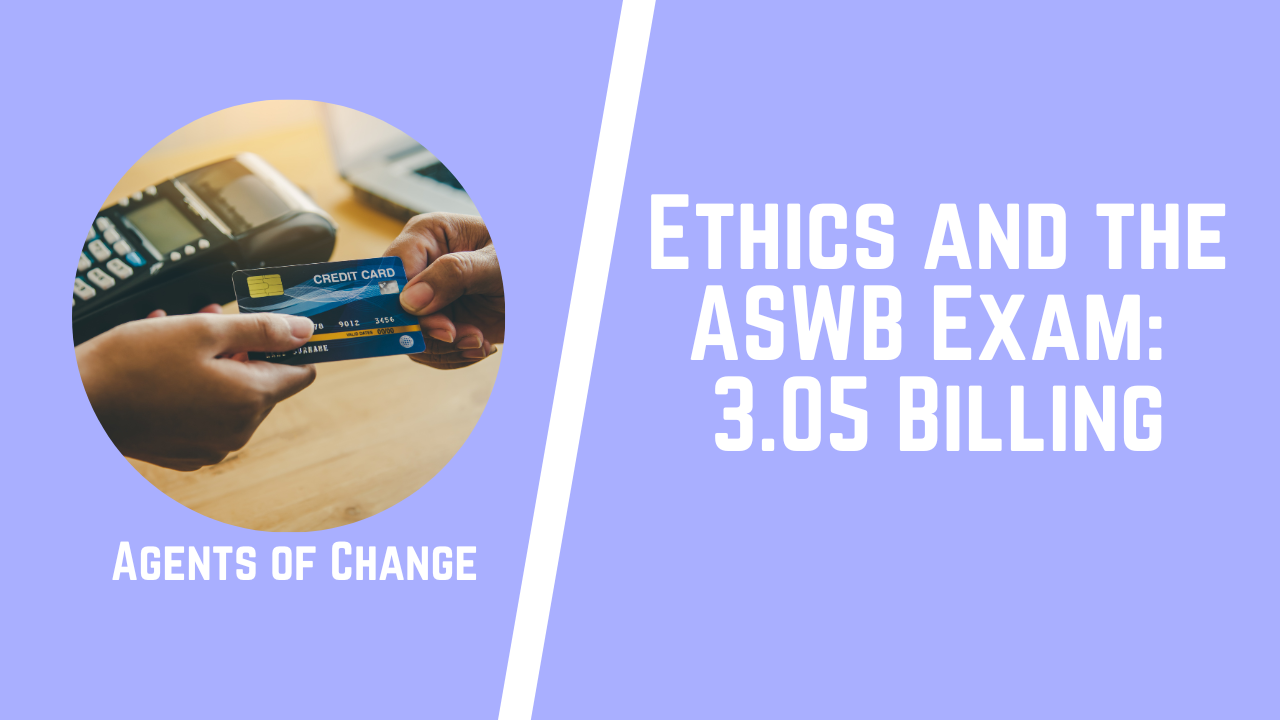
Ethics and the ASWB Exam: 3.05 Billing

Ethics and the ASWB Exam: 3.05 Billing
Billing may seem like a small detail in Social Work, but it can have a significant impact on your professional integrity and your clients’ trust. When it comes to the ASWB exam, understanding the NASW Code of Ethics Section 3.05 on Billing is essential. This section outlines the standards for transparency, fairness, and accountability when it comes to fees and financial arrangements. If you are preparing for the exam, knowing this section inside and out will help you avoid common mistakes and approach questions with confidence.

What makes 3.05 Billing so important is that it connects ethical principles to real-world practice. Clear communication about fees not only prevents misunderstandings but also builds a foundation of trust between Social Workers and their clients. The ASWB exam often tests your ability to recognize and resolve ethical issues around billing, so having a solid grasp of this section can be the difference between a passing score and a frustrating retake.

Learn more about the ASWB exam and create a personalized ASWB study plan with Agents of Change. We’ve helped tens of thousands of Social Workers pass their ASWB exams and want to help you be next!

1) What Is Section 3.05 Billing?

a social worker discussing billing with potential clients

Full Text of 3.05 Billing

3.05 Billing
Social workers should establish and maintain billing practices that accurately reflect the nature and extent of services provided and that identify who provided the service in the practice setting.

Breakdown of Each Part of the Section

🌐 “Establish and maintain billing practices”

This means setting up clear, consistent billing procedures from the very start of professional activity. That includes creating policies for fees, session lengths, cancellations, insurance claims, and documentation. “Maintain” implies regular review—update policies if laws change or new rules come into effect.

“That accurately reflect the nature and extent of services provided”

Every charge must match exactly what was done. If you claim an hour of therapy, you must have provided that hour. You can’t bill for time not spent or inflate the services delivered. The billing must mirror the session, consultation, documentation, or other interventions exactly.

“And that identify who provided the service in the practice setting”

Clients, payers, and oversight bodies need to know who delivered the service. If multiple Social Workers or interns are involved, the billing must specify the individual practitioner. That prevents confusion, enables accountability, and keeps things transparent for client and provider records.


This section may look short, but its components carry significant weight. Understanding each part helps you see how important transparency, precision, and accountability are in ethical billing and why the ASWB exam tests them.

Agents of Change packages include 30+ ASWB topics, 2 free study groups per month, and hundreds of practice questions so you’ll be ready for test day!

2) Why Understanding 3.05 Billing Matters on the ASWB Exam

Ethics questions often trip up test-takers, and 3.05 Billing is no exception. While it might seem straightforward, the ASWB exam uses this section to test whether you understand not just the wording but also how it applies to real-world Social Work scenarios.

a social worker discussing billing with potential clients

Knowing this section in detail can make the difference between a confident answer and a costly mistake.


How 3.05 Billing Connects to Ethical Practice

Billing isn’t just about numbers. It reflects the core ethical values of Social Work, including honesty, integrity, and client respect. When you’re transparent about fees and billing practices, you demonstrate accountability to both clients and the profession.

Key ethical links include:

  • Transparency: Clear billing policies build trust with clients.

  • Accuracy: Ethical practice demands that charges match actual services provided.

  • Fairness: Proper billing prevents exploitation or misunderstandings.

These values are directly tested on the ASWB exam because they are tied to the NASW Code of Ethics and objective professional standards.


Common Exam Question Traps

The exam isn’t just testing whether you can memorize 3.05 Billing. It aims to test your ability to recognize subtle ethical problems hidden in scenarios.

Typical traps include:

  • A Social Worker bills for a full session when only half was provided.

  • A supervisor’s name appears on a bill even though a student intern delivered the session.

  • A client is charged for services without prior explanation of fees.

  • Insurance is billed for a service that isn’t covered or wasn’t rendered.

Recognizing these situations quickly can help you choose the correct answer and avoid distractors that look “almost right.”


How This Topic Shows Up on the ASWB Exam

You’re likely to encounter 3.05 Billing in questions involving ethics, professional conduct, and client relationships. The scenarios often test:

  • Knowledge of proper billing procedures

  • Understanding informed consent for fees

  • Identifying fraudulent or unethical billing behavior

  • Responding to disputes about charges or payment

By mastering this section, you’ll be prepared for questions that require both knowledge and judgment.


Why Agents of Change Is Essential for Mastering This Section

Studying billing ethics on your own can feel overwhelming. This is why Agents of Change is a powerful resource. With their program, you get:

  • Comprehensive study materials that explain every section of the NASW Code of Ethics, including 3.05 Billing.

  • Practice exams with scenarios that mirror real test questions.

  • Two live study groups per month, where you can ask questions and hear expert explanations.

  • Flashcards to reinforce key ethical concepts.

  • Study plans that keep you on track, so you don’t lose focus.

  • Access until you pass, so there’s no risk of starting too early.

By using Agents of Change, you’ll learn how to spot the nuances in billing questions and avoid falling for common exam pitfalls.

3) ASWB Practice Question: Billing

A Social Worker in a private practice has been seeing a client for weekly sessions. The client recently canceled two sessions but was charged for both. The client complains, stating they were never informed about any cancellation fees. What should the Social Worker do next?

A) Charge the client anyway because the time was reserved.
B) Explain the cancellation policy after the complaint and apply it going forward.
C) Refund the charges and clearly review the billing policy with the client.
D) Refer the client to another Social Worker if they disagree with the policy.


Correct Answer

C) Refund the charges and clearly review the billing policy with the client.


Rationale

Section 3.05 Billing requires Social Workers to establish and maintain billing practices that are transparent and accurately reflect the services provided. Because the client was not informed about a cancellation policy before being charged, billing them for missed sessions would be unethical.

The Social Worker must take corrective action, which means refunding the inappropriate charges and then explaining the billing and cancellation policies moving forward.

  • Option A is incorrect because billing without informed consent violates ethical billing standards.

  • Option B is partially correct in explaining the policy, but it fails to address the unethical charge that already occurred.

  • Option D is incorrect because referring the client out does not resolve the ethical violation.

This question reflects exactly how this section of the Code of Ethics may appear on the ASWB exam: it tests your ability to apply ethical standards to practical, real-world scenarios.

4) FAQs – Code of Ethics: 3.05 Billing

Q: What exactly does Section 3.05 Billing require from Social Workers?

A: Section 3.05 Billing of the NASW Code of Ethics requires Social Workers to maintain billing practices that are clear, accurate, and transparent. This means:

  • Accurate charges that reflect the actual services provided.

  • Clear identification of who provided the service, whether it was a licensed Social Worker, intern, or another professional within the practice.

  • Transparent communication about fees and policies, including cancellation fees or other billing details, before services begin.

Failing to meet any of these expectations can lead to ethical violations. On the ASWB exam, you’re expected to apply these principles to real-life scenarios, so knowing them well is crucial.

Q: Why is 3.05 Billing such a common topic on the ASWB exam?

A: The ASWB exam tests knowledge of ethical principles that affect daily Social Work practice, and billing is one of those areas where mistakes often happen. Because billing touches both client relationships and professional accountability, it’s a high-stakes topic. You may see questions involving:

  • Disputes over charges

  • Incorrectly billing for services

  • Failure to disclose billing policies

  • Ethical responses to fraudulent billing behavior

By mastering 3.05 Billing, you show the exam (and yourself) that you can balance professional integrity with client advocacy.

Q: How can Agents of Change help me prepare for billing-related exam questions?

A: Agents of Change is one of the most effective resources for mastering ethics questions like 3.05 Billing. With their program, you get:

  • Detailed study materials that explain each part of the NASW Code of Ethics.

  • Practice questions and exams designed to reflect the wording and style of the actual ASWB exam.

  • Two live study groups per month, where you can ask billing-related questions and hear expert breakdowns.

  • Flashcards and structured study plans to reinforce your understanding and keep you on track.

  • Access until you pass, which means there’s no risk of starting your preparation too soon.

Agents of Change doesn’t just teach you what 3.05 Billing says. It helps you learn how to think ethically under exam pressure, so you can pick the correct answer with confidence.

5) Conclusion

Understanding 3.05 Billing is not just about memorizing a section of the NASW Code of Ethics. It is about recognizing how ethical billing practices protect clients, strengthen the Social Work profession, and prepare you for success on the exam. When you fully grasp these principles, you will be able to handle billing questions with confidence and apply ethical reasoning to real-world situations.

The ASWB exam expects you to think critically, and 3.05 Billing is a prime example of this. Questions about billing are often designed to test whether you can identify unethical practices, correct mistakes, and uphold professional standards. By mastering this topic, you not only prepare for the test but also equip yourself to serve clients with integrity and transparency in your future practice.


► Learn more about the Agents of Change course here: https://agentsofchangeprep.com

About the Instructor, Dr. Meagan Mitchell: Meagan is a Licensed Clinical Social Worker and has been providing individualized and group test prep for the ASWB for over 10 years. From all of this experience helping others pass their exams, she created the Agents of Change course to help you prepare for and pass the ASWB exam!

Find more from Agents of Change here:

► Facebook Group: https://www.facebook.com/groups/aswbtestprep

► Podcast: https://podcasters.spotify.com/pod/show/agents-of-change-sw

#socialwork #testprep #aswb #socialworker #socialwork #socialworktest #socialworkexam #exam #socialworktestprep #socialworklicense #socialworklicensing #licsw #lmsw #lcsw #aswbexam #aswb #lcswexam #lmswexam #aswbtestprep #aswbtest #lcswtestprep #lcswtest #lmswtestprep #lmswtest #aswbcourse #learningstyles #learningstyle

Disclaimer: This content has been made available for informational and educational purposes only. This content is not intended to be a substitute for professional medical or clinical advice, diagnosis, or treatment.

Share:

Discover more from Agents of Change

Subscribe now to keep reading and get access to the full archive.

Continue reading