Ethics and the ASWB Exam: 4.02 Discrimination
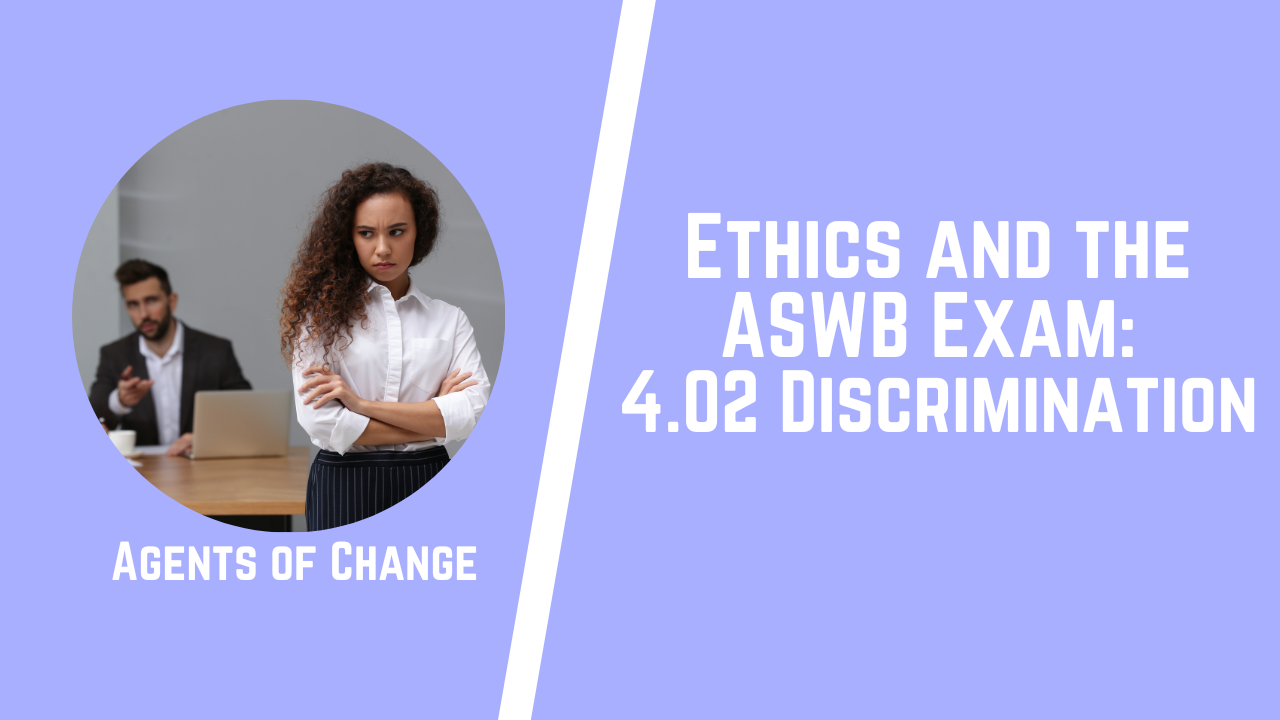
Ethics and the ASWB Exam: 4.02 Discrimination
Studying for the ASWB exam means more than memorizing terms and concepts. It’s about proving that you’re ready to uphold the core values of the Social Work profession. One of the most essential parts of that responsibility is understanding the ethical boundaries and expectations outlined by the NASW Code of Ethics. Among them, Section 4.02 on Discrimination stands out as a key area you’ll need to grasp completely if you want to pass the exam and thrive in practice.

Section 4.02 isn’t just a line in a textbook. It’s a clear, firm expectation that Social Workers reject and actively oppose all forms of discrimination. This applies across race, gender identity, religion, age, disability, and many other areas. On the ASWB exam, questions linked to this standard can appear in various forms. You might be asked to recognize unethical behavior in a work setting or to choose the best response to a discriminatory incident involving a client or colleague.

In this article, we’ll unpack what Ethics and the ASWB Exam: 4.02 Discrimination really means, why it’s so vital, and how you can prepare for related questions. We’ll also show you how a powerful study tool like Agents of Change can support you every step of the way. If you’re serious about getting licensed and making a real difference in people’s lives, this is information you can’t afford to skip.

Learn more about the ASWB exam and create a personalized ASWB study plan with Agents of Change. We’ve helped tens of thousands of Social Workers pass their ASWB exams and want to help you be next!

1) What Is 4.02 Discrimination?

Ethical standards in Social Work aren’t abstract ideals — they’re the compass for everything a Social Worker does. Among the most vital sections in the NASW Code of Ethics is 4.02 Discrimination, which outlines the professional obligation to actively resist all forms of prejudice and bias. This section is essential not just for practice but also for the ASWB exam, where ethical decision-making is often tested through real-world scenarios.

a person in a wheelchair frustrated with a therapist in a warm environment

Here’s the full text of Section 4.02 from the NASW Code of Ethics:

4.02 Discrimination

Social Workers should not practice, condone, facilitate, or collaborate with any form of discrimination on the basis of race, ethnicity, national origin, color, sex, sexual orientation, gender identity or expression, age, marital status, political belief, religion, immigration status, or mental or physical ability.

This brief but powerful statement packs in multiple responsibilities. Let’s break it down:

“Should not practice, condone, facilitate, or collaborate”

This phrase covers more than just your direct actions. It means Social Workers must:

  • Not engage in discriminatory behavior (practice)

  • Not look the other way when it happens (condone)

  • Not make it easier for others to discriminate (facilitate)

  • Not go along with systems or structures that reinforce discrimination (collaborate)

Even silence in the face of injustice can be considered an ethical violation under this standard.

Protected Categories

This section lists specific categories that must be protected from discrimination. Each one is legally and ethically significant:

  • Race and Ethnicity: Rejecting racism and systemic bias is a foundational principle in Social Work. Cultural competence is expected, not optional.

  • National Origin and Color: These factors often intersect with race and language barriers. Discrimination based on accent or appearance is unacceptable.

  • Sex, Sexual Orientation, Gender Identity or Expression: Social Workers must respect all gender identities and sexual orientations. This includes using correct pronouns, recognizing unique barriers, and supporting LGBTQ+ clients authentically.

  • Age: Ageism can show up in assumptions about ability or relevance. Every client, regardless of age, deserves equal access to resources and respect.

  • Marital Status: Whether someone is single, married, divorced, or in a nontraditional family structure, it should have no impact on the services they receive.

  • Political Belief: This category reminds Social Workers to remain nonpartisan and to avoid letting their own views interfere with service delivery.

  • Religion: Clients’ spiritual beliefs should be honored, not minimized or dismissed. This applies whether someone is deeply religious, spiritual but not religious, or non-religious.

  • Immigration Status: Undocumented clients still have the right to dignity, confidentiality, and equitable services.

  • Mental or Physical Ability: Social Workers are called to fight ableism and ensure that accessibility, advocacy, and empowerment are central in practice.

Why This Breakdown Matters for the Exam

Ethics and the ASWB Exam: 4.02 Discrimination questions won’t say, “This is about 4.02.” Instead, you’ll be presented with client interactions or workplace dilemmas that involve subtle or noticeable forms of bias. To answer confidently, you must internalize what’s covered in this standard and how it applies in daily practice.

Whether it’s a coworker refusing to accommodate a client’s disability or a case note that reflects racial bias, you’ll need to spot the issue and act ethically, just like the Code says.

Agents of Change packages include 30+ ASWB topics, 2 free study groups per month, and hundreds of practice questions so you’ll be ready for test day!

2) Why Understanding 4.02 Discrimination Matters on the ASWB Exam

The ASWB exam isn’t just a test of what you know; it’s a test of how you’ll act as a Social Worker. Ethics are woven into every domain of the exam, and Section 4.02 Discrimination is one of the most testable areas. It touches clinical practice, community work, supervision, and even workplace dynamics.

discrimination of a woman taking place in an office environment

If you don’t understand this section deeply, you’re likely to miss critical points, or worse, misunderstand your ethical responsibilities in the field.


1. Ethics Questions Are Everywhere on the ASWB Exam

Ethical questions aren’t just in their own category; they’re embedded throughout the entire exam. Whether you’re taking the Bachelors, Masters, or Clinical level test, expect questions that test how you respond to ethically complex scenarios.

You may encounter discrimination-based questions in areas like:

  • Client advocacy

  • Confidentiality and client rights

  • Professional boundaries

  • Cultural competence

  • Social justice and systemic inequality

Often, these aren’t yes-or-no questions. They require critical thinking, prioritizing the Code of Ethics, and applying ethical reasoning to layered situations.


2. 4.02 Is About Action — Not Just Beliefs

The ASWB exam is designed to assess not just your values, but your actions in response to unethical behavior. Understanding 4.02 means knowing how to recognize and respond to discrimination, whether it’s:

  • Happening in your organization

  • Directed at your client

  • Coming from a colleague or supervisor

  • Subtly embedded in policies or assessments

You’ll need to know when to report, when to consult, when to intervene, and how to advocate, all in line with ethical guidelines.


3. Discrimination Is Often Subtle in Scenarios

On the exam, unethical behavior won’t always be glaring. It could show up as:

  • A case manager ignoring a client’s gender identity

  • A supervisor dismissing a request for disability accommodation

  • A Social Worker documenting biased observations in a client’s file

You’ll need to recognize:

  • What qualifies as discrimination

  • What your responsibilities are when you witness it

  • How to escalate ethically and professionally


4. It’s a Test of Your Judgment, Not Just Memorization

To pass the ASWB exam, you have to think like a Social Worker in real time. That means:

✅ Prioritizing ethical action over convenience
✅ Choosing the best — not just a “good enough” — response
✅ Balancing client dignity with systemic responsibilities

This is where many test-takers slip up. The wrong answer might sound practical, but if it violates the principles in 4.02, it’s the wrong call.


5. The Exam May Include “Best vs. First” Questions

Some of the trickiest ASWB questions ask what’s the best thing to do first. When discrimination is involved, your initial instinct might not be ethically sound unless you’ve trained yourself to think through 4.02 carefully.

Here’s a breakdown of what to look for:

🟢 BEST answer questions usually focus on long-term ethical outcomes and client well-being
🔵 FIRST step questions want your immediate, ethical response, often starting with consultation, not confrontation
🔴 Answers that overlook or tolerate bias, even passively, are almost always incorrect


6. Agents of Change Makes This Easier

When you’re trying to learn how discrimination shows up on the exam, reading the Code of Ethics isn’t always enough. You need context, examples, and guided practice. That’s where Agents of Change becomes an absolute game-changer.

They provide:

  • Targeted ethics-specific practice questions

  • Real-world examples that mirror what’s on the exam

  • Flashcards that help you recall key responsibilities under 4.02

  • Study groups where you can talk through tricky questions

  • A study plan to keep you on track and organized

And remember, with Agents of Change, you have access until you pass. That means no pressure to cram or worry about starting “too soon.”


Understanding 4.02 Discrimination matters because your judgment, on the exam and in the real world, affects lives. It’s your job to protect clients, uphold justice, and act ethically even when it’s uncomfortable. Knowing this section well sets you up for success in every area of the ASWB exam.

3) ASWB Practice Question: Discrimination

A Social Worker is conducting an intake assessment with a new client who uses a wheelchair. The Social Worker assumes the client will need assistance with daily living tasks and begins referring them to services for in-home support without asking about their level of independence. The client appears surprised and frustrated by the referrals. What ethical issue is MOST clearly presented in this scenario?

A) The Social Worker violated the client’s right to confidentiality
B) The Social Worker failed to gather a complete biopsychosocial assessment
C) The Social Worker made discriminatory assumptions based on the client’s physical ability
D) The Social Worker should have consulted a supervisor before making referrals

Correct Answer:
C) The Social Worker made discriminatory assumptions based on the client’s physical ability


Rationale:
This scenario directly reflects a violation of Section 4.02 Discrimination in the NASW Code of Ethics, which prohibits discrimination based on mental or physical ability. By assuming that the client needed support services solely based on their use of a wheelchair, without asking or exploring the client’s actual level of independence, the Social Worker allowed bias to shape their professional judgment. This kind of assumption is both ethically inappropriate and potentially damaging to the client’s autonomy and dignity.

  • Option A is incorrect because confidentiality is not at issue here.

  • Option B could be a secondary concern, but it misses the core ethical violation related to discrimination.

  • Option D suggests supervision is needed, but the primary problem is the discriminatory assumption itself — not the lack of consultation.

On the ASWB exam, the BEST answer identifies the most apparent ethical breach, which in this case is making assumptions rooted in bias. Always ask yourself: What action or decision in this scenario violates the Code of Ethics most directly? That will usually point you to the right answer.

4) FAQs – Code of Ethics: 4.02 Discrimination

Q: How do I know if a situation involves discrimination under Section 4.02 of the NASW Code of Ethics?

A: Discrimination isn’t always blatant. Under Section 4.02, it includes any action, inaction, assumption, or participation in a process that negatively affects someone based on race, gender identity, religion, ability, immigration status, and other protected characteristics. You can spot it when:

  • Services are withheld or altered because of a client’s identity

  • Stereotypes influence assessments, treatment plans, or referrals

  • A Social Worker fails to correct or report biased practices in an agency or team

  • The client’s cultural, political, or personal identity is dismissed or minimized

On the ASWB exam, look for subtle cues in question scenarios like a biased comment, a lack of informed consent, or unequal service delivery. If a client’s identity is ignored or used to justify different treatment, you’re likely dealing with a discrimination issue under 4.02.

Q: Will questions on the ASWB exam reference Section 4.02 Discrimination by name?

A: Rarely. The ASWB exam almost never labels questions by ethical code number. Instead, you’ll see realistic case-based scenarios where you’ll need to recognize when a Social Worker’s actions or inactions violate the ethical standard. You won’t be asked, “What does 4.02 Discrimination mean?” Instead, you’ll need to apply the ethical principle to the situation at hand.

That’s why understanding the intent and scope of 4.02 is so important. When you know what types of behaviors are considered discriminatory and how Social Workers are expected to respond, you’ll be able to confidently choose the right answer, even when the language in the question doesn’t spell it out.

Q: How can I effectively study 4.02 Discrimination and other ethical principles for the ASWB exam?

A: The most effective way to study Section 4.02 and other key ethics topics is through applied learning, not just memorization. That means:

  • Reviewing realistic practice questions that mirror the ASWB exam

  • Talking through ethical scenarios in study groups

  • Using flashcards to reinforce your understanding of specific responsibilities

  • Following a structured study plan so nothing slips through the cracks

With Agents of Change, you get all of that in one place. Their ASWB prep courses include in-depth ethics content, guided discussions, live support, and access until you pass. You won’t have to worry about timing it right or studying too soon. They’ve built their program to keep you on track, focused, and confident from day one to test day.

5) Conclusion

Understanding Ethics and the ASWB Exam: 4.02 Discrimination is more than just another step in your study plan. It’s a reflection of how seriously you take your responsibility as a future Social Worker. This section of the NASW Code of Ethics calls for a firm, active stance against all forms of bias, whether they’re obvious or subtle. It asks you to look closely at how identity, power, and systems shape the lives of the people you serve and how your role must be one of justice and advocacy.

When this topic shows up on the ASWB exam, it won’t always come with a flashing sign. Instead, it will test your awareness, judgment, and ability to respond ethically in real-world scenarios. That’s why mastering 4.02 means going beyond definitions. It means recognizing discriminatory behavior, responding appropriately, and upholding client dignity even when it feels challenging or uncomfortable. This section isn’t just about getting the answer right, it’s about being ready to act with integrity.


► Learn more about the Agents of Change course here: https://agentsofchangeprep.com

About the Instructor, Dr. Meagan Mitchell: Meagan is a Licensed Clinical Social Worker and has been providing individualized and group test prep for the ASWB for over 10 years. From all of this experience helping others pass their exams, she created the Agents of Change course to help you prepare for and pass the ASWB exam!

Find more from Agents of Change here:

► Facebook Group: https://www.facebook.com/groups/aswbtestprep

► Podcast: https://podcasters.spotify.com/pod/show/agents-of-change-sw

#socialwork #testprep #aswb #socialworker #socialwork #socialworktest #socialworkexam #exam #socialworktestprep #socialworklicense #socialworklicensing #licsw #lmsw #lcsw #aswbexam #aswb #lcswexam #lmswexam #aswbtestprep #aswbtest #lcswtestprep #lcswtest #lmswtestprep #lmswtest #aswbcourse #learningstyles #learningstyle

Disclaimer: This content has been made available for informational and educational purposes only. This content is not intended to be a substitute for professional medical or clinical advice, diagnosis, or treatment.

Share:

Discover more from Agents of Change

Subscribe now to keep reading and get access to the full archive.

Continue reading