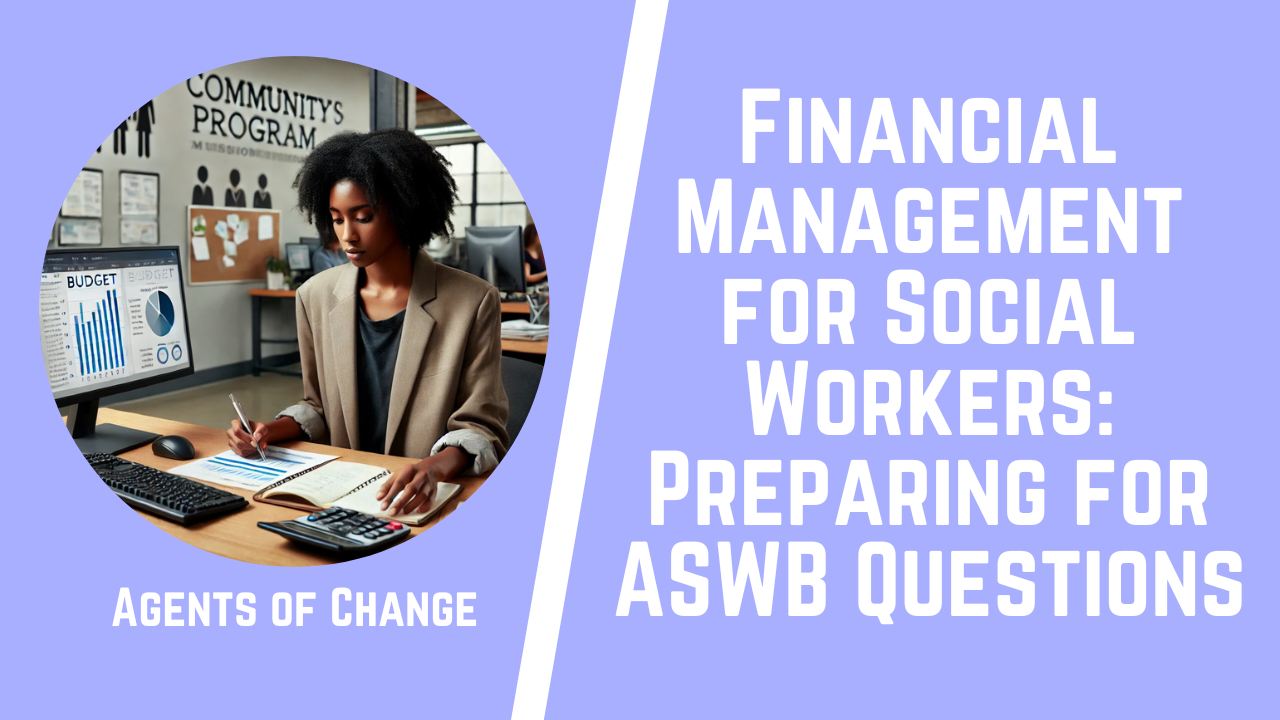
Financial Management for Social Workers: Preparing for ASWB Questions
Financial Management for Social Workers: Preparing for ASWB Questions
Financial management might not be the first skill you associate with Social Work, but it’s one of the most important. Social Workers operate in environments where budgets are tight, resources are limited, and ethical decisions are paramount. From balancing program budgets to advocating for funding, understanding financial principles is critical—not just for running effective programs but also for ensuring clients receive the support they need.

If you’re preparing for the Association of Social Work Boards (ASWB) exam, mastering these concepts is essential, as financial management questions often test your ability to navigate real-world challenges.

The ASWB exam isn’t just about theory; it’s about applying knowledge to scenarios you might encounter in practice. Questions related to financial management assess your ability to allocate resources, evaluate programs, and adhere to ethical guidelines when managing funds.

For Social Workers stepping into leadership roles or managing client-focused programs, a strong grasp of these skills can significantly impact outcomes for vulnerable communities. This makes financial literacy a testable competency and a cornerstone of effective Social Work practice.

In this guide, we’ll break down the financial management topics most relevant to Social Workers, providing tips and practical examples to help you prepare for ASWB questions. Whether you’re learning how to build budgets, handle ethical dilemmas, or prioritize resources, this article will equip you with the knowledge and confidence to excel. Let’s dive in and make financial management one of your professional strengths!

Learn more about the ASWB exam and create a personalized ASWB study plan with Agents of Change. We’ve helped thousands of Social Workers pass their ASWB exams and want to help you be next!

1) Preparing for ASWB Financial Management Questions

a diverse social worker in a modern office environment, carefully reviewing financial documents. The space is professional and organized

The ASWB exam covers a range of topics, and financial management questions often test your ability to apply budgeting, resource allocation, and ethical decision-making in Social Work settings. To succeed, you’ll need to grasp key concepts, practice interpreting financial scenarios, and approach each question strategically. Here’s how to prepare effectively.


1. Understand the Exam’s Focus

Financial management questions on the ASWB exam typically fall into the following areas:

  • Budgeting and Planning: Creating, managing, and evaluating budgets for programs or agencies.
  • Resource Allocation: Making decisions about how to distribute limited funds or materials.
  • Ethics in Financial Management: Handling funds responsibly and transparently.
  • Funding and Advocacy: Identifying funding sources and advocating for program support.

Knowing the scope of these questions helps you prioritize your study time and focus on concepts most likely to appear.


2. Master Key Financial Management Concepts

To answer questions confidently, you’ll need a solid understanding of foundational concepts. Focus on these areas:

Budgeting Basics

  • Define income sources (e.g., grants, government funding).
  • Categorize expenses like salaries, supplies, and overhead.
  • Balance income and expenses to avoid deficits.

Cost-Benefit Analysis

  • Identify the benefits (outcomes) of a program versus its costs.
  • Consider both quantitative (financial) and qualitative (social impact) factors.

Ethical Decision-Making

  • Avoid conflicts of interest.
  • Ensure transparency in financial reporting.
  • Use funds in accordance with donors’ or stakeholders’ intentions.

Advocacy for Funding

  • Build a compelling case for funding needs using data and success stories.
  • Communicate the social value of programs to stakeholders.

3. Develop Strong Study Habits

When preparing for ASWB financial management questions, strategic study habits can make all the difference.

Practice with Scenarios

Financial questions often involve scenarios where you must analyze data or evaluate decisions. For example:

  • “A program serving low-income families has run out of funds. What’s your next step?”
  • “You notice discrepancies in a budget report. How should you handle it?”

Use Study Guides and Sample Questions

Leverage resources like ASWB study guides and practice exams. Look for questions specifically related to financial management and ethics. Agents of Change has ASWB study guides for all levels of the exam.

Create Flashcards for Key Terms

Familiarize yourself with terms such as:

  • Fixed vs. variable costs
  • Fundraising strategies
  • Restricted vs. unrestricted funding

Claim your free ASWB flashcards from Agents of Change here


4. Practice Time Management

On the ASWB exam, time management is key. Financial management questions often include detailed scenarios or data tables, which can take longer to analyze.

Tips for Managing Time:

  • Skim the question first to identify the main issue (e.g., budgeting, ethics, or resource allocation).
  • Focus on eliminating obviously incorrect answers.
  • Save time-consuming questions for the end if needed.

5. Focus on Ethics

Ethical dilemmas in financial management are a frequent theme on the ASWB exam. To prepare, consider the following examples:

  • Scenario: A grant specifies funds for educational programs, but your agency uses them for unrelated costs. How do you respond?
    • Correct Answer: Reallocate funds to comply with the grant’s terms and ensure future transparency.
  • Scenario: Your agency has limited resources and must choose between two programs. What factors should guide your decision?
    • Correct Answer: Prioritize based on client needs, program effectiveness, and alignment with agency goals.

6. Build Confidence with Practice

Confidence comes from consistent practice. Use these steps to sharpen your skills:

  • Review financial management case studies from Social Work settings.
  • Discuss budgeting or resource allocation scenarios with colleagues or mentors.
  • Simulate exam conditions by timing yourself on sample questions.

By focusing on these strategies, you’ll be well-prepared for financial management questions on the ASWB exam. Keep building your understanding of key concepts, and don’t hesitate to seek out additional resources or ask for guidance if you feel stuck.

Agents of Change packages include 30+ ASWB topics, 2 free study groups per month, and hundreds of practice questions so you’ll be ready for test day!

2) Financial Management in Practice: Skills Every Social Worker Needs

Social Workers often find themselves juggling tight budgets, advocating for funding, and ensuring ethical financial practices—all while maintaining a focus on client well-being. Developing strong financial management skills equips you to handle these responsibilities effectively.

Let’s explore the practical skills Social Workers need to succeed in managing finances both on the job and in exam scenarios.


1. Budgeting Skills

Effective budgeting is at the heart of financial management in Social Work. Whether you’re managing a community program or assessing client needs, understanding how to allocate funds is crucial.

Steps to Create a Budget:

  • Define Objectives: Clearly outline the purpose of the budget (e.g., running a shelter or funding a youth outreach program).
  • List Expenses: Break down costs into categories such as:
    • Personnel (salaries, benefits)
    • Program materials (supplies, equipment)
    • Operational costs (rent, utilities)
  • Identify Funding Sources: Include income from grants, donations, and government funding.
  • Balance the Budget: Ensure income meets or exceeds expenses. If a deficit exists, adjust expenses or explore new funding options.

Common Challenges in Budgeting:

  • Limited resources to meet growing needs.
  • Unexpected costs that strain the budget.
  • Ethical dilemmas when deciding which programs to prioritize.

By mastering these elements, Social Workers can create budgets that align with organizational goals and meet client needs.


2. Resource Allocation

Social Workers often have to make tough decisions about how to distribute limited resources fairly and effectively.

a diverse social worker and colleagues in a serious and contemplative discussion within a community-centered environment. The scene emphasizes focus and problem-solving collaboration.

Key Principles of Resource Allocation:

  • Equity Over Equality: Allocate resources based on need rather than distributing them equally across programs.
  • Prioritize Impact: Focus funding on programs that demonstrate measurable success.
  • Engage Stakeholders: Involve clients, staff, and funders in discussions about resource allocation to ensure transparency and buy-in.

Example Scenario:

An agency has $50,000 to allocate between two programs:

  1. A job training initiative for unemployed adults.
  2. A parenting workshop for low-income families.

To decide, consider:

  • The number of people served by each program.
  • The long-term benefits and outcomes of each initiative.
  • The agency’s overall mission and goals.

3. Advocacy and Fundraising

Advocating for resources and securing funding are essential skills for Social Workers, particularly in leadership roles.

Steps to Effective Advocacy:

  1. Understand the Funding Landscape: Identify potential sources such as government grants, private foundations, or community fundraising events.
  2. Build a Compelling Case: Use data, success stories, and testimonials to highlight the importance of the program or service.
  3. Strengthen Relationships: Collaborate with funders and community leaders to gain their support.
  4. Measure Outcomes: Demonstrate the impact of your program through clear, measurable results.

Fundraising Techniques:

  • Hosting events like charity auctions or benefit concerts.
  • Running social media campaigns to engage donors.
  • Applying for grants with well-written, detailed proposals.

Advocacy ensures that programs receive the support they need to thrive, while fundraising builds financial sustainability.


4. Ethical Financial Practices

Maintaining ethics in financial management is a critical responsibility for Social Workers. Mismanagement or unethical practices can harm clients and damage an organization’s reputation.

Key Ethical Guidelines:

  • Transparency: Maintain clear financial records and share them with stakeholders.
  • Accountability: Use funds for their intended purpose and document how they are spent.
  • Avoid Conflicts of Interest: Refrain from any decisions that could benefit you personally or appear biased.
  • Prioritize Client Needs: Allocate funds in ways that serve clients’ best interests.

Ethical Dilemmas in Practice:

  • Using restricted funds for unrelated purposes due to budget constraints.
  • Favoring programs that attract donors over those addressing urgent client needs.

By adhering to ethical standards, Social Workers can build trust with clients, funders, and the broader community.


5. Program Evaluation and Cost-Benefit Analysis

Social Workers must evaluate the financial viability and impact of their programs to ensure resources are used effectively.

How to Conduct a Program Evaluation:

  • Collect Data: Gather information on program outcomes, costs, and client feedback.
  • Compare Costs and Benefits: Assess whether the program’s benefits outweigh its financial investment.
  • Make Recommendations: Use your findings to suggest improvements, scale successful programs, or discontinue those with low impact.

Example Application:

A housing assistance program costs $10,000 annually but prevents 20 families from becoming homeless. The benefit—reduced homelessness and improved stability—far outweighs the financial cost.


6. Financial Literacy

Finally, every Social Worker should have a basic understanding of financial terms and concepts to navigate their roles effectively.

Key Terms to Know:

  • Operating Costs: Day-to-day expenses required to run a program.
  • Restricted vs. Unrestricted Funds:
    • Restricted: Funds designated for a specific purpose.
    • Unrestricted: Funds that can be used flexibly.
  • Fixed vs. Variable Costs:
    • Fixed: Costs that stay the same (e.g., rent).
    • Variable: Costs that change based on activity levels (e.g., program materials).

Improving financial literacy ensures Social Workers are equipped to make informed decisions, advocate effectively, and succeed in their roles.


By developing these skills, Social Workers can manage finances confidently, advocate for the resources their clients need, and ensure ethical practices in all aspects of their work. These competencies not only enhance professional effectiveness but also contribute to stronger communities.

3) Tackling Common ASWB Financial Management Scenarios

The ASWB exam often includes financial management scenarios to test your ability to apply budgeting, ethical decision-making, and resource allocation skills in practical situations. These questions are designed to mirror challenges you may face as a Social Worker, requiring thoughtful analysis and strategic problem-solving.

a diverse social worker talking with a few colleagues in a community type setting

Below, we break down several common scenarios and provide actionable steps for tackling them effectively.


1. Budget Shortfalls

Scenario Overview:

You’re managing a program or project, and the budget unexpectedly falls short due to unforeseen expenses or reduced funding. The ASWB question asks how you would address this situation.

How to Handle a Budget Shortfall:

  • Reassess Priorities:
    • Identify essential vs. non-essential expenses.
    • Temporarily suspend or reduce lower-priority activities.
  • Explore Alternative Funding:
    • Apply for emergency grants.
    • Launch a short-term fundraising campaign.
  • Increase Efficiency:
    • Reduce operational waste.
    • Negotiate with vendors for discounts or payment extensions.
  • Communicate Transparently:
    • Notify stakeholders about the issue and proposed solutions.
    • Collaborate with team members to implement cost-saving measures.

Example ASWB Question:

“A community center you oversee is running out of funding halfway through the fiscal year. What’s your first step?”

  • Correct Answer: Review the program’s expenses and prioritize critical services to align with available funds.

2. Resource Allocation

Scenario Overview:

You’re presented with two or more programs competing for limited resources. The ASWB exam tests your ability to evaluate and prioritize effectively.

Key Considerations for Allocation:

  • Client Needs:
    • Which program serves the most vulnerable population?
    • What are the immediate needs of the community?
  • Program Outcomes:
    • Which program has demonstrated measurable success?
    • How many people benefit from each program?
  • Alignment with Mission:
    • Which program aligns most closely with your agency’s goals and values?

Example Resource Allocation Question:

“Your agency has enough funding to support only one of two programs: a free meal service for seniors or a job training initiative for young adults. What factors should guide your decision?”

  • Evaluate:

    • Impact on community well-being.
    • Alignment with agency priorities.
    • Sustainability of outcomes.
  • Correct Answer: Choose the program that serves the most urgent need and aligns with the agency’s mission.


3. Ethical Financial Dilemmas

Scenario Overview:

You encounter a situation where financial practices intersect with ethical concerns, such as misallocated funds or decisions that could harm clients.

Common Ethical Scenarios:

  • Restricted Funds Misuse:
    • A grant earmarked for mental health services is used to cover unrelated costs.
  • Transparency Issues:
    • Financial reports omit key details to make budgets appear balanced.
  • Conflict of Interest:
    • Favoring programs that benefit friends, family, or influential donors.

Steps for Ethical Decision-Making:

  1. Identify the Ethical Issue: Understand the root of the problem.
  2. Consult Policies: Review agency financial protocols and ethical guidelines.
  3. Engage Stakeholders: Involve supervisors or boards for accountability.
  4. Take Corrective Action: Rectify any misuses and ensure compliance moving forward.

Example Ethical Question:

“Your supervisor instructs you to use restricted funds to cover general operating expenses, which violates the grant agreement. What do you do?”

  • Correct Answer: Explain the restriction, suggest alternative solutions, and consult the agency’s financial policies.

4. Evaluating Program Viability

Scenario Overview:

You’re tasked with determining whether a program should continue, be modified, or end based on financial and operational data.

How to Evaluate a Program:

  • Gather Data:
    • Review the program’s costs, client outcomes, and participant feedback.
    • Analyze funding trends and sustainability.
  • Weigh Costs and Benefits:
    • Do the program’s benefits justify its costs?
    • Can the program be scaled or adjusted to improve efficiency?
  • Compare Alternatives:
    • Are there other programs with similar goals but lower costs?

Example Evaluation Question:

“A program that costs $100,000 annually serves 40 clients. Is it financially viable?”

  • Correct Answer: Determine the cost per client, assess the program’s outcomes, and consider whether similar results could be achieved with fewer resources.

5. Emergency Financial Decisions

Scenario Overview:

Your agency faces a financial crisis, such as a sudden funding cut or an unexpected expense. The ASWB exam may ask you to identify the best immediate response.

Responding to a Financial Emergency:

  • Stabilize the Situation:
    • Use reserves or emergency funds if available.
    • Delay non-essential expenditures.
  • Reassess Budget Priorities:
    • Focus spending on critical services and clients’ urgent needs.
  • Engage Stakeholders:
    • Inform funders, staff, and clients of temporary changes.
    • Seek collaborative solutions to mitigate the impact.
  • Plan for Recovery:
    • Explore long-term funding options.
    • Develop strategies to prevent future emergencies.

Example Emergency Question:

“A sudden rise in utility costs creates a $10,000 gap in your budget. What’s your first step?”

  • Correct Answer: Reassess the budget to reduce non-essential spending while seeking additional funding.

Tips for Tackling ASWB Financial Management Scenarios

To excel at financial management scenarios:

  • Read Carefully: Identify the main issue (budgeting, ethics, allocation, etc.).
  • Eliminate Distractors: Rule out answers that contradict ethical principles or practical constraints.
  • Focus on Outcomes: Base decisions on what benefits clients and aligns with the agency’s goals.
  • Practice Regularly: Use sample questions to sharpen your problem-solving skills.

By preparing for these scenarios, you’ll build the confidence and knowledge to navigate financial management questions on the ASWB exam—and handle real-world challenges with ease.

4) FAQs – Financial Management for Social Workers: Preparing for ASWB Questions

Q: What types of financial management questions can I expect on the ASWB exam?

A: The ASWB exam includes financial management questions that test your ability to apply budgeting, ethical decision-making, and resource allocation skills in Social Work settings. Common question formats include:

  • Scenario-based questions: You’ll analyze situations like budget shortfalls, resource prioritization, or ethical dilemmas and choose the best response.
  • Data interpretation: These questions may ask you to evaluate charts, budgets, or financial summaries to make informed decisions.
  • Ethics-focused questions: Expect to address issues such as misusing funds, maintaining transparency, and upholding accountability.

Q: Do I need advanced financial or math skills to answer ASWB financial management questions?

A: No, advanced financial or math skills are not required for the ASWB exam. The financial management questions focus on:

  • Basic budgeting concepts (e.g., balancing income and expenses).
  • Logical decision-making, such as prioritizing resource allocation.
  • Interpreting data or financial summaries provided in the exam.

You won’t need to perform complex calculations or use accounting methods. Instead, the exam evaluates your ability to understand and apply foundational financial principles in Social Work contexts.

Q: How can I prepare effectively for financial management questions on the ASWB exam?

A: To prepare for financial management questions, focus on building practical knowledge and applying it to real-world scenarios. Here are some tips:

  • Review key concepts: Study budgeting basics, cost-benefit analysis, ethical financial practices, and resource allocation principles.
  • Practice scenarios: Use sample questions to practice evaluating budgets, addressing ethical dilemmas, and making decisions about program viability.
  • Engage with study materials: Use ASWB study guides like Agents of Change, online resources, and flashcards to reinforce your understanding of financial terms.
  • Seek guidance: Discuss challenging topics with peers, mentors, or study groups for additional insights. All Agents of Change courses include 2 live study groups per month.

With consistent practice and strategic study, you’ll be well-prepared to tackle financial management questions on the ASWB exam.

5) Conclusion

Financial management is a vital skill for Social Workers, bridging the gap between limited resources and the immense needs of the communities they serve. From creating and managing budgets to navigating ethical dilemmas, these responsibilities ensure that agencies and programs run smoothly and clients receive the support they need.

On the ASWB exam, financial management questions test your technical knowledge and ability to apply these principles in real-world scenarios. By mastering these concepts, you’re setting yourself up for both exam success and professional competence.

As you prepare for the ASWB exam, focus on understanding core financial principles, practicing real-life scenarios, and sharpening your ethical decision-making skills. Financial management is not about complex math but rather about strategic thinking and effective problem-solving. By breaking down key topics—like resource allocation, program evaluation, and transparency—you’ll build confidence in answering financial management questions while also strengthening skills that will serve you well in your career.

6) ASWB Exam Practice Question: Financial Management for Social Workers

A community-based organization receives a grant restricted for use in a youth mentorship program. Due to an unexpected budget shortfall, the program director suggests using a portion of the grant funds to cover general administrative expenses for the agency. As a Social Worker overseeing the program, how should you respond?

A. Use the restricted funds for administrative expenses temporarily, with plans to repay the amount later.
B. Consult the agency’s financial policies and reallocate the funds to cover administrative costs since they are essential.
C. Inform the program director that the funds cannot be used for administrative expenses and propose seeking alternative funding sources.
D. Use the restricted funds for administrative costs, provided the majority is still used for the mentorship program.

Correct Answer:
C. Inform the program director that the funds cannot be used for administrative expenses and propose seeking alternative funding sources.


Rationale:

  • A is incorrect because using restricted funds for unintended purposes, even temporarily, violates the grant agreement and ethical guidelines. Repayment does not justify the misuse of funds.

  • B is incorrect because agency financial policies cannot override the restrictions specified by the grant provider. The funds must be used solely for the intended purpose.

  • D is incorrect because restricted funds cannot be partially diverted to other uses unless explicitly approved by the grant provider.

  • C is correct because it aligns with ethical financial practices. The Social Worker must adhere to the grant restrictions and seek alternative solutions, such as applying for additional funding or reallocating unrestricted funds within the agency’s budget. This response ensures compliance with funding agreements and maintains transparency and accountability.


► Learn more about the Agents of Change course here: https://agentsofchangeprep.com

About the Instructor, Meagan Mitchell: Meagan is a Licensed Clinical Social Worker and has been providing individualized and group test prep for the ASWB for over 8 years. From all of this experience helping others pass their exams, she created the Agents of Change course to help you prepare for and pass the ASWB exam!

Find more from Agents of Change here:

► Facebook Group: https://www.facebook.com/groups/aswbtestprep

► Podcast: https://podcasters.spotify.com/pod/show/agents-of-change-sw

#socialwork #testprep #aswb #socialworker #socialwork #socialworktest #socialworkexam #exam #socialworktestprep #socialworklicense #socialworklicensing #licsw #lmsw #lcsw #aswbexam #aswb #lcswexam #lmswexam #aswbtestprep #aswbtest #lcswtestprep #lcswtest #lmswtestprep #lmswtest #aswbcourse #learningstyles #learningstyle

Disclaimer: This content has been made available for informational and educational purposes only. This content is not intended to be a substitute for professional medical or clinical advice, diagnosis, or treatment.

Share:

Discover more from Agents of Change

Subscribe now to keep reading and get access to the full archive.

Continue reading