Agents of Change ASWB exam prep has helped 100,000+ social workers pass, with video and audio lessons, hundreds of practice questions, and live study groups. Start with 10 free practice questions.
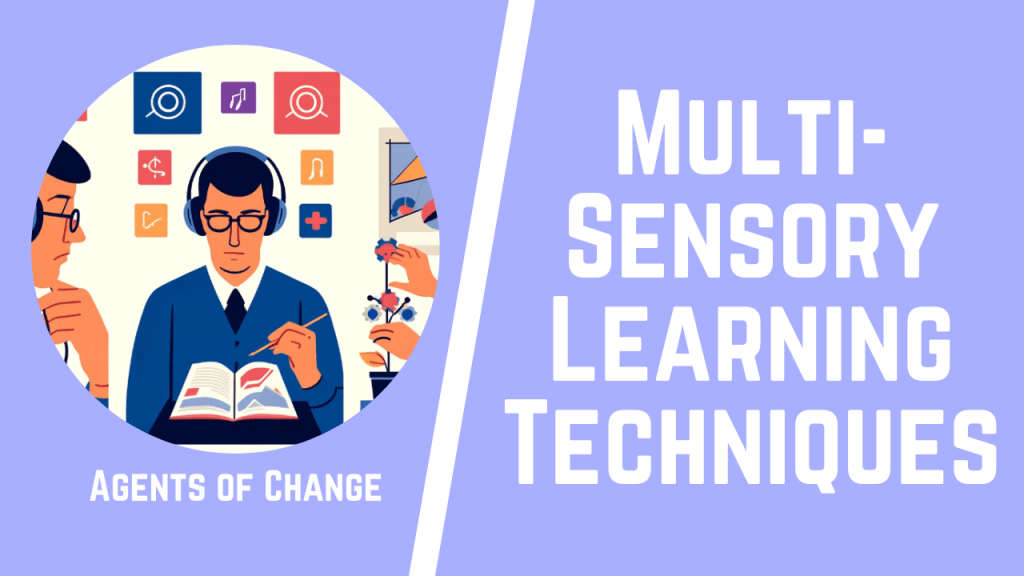
Studying for the ASWB exam can feel overwhelming. There’s a lot of material, and rereading notes or highlighting a textbook often doesn’t make it stick. Multisensory learning, which pairs visual, auditory, and hands-on activities, can make studying more active, engaging, and memorable.
The key is to use multisensory techniques the right way. Research doesn’t support the idea that you need to match your studying to one “learning style.” What does help is combining words and visuals, actively recalling information, and spacing your practice over time. In this guide, we’ll show you how to blend multisensory techniques with these proven strategies to prepare for the new ASWB exam.
Learn more about the ASWB exam and create a personalized ASWB study plan with Agents of Change. We’ve helped more than 100,000 Social Workers pass their ASWB exams and want to help you next!
Quick answer: multisensory studying for the ASWB exam
- Combine, don’t label: everyone benefits from pairing words with visuals and active practice; you don’t need to be a “visual learner.”
- Make it active: practice questions, flashcards, and explaining concepts out loud beat rereading.
- Space it out: short, repeated sessions over weeks work better than cramming.
- Practice the format: the new ASWB exam has two 61-question sections and 4 hours of testing time.
Jump to: What the Research Says · Visual · Auditory · Hands-On · Sample Study Plan · Practice Questions · FAQs
1) What the Research Says About Multisensory Learning
Multisensory, Not “Learning Styles”
Many people believe they’re a visual, auditory, or kinesthetic learner and should study only that way. A widely cited 2008 review in Psychological Science in the Public Interest by Pashler and colleagues found little evidence that matching instruction to a preferred learning style improves results. Instead, research supports approaches that help everyone:
- Dual coding: pairing words with visuals, like a diagram alongside a definition, gives your brain two ways to retrieve the same information.
- Active engagement: doing something with the material, such as explaining it, drawing it, or applying it to a scenario, builds stronger memory than passive review.
Pair Multisensory Techniques with Proven Study Strategies
A major 2013 review by Dunlosky and colleagues rated two strategies as having high utility across learners and subjects:
- Retrieval practice (self-testing): pulling information from memory, like answering practice questions or flashcards, strengthens learning more than rereading.
- Spaced practice: spreading study sessions over days and weeks leads to better long-term retention than cramming.
Mixing different topics in one session (interleaving) and explaining why an answer is correct (self-explanation) also help. The techniques below build these strategies in.
2) Visual Techniques
- Concept maps: put a topic like “crisis intervention” in the center and connect related ideas with labeled lines that explain the relationships.
- Comparison tables: line up easily confused concepts side by side, such as Schizoid vs. Schizotypal, or Erikson’s stages with their age ranges.
- Decision flowcharts: map out FIRST, NEXT, and BEST steps, such as safety first, then assessment, then intervention.
- Genograms and ecomaps: draw them for practice cases; both appear in exam scenarios.
- Flashcards with visuals: add a simple sketch or symbol to the back of each card. You can also claim free ASWB flashcards from Agents of Change.
- Color coding: use a consistent color system, such as one color for ethics and another for human development, to organize notes.
Make it active: after studying a diagram, cover it and redraw it from memory, then check what you missed.
3) Auditory Techniques
- Teach it out loud: explain a concept as if teaching a classmate. If you can’t explain it simply, you’ve found a gap to review.
- Study groups: talking through practice questions and rationales with others exposes you to new perspectives. All Agents of Change packages include 2 live study groups each month.
- Recorded summaries: record short summaries in your own words and listen during commutes or chores. Pause the recording and try to recall the next point before it plays.
- Podcasts: use exam-focused podcasts, like the Agents of Change podcast, to reinforce topics on the go.
- Mnemonics: rhymes, acronyms, and simple tunes can help with lists and sequences.
- Background sound: if music helps you focus, choose instrumental tracks; music with lyrics tends to compete with reading.
Agents of Change packages include video and audio lessons, hundreds of practice questions, a personalized study plan, and 2 live study groups each month so you’ll be ready for test day!
4) Hands-On (Kinesthetic) Techniques
- Role-play scenarios: with a study partner, act out a vignette, such as a client disclosing suicidal thoughts, and decide on the FIRST action together.
- Card sorting: write concepts on index cards and physically sort them, for example, matching defense mechanisms to examples or putting the steps of a model in order.
- Walk and recall: walk while reciting key concepts from memory, then check your notes.
- Write by hand: handwriting summaries can help you process information more deeply than typing.
- Build a model: for ecological or systems theory, use sticky notes or objects to represent each system and how they interact.
5) A Sample Multisensory Study Plan
A 60-Minute Session
- Warm-up retrieval (10 minutes): answer flashcards from earlier topics without looking at your notes.
- Visual (15 minutes): build a concept map or comparison table for today’s topic.
- Auditory (10 minutes): explain the topic out loud or discuss it with a study partner.
- Hands-on (10 minutes): role-play or sort cards to apply the concept.
- Practice questions (15 minutes): answer exam-style questions and read every rationale, including for the ones you got right.
Across Your Study Calendar
- Revisit each topic several times over a few weeks instead of covering it once.
- Mix topics in each practice set so you learn to recognize what a question is really asking.
- Take full-length, timed practice exams to build stamina for the new format: two 61-question sections and 4 hours of total testing time.
- Track which topics you miss most, and focus your next sessions there.
6) Practice Questions
Try these questions on topics that are easy to study with visual and hands-on techniques.
Question 1: A Social Worker wants a visual tool that shows a client’s relationships with outside systems such as school, work, church, and healthcare, including which connections are supportive or stressful. Which tool is MOST appropriate?
A) Genogram
B) Ecomap
C) Timeline
Correct Answer: B) Ecomap
Rationale: An ecomap shows a client’s connections to external systems and the nature of those relationships. A genogram focuses on family structure and patterns across generations, and a timeline tracks events over time.
Question 2: A client arrives for an unscheduled visit, crying and saying she can’t go on after learning her partner is leaving. What should the Social Worker do FIRST?
A) Explore the history of the relationship
B) Assess the client’s safety, including suicide risk
C) Help the client develop a plan for finding new housing
Correct Answer: B) Assess the client’s safety, including suicide risk
Rationale: In a crisis, safety comes first. The statement “can’t go on” requires a suicide risk assessment before exploring history or problem-solving. This FIRST step is easy to map in a decision flowchart.
Question 3: In systems theory, the idea that different starting points can lead to the same outcome is called:
A) Equifinality
B) Homeostasis
C) Multifinality
Correct Answer: A) Equifinality
Rationale: Equifinality means many paths can lead to the same outcome. Multifinality is the reverse, where similar starting points lead to different outcomes. Homeostasis is a system’s tendency to maintain balance. A comparison table is a great way to keep these straight.
Want more practice? Agents of Change offers four full-length, 122-question practice exams built for the new ASWB exam, and you can start with our free ASWB practice questions.
7) FAQs: Multisensory Learning for ASWB Exam Success
How do I know which techniques work best for me?
Try a mix and track your practice question scores by topic. Techniques that lead to better recall and higher scores are the ones to keep. Preferences matter for motivation, but don’t limit yourself to one “style.”
Can I use multisensory techniques if I have limited study time?
Yes. Listen to recorded summaries while commuting, review flashcards in short breaks, and recite key concepts while walking. Short, frequent sessions that include self-testing are more efficient than long sessions of rereading.
Do these techniques work for all ASWB content?
Yes, with some tailoring. Visual tools help with comparisons and sequences, auditory techniques help with explaining concepts and definitions, and hands-on activities help with applying knowledge to scenarios. Always finish with practice questions in the exam’s format.
8) Conclusion
Multisensory learning makes studying more engaging and memorable, especially when you pair visuals and hands-on activities with the strategies research supports most: retrieval practice and spaced practice. Don’t box yourself into a single learning style; use a mix of techniques and let your practice scores guide you.
With a consistent plan, active practice, and plenty of exam-style questions, you’ll walk into the new ASWB exam ready to apply what you know.
► Learn more about the Agents of Change course here: https://agentsofchangeprep.com
About the Instructor, Dr. Meagan Mitchell: Meagan is a Licensed Clinical Social Worker and has been providing individualized and group test prep for the ASWB for over 11 years. From all of this experience helping others pass their exams, she created the Agents of Change course to help you prepare for and pass the ASWB exam!
Find more from Agents of Change here:
► Facebook Group: https://www.facebook.com/groups/aswbtestprep
► Podcast: https://podcasters.spotify.com/pod/show/agents-of-change-sw
Disclaimer: This content has been made available for informational and educational purposes only. This content is not intended to be a substitute for professional medical or clinical advice, diagnosis, or treatment.