Agents of Change ASWB exam prep has helped 100,000+ social workers pass, with video and audio lessons, hundreds of practice questions, and live study groups. Start with 10 free practice questions.
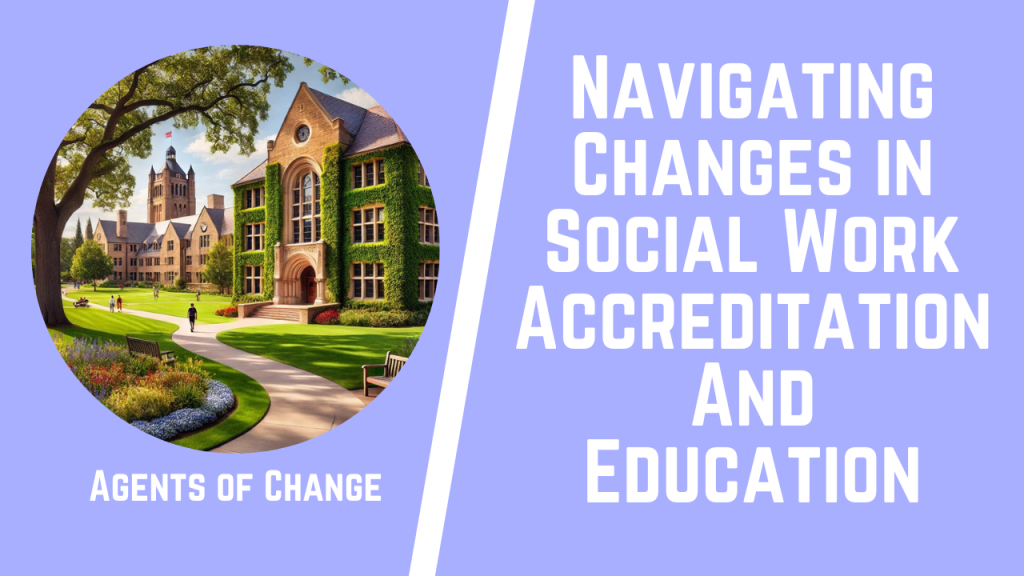
Social Work education and licensing have both changed in recent years. The Council on Social Work Education (CSWE) updated its accreditation standards in 2022, and ASWB launched a new exam blueprint in August 2026. If you’re a student or recent graduate, it helps to understand how these two systems work and how they connect.
In this guide, we’ll explain what accreditation is and why it matters, how the ASWB exam content is actually determined, what the recent changes mean for test takers, and how to prepare.
Learn more about the ASWB exam and create a personalized ASWB study plan with Agents of Change. We’ve helped more than 100,000 Social Workers pass their ASWB exams and want to help you next!
Quick answer: Social Work accreditation and the ASWB exam
- Accreditation: CSWE accredits BSW and MSW programs using its 2022 Educational Policy and Accreditation Standards (EPAS), built around nine competencies.
- Why it matters: most states require a degree from a CSWE-accredited program for licensure.
- Exam content: ASWB sets exam content through a practice analysis of licensed Social Workers, not through accreditation standards.
- The new exam: since August 2026, exams have three content domains, with Values and Ethics carrying the most weight.
- How to prepare: use materials updated for the new exam and focus on scenario-based practice.
Jump to: Understanding Accreditation · How Exam Content Is Set · How to Prepare · Practice Questions · FAQs
1) Understanding Accreditation in Social Work Education
Accreditation is a formal review in which an independent body evaluates whether an educational program meets established standards. In the U.S., CSWE accredits baccalaureate (BSW) and master’s (MSW) Social Work programs. Programs go through an initial review and periodic reaffirmation to keep their status.
Why Accreditation Matters
- Licensure: most states require a degree from a CSWE-accredited program to qualify for a Social Work license and the ASWB exam.
- Employment: many employers require or prefer graduates of accredited programs.
- Advanced standing: graduates of accredited BSW programs may qualify for advanced standing in MSW programs.
- Quality: accredited programs must meet standards for curriculum, faculty, field education, and assessment of student outcomes.
The 2022 EPAS and Its Nine Competencies
CSWE’s 2022 EPAS is competency-based: programs must show that students can demonstrate nine competencies, including:
| Competency | Focus |
|---|---|
| 1 | Demonstrate ethical and professional behavior |
| 2 | Advance human rights and social, racial, economic, and environmental justice |
| 3 | Engage anti-racism, diversity, equity, and inclusion (ADEI) in practice |
| 4 | Engage in practice-informed research and research-informed practice |
| 5 | Engage in policy practice |
| 6 to 9 | Engage, assess, intervene with, and evaluate practice with individuals, families, groups, organizations, and communities |
Field education remains central, often described as Social Work’s signature pedagogy. The standards also emphasize technology, interprofessional collaboration, and ongoing program assessment.
A recent update: in January 2026, CSWE released guidance allowing programs in states with laws restricting anti-racism, diversity, equity, and inclusion content to adjust competency wording in their accreditation documents to comply with state law. CSWE stated that no competencies were eliminated and programs must still meet all nine.
Agents of Change packages include video and audio lessons, hundreds of practice questions, a personalized study plan, and 2 live study groups each month so you’ll be ready for test day!
2) How ASWB Exam Content Is Actually Determined
It’s a common misconception that the ASWB exam follows accreditation standards. In fact, ASWB builds its exams from a practice analysis: a large survey of what licensed Social Workers actually do and need to know for safe, competent, and ethical entry-level practice.
For the current exams, ASWB’s 2024 practice analysis (the Social Work Census) collected 25,263 usable responses from every U.S. and Canadian jurisdiction, the largest in ASWB’s history. A task force of practitioners used the results to set new blueprints that:
- Reduce each exam from four content areas to three: Values and Ethics, Assessment and Planning, and Intervention and Practice
- Rename KSAs as “applied knowledge statements”
- Give Values and Ethics the largest share of questions, because Social Workers rated it as more important than in past studies
- Use one set of blueprints for both the U.S. and Canada
The new exams launched in August 2026 with 122 questions (110 scored) in two 61-question sections. See the August 2026 exam changes and what’s tested in each domain.
| CSWE Accreditation | ASWB Exam | |
|---|---|---|
| Purpose | Ensures the quality of Social Work education programs | Measures entry-level competence for licensure |
| Basis | 2022 EPAS and its nine competencies | A practice analysis of licensed Social Workers |
| Who it applies to | BSW and MSW programs | Individual candidates for licensure |
| How they connect | Both reflect current practice, so topics overlap, including ethics, assessment, diversity, and practice with systems of all sizes |
3) How to Prepare for the ASWB Exam
| Strategy | How to Do It |
|---|---|
| Use updated materials | Make sure your study resources reflect the August 2026 blueprint and the three content domains. |
| Prioritize ethics | Values and Ethics carries the most weight. Review the NASW Code of Ethics, especially confidentiality, boundaries, and informed consent. |
| Practice with scenarios | Most questions are vignettes. Practice prioritizing (FIRST, NEXT, BEST) and use our six-step ASWB answer strategy. |
| Cover cultural humility and diversity | Expect questions about working effectively and respectfully with clients from all backgrounds. |
| Know technology and collaboration | Review telehealth ethics, electronic records and privacy, and working on interdisciplinary teams. NASW’s practice standards include technology standards. |
| Mix study methods | Combine practice questions, flashcards, study groups, and teaching concepts out loud. |
| Simulate the exam | Take full-length, timed practice exams, and get used to a mix of 3- and 4-option questions. |
Agents of Change packages are updated for the new exam, with video and audio lessons, hundreds of practice questions with rationales, four full-length, 122-question practice exams, a personalized study plan, 2 live study groups each month, and access until you pass.
4) Practice Questions
Question 1: A hospital Social Worker learns at a team meeting that a physician plans to discharge a patient who has no safe place to go. What should the Social Worker do FIRST?
A) Accept the physician’s decision because it is a medical matter
B) Share the patient’s housing situation with the team and advocate for a safe discharge plan
C) Arrange a shelter placement without consulting the team
Correct Answer: B) Share the patient’s housing situation with the team and advocate for a safe discharge plan
Rationale: Interprofessional collaboration means contributing the Social Work perspective. The Social Worker advocates for a safe plan with the team rather than deferring or acting alone.
Question 2: A client asks a Social Worker to communicate by text message between telehealth sessions. What should the Social Worker do FIRST?
A) Agree, since texting is convenient
B) Review agency policy and discuss the privacy risks and boundaries of texting with the client
C) Refuse all communication between sessions
Correct Answer: B) Review agency policy and discuss the privacy risks and boundaries of texting with the client
Rationale: Technology use requires informed consent about privacy and boundaries, consistent with agency policy. Agreeing or refusing outright skips that discussion.
Question 3: A Social Worker begins working with a family whose cultural practices around child-rearing are unfamiliar to her. No safety concerns have been identified. What is the BEST approach?
A) Ask the family about their practices and what they mean to them
B) Advise the family to adopt practices common in the U.S.
C) Transfer the case to a colleague who shares the family’s background
Correct Answer: A) Ask the family about their practices and what they mean to them
Rationale: Cultural humility means learning from the family and avoiding assumptions. Without safety concerns, there’s no reason to impose different practices or transfer the case.
Want more practice? Start with our free ASWB practice questions.
5) FAQs: Social Work Accreditation and the ASWB Exam
Do accreditation changes change the ASWB exam?
Not directly. ASWB sets exam content through its practice analysis of licensed Social Workers. Accreditation standards and the exam often cover overlapping topics because both reflect current practice, but they’re separate processes.
Do I need a degree from a CSWE-accredited program to take the ASWB exam?
In most states, yes. Your state licensing board decides who’s eligible to test, so check your board’s requirements, especially if you earned your degree outside the U.S.
What should I focus on for the new exam?
Values and Ethics carries the most weight, followed by Assessment and Planning and Intervention and Practice. Practice scenario-based questions and use materials updated for the August 2026 blueprint.
6) Conclusion
Accreditation shapes the education that prepares you for practice, and ASWB’s practice analysis shapes the exam that licenses you. Understanding the difference helps you prepare wisely: graduate from an accredited program, use study materials updated for the new exam, prioritize ethics, and practice applying your knowledge to real-world scenarios.
► Learn more about the Agents of Change course here: https://agentsofchangeprep.com
About the Instructor, Dr. Meagan Mitchell: Meagan is a Licensed Clinical Social Worker and has been providing individualized and group test prep for the ASWB for over 11 years. From all of this experience helping others pass their exams, she created the Agents of Change course to help you prepare for and pass the ASWB exam!
Find more from Agents of Change here:
► Facebook Group: https://www.facebook.com/groups/aswbtestprep
► Podcast: https://podcasters.spotify.com/pod/show/agents-of-change-sw
Disclaimer: This content has been made available for informational and educational purposes only. This content is not intended to be a substitute for professional medical or clinical advice, diagnosis, or treatment.