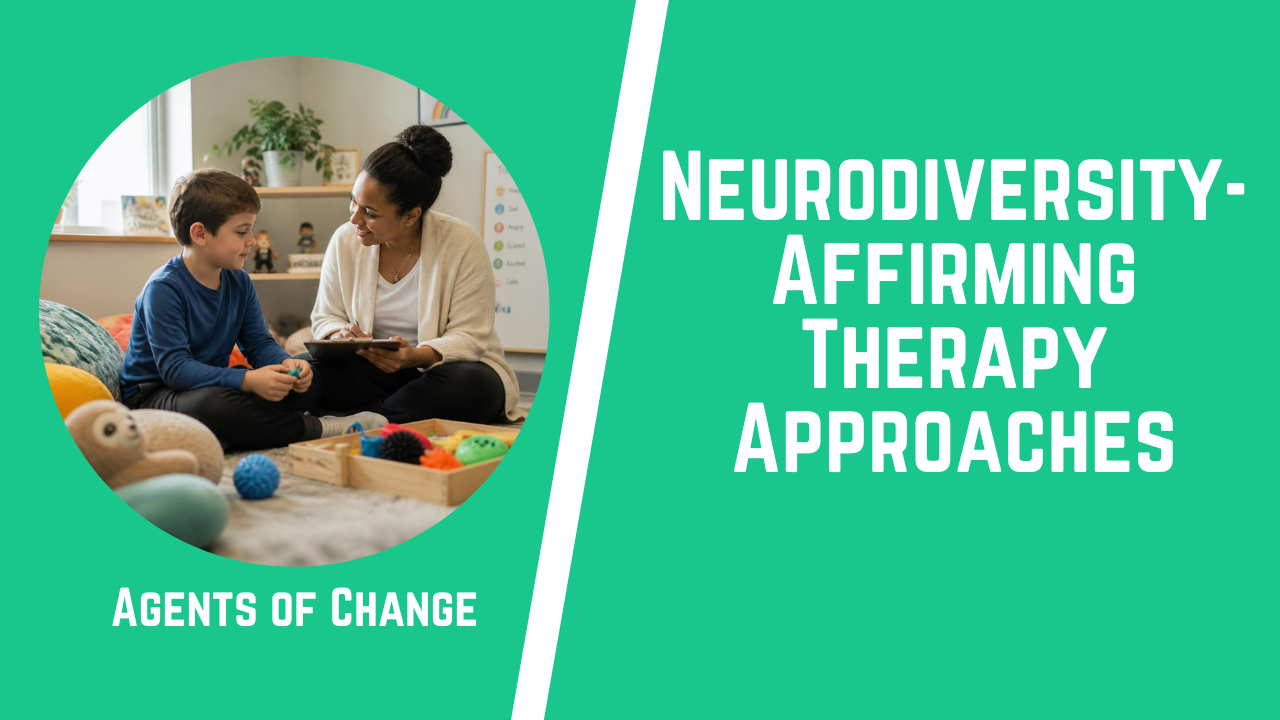
Neurodiversity-Affirming Therapy Approaches

Neurodiversity-Affirming Therapy Approaches

For many years, mental health treatment often viewed neurological differences through a deficit-based lens. Autistic clients were encouraged to appear less Autistic, people with ADHD were told to become more organized or disciplined, and those with sensory or communication differences were frequently expected to adapt without receiving meaningful accommodations. Progress was often measured by how closely a person could conform to neurotypical expectations.

The field is beginning to move in a different direction. Rather than asking how to reduce or hide a client’s differences, clinicians are increasingly asking what that person needs to feel safe, understood, connected, and supported. Neurodiversity-affirming therapy approaches recognize neurological differences as part of natural human variation while still making room for the real challenges clients may experience in daily life.

This shift changes how therapists interpret behavior, establish treatment goals, communicate with clients, and evaluate progress. It also encourages clinicians to consider the impact of masking, ableism, environmental barriers, chronic misunderstanding, and inaccessible systems. Instead of treating the person as the problem, neurodiversity-affirming care looks at the full context and helps clients build lives that are more sustainable, authentic, and aligned with their individual needs.

Did you know? Agents of Change Continuing Education offers Unlimited Access to 200+ ASWB and NBCC-approved online CE courses and 20+ Live Events per year for one low annual fee to meet your state’s requirements for Continuing Education credits and level up your career.

We’ve helped hundreds of thousands of Social Workers, Counselors, and Mental Health Professionals with Continuing Education, learn more here about Agents of Change and claim your 7.5 free CEUs.

1) Why the Field Is Moving Away From Deficit-Based Treatment

For much of its history, mental health care has evaluated neurodivergent people according to how closely they meet neurotypical expectations. Differences in communication, attention, emotional regulation, social interaction, sensory processing, and movement were often described primarily as deficits. Treatment then focused on reducing those visible differences, even when they weren’t harmful to the client.

neurodiverse child in mental health therapy session with diverse therapist

Today, clinicians, researchers, disability advocates, and neurodivergent communities are questioning whether conformity should be the primary measure of therapeutic success. The field is increasingly recognizing that some behaviors previously viewed as symptoms may be adaptive responses, communication attempts, or strategies for managing an inaccessible environment.

Deficit-Based Models Can Confuse Difference With Dysfunction

A deficit-based approach usually begins by identifying what a person cannot do or how their behavior differs from what is considered typical. This framework may describe limited eye contact as a social deficit, repetitive movement as inappropriate behavior, difficulty beginning tasks as laziness, or direct communication as a lack of social awareness.

These interpretations focus on how the behavior appears to others. They may overlook what the client is experiencing internally.

For example:

  • Avoiding eye contact may help a client listen and process language more effectively.
  • Rocking, pacing, or moving the hands may support emotional or sensory regulation.
  • Canceling plans may reflect exhaustion, sensory overload, or difficulty transitioning.
  • Asking repeated questions may help create predictability during an uncertain situation.
  • Shutting down may indicate that the client has exceeded their processing capacity.
  • Missing deadlines may result from executive functioning barriers rather than indifference.

When clinicians treat every difference as a problem, therapy can become an effort to make the client appear more typical rather than helping the client function more comfortably and safely.

Masking Can Be Mistaken for Improvement

Masking occurs when a neurodivergent person hides, suppresses, or compensates for their natural traits to meet social expectations. A client may force eye contact, rehearse conversations, imitate facial expressions, suppress stimming, tolerate overwhelming environments, or pretend to understand unclear instructions.

From the outside, masking may look like successful treatment. The client appears calmer, more socially engaged, or more compliant. Internally, however, they may be experiencing intense stress and exhaustion.

The possible costs of sustained masking include:

  • Increased anxiety
  • Emotional exhaustion
  • Loss of identity
  • Reduced awareness of personal needs
  • Difficulty recognizing overload
  • Social burnout
  • Lower self-esteem
  • Delayed emotional reactions after demanding situations
  • Fear of rejection if authentic traits become visible

A child who appears regulated at school may experience significant distress after returning home. An adult who performs well during meetings may need hours to recover afterward. A client who has learned to smile and maintain eye contact may still feel disconnected, overwhelmed, or unsafe.

Neurodiversity-affirming care asks whether the client’s internal well-being is improving, rather than relying entirely on outward behavior.

Compliance Is No Longer Viewed as the Same as Wellness

Traditional treatment models sometimes prioritized compliance with adult, school, workplace, or social expectations. Clients might have been rewarded for sitting still, following directions quickly, tolerating discomfort, or suppressing emotional reactions.

Compliance can occasionally support safety, but automatic obedience isn’t a healthy goal in every situation. Neurodivergent clients also need opportunities to recognize discomfort, express disagreement, ask questions, decline unreasonable demands, and establish boundaries.

A client may be showing meaningful progress when they:

  • Request clearer instructions
  • Ask for a break before becoming overwhelmed
  • Decline an overstimulating activity
  • Explain that a sensory experience is painful
  • Use a preferred communication method
  • Challenge an unrealistic expectation
  • Ask for an accommodation
  • Leave an interaction that feels unsafe

These actions may appear less compliant, yet they can represent increased self-awareness and stronger self-advocacy.

Environmental Barriers Matter

Deficit-based models tend to locate the problem entirely within the individual. If a client struggles in a bright, noisy classroom, the goal may be to increase the client’s tolerance. If an employee misses verbal instructions, treatment may focus on improving attention. If someone becomes overwhelmed at a crowded gathering, therapy may target avoidance.

Neurodiversity-affirming care considers whether the environment can be changed first.

Helpful environmental adjustments might include:

  • Providing written instructions
  • Reducing background noise
  • Allowing headphones or sensory tools
  • Offering flexible seating
  • Giving advance notice of schedule changes
  • Creating predictable routines
  • Allowing remote participation
  • Breaking large tasks into clear steps
  • Providing recovery time after demanding activities
  • Using direct and concrete communication

These accommodations don’t remove accountability or prevent skill development. They create conditions in which the client can access their abilities more consistently.

Lived Experience Is Reshaping Clinical Practice

Neurodivergent advocates have played a major role in challenging deficit-based treatment. Many adults have described the long-term effects of interventions that prioritized appearing typical over feeling safe, understood, or autonomous.

Their perspectives have encouraged clinicians to reconsider whose goals are being centered in treatment.

Before setting a goal, therapists can ask:

  • Does the client personally want this behavior to change?
  • Is the behavior harmful, or is it simply unusual?
  • Who benefits most from the proposed change?
  • What need is the behavior meeting?
  • Could the environment be adapted?
  • Does the goal increase autonomy?
  • Could the intervention unintentionally increase shame or masking?

Listening to lived experience doesn’t mean abandoning clinical knowledge. It means combining professional expertise with the client’s understanding of their own body, identity, needs, and environment.

Strength-Based Care Produces More Meaningful Goals

Moving away from deficit-based treatment doesn’t mean ignoring disability or pretending that every neurological difference is easy. Neurodivergent clients may experience serious challenges with communication, daily living, employment, relationships, learning, sensory regulation, or mental health.

The difference lies in how those challenges are understood.

Rather than asking, “How do we eliminate this trait?” the clinician might ask:

  • How can we reduce distress?
  • What support would make this task more accessible?
  • What skill does the client want to develop?
  • How can the client communicate this need?
  • What strengths can support the treatment goal?
  • What would improve the client’s quality of life?

This approach allows therapy to address real difficulties without framing the client’s identity as defective.

A Broader Definition of Progress

As the field shifts toward Neurodiversity-Affirming Therapy Approaches, clinicians are expanding how they define therapeutic progress. Success may include greater independence, but it may also involve accepting support. It may include building skills, changing the environment, setting boundaries, reducing shame, or creating more sustainable routines.

Progress might look like a client recognizing overload before reaching a crisis. It might involve using a sensory tool in public, asking for written instructions at work, or choosing friendships where direct communication is welcomed.

The goal is no longer to make neurodivergence less visible at any cost. The goal is to help clients experience greater safety, agency, connection, self-understanding, and quality of life.

Learn more about Agents of Change Continuing Education. We’ve helped hundreds of thousands of Social Workers, Counselors, and Mental Health Professionals with their online continuing education and CEUs, and we want you to be next!

2) What Neurodiversity-Affirming Therapy Approaches Look Like in Practice

Neurodiversity-Affirming Therapy Approaches are less about following one specific treatment model and more about changing how clinicians understand clients, behaviors, goals, and support needs. A therapist may still use CBT, ACT, DBT, play therapy, family therapy, or other evidence-based interventions. The difference is that these methods are adapted to respect neurological differences rather than trying to eliminate them.

Begin With Curiosity

Affirming practice starts by asking what a behavior means before deciding that it needs to change. Behaviors that appear avoidant, resistant, disruptive, or unusual may serve an important purpose.

neurodiverse teen in mental health therapy session with diverse therapist

For example, a client may avoid eye contact because it interferes with concentration. Repetitive movement may support regulation. Canceling plans might reflect sensory overload or limited energy rather than a lack of interest.

Helpful questions include:

  • What happens before this behavior?
  • What need might it be meeting?
  • Is the behavior harmful, or is it simply different?
  • Does the client want it to change?
  • Could the environment be adjusted first?

Curiosity helps clinicians avoid making assumptions based only on outward appearance.

Collaborate on Meaningful Goals

Treatment goals should reflect what matters to the client. A goal shouldn’t exist simply because a caregiver, teacher, employer, or clinician wants the person to appear more typical.

Affirming goals may focus on:

  • Identifying sensory needs
  • Building self-advocacy skills
  • Reducing shame
  • Improving emotional awareness
  • Creating sustainable routines
  • Developing supportive relationships
  • Recovering from burnout
  • Communicating boundaries

The therapist can still support growth and accountability, but the goal should improve the client’s quality of life rather than reward conformity.

Adapt Communication

Traditional talk therapy often relies on fast verbal responses, open-ended questions, eye contact, and abstract emotional language. These expectations may create barriers for some neurodivergent clients.

Therapists can offer:

  • Written agendas
  • Visual emotion scales
  • Specific questions
  • Extra processing time
  • Typed or written responses
  • Concrete examples
  • Session summaries
  • Breaks during difficult conversations

Instead of asking, “How did that make you feel?” a therapist might ask whether the client felt tense, tired, restless, numb, angry, or confused. More structured questions can make participation easier without reducing the depth of therapy.

Consider Sensory and Environmental Needs

The therapy environment can affect whether a client is able to engage. Bright lighting, background noise, strong scents, uncomfortable seating, or visual clutter may increase distress.

Affirming accommodations might include dimmer lighting, flexible seating, fidget tools, movement breaks, reduced noise, telehealth options, or permission to avoid eye contact. These adjustments don’t lower expectations. They reduce unnecessary barriers.

Support Regulation Without Shaming

Stimming, pacing, rocking, humming, or using repetitive movements may help a client focus or regulate. Unless a behavior is dangerous, therapy doesn’t need to prioritize stopping it.

When a behavior causes harm, the clinician can explore its function and help the client find safer alternatives. The focus remains on regulation and harm reduction rather than suppression.

Measure Progress Differently

Progress may look like asking for accommodations, recognizing overload earlier, setting boundaries, using a sensory tool, or reducing the need to mask.

The central question is no longer, “Does this person appear more typical?” It becomes, “Does this person feel safer, more capable, more understood, and more in control of their life?”

Agents of Change has helped hundreds of thousands of Social Workers, Counselors, and Mental Health Professionals with Continuing Education, learn more here about Agents of Change and claim your 7.5 free CEUs!

3) Avoid Common Mistakes in Affirming Practice

Neurodiversity-affirming care requires more than using updated terminology or describing therapy as strengths-based. Clinicians can have positive intentions while still relying on assumptions rooted in compliance, normalization, or deficit-based treatment. Recognizing these common mistakes can help therapists provide care that genuinely supports autonomy, safety, and quality of life.

Mistake 1: Treating Affirmation as Constant Agreement

Affirming a client doesn’t mean agreeing with every belief, avoiding accountability, or refusing to discuss harmful behavior. A therapist may worry that challenging a neurodivergent client will feel invalidating, but avoiding difficult conversations can limit meaningful growth.

Affirmation means respecting the client’s neurological identity and validating their internal experience. It doesn’t require the therapist to overlook the impact of the client’s choices on themselves or others.

How to Avoid It

Therapists can combine validation with thoughtful challenge by:

  • Acknowledging the client’s perspective before exploring alternatives
  • Separating the client’s identity from a specific behavior
  • Discussing impact without assigning negative character traits
  • Using curiosity instead of confrontation
  • Developing goals collaboratively
  • Identifying strategies that preserve both accountability and dignity

For example, a therapist might say, “It makes sense that you became overwhelmed when the plan changed. Let’s also look at how yelling affected the other person and what could help you communicate your needs next time.”

Mistake 2: Assuming All Neurodivergent Clients Have the Same Needs

Neurodivergent people aren’t a single, uniform group. Two clients with the same diagnosis may have entirely different sensory needs, communication styles, strengths, challenges, identities, and preferences.

A strategy that helps one Autistic client may frustrate another. One person with ADHD may benefit from detailed schedules, while someone else may find rigid planning overwhelming. Relying on a diagnosis alone can cause clinicians to overlook the individual sitting in front of them.

How to Avoid It

Conduct an individualized assessment that explores:

  • Communication preferences
  • Sensory experiences
  • Executive functioning needs
  • Cultural and family context
  • Previous treatment experiences
  • Areas of strength and interest
  • Current support systems
  • Personal goals and priorities
  • Preferred language and identity terms

Avoid assuming that a technique will be helpful simply because it’s commonly recommended for a particular diagnosis. Ask the client what works, what hasn’t worked, and what they would like to try.

Mistake 3: Romanticizing Neurodivergence

Strength-based care can unintentionally minimize disability. Statements suggesting that every challenge is a hidden gift or superpower may feel dismissive to clients who experience significant barriers in daily life.

A client may appreciate their creativity, attention to detail, or intense interests while still struggling with eating, sleeping, employment, communication, personal care, or sensory distress. Celebrating strengths shouldn’t require denying support needs.

How to Avoid It

Make room for the full complexity of the client’s experience. Therapists can:

  • Recognize strengths without forcing a positive interpretation
  • Validate grief, frustration, and exhaustion
  • Discuss disability directly when the client wants to
  • Avoid comparing one neurodivergent person with another
  • Support accommodations without presenting them as a failure
  • Ask clients how they understand their own neurodivergence

Affirming care allows clients to feel pride, grief, anger, relief, or uncertainty. They don’t have to describe neurodivergence as either entirely positive or entirely negative.

Mistake 4: Rewarding Masking as Therapeutic Progress

A client who makes more eye contact, sits still, speaks in a socially expected way, or hides distress may appear to be improving. However, these changes could reflect increased masking rather than genuine well-being.

When therapists focus primarily on outward behavior, they may miss the exhaustion required to maintain that appearance. A client may look calm during a session while experiencing intense internal distress.

How to Avoid It

Evaluate progress by looking beyond visible conformity. Ask:

  • Does the client feel safer?
  • Are they experiencing less shame?
  • Can they recognize overload earlier?
  • Are they communicating their needs more effectively?
  • Do they have access to accommodations?
  • Are their routines becoming more sustainable?
  • How much energy does the client spend appearing regulated?
  • What happens after socially demanding situations?

Progress may involve using a sensory tool, requesting written instructions, taking more breaks, or declining an overwhelming activity. These changes may make neurodivergence more visible while improving the client’s overall functioning and health.

Mistake 5: Expecting the Client to Educate the Therapist

Clients should be invited to describe their personal experiences, but they shouldn’t carry the responsibility of teaching their therapist the foundations of autism, ADHD, sensory processing, masking, disability culture, or neurodiversity-affirming care.

When clinicians lack basic knowledge, clients may spend valuable session time explaining terminology or correcting harmful assumptions. This can weaken trust and recreate the experience of being misunderstood by professionals.

How to Avoid It

Therapists should take responsibility for ongoing education by:

  • Completing continuing education on neurodivergence
  • Learning from neurodivergent-led resources
  • Seeking consultation or supervision
  • Reviewing current clinical research
  • Examining personal assumptions about productivity and normality
  • Staying open to respectful correction
  • Avoiding interventions outside their area of competence

Clients remain the experts on their own lives. Clinicians are responsible for developing the foundational knowledge needed to understand and support them.

Moving From Good Intentions to Affirming Action

The central question isn’t whether a therapist considers themselves affirming. It’s whether the client experiences the therapeutic relationship as respectful, accessible, collaborative, and safe.

Clinicians can regularly ask themselves:

  • Whose goals are guiding treatment?
  • Am I addressing harm or simply discouraging difference?
  • Have I considered environmental barriers?
  • Does this intervention increase the client’s autonomy?
  • Am I listening to the client’s description of their own experience?
  • Could my definition of progress unintentionally reward masking?

Neurodiversity-affirming practice is an ongoing process rather than a label a clinician earns once. It requires reflection, humility, continued education, and a willingness to adjust when clients communicate that an approach isn’t working.

4) A Practical Checklist for Clinicians with Affirming Care

Neurodiversity-affirming care requires ongoing reflection rather than a single set of techniques. Clinicians can use this checklist to evaluate whether their assessments, environments, communication styles, and treatment goals support dignity, autonomy, and meaningful quality of life.

Before the Session

  • Have I learned about the client’s communication preferences?
  • Do I know whether the client has sensory, mobility, processing, or accessibility needs?
  • Is the therapy space free from unnecessary noise, strong scents, harsh lighting, or visual clutter?
  • Can the client choose where to sit, whether to make eye contact, or how to participate?
  • Have I provided clear information about what to expect?
  • Am I prepared to offer written, visual, verbal, or movement-based ways to communicate?

During the Session

  • Am I using clear, direct, and concrete language?
  • Have I allowed enough processing time before repeating or rephrasing a question?
  • Am I interpreting behavior with curiosity rather than judgment?
  • Have I asked what the behavior means to the client?
  • Am I allowing safe stimming, movement, fidgeting, or changes in posture?
  • Have I checked whether the client needs a break?
  • Am I avoiding assumptions based on eye contact, facial expression, tone, or body language?
  • Does the client have meaningful choices in the conversation?

When Assessing Concerns

Before labeling a behavior as a symptom or problem, ask:

  • Is the behavior dangerous or harmful?
  • Is it distressing to the client, or mainly uncomfortable for other people?
  • What happened before the behavior?
  • Could it be communicating pain, confusion, overload, fear, or an unmet need?
  • Could sensory demands or executive functioning challenges be contributing?
  • Is the client responding to an inaccessible or unsafe environment?
  • Could trauma, anxiety, depression, or another condition also explain the concern?
  • What does the client want help changing?

When Developing Treatment Goals

Affirming goals should:

  • Reflect the client’s priorities
  • Improve safety or quality of life
  • Increase autonomy and self-understanding
  • Support communication and self-advocacy
  • Reduce distress without demanding conformity
  • Include environmental accommodations when appropriate
  • Respect the client’s identity and preferred language
  • Account for energy, sensory needs, and realistic capacity
  • Avoid rewarding masking as the primary sign of progress

Ask yourself, “Would this goal still matter if no one were watching the client?”

When Choosing Interventions

  • Can the intervention be adapted to the client’s learning and communication style?
  • Is the purpose of the intervention clear to the client?
  • Has the client agreed to the approach?
  • Does the intervention reduce harm, or does it simply make the client appear more typical?
  • Am I helping the client develop choices rather than demanding one correct response?
  • Could an accommodation work better than repeated exposure or increased pressure?
  • Am I monitoring for exhaustion, shutdown, distress, or increased masking?
  • Is the pace sustainable?

When Working With Caregivers or Other Systems

  • Is the client’s voice included in decision-making?
  • Have I separated caregiver stress from the client’s treatment goals?
  • Am I helping caregivers understand the need behind the behavior?
  • Have I explored environmental changes before focusing on compliance?
  • Are expectations developmentally and neurologically appropriate?
  • Am I supporting boundaries, consent, and self-advocacy?
  • Have I protected the client’s privacy whenever possible?
  • Am I encouraging collaboration rather than control?

When Measuring Progress

Progress may include:

  • Recognizing overload earlier
  • Asking for help or accommodations
  • Communicating needs more clearly
  • Experiencing less shame
  • Developing safer regulation strategies
  • Setting and maintaining boundaries
  • Building supportive relationships
  • Creating more sustainable routines
  • Recovering more effectively after stress
  • Making informed choices about masking
  • Feeling more understood and in control

Progress shouldn’t be measured only by productivity, compliance, eye contact, stillness, or the absence of visible distress.

Ongoing Professional Reflection

Regularly ask yourself:

  • Whose comfort is this intervention serving?
  • Am I confusing difference with dysfunction?
  • Have I made assumptions about the client’s abilities?
  • Am I listening when the client says something isn’t working?
  • Do I need additional training, consultation, or supervision?
  • Am I learning from neurodivergent voices and lived experiences?
  • Have my documentation and language remained respectful?
  • Does the client experience therapy as collaborative, accessible, and safe?

Affirming care doesn’t require perfection. It requires humility, flexibility, curiosity, and a willingness to change course when a client’s needs aren’t being met.

5) FAQs – Neurodiversity-Affirming Therapy Approaches

Q: What is the main goal of neurodiversity-affirming therapy?

A: The goal is to support a client’s well-being, autonomy, communication, and quality of life without treating neurological differences as defects. Therapy may still address distress, harmful behavior, executive functioning challenges, or relationship concerns. However, success is measured by meaningful improvement for the client rather than how closely they appear to meet neurotypical expectations.

Q: Does neurodiversity-affirming care mean therapists cannot challenge clients?

A: No. Affirming care allows therapists to address harmful behaviors, inaccurate beliefs, relationship conflict, and personal responsibility. The clinician can validate the client’s experience while also exploring the impact of their actions and identifying more effective responses. Respecting neurodivergence doesn’t require avoiding accountability or difficult conversations.

Q: Can evidence-based therapies be used in neurodiversity-affirming practice?

A: Yes. Approaches such as CBT, ACT, DBT, play therapy, family therapy, and exposure-based interventions can be adapted to a client’s communication style, sensory needs, processing speed, and goals. Clinicians should avoid using these approaches primarily to encourage masking, compliance, or forced conformity. The intervention should reduce distress, increase choice, and help the client build a more sustainable life.

6) Conclusion

Neurodiversity-affirming care represents an important shift in how therapists understand difference, distress, and therapeutic progress. Rather than treating neurodivergent traits as problems to eliminate, this approach asks clinicians to consider the client’s environment, communication style, sensory needs, executive functioning, identity, and lived experience. The goal is to help clients feel safer, more capable, and more understood without requiring them to hide who they are.

This doesn’t mean ignoring challenges, avoiding accountability, or abandoning evidence-based treatment. It means adapting interventions so they support autonomy, reduce shame, and improve quality of life. Progress may look like recognizing overload earlier, asking for accommodations, setting boundaries, developing sustainable routines, or communicating needs with greater confidence.

As the field continues moving away from deficit-based treatment, clinicians have an opportunity to create therapy spaces where neurodivergent clients don’t have to perform normalcy to receive support. Through curiosity, collaboration, continued education, and thoughtful self-reflection, therapists can provide care that respects neurological differences while addressing real concerns. Affirming practice begins with a simple but powerful question: What does this client need to live a life that feels safe, meaningful, and authentically their own?

————————————————————————————————————————————————

► Learn more about the Agents of Change Continuing Education here: https://agentsofchangetraining.com

About the Lead Instructor, Dr. Meagan Mitchell: Meagan is a Licensed Clinical Social Worker and has been providing Continuing Education for Social Workers, Counselors, and Mental Health Professionals for more than 10 years. From all of this experience helping others, she created Agents of Change Continuing Education to help Social Workers, Counselors, and Mental Health Professionals stay up-to-date on the latest trends, research, and techniques.

#socialwork #socialworker #socialwork #socialworklicense #socialworklicensing #continuinged #continuingeducation #ce #socialworkce #freecesocialwork #lmsw #lcsw #counselor #NBCC #ASWB #ACE

Disclaimer: This content has been made available for informational and educational purposes only. This content is not intended to be a substitute for professional medical or clinical advice, diagnosis, or treatment

Note: Certain images used in this post were generated with the help of artificial intelligence.

Share:

Discover more from Agents of Change

Subscribe now to keep reading and get access to the full archive.

Continue reading