Preparing for your ASWB Masters Exam While You’re Still in School
Preparing for your ASWB Masters Exam While You’re Still in School
Starting a Social Work program comes with a mix of excitement, purpose, and more than a few long nights of studying. Between classes, field placements, and personal responsibilities, it can feel like there is barely enough time to focus on what is right in front of you, let alone think about a licensing exam that may still feel far away. Still, many students quietly wonder when they should start preparing for the ASWB Masters Exam and whether waiting until after graduation is really the best plan.

Preparing for your ASWB Masters Exam while you’re still in school can feel like a big step, yet it does not have to mean adding stress to an already full schedule. In fact, when approached thoughtfully, early preparation can fit naturally alongside your coursework and help reinforce what you are already learning in class. Concepts from human behavior, assessment, ethics, and intervention often overlap with exam content, providing a strong foundation for future success.

This post shows how you can begin building exam readiness without feeling overwhelmed or rushed. You will find practical strategies for blending exam prep with your current classes, ways to study consistently without burnout, and guidance on choosing supportive resources that match student life. By the end, the goal is for you to feel more confident about the path ahead and more in control of when and how you prepare.

Learn more about the ASWB exam and create a personalized ASWB study plan with Agents of Change. We’ve helped hundreds of thousands of Social Workers pass their ASWB exams and want to help you be next!

1) Why Early ASWB Prep Makes Sense (Even If It Feels Early)

At first glance, studying for a licensing exam while you are still in school can feel unnecessary or even overwhelming. After all, you already have papers, projects, and field hours to manage. Still, early ASWB preparation is less about adding pressure and more about making the most of the learning you are already doing. When approached with intention, it can actually make your final months in school and your post-graduation transition much smoother.

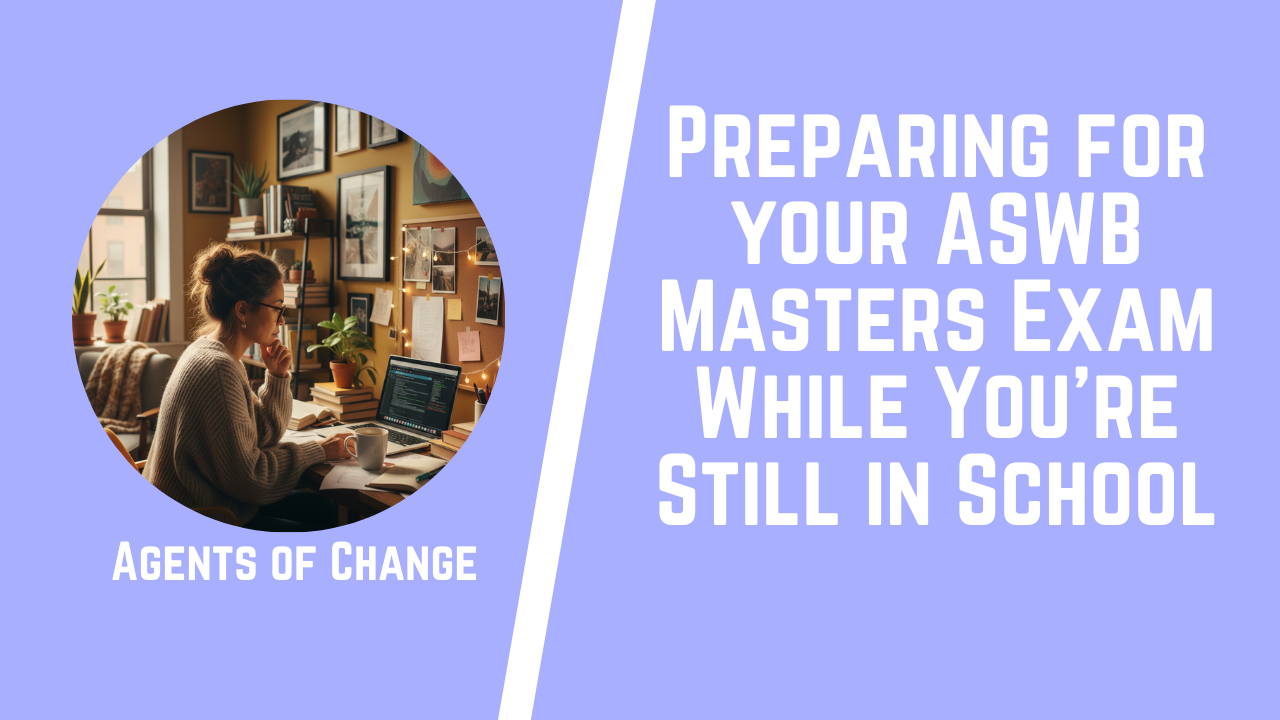
a masters-aged diverse student studying for an exam in front of a computer in a warm creative setting

Your Brain Is Already in Learning Mode

While you are actively taking classes, your brain is constantly absorbing, organizing, and applying new information. This is the perfect environment for gentle exam preparation.

Instead of relearning concepts later, you are reinforcing them now. That repetition helps with long-term memory and makes future review feel more like a refresh rather than starting from scratch.

Benefits of studying while concepts are fresh include:

  • Stronger retention over time

  • Easier connections between theory and real situations

  • Less frustration when reviewing later

You Reduce the Post-Graduation Pressure

Graduation is often followed by job searching, adjusting to new routines, and sometimes moving or changing financial responsibilities. Adding full-scale exam prep on top of all that can feel like too much at once.

By starting earlier, you spread your workload over a longer period and avoid putting everything into a short, stressful window.

Early prep can help you:

  • Avoid last-minute cramming

  • Feel more confident scheduling your exam

  • Enter your career with one major hurdle already underway

You Get Time to Identify and Strengthen Weak Areas

Everyone has topics that feel harder than others. Some students struggle with policy, others with diagnosis, and many find ethics questions tricky because the answers are so nuanced.

Starting early gives you space to notice patterns in what feels difficult and work on them gradually.

This allows you to:

  • Review challenging topics multiple times

  • Ask professors or supervisors for clarification while you are still in training

  • Practice applying concepts without rushing

You Can Practice Thinking Like the Exam Thinks

The ASWB Masters Exam is not only about what you know. It is about how you prioritize, assess risk, and choose the best next step. That kind of thinking develops over time.

Early exposure to practice questions helps you learn how the exam frames problems and what it values in decision-making.

Over time, you begin to recognize:

  • How questions are structured

  • What details matter most in scenarios

  • How to avoid common traps in answer choices

You Build Confidence Through Familiarity

One of the biggest sources of test anxiety is the unknown. When you have never seen the format, timing, or style of questions, everything can feel intimidating.

Early preparation replaces that uncertainty with familiarity. You begin to recognize patterns, understand expectations, and trust your ability to work through questions thoughtfully.

Confidence grows when you:

  • See improvement over time

  • Understand why answers are right or wrong

  • Feel prepared rather than surprised

In the end, early ASWB preparation is less about doing more and more about doing things at the right time. By aligning your exam prep with your education, you turn what could be an overwhelming future task into a manageable and steady part of your professional journey.

Agents of Change packages include 30+ ASWB topics, 2 free study groups per month, and hundreds of practice questions so you’ll be ready for test day!

2) Can I Use My Coursework to Prepare for the ASWB Exam?

This is one of the most common questions students ask, and it makes a lot of sense. You are already reading textbooks, writing case analyses, and discussing interventions in class, so it is natural to wonder whether that work is enough to prepare you for the ASWB Masters Exam. The short answer is that your coursework is a strong starting point, but it is usually not the full picture when it comes to exam readiness.

a masters-aged diverse student studying for an exam in front of a computer in a warm creative setting

Where Coursework and the ASWB Exam Overlap

Masters-level Social Work programs are designed to build competent, ethical, and reflective practitioners. Much of what you learn does appear on the exam in some form, especially when it comes to foundational knowledge.

You will likely see overlap in areas such as:

  • Human behavior and the social environment

  • General assessment concepts

  • Intervention approaches

  • Ethics and professional boundaries

  • Policy and service delivery frameworks

When you are studying these topics in class, you are strengthening your understanding of material that the exam will test. This is one reason why preparing while you are still in school can feel more natural than starting after a long break from academic life.

Why Coursework Alone Usually Is Not Enough

Even though the content overlaps, the way the ASWB exam asks questions is very different from most classroom exams or assignments. Instead of asking you to explain a concept or write an analysis, the exam focuses on what you should do first, next, or best in a specific client situation.

Classroom learning often emphasizes:

  • Theory and research

  • Broader clinical discussions

  • Long-form analysis and reflection

The ASWB exam, on the other hand, emphasizes:

  • Prioritization and safety

  • Ethical decision-making under pressure

  • Practical application in short scenarios

Without targeted practice, many students are surprised by how tricky the exam questions can feel, even when they know the material well.

Turning Coursework Into a Helpful Study Tool

Your classes can absolutely support your exam prep when used intentionally. Instead of treating school and exam prep as two separate tracks, you can let them reinforce each other.

Helpful strategies include:

  • Connecting class topics to exam domains

  • Asking yourself how a concept might appear in a multiple-choice scenario

  • Noting ethical principles that come up in case discussions

  • Reflecting on how interventions are prioritized in real practice

This approach helps shift your thinking from academic explanations to exam-style decision-making, which is a key skill on test day.

Why Purpose Built Prep Tools Are a Smart Investment

Even with strong coursework, most students benefit from using resources designed specifically for the ASWB exam. Purpose-built programs focus on how the test is structured, what types of mistakes are common, and how to apply knowledge in the exact format the exam requires.

This is where Agents of Change Test Prep becomes especially valuable. Their programs are designed around the actual ASWB exam blueprint and include:

  • Comprehensive video lessons that focus on test-relevant material

  • Practice exams that mirror the real exam structure and difficulty

  • Flashcards for efficient review

  • Two live study groups per month for guided support and questions

  • Study plans that help you stay organized and consistent

Another major benefit is that with Agents of Change, you have access until you pass your exam. This means you can start using the materials while you are still in school and continue after graduation without worrying about your access expiring. There is no risk of buying too early, which makes it easier to pace your studying and reduce pressure.

Blending Both for the Best Results

When coursework and exam prep tools are used together, they can complement each other in powerful ways. Your classes provide depth, theory, and real-world discussion. Exam prep programs provide structure, strategy, and practice with the exact type of questions you will face.

Together, they help you:

  • Understand concepts deeply

  • Apply them correctly in exam scenarios

  • Build confidence through repeated exposure

So yes, your coursework plays an important role in preparing for the ASWB exam, and it should absolutely be part of your study process. Still, pairing that foundation with purpose-built preparation tools like Agents of Change Test Prep is often what turns solid knowledge into true exam readiness.

3) Building a Study Schedule that Works While You’re Still in School

One of the biggest concerns students have about starting ASWB prep early is time. Between classes, internships, work, and personal responsibilities, your calendar can already feel packed. The goal is not to squeeze in huge study sessions, but to build a steady routine that fits into your real life and supports what you are already doing in school.

A good study schedule during your final semester should feel realistic, flexible, and repeatable. You want something that keeps you moving forward without making you feel like you are constantly behind.

Start With What You Already Have on Your Calendar

Before adding anything new, look at your existing weekly rhythm. Most students already have predictable blocks of time around:

  • Class days and commute times

  • Internship or field placement hours

  • Evenings when energy is low

  • Weekends when you may have more flexibility

Instead of fighting your schedule, work with it. Short, focused study sessions tend to work better than long, hard-to-sustain sessions.

Helpful places to fit in ASWB prep include:

  • Right after class, while concepts are fresh

  • Short sessions on non-internship days

  • Light review on weekends rather than heavy studying

Focus on Consistency, Not Perfection

It is tempting to design an ambitious schedule that looks great on paper and collapses after two weeks. A better approach is to plan for what you can reasonably maintain, even during busy weeks.

Consistency builds:

  • Familiarity with exam format

  • Confidence in applying concepts

  • Reduced anxiety as test day approaches

If you miss a session, that does not mean you failed your plan. It just means you pick up again at the next scheduled time.

Sample Study Schedule for a Final Semester Student

Here is an example of how a manageable ASWB study schedule might look during the final semester of a Masters program, assuming the exam is taken shortly after graduation or near the end of the term.

This schedule assumes:

  • Classes two to three days per week

  • Internship three days per week

  • Moderate outside work or personal commitments

Weeks 1 to 4 of the Semester
Goal: Build familiarity and reinforce coursework

  • Monday: 30 minutes reviewing practice questions related to current class topics

  • Wednesday: 20 to 30 minutes of flashcards or quick concept review

  • Saturday: 45 minutes watching targeted exam prep videos and taking notes

Focus areas:

  • Human behavior and development

  • General assessment principles

  • Professional values and ethics basics

Weeks 5 to 9 of the Semester
Goal: Increase application and scenario-based thinking

  • Tuesday: 30 minutes of practice questions with answer review

  • Thursday: 30 minutes reviewing weaker topic areas

  • Sunday: 60 minutes mixed content review and short quizzes

Focus areas:

  • Intervention strategies

  • Ethical decision-making in scenarios

  • Policy and service delivery systems

Weeks 10 to 13 of the Semester
Goal: Strengthen test strategy and endurance

  • Monday: 45 minutes focused on ethics and boundaries

  • Wednesday: 45 minutes practice questions and rationale review

  • Saturday: Full-length or half-length practice exam every other week

Focus areas:

  • Prioritization questions

  • Safety and risk assessment

  • Managing time and pacing

This kind of gradual increase helps you build skill and confidence without suddenly shifting into intense study mode at the end of the semester.

How Study Plans Can Make This Easier

Creating your own schedule can work, but it can also take time and mental energy that students already have very little of. This is where programs like Agents of Change Test Prep can be especially helpful.

All Agents of Change programs include structured study plans that:

  • Break content into manageable steps

  • Align study tasks with realistic timelines

  • Reduce guesswork about what to study next

Since access lasts until you pass the exam, you can start following a study plan while still in school and continue using it after graduation if your exam date is later. You never have to worry about rushing or wasting your access by starting early.

Make Room for Flexibility and Real Life

Even the best schedule will run into weeks with extra assignments, family obligations, or emotional exhaustion. Building flexibility into your plan keeps you from giving up when things get busy.

Helpful flexibility strategies include:

  • Keeping sessions short during heavy weeks

  • Shifting study days instead of skipping the week entirely

  • Using lighter tools like flashcards when energy is low

Your goal is progress over time, not perfect adherence to a rigid plan.

By building a study schedule that respects your student life instead of competing with it, ASWB prep becomes part of your routine rather than another source of stress. With consistent, well-paced studying and support from purpose-built tools like Agents of Change, you can move toward exam day feeling prepared, grounded, and confident in the work you have already done.

4) State-Level Regulations for Taking the ASWB Exam While Still in School

State boards set the eligibility rules for when you can sit for the ASWB Masters-level exam, and the differences can be surprisingly big. In some places, you can apply in your final semester and test before graduation. In others, you must wait until your degree is officially conferred and verified. Because these rules change (sometimes quickly), the safest approach is to treat your state board as the final authority, even if a school website or a third-party guide says otherwise. ASWB itself emphasizes that you must be approved by your jurisdiction before you can take an exam.

What “Allowed While Still in School” Usually Means

When a state does let current MSW students test early, it usually looks like one of these:

  • Last semester eligibility (you’re currently enrolled and near completion)

  • School verification required (a dean/registrar letter or a form confirming you’re in your final term)

  • You can test early, but the license won’t be issued until graduation (so you still need the conferred degree on record)

A clear example is Wisconsin’s DSPS, which explicitly states that applicants may take the national exam before graduation.
Connecticut also explicitly permits students in their last semester to apply to sit for the Masters-level exam prior to graduation, with specific application steps.

States Confirmed to Allow MSW Students to Sit for the ASWB Masters Exam in the Final Semester

These states provide explicit language from an official state agency or a credible, state-specific regulatory source indicating that you can take the Masters-level ASWB exam while still enrolled (typically in the last semester).

Connecticut (CT)

  • CT allows a student in their last semester of an MSW program to apply to sit for the Masters-level exam prior to graduation, as part of the master’s-level license application process.

Wisconsin (WI)

  • WI states that applicants may take the ASWB exam prior to graduation.

Ohio (OH)

  • Ohio’s Social Worker FAQ materials include guidance addressing whether a person can apply in the last semester of a Social Work program (the board’s FAQ is designed to answer exactly that kind of eligibility question).
    Practical note: The exact steps and documentation can change, so always follow the board’s current instructions.

Indiana (IN)

  • Indiana’s state form language indicates an applicant may take the ASWB Masters Examination prior to graduation with a “Letter of Good Standing”/school verification.

Illinois (IL)

  • Illinois changed its process so that master’s-level students in their last semester can begin the process of sitting for the ASWB Masters exam for the LSW pathway without waiting until after graduation (as described by NASW-Illinois in a policy update referencing the change).

States Confirmed to Require Degree Conferral Before You Can Be Made Eligible

In some states, the gating issue is that the board (or the education department) won’t approve your exam registration until your school confirms you’ve graduated.

New York (NY)

  • New York’s process is commonly described by universities as requiring degree conferral/education verification before you become eligible to take the ASWB Masters exam, because NYSED approves eligibility after the education is verified post-conferral.
    (NY’s process is distinctive in how the education verification and eligibility notification are handled, so it’s worth reading your state’s instructions carefully.)

Michigan (MI)

  • Michigan’s recent licensing guidance indicates Masters/Clinical exam eligibility is tied to completion of supervised experience hours for the designation before you can be made eligible for the exam. In other words, for many applicants, this prevents “still in school” Masters exam timing in the usual sense.

Why a “Full 50-State Yes/No List” Is Trickier Than It Sounds

Many states don’t phrase their rules as “yes, you can test before graduation” or “no, you cannot.” Instead, they describe eligibility as part of an application workflow, and the “answer” depends on details like:

  • Whether the state requires a conferred transcript to approve exam eligibility

  • Whether the state issues a temporary/associate/limited status that can be started before graduation

  • Whether the state uses the ASWB Masters exam for the credential you’re pursuing (some pathways use different exams or sequence requirements)

Because of that, the most reliable way to verify your own state is:

  1. Find your jurisdiction’s current exam eligibility page or application instructions

  2. Search that page for phrases like “last semester,” “prior to graduation,” “conferred,” “degree awarded,” or “verification letter”

  3. If it’s unclear, email or call the board and ask: “Can MSW students in their final semester be approved to sit for the ASWB Masters exam before degree conferral?”

How This Connects to Your Study Timeline

If your state allows final-semester testing, you can time your prep so you’re ready to test near the end of the semester, right when coursework is fresh. If your state requires degree conferral first, your ideal plan is to build momentum during the final term, then shift into higher-intensity practice right after graduation.

Either way, it’s a strong argument for using purpose-built resources that won’t penalize you for starting early. With Agents of Change Test Prep, you get comprehensive materials, practice exams, flashcards, two live study groups per month, and built-in study plans to keep you on track. And because you keep access until you pass, you truly can’t buy “too soon,” even if your state makes you wait until after graduation to sit for the exam.

5) FAQs – Preparing for your ASWB Masters Exam While You’re Still in School

Q: How early is too early to start preparing for the ASWB Masters Exam?

A: For most students, there is no real downside to starting light preparation a year or more before graduation, as long as the approach is realistic and not overwhelming. Early preparation does not mean full-length practice exams every week. It usually means getting familiar with exam-style questions, reviewing key concepts as they come up in class, and slowly building confidence with application-based thinking.

Since your coursework already overlaps with many exam domains, early prep often feels like an extension of your classes rather than an extra burden. If you use a program like Agents of Change, the fact that you have access until you pass also removes the fear of starting too soon, because your materials will still be there when you are closer to test day.

Q: If I am doing well in my Masters program, do I really need separate ASWB test prep?

A: Strong academic performance is a great sign, but classroom success does not always translate directly into exam success. The ASWB Master’s Exam is heavily focused on decision-making, prioritization, and choosing the best next step in realistic client scenarios. Many students are surprised by how different this feels compared to essays, presentations, or traditional exams.

Purpose-built prep tools help bridge that gap by teaching you how the exam “thinks,” what common traps look like, and how to approach tricky ethical situations. Programs like Agents of Change Test Prep are designed around the actual exam blueprint and provide structured study plans, practice exams, and live study groups, which are things coursework typically does not offer.

Q: What if my state does not allow me to take the ASWB exam until after I graduate? Should I still prepare while in school?

A: Yes, and in many ways this can work in your favor. Preparing while you are still in school lets you take advantage of fresh academic knowledge and real-time field experience. Even if you must wait until your degree is officially conferred to sit for the exam, you can use your final semester to build a strong foundation, identify weak areas, and become comfortable with the exam format. Then, after graduation, you can shift into more intensive practice without starting from zero.

6) Conclusion

Preparing for the ASWB Masters Exam while you are still in school can feel like a big decision, but it is often a steady and empowering one. When you use your coursework, field experiences, and gradual review to support your exam readiness, studying becomes part of your professional growth instead of a last-minute scramble. Over time, small and consistent effort can build strong confidence and reduce the stress that so many graduates feel when licensure suddenly becomes the only focus.

Every student’s path will look a little different, especially with state rules, personal schedules, and career timelines to consider. Still, the common thread is that early preparation gives you more control over your process and more flexibility in how you learn. With purpose-built tools like Agents of Change, structured study plans, practice exams, flashcards, and live study groups can guide your progress and keep you focused on what actually matters for test day. Having access until you pass also means you can move at a pace that fits your life without worrying about losing support.


► Learn more about the Agents of Change course here: https://agentsofchangeprep.com

About the Instructor, Dr. Meagan Mitchell: Meagan is a Licensed Clinical Social Worker and has been providing individualized and group test prep for the ASWB for over 11 years. From all of this experience helping others pass their exams, she created the Agents of Change course to help you prepare for and pass the ASWB exam!

Find more from Agents of Change here:

► Facebook Group: https://www.facebook.com/groups/aswbtestprep

► Podcast: https://podcasters.spotify.com/pod/show/agents-of-change-sw

#socialwork #testprep #aswb #socialworker #socialwork #socialworktest #socialworkexam #exam #socialworktestprep #socialworklicense #socialworklicensing #licsw #lmsw #lcsw #aswbexam #aswb #lcswexam #lmswexam #aswbtestprep #aswbtest #lcswtestprep #lcswtest #lmswtestprep #lmswtest #aswbcourse #learningstyles #learningstyle

Disclaimer: This content has been made available for informational and educational purposes only. This content is not intended to be a substitute for professional medical or clinical advice, diagnosis, or treatment.

Note: Certain images used in this post were generated with the help of artificial intelligence.

Share:

Discover more from Agents of Change

Subscribe now to keep reading and get access to the full archive.

Continue reading