Social Learning Theory and the ASWB Exam

Social Learning Theory and the ASWB Exam
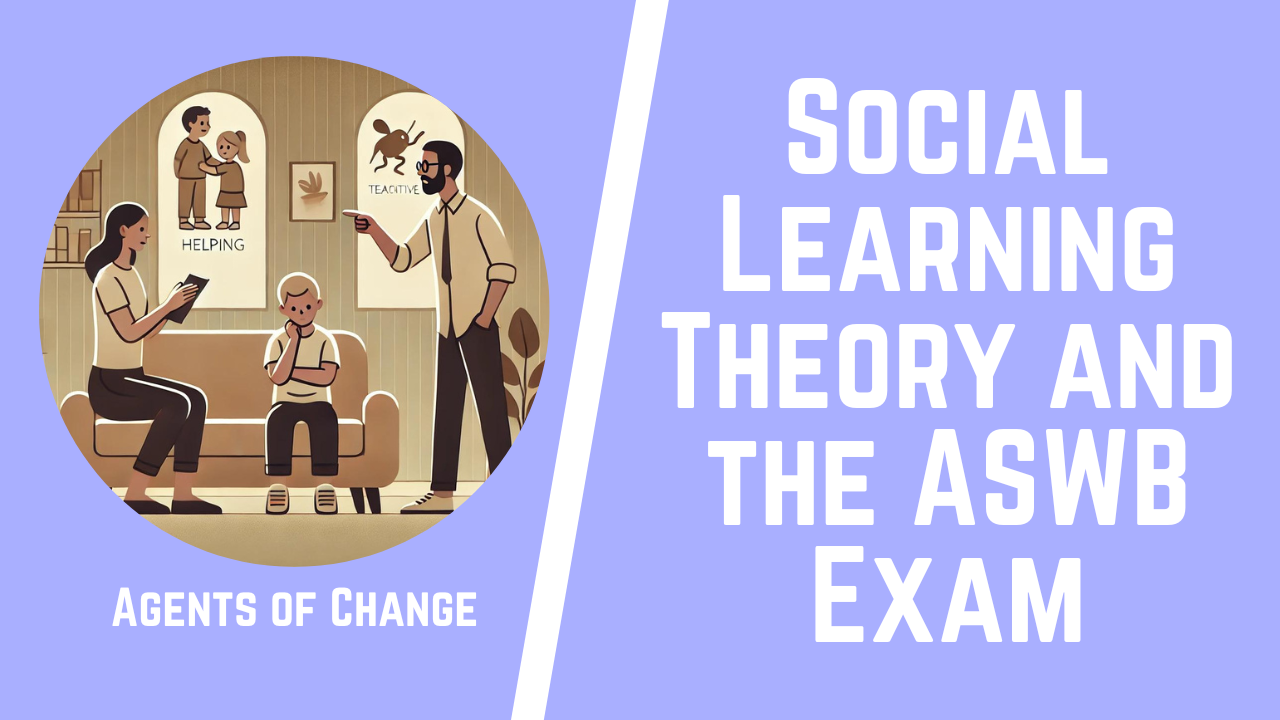
Preparing for the ASWB Exam can be overwhelming, especially when you’re faced with numerous theories, terms, and frameworks. One theory you definitely don’t want to overlook is Social Learning Theory. Developed by Albert Bandura, this theory goes beyond individual learning to explain how people absorb behaviors, attitudes, and emotional reactions from their environment through observation.

As a Social Worker, you’ll encounter situations where understanding this concept can be crucial—not only for your clients but also for passing the ASWB Exam.

But why is Social Learning Theory so important for the ASWB Exam? The test evaluates your readiness to practice as a licensed Social Worker by covering human development, behavior, and intervention strategies. Social Learning Theory is a frequent subject in these areas, showing up in questions related to how people acquire behaviors and interact with their environment. Whether you’re studying the behavior of children in foster care or adults overcoming addiction, knowing this theory inside out can give you a significant advantage on exam day.

Learn more about the ASWB exam and create a personalized ASWB study plan with Agents of Change. We’ve helped thousands of Social Workers pass their ASWB exams and want to help you be next!

1) What Is Social Learning Theory?

Social Learning Theory, developed by psychologist Albert Bandura in the 1960s, revolutionized how we understand human behavior and learning. Unlike traditional theories that focused solely on direct experiences—such as classical conditioning and operant conditioning—Social Learning Theory posits that people can learn new behaviors simply by observing others. This concept of learning through observation has profound implications, not only for psychology but also for Social Work and human development.

In essence, Social Learning Theory bridges the gap between behaviorism and cognitive theories of learning, proposing that our environment, behavior, and cognition all interact in a dynamic and continuous way. Bandura’s groundbreaking work revealed that learning could occur in social settings without any direct reinforcement, a concept that became foundational to understanding how people adapt to and influence their environments.

A child observing the behavior of parents in a home environment, with one parent displaying positive behavior and the other negative behavior. This captures the concept of social learning within a realistic household setting.

The Core Principles of Social Learning Theory

At the heart of Social Learning Theory are four core principles that shape how individuals learn from their surroundings. These principles emphasize the importance of observing others and understanding the potential consequences of actions before engaging in similar behavior.

  1. Observational Learning
    The theory’s foundation rests on the idea that people learn by watching others. This process is called observational learning, or “modeling.” We don’t have to experience everything firsthand to understand or replicate behavior. By observing others—whether they’re parents, peers, teachers, or even media characters—we internalize behaviors, attitudes, and emotional responses.

  2. Modeling
    Modeling is central to Social Learning Theory. People, especially children, are heavily influenced by the behavior of others around them, known as models. These models can demonstrate behavior intentionally or unintentionally, influencing how the observer learns. The behavior that is modeled doesn’t have to be explicitly taught; it can be observed in casual settings or through media exposure. Importantly, models are often figures that the learner respects or sees as similar to themselves.

  3. Reinforcement and Punishment
    Although Bandura emphasized learning through observation, he also recognized the importance of reinforcement and punishment. These external factors influence whether or not an individual decides to replicate a behavior they’ve observed.

    • Reinforcement can be either direct or vicarious. If an observed behavior leads to positive outcomes for the model, the observer is more likely to imitate it. This is called vicarious reinforcement, where seeing someone else rewarded for their actions makes an individual more inclined to behave similarly.
    • Punishment, on the other hand, can deter behaviors. If someone observes a model being punished for a specific behavior, they’re less likely to replicate that behavior. This is known as vicarious punishment. However, it’s important to note that punishments must be perceived as credible or relevant for them to influence learning effectively.
  4. Reciprocal Determinism
    One of the most distinctive elements of Social Learning Theory is the concept of reciprocal determinism. This principle suggests that behavior is not simply the result of the environment or inner drives, but the interaction of the person, their behavior, and the environment. In other words, individuals are both influenced by and influencers of their surroundings. The choices we make affect our environment, and in turn, the environment influences us.

Factors That Influence Observational Learning

While everyone can learn through observation, several key factors influence whether an individual is likely to imitate a behavior they observe. These factors highlight why not every behavior we witness is automatically replicated.

  • Attention: For observational learning to occur, the learner must pay attention to the model. This means the behavior being observed must be noticeable and engaging. Distractions or lack of interest can reduce the likelihood of learning.
  • Retention: The observer must be able to remember the behavior after it has been observed. This involves cognitive processes, such as storing the observed behavior in long-term memory.
  • Reproduction: Even if a behavior is observed and remembered, the individual must be physically and cognitively able to reproduce it. For example, a child may observe an adult driving a car, but they cannot reproduce this behavior until they reach the required physical and legal capabilities.
  • Motivation: Motivation plays a crucial role in whether an individual will actually perform the learned behavior. If the observer expects positive reinforcement or sees value in the behavior, they’re more likely to imitate it.

Real-Life Examples of Social Learning Theory

To fully grasp how Social Learning Theory operates, it helps to look at a few everyday scenarios where the theory comes into play. Here are some examples:

  • Children and Aggression
    One of the most famous demonstrations of Social Learning Theory is Bandura’s Bobo Doll Experiment, where children watched adults behave aggressively toward a Bobo doll. The children who observed the aggressive behavior were more likely to imitate the actions, demonstrating how easily aggressive behavior could be learned by watching others.

  • Peer Pressure in Adolescents
    Social Learning Theory helps explain peer pressure, especially in adolescence. Teenagers often imitate the behaviors of their peers, particularly those they admire or see as similar to themselves. For example, if a teenager witnesses their friends engaging in risky behavior like smoking or skipping school—and sees them rewarded with social acceptance—they may be more inclined to imitate these behaviors despite knowing they are harmful.

  • Media Influence on Behavior
    In today’s digital world, Social Learning Theory is highly relevant when considering the influence of media. Children and adults alike can learn behaviors from television shows, movies, social media, and video games. These mediums often provide models for behavior, sometimes glamorizing risky or inappropriate actions, which can lead to imitation.

Social Learning Theory provides a comprehensive framework for understanding human behavior, especially in the context of social interactions and environments. As a Social Worker, understanding and applying this theory can help you navigate the complexities of human development, guide behavioral interventions, and foster lasting change in your clients’ lives. Whether in practice or on the ASWB Exam, this theory is a cornerstone of effective Social Work.

Agents of Change packages include 30+ ASWB topics, 2 free study groups per month, and hundreds of practice questions so you’ll be ready for test day!

2) Why Social Learning Theory Matters in Social Work

Social Learning Theory is more than just a theoretical framework—it’s a practical guide that helps Social Workers understand, predict, and modify human behavior. Since Social Work revolves around helping individuals navigate their social environments and improve their quality of life, understanding how people learn from those environments is crucial.

Social Learning Theory, with its emphasis on observational learning, modeling, and reinforcement, gives Social Workers valuable insights into how behavior is shaped and how it can be altered for positive outcomes.

A child feeling peer pressure from their friends in a social setting, reflecting the discomfort and hesitation that often accompanies these situations. The image emphasizes the dynamics of peer influence and its impact on decision-making.

In this section, we’ll explore the various reasons Social Learning Theory is essential to Social Work practice, from enhancing client interventions to informing strategies for behavior change and improving societal outcomes.

1. Understanding Human Behavior

At the core of Social Work is the need to understand why people behave the way they do. Social Learning Theory offers a framework for this by explaining how behavior is influenced by external social factors, rather than solely internal psychological ones. This holistic view of behavior enables Social Workers to take into account the multiple influences a person encounters in their environment, helping them address the root causes of their clients’ challenges.

Key Points for Social Workers:
  • Behavior is shaped by the social environment: Rather than looking only at internal factors like emotions or unconscious drives, Social Workers need to consider external influences such as family, community, and media.
  • Observational learning explains learned behaviors: A child growing up in a violent household may observe and model aggressive behaviors. Similarly, a person surrounded by peers who misuse substances may learn these behaviors through observation.
  • Reciprocal determinism: The idea that behavior, cognition, and environment all interact and influence each other is critical in Social Work. Understanding this interaction helps Social Workers intervene in ways that can disrupt negative cycles of behavior and create positive feedback loops.

2. Informing Client Interventions

One of the most significant contributions of Social Learning Theory to Social Work is its practical application in client interventions. Whether Social Workers are helping individuals, families, or communities, interventions often require modifying learned behaviors that are harmful or unproductive. Social Learning Theory helps Social Workers structure interventions that are not only effective but also grounded in a clear understanding of how people learn and change.

Key Applications of Social Learning Theory in Client Interventions:
  • Behavior modification: Social Learning Theory informs behavior modification strategies by emphasizing the role of environmental change and positive role models. By altering a client’s environment and reinforcing desired behaviors, Social Workers can help clients unlearn harmful behaviors and adopt healthier alternatives.
  • Cognitive-Behavioral Therapy (CBT): Many Social Workers use CBT, a practice rooted in Social Learning Theory. CBT helps clients identify and change problematic behaviors by addressing the cognitive patterns and environmental factors that contribute to them.
  • Group and family therapy: In family or group therapy sessions, Social Learning Theory can be used to help clients learn from each other’s behaviors. For example, parents in a family therapy setting may model positive communication, which children can then learn to replicate.
Example Interventions:
  • In a youth mentorship program, a Social Worker might pair an adolescent struggling with aggression with a mentor who demonstrates constructive ways of dealing with anger. By observing this positive behavior, the adolescent can learn and replicate it in their own life.
  • In substance abuse recovery, clients may observe peers in support groups successfully managing their addiction, which in turn motivates them to adopt similar coping strategies.

3. Promoting Behavior Change in Clients

Social Learning Theory also helps Social Workers understand how to initiate and sustain behavior change in clients. Since the theory is built on the idea that people learn behaviors by observing others, Social Workers can harness this by ensuring that clients are exposed to positive role models and supportive environments. When clients observe others being rewarded for positive behaviors, they’re more likely to adopt these behaviors themselves.

Steps for Promoting Behavior Change:
  1. Identify negative models: Social Workers first need to identify negative influences or role models in the client’s life that may be contributing to problematic behaviors.
  2. Introduce positive role models: Once negative influences are identified, Social Workers can introduce clients to individuals or environments that model the desired behaviors.
  3. Encourage reinforcement: Positive reinforcement is crucial for solidifying behavior change. Social Workers can work with clients to set up systems where desired behaviors are consistently reinforced, whether through social support, recognition, or personal rewards.
Behavior Change Example:
  • In a school setting, a Social Worker might work with a child exhibiting disruptive behavior. By encouraging the teacher to model positive behaviors like patience and cooperation, and by setting up a reward system for when the child follows instructions, the Social Worker leverages Social Learning Theory to help modify the child’s behavior.

4. Supporting Client Empowerment

Social Learning Theory emphasizes that individuals are not passive recipients of their environment but active participants in shaping it. This is a powerful concept in Social Work, where the goal is often to empower clients to take control of their lives and make positive changes. By helping clients understand that they can influence their environment, Social Workers foster a sense of agency and self-efficacy, both of which are key to long-term success.

How Social Learning Theory Supports Empowerment:
  • Self-efficacy: Bandura, the creator of Social Learning Theory, introduced the concept of self-efficacy, or the belief in one’s ability to succeed in specific situations. Social Workers can use this concept to help clients build confidence in their ability to change their behaviors and environments.
  • Reciprocal control: Since Social Learning Theory proposes that individuals can influence their surroundings, Social Workers can empower clients to actively shape their environments. Whether that’s leaving a toxic relationship or changing a negative peer group, clients are encouraged to see themselves as capable of enacting positive change.
Empowerment in Action:
  • A Social Worker helping a client overcome homelessness might emphasize the client’s ability to take small, manageable steps toward improving their situation. By celebrating each success and reinforcing the client’s progress, the Social Worker helps build the client’s confidence and belief in their ability to effect change in their life.

5. Addressing Social and Cultural Contexts

Another reason Social Learning Theory is so valuable in Social Work is its ability to account for social and cultural influences on behavior. Social Workers often serve clients from diverse backgrounds, and Social Learning Theory helps explain how cultural norms, media, and societal structures influence behavior. It encourages Social Workers to consider the broader social context when assessing client behavior, ensuring that interventions are culturally sensitive and effective.

How Social Learning Theory Addresses Social Context:
  • Cultural models: Social Learning Theory highlights the importance of role models within a cultural context. For example, in some cultures, certain behaviors are valued and modeled consistently. Social Workers must recognize these cultural influences when working with clients and use culturally relevant role models in interventions.
  • Media and societal influence: Social Learning Theory also acknowledges the powerful role media plays in shaping behavior. Social Workers can help clients critically assess the messages they receive from media and society and encourage them to seek out positive influences.
Cultural Sensitivity in Practice:
  • In a community intervention, a Social Worker working with an immigrant family might identify community leaders who model behaviors that align with the family’s cultural values, helping them adjust to life in a new country while maintaining a sense of cultural identity.

Why It All Matters for Social Workers

Ultimately, Social Learning Theory provides Social Workers with a robust framework for understanding and influencing behavior. By focusing on how individuals learn from their social environments, Social Workers can design interventions that are not only effective but also sustainable. The theory’s emphasis on role models, reinforcement, and reciprocal determinism aligns perfectly with the goals of Social Work, which aim to empower individuals to change their lives by influencing both internal and external factors.

Key Takeaways for Social Workers:

  • Holistic view of behavior: Social Learning Theory gives Social Workers a comprehensive understanding of behavior, factoring in social influences and personal agency.
  • Practical intervention strategies: Whether working with individuals, families, or groups, Social Workers can apply Social Learning Theory to modify behaviors and create lasting change.
  • Empowering clients: By emphasizing the client’s ability to shape their environment and behaviors, Social Learning Theory supports the Social Work goal of client empowerment.

Incorporating Social Learning Theory into Social Work practice allows Social Workers to bridge the gap between theory and real-world application, making it a powerful tool for both professional development and client success.

Learn more additional tips and tricks for the ASWB exam and get hundreds of practice questions with Agents of Change!

3) Social Learning Theory and the ASWB Exam

The ASWB (Association of Social Work Boards) Exam is a critical step toward becoming a licensed Social Worker, assessing your knowledge of core Social Work principles, theories, and practices. One of the key theories you’ll encounter on the exam is Social Learning Theory, a framework that is especially important in understanding human behavior and intervention strategies.

A diverse social worker studying for an exam in front of a computer in a cozy home environment. The setting is warm and inviting, with the social worker focused on their preparation, surrounded by study materials.

Not only is Social Learning Theory a cornerstone of Social Work education, but it also frequently appears on the ASWB Exam in various contexts—from human development to client interventions.

1. Relevance of Social Learning Theory on the ASWB Exam

Social Learning Theory, pioneered by Albert Bandura, is integral to Social Work because it explains how individuals learn behaviors by observing others in their social environments.

On the ASWB Exam, questions often assess your understanding of how this theory applies to various client scenarios and intervention strategies. Given that Social Workers frequently use Social Learning Theory in practice, it’s no surprise that it plays a prominent role in the exam.

Here are some reasons why Social Learning Theory is essential for the ASWB Exam:

  • Behavioral Understanding: Many exam questions focus on understanding why individuals behave in specific ways, especially in relation to their environments. Social Learning Theory offers insights into how clients might have learned problematic or harmful behaviors through observation of role models, whether intentionally or unintentionally.
  • Intervention Strategies: The theory helps Social Workers determine appropriate intervention strategies based on altering the client’s environment, introducing positive role models, or reinforcing desirable behaviors.
  • Application in Different Settings: Whether you’re dealing with family dynamics, school environments, or community interventions, Social Learning Theory is applicable. The ASWB Exam often requires you to apply the theory to real-world scenarios, ensuring you understand how it influences behavior in a wide range of contexts.

2. Types of Questions Involving Social Learning Theory

On the ASWB Exam, questions related to Social Learning Theory can take various forms, often challenging your ability to apply theoretical knowledge to practical situations. These questions typically appear in sections covering human behavior, development, and intervention techniques. It’s not enough to simply memorize the theory; you’ll need to recognize how to apply it in clinical and ethical situations.

Common Question Types:
  • Direct Theory Questions: These questions test your knowledge of key Social Learning Theory principles such as modeling, observational learning, reinforcement, and reciprocal determinism.
  • Case Scenarios: Often, you’ll be given case studies where a client’s behavior needs to be understood or addressed. You may need to identify which theoretical model best explains the client’s behavior or suggest an intervention grounded in Social Learning Theory.
  • Ethical Considerations: Some questions will challenge you to consider the ethical implications of using Social Learning Theory in practice, especially in scenarios where modeling and reinforcement may impact vulnerable populations.
Example Questions:
  1. Direct Theory Question:
    “According to Social Learning Theory, which of the following is the most likely reason a child begins to display aggressive behavior after starting school?”

    • A. The child is modeling aggressive behaviors observed in peers.
    • B. The child’s aggression is the result of unmet psychological needs.
    • C. The child has a biological predisposition to aggression.
    • D. The child is experiencing a cognitive delay in impulse control.
      (Answer: A. Social Learning Theory focuses on learned behaviors through observation, such as aggressive behaviors picked up from peers.)
  2. Case Scenario:
    “A 13-year-old boy is being seen by a Social Worker for behavioral issues at school, including bullying his classmates. The boy’s parents report that they often argue and use harsh discipline at home. According to Social Learning Theory, what would be the most effective intervention for the Social Worker to implement?”

    • A. Encouraging the parents to reduce their arguments and use positive role modeling.
    • B. Recommending medication to manage the boy’s aggressive tendencies.
    • C. Teaching the boy to reflect on his emotions through individual therapy.
    • D. Placing the boy in a special education program.
      (Answer: A. Social Learning Theory suggests that behavior is learned through observation, so modifying the behavior of the parents serves as a positive intervention.)
  3. Ethical Consideration:
    “A Social Worker is working with a group of adolescents who have been exposed to gang violence in their community. To promote positive behaviors, the Social Worker introduces a former gang member as a role model. According to Social Learning Theory, what ethical consideration should the Social Worker keep in mind?”

    • A. Ensuring that the former gang member does not inadvertently glorify past criminal activities.
    • B. Making sure the adolescents do not develop too much reliance on the role model.
    • C. Avoiding reinforcement of the adolescents’ existing peer dynamics.
    • D. Ensuring the adolescents understand that the role model’s experiences are unique.
      (Answer: A. Social Learning Theory highlights the importance of careful modeling, and there is an ethical concern that past behaviors should not be inadvertently glorified.)

3. How to Study Social Learning Theory for the ASWB Exam

Preparing for questions related to Social Learning Theory on the ASWB Exam requires a clear understanding of both the theory itself and its applications in Social Work practice. Below are some effective strategies for ensuring you’re ready to tackle these questions on exam day.

Study Tips:
  • Master Key Concepts: Focus on the core principles of Social Learning Theory: observational learning, modeling, reinforcement, and reciprocal determinism. Be sure you can define these terms and explain how they apply to different social contexts.
  • Use Flashcards: Create flashcards with key terms and scenarios that require applying Social Learning Theory. Regularly quiz yourself on these terms to reinforce your understanding. Claim your free Agents of Change flashcards here.
  • Practice Case Studies: Since many ASWB Exam questions are scenario-based, practice applying Social Learning Theory to case studies. Look for examples from your fieldwork or study materials that demonstrate how this theory can be used in real-life Social Work practice.
  • Mock Exams: Take practice exams that feature questions on Social Learning Theory. This will help you become familiar with how the theory is tested and give you confidence in applying it to different situations. Agents of Change offers 3 full-length practice exams.
  • Group Study: Social Learning Theory emphasizes learning through social interactions, so studying with a group can reinforce your understanding. Teaching others about the theory or discussing case scenarios together can help solidify the material in your mind.
Important Concepts to Focus On:
  • Modeling: Understand how individuals, particularly children, learn behaviors by observing others. Be able to identify situations where clients have learned through modeling and how to introduce positive models.
  • Reinforcement: Know the difference between direct and vicarious reinforcement and how both can influence behavior. Be prepared to explain how reinforcement strengthens or weakens observed behaviors.
  • Reciprocal Determinism: This concept suggests that individuals are influenced by their environment, but they also have the ability to influence their environment. Be ready to identify scenarios where clients shape, and are shaped by, their surroundings.

4. Social Learning Theory in Different ASWB Exam Levels

The ASWB Exam has several levels—Bachelors, Masters, Advanced Generalist, and Clinical—each with varying degrees of complexity. The role Social Learning Theory plays in each exam level differs, but it is present in all forms, especially in relation to human behavior and interventions.

ASWB Exam Levels:
  • Bachelors Level: At the Bachelors level, questions about Social Learning Theory will likely be more straightforward, focusing on basic understanding and identification of the theory’s core concepts. Expect questions about how individuals learn behaviors from their environment and how Social Workers can apply these insights to promote positive change.
  • Masters Level: At the Masters level, you will need to apply Social Learning Theory in more complex scenarios. This could involve identifying how modeling and reinforcement contribute to a client’s behavior and suggesting intervention strategies that leverage these principles.
  • Advanced Generalist and Clinical Levels: At these levels, expect more nuanced and detailed questions that require integrating Social Learning Theory with advanced practice techniques. You may be asked to address ethical considerations when applying the theory or use it to develop treatment plans for clients with complicated behavioral histories.

5. Ethical Considerations of Social Learning Theory in the ASWB Exam

Ethical decision-making is a key component of Social Work practice and the ASWB Exam. When it comes to Social Learning Theory, ethical issues often arise in how Social Workers use role models and reinforcement with clients, particularly vulnerable populations. The ASWB Exam will test your ability to identify and resolve these ethical dilemmas.

Ethical Questions to Consider:
  • Choosing Role Models: Social Workers must be careful when selecting role models for clients. Are these models truly positive, or might they inadvertently reinforce negative behaviors?
  • Power Dynamics: When using modeling in a therapeutic setting, Social Workers must consider the power dynamics at play. Are clients being encouraged to adopt behaviors because of genuine learning, or is there undue influence?
  • Cultural Sensitivity: Social Learning Theory should be applied in ways that respect cultural norms and values. Social Workers must ensure that role models and interventions are culturally appropriate and do not impose external values on clients.

Understanding Social Learning Theory is crucial for passing the ASWB Exam and, more importantly, for becoming an effective Social Worker. By mastering the theory’s core principles—observational learning, modeling, reinforcement, and reciprocal determinism—you’ll be better equipped to answer exam questions and apply the theory in your future practice.

Focus on how the theory connects to real-world scenarios, practice applying it to case studies, and stay mindful of ethical considerations. With the right preparation, Social Learning Theory can be a tool that not only helps you pass the ASWB Exam but also informs your work with clients for years to come.

4) FAQs – Social Learning Theory and ASWB Exam

Q: How is Social Learning Theory relevant to the ASWB Exam?

A: Social Learning Theory plays a crucial role in the ASWB Exam because it’s a foundational framework for understanding human behavior, one of the key areas tested on the exam. The theory explains how people learn behaviors by observing others in their social environments, which is essential for Social Workers when assessing clients and creating intervention strategies.

Questions related to Social Learning Theory might ask you to identify how behaviors are acquired through modeling or reinforcement, or how to apply these concepts in real-life Social Work practice. Being familiar with this theory helps you navigate questions about behavior modification, human development, and ethical client interventions.

Q: What types of ASWB Exam questions focus on Social Learning Theory?

A: Questions related to Social Learning Theory on the ASWB Exam come in various forms. Common types include:

  • Direct Theory Questions: These test your knowledge of the theory’s key principles like modeling, observational learning, and reinforcement.
  • Case Scenarios: You’ll be asked to apply the theory to real-world situations where clients exhibit behaviors influenced by their environments. These scenarios might involve family dynamics, substance abuse, or community interactions.
  • Ethical Considerations: You may encounter questions about the ethical use of role models or reinforcement in client interventions, requiring you to evaluate the potential impact of using Social Learning Theory in specific contexts.

Q: What’s the best way to study Social Learning Theory for the ASWB Exam?

A: To effectively study Social Learning Theory for the ASWB Exam, focus on both understanding the theory’s principles and applying them to practical scenarios. Here are a few strategies:

  • Review Core Concepts: Ensure you thoroughly understand key ideas like modeling, vicarious reinforcement, and reciprocal determinism. Use flashcards to reinforce these concepts.
  • Practice Case Studies: Apply Social Learning Theory to real-life case scenarios, thinking through how the theory informs behavior and potential interventions.
  • Take Mock Exams: Use practice questions to familiarize yourself with how Social Learning Theory is tested on the exam. Look for scenario-based questions that require both theoretical understanding and practical application.

5) Conclusion

Social Learning Theory is an essential component of Social Work practice and a significant focus of the ASWB Exam. Understanding how individuals learn behaviors from their social environments, through observation and reinforcement, provides a powerful framework for Social Workers to assess and intervene effectively with their clients. Whether you’re dealing with behavioral issues in children, substance abuse, or group dynamics, Social Learning Theory offers insights into how behaviors are acquired and how they can be changed through positive modeling and supportive environments.

For those preparing for the ASWB Exam, mastering Social Learning Theory is not just about memorizing terms but applying these principles in real-world scenarios. The exam will challenge you to connect theory to practice, requiring you to think critically about how Social Learning Theory informs intervention strategies and ethical decision-making.

By practicing with case scenarios, reviewing core concepts, and understanding the role of modeling and reinforcement, you can approach the exam with confidence.

6) ASWB Practice Question: Social Learning Theory

A Social Worker is meeting with the parents of a 10-year-old boy who has recently been acting aggressively toward his classmates at school. The parents report that they often argue in front of their child and use harsh discipline at home. Based on Social Learning Theory, what is the most likely cause of the child’s aggressive behavior?

A. The child has developed a biological predisposition to aggressive behavior.
B. The child is modeling the aggressive behavior observed from his parents.
C. The child’s aggressive behavior is due to cognitive developmental delays.
D. The child is expressing aggression because of poor impulse control.

Answer:
B. The child is modeling the aggressive behavior observed from his parents.

Rationale:
According to Social Learning Theory, individuals, especially children, learn behaviors by observing and imitating others in their environment. In this scenario, the child is likely modeling the aggressive behaviors he has observed from his parents during arguments.

Social Learning Theory emphasizes that children often replicate behaviors seen in their primary caregivers, especially when those behaviors are consistent or emotionally charged. The other answer choices—biological predisposition, cognitive developmental delays, and poor impulse control—are potential factors in behavior but do not align directly with the principles of Social Learning Theory, which focuses on learned behaviors through observation.


► Learn more about the Agents of Change course here: https://agentsofchangeprep.com

About the Instructor, Meagan Mitchell: Meagan is a Licensed Clinical Social Worker and has been providing individualized and group test prep for the ASWB for over 8 years. From all of this experience helping others pass their exams, she created the Agents of Change course to help you prepare for and pass the ASWB exam!

Find more from Agents of Change here:

► Facebook Group: https://www.facebook.com/groups/aswbtestprep

► Podcast: https://podcasters.spotify.com/pod/show/agents-of-change-sw

#socialwork #testprep #aswb #socialworker #socialwork #socialworktest #socialworkexam #exam #socialworktestprep #socialworklicense #socialworklicensing #licsw #lmsw #lcsw #aswbexam #aswb #lcswexam #lmswexam #aswbtestprep #aswbtest #lcswtestprep #lcswtest #lmswtestprep #lmswtest #aswbcourse #learningstyles #learningstyle

Disclaimer: This content has been made available for informational and educational purposes only. This content is not intended to be a substitute for professional medical or clinical advice, diagnosis, or treatment

Share:

Discover more from Agents of Change

Subscribe now to keep reading and get access to the full archive.

Continue reading