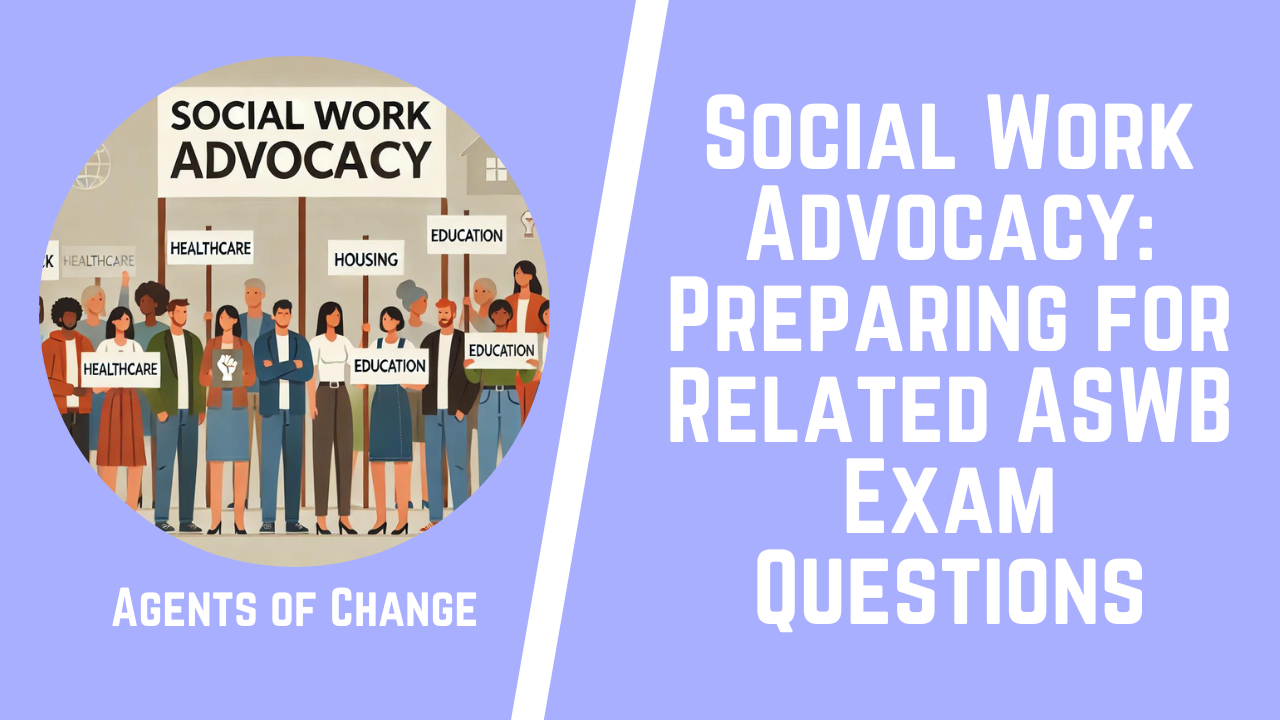
Social Work Advocacy stands at the heart of the Social Work profession, driving efforts to champion the rights and needs of individuals, families, and communities. Whether advocating for a single client’s access to essential services or pushing for broader policy changes, Social Workers play a critical role in fostering social justice and equality.
Understanding the intricacies of advocacy is not only essential for effective practice but also a significant component of the Association of Social Work Boards (ASWB) exam. As you prepare for this exam, grasping the key aspects of advocacy will empower you to answer related questions confidently and correctly.
Preparing for the ASWB exam can be daunting, especially regarding complex and multifaceted topics like advocacy. The exam’s questions on advocacy require a solid grasp of ethical principles, practical skills, and the ability to analyze and respond to various scenarios.
By focusing on these areas, you can develop a robust understanding of what advocacy entails and how it applies to different aspects of Social Work. This preparation will not only help you succeed on the exam but also enhance your effectiveness as a Social Worker in real-world settings.
Learn more about the ASWB exam and create a personalized ASWB study plan with Agents of Change. We’ve helped thousands of Social Workers pass their ASWB exams and want to help you be next!
1) The Role of Advocacy in Social Work

Advocacy is a cornerstone of the Social Work profession. It involves activities that seek to ensure that all people, particularly those who are vulnerable, oppressed, or living in poverty, have their voices heard on issues that are important to them.
Advocacy in Social Work is about championing social justice and human rights, and it can be practiced on various levels, from direct client support to systemic change. Understanding the multifaceted role of advocacy is crucial for aspiring Social Workers, not only for their professional practice but also for successfully passing the ASWB exam.
What is Social Work Advocacy?
Social Work Advocacy encompasses a broad range of activities and responsibilities aimed at promoting social change, equity, and the empowerment of individuals and communities. Here are the primary types of advocacy in Social Work:
-
Individual Advocacy: Involves direct intervention and support to help clients navigate systems and access resources. Social Workers act on behalf of clients to ensure their needs and rights are met.
-
Systemic Advocacy: Focuses on policy change and reform to address systemic issues affecting large groups of people. This involves working with legislators, community leaders, and organizations to create long-term solutions.
-
Self-Advocacy: Empowering clients to advocate for themselves by providing them with the tools, knowledge, and confidence to voice their needs and rights.
Why is Advocacy Important?
Advocacy is vital in Social Work for several reasons:
-
Empowering Clients: Advocacy helps individuals gain access to necessary services, resources, and opportunities. It empowers them to make informed decisions and improve their quality of life.
-
Promoting Social Justice: Social Workers advocate for policies and practices that promote equality and challenge social injustices, thereby fostering a more equitable society.
-
Influencing Policy: By engaging in advocacy, Social Workers can influence public policies and legislation, ensuring they are fair and inclusive. This can lead to systemic changes that benefit entire communities.
The Impact of Advocacy on Different Levels
Micro-Level Advocacy
Micro-level advocacy refers to actions taken on an individual or small group basis. This involves:
-
Client Advocacy: Assisting clients with personal issues such as housing, healthcare, and education.
-
Navigating Systems: Helping clients understand and navigate complex systems like social services, legal systems, and healthcare.
-
Personal Empowerment: Encouraging clients to develop self-advocacy skills to effectively communicate their needs and concerns.
Mezzo-Level Advocacy
Mezzo-level advocacy focuses on larger groups or communities. This includes:
-
Community Organizing: Mobilizing community members to address local issues and work collectively towards common goals.
-
Group Advocacy: Facilitating support groups or community meetings to discuss and address shared concerns.
-
Resource Coordination: Connecting community members with resources and services that can assist them in achieving their goals.
Macro-Level Advocacy
Macro-level advocacy involves working on a broader scale to influence policies and societal norms. This includes:
-
Policy Advocacy: Engaging with policymakers to promote laws and regulations that support social justice and equity.
-
Research and Data: Using research and data to highlight issues and advocate for evidence-based solutions.
-
Coalition Building: Partnering with other organizations and advocacy groups to strengthen efforts and create a united front on key issues.
Ethical Principles in Advocacy
Ethics play a critical role in Social Work advocacy. Social Workers must adhere to ethical principles to ensure their advocacy efforts are just and effective. Key ethical principles include:
-
Confidentiality: Respecting clients’ privacy and ensuring that any information shared during advocacy efforts is kept confidential unless the client has given explicit consent or there is a risk of harm.
-
Informed Consent: Ensuring that clients understand their rights and the potential outcomes of advocacy actions. Clients should be fully informed and voluntarily consent to any actions taken on their behalf.
-
Cultural Competence: Recognizing and respecting the diverse backgrounds and cultures of clients. Advocacy efforts should be inclusive and sensitive to the cultural contexts of those being represented.
Skills and Strategies for Effective Advocacy
To be an effective advocate, Social Workers need a specific set of skills and strategies:
-
Communication Skills: Clear and effective communication is essential for advocating on behalf of clients and negotiating with various stakeholders.
-
Negotiation Skills: The ability to negotiate and mediate is crucial in resolving conflicts and securing resources for clients.
-
Networking: Building relationships with other professionals, organizations, and community leaders can enhance advocacy efforts and create a broader support system.
-
Research and Data Utilization: Gathering and using data to support advocacy efforts can strengthen arguments and demonstrate the need for change.
-
Persistence and Resilience: Advocacy often involves facing resistance and setbacks. Persistence and resilience are essential qualities for sustaining efforts and achieving long-term goals.
Examples of Advocacy in Action
To illustrate the role of advocacy in Social Work, consider the following examples:
-
Healthcare Advocacy: A Social Worker might advocate for a client who has been denied health insurance coverage, working with healthcare providers and insurance companies to ensure the client receives necessary medical care.
-
Housing Advocacy: In cases of housing discrimination, a Social Worker could assist clients in filing complaints, securing legal representation, and finding alternative housing solutions.
-
Policy Advocacy: Social Workers might collaborate with advocacy groups to lobby for policy changes that address issues like child welfare, mental health services, or criminal justice reform.
The role of advocacy in Social Work is critical to the profession. Whether on the micro, mezzo, or macro level, advocacy efforts are essential for promoting social justice, empowering clients, and effecting systemic change.
By understanding the principles, strategies, and skills required for effective advocacy, Social Workers can better prepare for the ASWB exam and, more importantly, make a significant impact in their communities and the lives of their clients.
Agents of Change packages include 30+ ASWB topics, 2 free study groups per month, and hundreds of practice questions so you’ll be ready for test day!
2) Preparing for ASWB Exam Questions on Advocacy
The ASWB exam is a crucial step for anyone pursuing a career in Social Work. It tests your knowledge across various domains, including human development, assessment, intervention planning, and ethics.
Advocacy is a significant component of these domains, particularly within the ethics and professionalism sections. To succeed, it’s important to understand the structure of the exam and the types of questions you’ll encounter.
Exam Structure
-
Content Areas: The ASWB exam covers several key areas:
-
Human Development, Diversity, and Behavior in the Environment
-
Assessment and Intervention Planning
-
Direct and Indirect Practice
-
Professional Relationships, Values, and Ethics
-
-
Question Formats: Expect multiple-choice questions that assess your ability to apply Social Work principles in various scenarios. Questions often include vignettes or case studies that require critical thinking and problem-solving skills.
Study Strategies for Advocacy Topics

Review Key Concepts
A solid understanding of fundamental advocacy concepts is essential for the ASWB exam. Focus on the following areas:
-
Definitions and Types of Advocacy:
-
Individual, systemic, and self-advocacy
-
The role of Social Workers in different advocacy contexts
-
-
Ethical Principles:
-
Confidentiality, informed consent, and cultural competence
-
-
Legislation and Policies:
-
Key laws affecting Social Work practice and advocacy
-
Analyze Case Studies
Case studies are a vital tool for understanding how advocacy principles are applied in real-world scenarios. They help you develop the ability to identify advocacy issues and appropriate interventions. When analyzing case studies:
-
Identify the Advocacy Issue: Determine what advocacy issue is being presented.
-
Assess the Ethical Considerations: Consider the ethical principles that apply to the situation.
-
Formulate an Intervention Plan: Plan how you would address the issue through advocacy.
Practice Questions
Practicing with sample questions is one of the most effective ways to prepare for the ASWB exam. Use resources such as ASWB exam prep books and online question banks. Focus on questions related to advocacy to improve your test-taking skills. Here are some tips:
-
Simulate Exam Conditions: Practice under timed conditions to get used to the exam format.
-
Review Rationales: Understand why the correct answers are correct and why the wrong answers are incorrect.
-
Track Your Progress: Identify areas where you need further study and focus on those topics.
Effective Study Techniques
Flashcards
Flashcards are a great way to reinforce your memory of key terms and concepts. Create flashcards for:
-
Definitions: Key advocacy terms and principles
-
Laws and Policies: Important legislation related to social work advocacy
-
Ethical Considerations: Scenarios involving ethical dilemmas and appropriate responses
- Agents of Change offers free flashcards here
Group Study
Studying in groups can provide multiple perspectives and deepen your understanding of advocacy concepts. Benefits of group study include:
-
Discussion: Discussing scenarios and ethical dilemmas with peers can provide new insights.
-
Support: Group members can motivate each other and provide support.
-
Resource Sharing: Share study materials and resources with each other.
-
All Agents of Change programs include 2 live study groups per month
Simulation Exams
Taking full-length practice exams can help reduce anxiety and improve your time management skills. When taking simulation exams:
-
Mimic Test Conditions: Take the exam in a quiet environment without interruptions.
-
Use a Timer: Keep track of the time to ensure you can complete the exam within the allotted time.
-
Review Your Results: Analyze your performance to identify strengths and weaknesses.
- Agents of Change offers 3 full-length (150-question) practice exams
Learn more additional tips and tricks for the ASWB exam and get hundreds of practice questions with Agents of Change!
3) Key Advocacy Concepts to Master
Understanding the Foundations of Advocacy
Mastering advocacy requires a deep understanding of its foundational concepts. These concepts form the backbone of effective Social Work practice and are essential for both day-to-day interactions and larger systemic changes. Here’s a detailed look at the critical advocacy concepts every Social Worker should master.
Types of Advocacy
Advocacy in Social Work can be classified into several types, each with its unique focus and approach. Understanding these types helps Social Workers apply the right strategies in different contexts.
-
Individual Advocacy: Focuses on helping individual clients navigate systems, access resources, and defend their rights. This often involves:
-
Direct Intervention: Assisting clients with immediate needs such as housing, healthcare, and education.
-
Support Services: Connecting clients with necessary services and support networks.
-
Rights Protection: Ensuring clients are aware of and can exercise their rights.
-
-
Systemic Advocacy: Aims at influencing policies and practices that affect large groups or entire communities. It includes:
-
Policy Change: Working to alter laws, regulations, and institutional practices.
-
Community Organizing: Mobilizing communities to advocate for their collective interests.
-
Public Awareness Campaigns: Raising awareness about social issues and advocating for change through media and public speaking.
-
-
Self-Advocacy: Empowering clients to advocate for themselves. This involves:
-
Education: Teaching clients about their rights and how to assert them.
-
Skill Development: Helping clients develop the skills needed to advocate effectively.
-
Confidence Building: Encouraging clients to believe in their ability to make change.
-
Ethical Principles in Advocacy
Ethics are central to advocacy in Social Work. Social Workers must navigate complex ethical dilemmas and ensure their advocacy efforts align with professional standards. Key ethical principles include:
Confidentiality
-
Respecting Privacy: Social Workers must protect client information and share it only with consent or when legally required.
-
Balancing Needs: Understanding when it’s necessary to breach confidentiality for the greater good, such as in cases of imminent harm.
Informed Consent
-
Client Autonomy: Clients should be fully informed about the advocacy process and consent to any actions taken on their behalf.
-
Transparency: Social Workers must provide clear and complete information about the potential outcomes and risks of advocacy efforts.
Cultural Competence
-
Cultural Sensitivity: Social Workers must respect and integrate clients’ cultural backgrounds into their advocacy efforts.
-
Inclusive Practices: Ensuring advocacy strategies are inclusive and considerate of diverse cultural contexts.
Policy and Legislation Knowledge
A robust understanding of relevant policies and legislation is crucial for effective advocacy. Social Workers need to be well-versed in the laws and regulations that impact their clients and practice.
Key Legislation
-
The Social Security Act: Provides a foundation for many social welfare programs, including Medicaid and Medicare.
-
Provisions to Know: Eligibility criteria, benefits provided, and how to assist clients in accessing these services.
-
-
The Americans with Disabilities Act (ADA): Ensures rights and protections for individuals with disabilities.
-
Important Sections: Employment rights, public accommodations, and accessibility standards.
-
-
The Child Abuse Prevention and Treatment Act (CAPTA): Focuses on protecting children from abuse and neglect.
-
Key Components: Reporting requirements, support services for affected families, and prevention programs.
-
Advocacy Skills and Techniques
Effective advocacy requires a diverse set of skills and techniques. Social Workers must be adept at communication, negotiation, and networking to champion their clients’ needs successfully.
Communication Skills
-
Active Listening: Essential for understanding clients’ needs and concerns.
-
Clear Articulation: Ability to convey clients’ needs and rights effectively to various stakeholders.
-
Persuasion: Skills to influence decision-makers and advocate for desired outcomes.
Negotiation Skills
-
Conflict Resolution: Ability to mediate disputes and find mutually acceptable solutions.
-
Problem-Solving: Developing creative solutions to address clients’ issues.
-
Compromise: Finding middle ground to satisfy all parties involved.
Networking
-
Building Relationships: Creating a network of supportive professionals and organizations.
-
Collaboration: Working with other Social Workers, community leaders, and advocacy groups to amplify efforts.
-
Resource Sharing: Exchanging information and resources to enhance advocacy strategies.
Practical Application of Advocacy Concepts
To effectively apply these advocacy concepts, Social Workers must integrate them into their daily practice and long-term strategies. This involves:
Case Management
-
Holistic Approach: Viewing clients’ needs in a comprehensive manner and addressing multiple facets of their lives.
-
Resource Coordination: Ensuring clients receive the services they need from various providers.
-
Follow-Up: Monitoring clients’ progress and adjusting advocacy strategies as needed.
Community Engagement
-
Grassroots Organizing: Mobilizing community members to participate in advocacy efforts.
-
Public Speaking: Raising awareness about social issues through public forums, workshops, and media engagements.
-
Campaign Management: Planning and executing advocacy campaigns to influence public opinion and policy.
Examples of Advocacy in Action
Understanding how to apply advocacy concepts in real-world scenarios is crucial for effective practice. Here are some examples:
-
Healthcare Advocacy: A Social Worker helps a client denied health insurance coverage by advocating with the insurance company and exploring alternative healthcare programs.
-
Housing Advocacy: Addressing housing discrimination by assisting clients in filing complaints, seeking legal representation, and finding alternative housing options.
-
Policy Advocacy: Collaborating with advocacy groups to lobby for changes in child welfare policies, ensuring better protection and services for children at risk.
4) FAQs – Social Work Advocacy on the ASWB Exam
Q: What is the best way to study for advocacy questions on the ASWB exam?
A: The best way to study for advocacy questions on the ASWB exam is to combine several study techniques to ensure a comprehensive understanding. Start by reviewing key advocacy concepts, such as the different types of advocacy, ethical principles, and relevant policies and legislation.
Utilize flashcards to reinforce your memory of important terms and concepts. Practice with sample questions and case studies to apply your knowledge in realistic scenarios. Additionally, consider joining a study group to discuss complex topics and share resources. Taking full-length practice exams under timed conditions can also help you become familiar with the exam format and improve your time management skills.
Q: How can I effectively balance client confidentiality with advocacy efforts?
A: Balancing client confidentiality with advocacy efforts requires a thorough understanding of ethical principles and careful judgment. Always start by respecting the client’s privacy and seeking informed consent before sharing any personal information. Explain the purpose of the advocacy efforts and how sharing certain information could benefit the client.
If breaching confidentiality is necessary, such as cases involving imminent harm, follow your agency’s protocols and legal requirements. Discussing ethical dilemmas with supervisors or colleagues can provide additional perspectives and help ensure that your actions align with professional standards.
Q: What types of real-world advocacy actions can Social Workers engage in?
A: Social Workers can engage in a wide range of advocacy actions at the individual, community, and policy levels. Individual advocacy might include helping clients navigate healthcare systems, secure housing, or access social services. Community advocacy involves organizing and mobilizing community members to address local issues, such as starting a community garden or improving neighborhood safety.
At the policy level, Social Workers can lobby to change laws and regulations, participate in public awareness campaigns, and collaborate with advocacy groups to promote systemic change. These actions are essential for advancing social justice and empowering clients to improve their lives.