Stages of Group Development and the ASWB Exam
Stages of Group Development and the ASWB Exam
Becoming a licensed Social Worker requires more than just passing a test—it’s about mastering the knowledge and skills essential to supporting individuals and communities. One key component of this journey is the ASWB (Association of Social Work Boards) exam, which evaluates your readiness to enter the field professionally. Among the various topics tested, one area that’s often underestimated but extremely vital is group development.

Understanding how groups form, evolve, and dissolve is crucial for anyone working in Social Work, whether you’re leading therapy groups, facilitating community meetings, or managing organizational teams.

Bruce Tuckman’s model of the five stages of group development—Forming, Storming, Norming, Performing, and Adjourning provides a framework for understanding the dynamics that unfold within a group. Each stage brings unique challenges and opportunities that Social Workers must navigate to help their groups thrive. And here’s the kicker: knowing how to recognize these stages and respond effectively isn’t just good practice—it’s also a key topic that comes up on the ASWB exam. By mastering group development, you not only enhance your practice but also improve your chances of passing this critical test.

Learn more about the ASWB exam and create a personalized ASWB study plan with Agents of Change. We’ve helped thousands of Social Workers pass their ASWB exams and want to help you be next!

1) Stages of Group Development: What Every Social Worker Needs to Know

In Social Work, whether you’re facilitating therapy groups, leading community initiatives, or working with interdisciplinary teams, understanding how groups evolve is critical. The stages of group development, introduced by Bruce Tuckman in 1965, provide a helpful framework for recognizing how groups progress from formation to dissolution.

These stages—Forming, Storming, Norming, Performing, and Adjourning—offer insights into the behaviors, challenges, and dynamics that naturally arise as people work together.

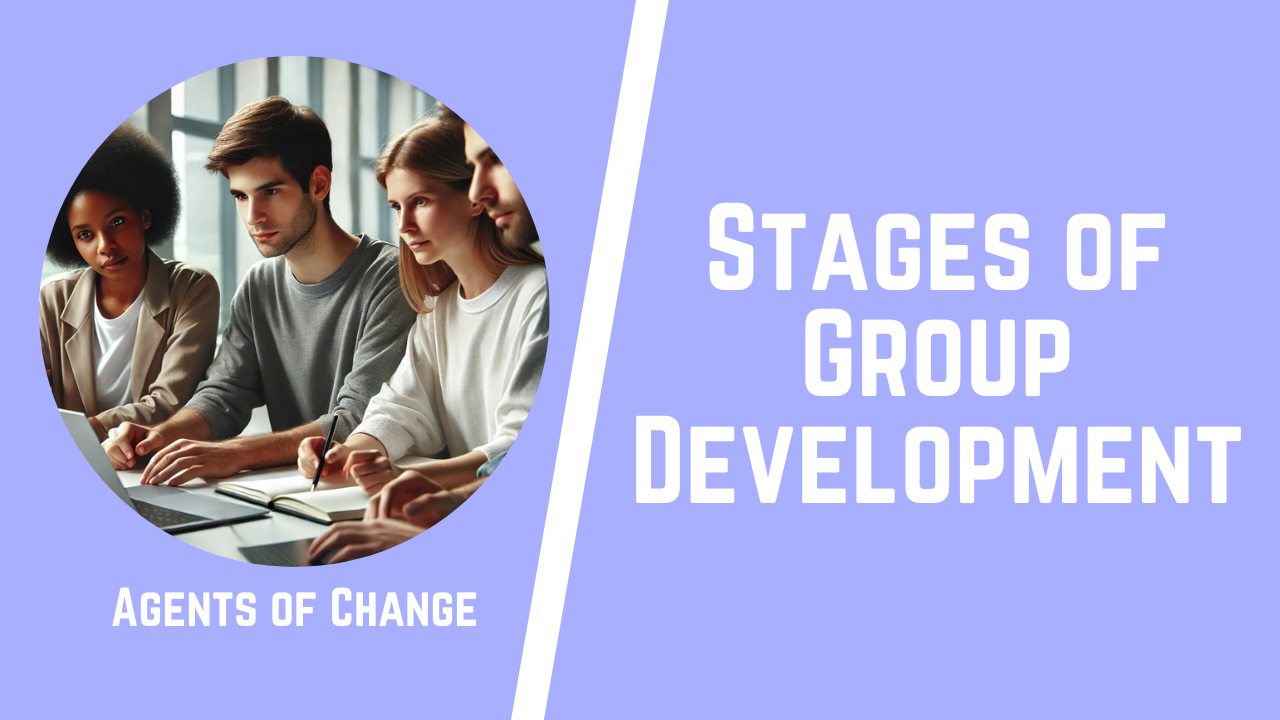
A small group of three diverse people working together around a table, featuring different ethnicities, genders, and ages.

For Social Workers, these stages are particularly important because they shape how you interact with and guide groups toward their goals. Misunderstanding or mishandling a group’s developmental phase can derail progress, while the ability to identify and navigate these stages can enhance group cohesion, productivity, and individual growth.

1. Forming: The Beginning of the Journey

The Forming stage is the group’s first step. At this point, members are coming together for the first time, and everything is new and unfamiliar. People are often polite but hesitant, trying to figure out where they fit within the group. As the facilitator, your role is to help group members get oriented, establish a sense of safety, and provide the structure needed to help the group begin its journey.

Here is an image depicting a group in the forming stage of group development, where individuals are introducing themselves and engaging with curiosity, capturing the early moments of interaction.

Key characteristics of the Forming stage include:

  • Uncertainty and anxiety about roles, goals, and the group’s purpose
  • A lack of trust between members, as relationships are just beginning to form
  • A high reliance on the leader or facilitator to provide direction and guidance

As a Social Worker, this is your moment to set the tone for how the group will operate. This means establishing clear goals, setting expectations for participation, and encouraging open communication. Providing a safe and welcoming environment is critical in this phase, as members are testing the waters to see whether they can trust both the group and the process.

Strategies for the Forming Stage:
  • Introduce group norms early, such as confidentiality and respectful communication.
  • Facilitate icebreaker activities to help members get comfortable with one another.
  • Set clear goals and define the purpose of the group to manage expectations.

2. Storming: When Tensions Rise

Once the initial pleasantries of the Forming stage wear off, groups enter the Storming stage. Here’s where things can get bumpy! In this phase, group members are more likely to express their opinions openly, which can lead to conflict, tension, and power struggles. Personality clashes, competition for leadership, and disagreements about the group’s goals or methods are common.

For Social Workers, this stage can be challenging but is also a necessary part of group development. Conflict isn’t inherently bad—in fact, it can lead to deeper trust and better understanding if it’s handled properly. Your role is to mediate disputes, encourage open dialogue, and help the group move through the conflict in a way that fosters growth rather than resentment.

Common dynamics in the Storming stage include:

  • Role conflicts, as members challenge the authority of the leader or one another
  • Emotional reactions, including frustration, defensiveness, or anger
  • Testing group boundaries, as members push to see what’s acceptable
Strategies for the Storming Stage:
  • Encourage constructive conflict resolution by helping members express their feelings and listen to one another.
  • Reframe negative behaviors and focus on common goals to remind the group why they’re working together.
  • Reinforce group norms and boundaries to provide a stable foundation during times of tension.

The Storming phase may feel uncomfortable, but it’s crucial for the group to go through this process. As conflicts get resolved, the group can emerge stronger and more united.

3. Norming: Establishing Group Identity

After the turbulence of the Storming stage, groups enter a period of Norming, where things begin to settle down. In this stage, conflicts have been largely resolved, and members start to understand and accept their roles. There’s a greater sense of cohesion and teamwork as the group begins to operate more smoothly.

During the Norming stage, group norms become established—these are the unwritten rules that guide how members interact with each other. This phase is about building trust, fostering cooperation, and solidifying the group’s identity. For Social Workers, this is a time to encourage members to take more ownership of the group and their roles within it.

Key characteristics of the Norming stage include:

  • Increased collaboration as members work together more harmoniously
  • A greater sense of trust and mutual respect between members
  • Role clarity, with individuals understanding and accepting their responsibilities
Strategies for the Norming Stage:
  • Acknowledge the group’s progress and celebrate small victories to reinforce positive behavior.
  • Encourage members to take on more leadership roles or responsibilities within the group.
  • Continue to foster open communication, ensuring that any lingering issues are addressed before they become larger conflicts.

In this phase, Social Workers can shift from being directive to more supportive, allowing the group to build on its strengths and develop further.

4. Performing: Reaching Peak Functionality

Once a group hits its stride, it enters the Performing stage. At this point, the group is functioning at a high level, and members are focused on achieving their goals. Communication flows freely, and the group operates with a sense of purpose and efficiency. Group members are comfortable with one another and are able to work together with minimal conflict.

For Social Workers, the Performing stage is a rewarding phase because it demonstrates the group’s growth and potential. Your role becomes more about maintaining momentum, providing guidance as needed, and ensuring that the group stays focused on its objectives.

Key features of the Performing stage include:

  • High levels of collaboration and problem-solving
  • A shared commitment to the group’s mission and goals
  • Independence among members, with less reliance on the facilitator
Strategies for the Performing Stage:
  • Continue to encourage autonomy by allowing members to take on more leadership roles within the group.
  • Provide positive reinforcement and feedback to keep the group motivated.
  • Monitor for any emerging issues that could disrupt the group’s progress and address them promptly.

At this stage, Social Workers act as facilitators, ensuring that the group remains productive and focused. This is also a good time to reflect on the group’s achievements and set any additional goals if appropriate.

5. Adjourning: Wrapping It All Up

Finally, the Adjourning stage marks the end of the group’s journey. In this phase, the group’s work is complete, and it’s time to disband. This stage can be bittersweet—while members may feel a sense of accomplishment, they may also experience sadness or loss as the group comes to an end.

For Social Workers, the Adjourning stage is about facilitating closure. It’s important to help group members process their emotions and reflect on what they’ve learned. This is also a time for members to think about how they’ll apply the skills or insights gained from the group in their future endeavors.

Key elements of the Adjourning stage include:

  • Reflection on the group’s accomplishments and challenges
  • Feelings of closure and emotional processing
  • Planning for the future, as members think about how to move forward individually
Strategies for the Adjourning Stage:
  • Facilitate a final reflection where members can discuss their experiences and share what they’ve learned.
  • Encourage healthy closure, acknowledging the emotional aspects of ending the group.
  • Provide resources or referrals if members need additional support as they transition out of the group.

In this final stage, the goal is to help group members move forward with a sense of completion and achievement, ensuring that the group experience has a lasting positive impact.


Why Social Workers Need to Master Group Development Stages

Understanding these five stages of group development is more than just theory—it’s a practical tool for Social Workers to enhance their work in group settings. Each stage presents unique challenges, and your ability to recognize these phases and respond accordingly can make all the difference in how successful the group becomes.

  • In the Forming stage, Social Workers create the foundation for trust and collaboration.
  • During Storming, they act as mediators, helping the group resolve conflict and build resilience.
  • In the Norming phase, they solidify group identity and reinforce positive norms.
  • At Performing, they guide the group toward productivity and independence.
  • And in Adjourning, they ensure that group members leave with a sense of closure and accomplishment.

Mastering the stages of group development allows you to be a more effective facilitator, helping groups navigate their dynamics and reach their goals. Understanding these stages is also essential for success on the ASWB exam, as you’ll encounter scenarios that test your knowledge of group dynamics and interventions.

Agents of Change packages include 30+ ASWB topics, 2 free study groups per month, and hundreds of practice questions so you’ll be ready for test day!

2) Why the Stages of Group Development Matter for the ASWB Exam

The ASWB exam is designed to assess your readiness for professional Social Work practice, and one of the key areas it covers is your understanding of group dynamics. The stages of group development—Forming, Storming, Norming, Performing, and Adjourning—are crucial concepts that not only appear in the real-world practice of Social Work but also feature prominently on the exam. Why? Because groups are everywhere in Social Work: in therapy settings, support groups, community work, and even workplace teams.

Understanding these stages helps you navigate the dynamics of any group you might be involved with, and recognizing where a group is in its developmental process can guide your intervention strategies. For the ASWB exam, knowing these stages is not just about passing the test—it’s about showing that you’re equipped to work effectively in group settings, which is a core competency for many areas of Social Work practice.

Let’s dive deeper into why the stages of group development matter for the ASWB exam and how this knowledge will help you ace it.


1. Application of Theory to Practice

The ASWB exam is not a simple test of memorization—it emphasizes the application of theoretical knowledge to real-world scenarios. Questions are often framed as case vignettes, requiring you to use your understanding of group dynamics to choose the best intervention or action. That’s why knowing the stages of group development is so essential. When you recognize which stage a group is in, you can quickly identify the most appropriate strategies for facilitating progress and resolving conflicts.

A diverse social worker studying for an exam in a cozy home environment. The setting reflects a warm, relaxed atmosphere, with study materials and a laptop, creating a focused and dedicated ambiance.

For example, imagine you’re given a case scenario where a therapy group is struggling with conflict and members are challenging each other’s opinions. This is likely the Storming stage, and your task is to apply appropriate conflict resolution techniques to move the group forward. If you can recognize this stage in the case, you’re already halfway to choosing the correct answer.

How the ASWB Exam Tests Your Ability to Apply Theory:
  • Case-based questions that require identification of the group’s stage
  • Questions asking for the most appropriate intervention for that stage
  • Scenarios that involve group dynamics, such as handling conflict or role confusion
  • Questions that test your ability to connect group theory to ethical practice (e.g., maintaining confidentiality or handling group power dynamics)

Having a solid grasp of the stages will allow you to approach these questions with confidence, applying your knowledge to select answers that demonstrate your readiness to work in real-world group settings.


2. Handling Group Conflict and Challenges

One of the most common topics in both Social Work practice and the ASWB exam is conflict management—and the stages of group development are deeply tied to how conflicts emerge and are resolved in groups. The Storming stage, in particular, is rife with potential conflicts as group members begin to express themselves more openly and test the boundaries of the group. Recognizing this stage allows you to approach conflict as a natural and necessary part of the group’s growth, rather than something to be avoided or suppressed.

On the exam, you’ll likely encounter scenarios where groups are in conflict, and your task will be to choose an appropriate intervention. For example, questions may present a therapy group where certain members are challenging the facilitator’s authority or engaging in power struggles. Knowing that this is typical of the Storming stage, you can select responses that involve promoting open communication, encouraging empathy, and setting clear boundaries to help the group move forward.

How Group Conflict Appears on the ASWB Exam:
  • Questions about managing interpersonal conflicts within a group
  • Scenarios where group members are challenging the leader’s authority
  • Situations involving resistance to group norms or goals
  • Questions testing your ability to mediate and guide the group toward resolution

The key is to recognize that conflict is a normal part of group development and to choose interventions that help the group navigate through it without derailing the process. Understanding these stages helps you select the most effective strategies for keeping the group on track.


3. Tailoring Interventions to Group Stages

The ASWB exam often requires you to choose the best intervention based on the specific stage a group is in. Each stage of group development calls for different types of leadership, guidance, and interventions from the Social Worker. Understanding where a group is in its developmental process allows you to select interventions that are tailored to the group’s current needs, maximizing their effectiveness.

For instance, during the Forming stage, group members are likely to be anxious, unsure of their roles, and dependent on the facilitator for structure. In this stage, the appropriate intervention might involve setting clear expectations, facilitating introductions, and establishing ground rules to help the group feel secure and focused. In contrast, during the Performing stage, group members are more independent and cohesive, so the facilitator’s role becomes less directive and more supportive, perhaps providing feedback and monitoring the group’s progress with minimal intervention.

How the Exam Tests Your Ability to Tailor Interventions:
  • Questions asking for the most appropriate role of the facilitator based on the group’s stage
  • Scenarios that require identifying the group’s needs and choosing interventions that align with their developmental phase
  • Case-based questions where you must determine whether the group requires more structure (early stages) or less intervention (later stages)

The ability to tailor interventions shows that you understand group dynamics and can adapt your approach as the group evolves, which is exactly what the ASWB exam is testing for.


4. Client-Centered Approach in Group Settings

At the heart of Social Work is the client-centered approach, which emphasizes meeting clients where they are. The stages of group development are, in many ways, an extension of this approach, as each stage reflects the evolving needs, behaviors, and dynamics of the group as a whole. On the ASWB exam, questions often focus on how well you can adapt your interventions to meet the group’s needs at various stages, ensuring that you’re not imposing rigid solutions but rather facilitating the group’s growth organically.

For example, during the Norming stage, group members are beginning to gel and work collaboratively, but they may still need reinforcement of group norms and encouragement to engage fully. A client-centered Social Worker in this stage would focus on building trust and reinforcing positive behaviors that align with the group’s emerging cohesion. The exam may present you with scenarios where you need to balance support and autonomy—a key indicator of a client-centered approach.

How the Client-Centered Approach Relates to Group Stages:
  • Understanding when to step back and let the group lead (later stages) versus when to offer more guidance (earlier stages)
  • Recognizing when group members are ready for more responsibility and adapting your leadership style accordingly
  • Tailoring your communication and interventions to respect the unique dynamics of the group as they progress through each stage

By showing that you can meet a group where it is developmentally, you demonstrate the client-centered approach that the ASWB exam looks for in competent Social Workers.


5. Ethics and Group Development

Ethical decision-making is at the core of the ASWB exam, and it’s particularly important when it comes to working with groups. Each stage of group development presents potential ethical challenges that Social Workers need to be prepared for, such as maintaining confidentiality, navigating power dynamics, or managing emotional reactions during the Adjourning stage.

For instance, in the Storming stage, conflicts may arise that challenge the group’s boundaries or threaten the safety and well-being of members. It’s your ethical responsibility to manage these conflicts in a way that protects all participants and upholds professional standards. Similarly, during the Adjourning stage, it’s important to help group members process their emotions about the group ending in a way that respects their individual needs and the group’s collective experience.

Ethical Considerations on the ASWB Exam:
  • Questions about confidentiality and boundaries in group settings
  • Scenarios where group dynamics present ethical dilemmas, such as handling power struggles or emotional distress
  • Questions testing your ability to promote a safe and ethical environment throughout the group’s developmental process

By understanding the stages of group development, you’ll be better equipped to navigate these ethical challenges and select answers that reflect best practices in ethical Social Work.

Learn more additional tips and tricks for the ASWB exam and get hundreds of practice questions with Agents of Change!

3) Strategies for Studying Group Development for the ASWB Exam

Studying for the ASWB exam can feel overwhelming given the wide range of topics it covers, but focusing on key areas like group development can help streamline your preparation. The stages of group development—Forming, Storming, Norming, Performing, and Adjourning—are critical to your success on the exam, as they frequently appear in case-based questions that test your understanding of group dynamics and your ability to apply theory to practice.

To make sure you’re fully prepared, it’s important to use effective study strategies that not only help you memorize the stages but also allow you to apply them in real-world scenarios. Below are several strategies that can help you study group development for the ASWB exam, ensuring you’re ready to handle any questions that come your way.


1. Understand the Theory: Know Each Stage Inside and Out

The first step in studying group development is to ensure you have a clear understanding of each stage. While memorization can help, it’s not enough to just know the names of the stages—you need to grasp what happens in each phase, the dynamics at play, and the appropriate interventions a Social Worker should employ.

Key Focus Areas for Each Stage:
  • Forming: What are the typical behaviors and emotions of group members during this phase? What role does the Social Worker play in setting expectations and creating a safe environment?
  • Storming: How do conflicts arise in this stage? What are the best conflict resolution strategies to help the group move forward?
  • Norming: What group norms typically emerge during this stage, and how can a Social Worker reinforce positive group behavior?
  • Performing: What does a high-functioning group look like, and what role does the Social Worker play in maintaining the group’s productivity?
  • Adjourning: How should a Social Worker help the group process the end of their journey and ensure that members leave with a sense of closure?
Study Tips for Mastering the Theory:
  • Create flashcards with the name of each stage on one side and its key characteristics, challenges, and strategies on the other.
  • Summarize each stage in your own words to ensure you fully understand the concepts.
  • Develop a mind map that shows how the stages progress and how the group dynamics evolve from one phase to the next.

A solid understanding of the theory is essential for tackling case-based questions on the ASWB exam, where you’ll be asked to recognize which stage a group is in and choose the appropriate intervention.


2. Connect Group Development to Real-World Scenarios

Memorizing the stages is just the beginning—what’s more important is your ability to apply them to real-world scenarios, which is exactly what the ASWB exam tests. The exam presents case-based questions where you’ll need to determine what stage a group is in and select the best intervention. To prepare for this, it helps to relate the theoretical stages to actual experiences, whether from your own life, field placements, or hypothetical scenarios.

Ways to Connect Theory to Practice:
  • Reflect on your own experiences: Think about times when you’ve been part of a group—whether in school, work, or community settings. Can you identify which stage the group was in? How did the dynamics shift over time?
  • Case studies: Review case studies from your Social Work coursework or find sample case scenarios online that focus on group dynamics. As you read, try to identify the group’s stage and think about what intervention you’d use.
  • Role-playing exercises: If you’re studying with others, try role-playing different stages of group development. One person can act as the facilitator, while the others take on the roles of group members. This will help you practice identifying stages and applying interventions in real time.
Study Tip for Scenario-Based Learning:
  • Create a study journal where you write out hypothetical group scenarios and practice identifying the group’s stage. Include what strategies you would use as a Social Worker to move the group forward. Over time, this will strengthen your ability to apply theory to practice.

By grounding the stages of group development in real-life situations, you’ll be better prepared to handle the types of questions the ASWB exam throws your way.


3. Practice with Case-Based Questions

The ASWB exam uses case-based questions to evaluate your knowledge of group development and your ability to apply that knowledge in practical scenarios. One of the most effective ways to study for these types of questions is to practice with mock exams or question banks that include case scenarios specifically related to group dynamics.

How to Tackle Case-Based Questions:
  • Identify the stage: When reading the question, try to determine which stage of group development the case describes. Are there signs of conflict (Storming), or is the group working well together (Performing)?
  • Look for key dynamics: Pay attention to group behaviors, conflicts, and interactions mentioned in the scenario. These clues will help you pinpoint the stage.
  • Choose the appropriate intervention: Once you’ve identified the stage, select the response that aligns with the group’s needs at that phase. For example, if the group is in the Norming stage, the answer might involve reinforcing group norms or facilitating deeper engagement.
Sample Case-Based Question:

A community support group for new parents is struggling to get participants to engage in discussions. Several group members have expressed concerns about the lack of structure, and some have been absent from recent meetings. As the facilitator, what should you do?

  • A) Encourage group members to share their thoughts openly, even if it causes conflict.
  • B) Provide clear expectations for group participation and revisit the group’s purpose.
  • C) Reduce the frequency of meetings to lessen the pressure on group members.
  • D) Allow the group to self-regulate without interference.

Answer: B) Provide clear expectations for group participation and revisit the group’s purpose. This scenario likely represents the Forming or early Storming stage, where members are still unsure of their roles and the group lacks structure. Providing clear guidance is the appropriate intervention.

Study Tip for Case-Based Practice:

The more case-based questions you practice, the more comfortable you’ll be when you encounter similar scenarios on the ASWB exam.


4. Utilize Mnemonics and Visual Aids

Studying group development stages can be a lot to take in, especially when trying to keep each stage straight in your mind. Mnemonics and visual aids can help simplify the memorization process and ensure that the stages and their key features stick in your memory.

Mnemonic for Remembering the Stages of Group Development:
  • Forming: First stage where the group is figuring things out.
  • Storming: Second stage where conflict and tension arise.
  • Norming: Third stage where the group establishes norms and cohesion.
  • Performing: Fourth stage where the group works efficiently toward its goals.
  • Adjourning: Final stage where the group disbands.

A simple mnemonic like “First Storms Never Perform Alone” can help you quickly recall the order of the stages.

Visual Aids:
  • Create a diagram that visually represents the progression of the stages. This could include a flowchart or timeline showing how the group evolves from Forming to Adjourning.
  • Use color coding to differentiate the stages and highlight key characteristics of each one. For example, you might use red for the conflict-heavy Storming stage and green for the more harmonious Norming stage.
Study Tip for Mnemonics and Visual Aids:
  • Hang your mnemonic or visual aid somewhere you can see it often, such as on a wall or your study desk. Frequent exposure will help reinforce the stages in your mind, making them easier to recall during the exam.

5. Review Ethical Considerations in Group Development

Ethics is a critical part of the ASWB exam, and it often intersects with group development. Each stage of group development can present unique ethical challenges, and knowing how to navigate these ethically is key to both passing the exam and practicing responsibly as a Social Worker.

Ethical Considerations by Stage:
  • Forming: How do you establish group norms around confidentiality and respect? How do you manage power dynamics early on?
  • Storming: What is your ethical responsibility in managing conflicts? How do you ensure that all members feel safe to express themselves?
  • Norming: How do you handle ethical issues related to group cohesion, such as ensuring that quieter members aren’t excluded?
  • Performing: How do you maintain professional boundaries and ensure that the group doesn’t become too dependent on the facilitator?
  • Adjourning: How do you ethically manage the emotions surrounding the end of a group? What is your role in providing closure while respecting members’ emotional needs?

By reviewing ethical issues related to each stage, you’ll be better equipped to handle questions that combine group dynamics with ethical decision-making on the ASWB exam.

Study Tip for Ethics:
  • As you study each stage, think about potential ethical dilemmas that could arise and how you would handle them. This will prepare you for questions that test your understanding of both group development and ethics.

The stages of group development are a critical part of your ASWB exam preparation, as they appear in multiple types of questions, from theory-based inquiries to case scenarios involving conflict resolution and ethics. By understanding each stage in depth, connecting theory to practice, and using effective study tools like case-based questions and mnemonics, you can approach this section of the exam with confidence.

Remember, the key to success on the ASWB exam isn’t just memorizing the stages but being able to apply them in real-world scenarios. With the right study strategies, you’ll be well-prepared to recognize group dynamics and choose the interventions that demonstrate your competence as a future Social Worker.

4) FAQs – Stages of Group Development and ASWB Exam

Q: Why are the stages of group development important for the ASWB exam?

A: The stages of group development—Forming, Storming, Norming, Performing, and Adjourning—are crucial for the ASWB exam because they form the foundation for understanding group dynamics, which is a significant aspect of Social Work practice.

The ASWB exam often includes case-based questions that require you to recognize which stage a group is in and to apply appropriate interventions based on that stage. This knowledge helps demonstrate that you can effectively facilitate groups, resolve conflicts, and guide members through their developmental journey.

Whether you’re managing therapy groups, community initiatives, or even interdisciplinary teams, a strong grasp of group development stages shows that you’re ready to handle group dynamics in the real world.

Q: How do I identify which stage of group development a group is in during the exam?

A: To identify a group’s stage on the ASWB exam, pay attention to the behaviors and interactions described in the scenario. Here are some key indicators:

  • In the Forming stage, group members will likely be anxious, polite, and unsure of their roles. The focus is on getting acquainted and understanding the group’s purpose.
  • The Storming stage is characterized by conflict, power struggles, or resistance as members begin to assert themselves and test boundaries.
  • During Norming, the group will start to collaborate more effectively, with clear roles and shared norms.
  • In the Performing stage, the group is highly functional, working smoothly toward its goals with little conflict.
  • The Adjourning stage involves the dissolution of the group, where members reflect on their experiences and process feelings of closure.

By recognizing these patterns, you can identify the group’s developmental phase and select the best response or intervention.

Q: What strategies should I use to prepare for group development questions on the ASWB exam?

A: To effectively prepare for group development questions on the ASWB exam, focus on applying the theory to practical scenarios. Here are some strategies:

  • Master the theory: Understand the key characteristics, challenges, and interventions for each stage (Forming, Storming, Norming, Performing, Adjourning). Use flashcards, summaries, and visual aids like diagrams to reinforce your knowledge.
  • Practice with case scenarios: Use practice exams or study guides with case-based questions that involve group dynamics. Focus on identifying the group’s stage and the appropriate Social Work intervention.
  • Relate theory to real life: Reflect on your own experiences in groups or role-play different group stages with study partners. This helps solidify your ability to recognize stages and respond effectively.
  • Review ethical issues: Study the ethical considerations associated with each stage, such as confidentiality, managing conflict, and facilitating group closure.

By combining theoretical knowledge with practical application, you’ll be well-prepared to tackle group development questions on the ASWB exam.

5) Conclusion

Understanding the stages of group development is not just a theoretical exercise—it’s a crucial skill for any aspiring Social Worker, and it plays a significant role in your preparation for the ASWB exam. These stages—Forming, Storming, Norming, Performing, and Adjourning—represent the natural evolution of group dynamics, offering you a framework to recognize how groups operate and how best to intervene as a facilitator. By mastering this concept, you equip yourself with the tools to not only succeed in practice but also to confidently answer the case-based questions that often appear on the ASWB exam.

Studying for this exam can feel overwhelming, but focusing on key areas like group development allows you to tackle the material with more confidence and clarity. Applying strategies like connecting theory to real-life experiences, practicing case-based questions, and reviewing ethical considerations will help you deepen your understanding of group dynamics.

With this knowledge, you’ll be better equipped to identify group stages, select appropriate interventions, and demonstrate your competence as a future Social Worker.

6) ASWB Practice Question: Group Development

A social worker is facilitating a support group for individuals recovering from substance abuse. During the third session, several group members begin expressing frustration with one another, challenging each other’s experiences, and questioning the effectiveness of the group. The social worker notices tension rising and some group members becoming defensive. What stage of group development is the group most likely in, and what should the social worker do next?

A) Forming; Establish group goals and explain the purpose of the group.
B) Storming; Encourage open dialogue and guide the group toward resolving conflicts.
C) Norming; Reinforce group cohesion and validate members’ feelings.
D) Adjourning; Help group members reflect on their progress and prepare for the end of the group.

Correct Answer:

B) Storming; Encourage open dialogue and guide the group toward resolving conflicts.

Rationale:

The group is most likely in the Storming stage, which is characterized by conflict, tension, and power struggles as members begin to assert themselves and challenge each other. In this phase, it’s normal for members to express frustration and experience interpersonal conflicts. The social worker’s role during this stage is to encourage open communication and help the group navigate these challenges in a constructive way, fostering trust and collaboration.

  • A) Forming is incorrect because the group has already progressed beyond the initial stage where members are polite and just getting acquainted.
  • C) Norming is incorrect because the group has not yet developed the cohesion and collaborative spirit typical of this stage.
  • D) Adjourning is incorrect because the group is not nearing the end of its process; instead, it is working through critical developmental conflicts.

By recognizing the group’s current stage and using appropriate interventions, the social worker can help the group move forward effectively.


► Learn more about the Agents of Change course here: https://agentsofchangeprep.com

About the Instructor, Meagan Mitchell: Meagan is a Licensed Clinical Social Worker and has been providing individualized and group test prep for the ASWB for over 8 years. From all of this experience helping others pass their exams, she created the Agents of Change course to help you prepare for and pass the ASWB exam!

Find more from Agents of Change here:

► Facebook Group: https://www.facebook.com/groups/aswbtestprep

► Podcast: https://podcasters.spotify.com/pod/show/agents-of-change-sw

#socialwork #testprep #aswb #socialworker #socialwork #socialworktest #socialworkexam #exam #socialworktestprep #socialworklicense #socialworklicensing #licsw #lmsw #lcsw #aswbexam #aswb #lcswexam #lmswexam #aswbtestprep #aswbtest #lcswtestprep #lcswtest #lmswtestprep #lmswtest #aswbcourse #learningstyles #learningstyle

Disclaimer: This content has been made available for informational and educational purposes only. This content is not intended to be a substitute for professional medical or clinical advice, diagnosis, or treatment

Share:

Discover more from Agents of Change

Subscribe now to keep reading and get access to the full archive.

Continue reading