Working with LGBTQ+ Populations: Cultural Competency Tips for the ASWB Exam
Working with LGBTQ+ Populations: Cultural Competency Tips for the ASWB Exam
In Social Work, cultural competency is key, especially when working with LGBTQ+ populations. LGBTQ+ individuals face unique challenges and barriers that can impact their mental health, access to resources, and overall well-being.

The ASWB (Association of Social Work Boards) exam recognizes the importance of understanding these diverse experiences and often includes questions focused on LGBTQ+ cultural competency. Whether you’re preparing to sit for the exam or simply aiming to enhance your practice, a firm grasp of LGBTQ+ issues is essential for providing inclusive and ethical care.

For Social Workers, cultural competency isn’t just about memorizing terminology; it’s about fostering authentic connections, advocating for equal access, and approaching every client with empathy and respect. LGBTQ+ clients may have faced discrimination, trauma, or stigma related to their identity, which can shape their interactions with Social Workers. The ASWB exam will challenge your knowledge of how to respond in these situations, requiring not just an understanding of terminology but also an awareness of LGBTQ+ health disparities, discrimination, and identity issues.

In this post, we’ll explore essential tips for boosting your cultural competency when working with LGBTQ+ populations—tips that align directly with what you’ll need for the ASWB exam. We’ll cover vital concepts, practical strategies, and common challenges, equipping you with the tools to better serve LGBTQ+ clients and succeed on exam day. By preparing thoughtfully, you’ll be able to approach the ASWB exam with confidence and support LGBTQ+ individuals in ways that truly respect and affirm their identities.

Learn more about the ASWB exam and create a personalized ASWB study plan with Agents of Change. We’ve helped thousands of Social Workers pass their ASWB exams and want to help you be next!

1) Why LGBTQ+ Cultural Competency Matters in Social Work

Understanding and practicing LGBTQ+ cultural competency is crucial in Social Work, where inclusivity and respect for diversity are at the core of ethical practice. LGBTQ+ clients face unique challenges that often stem from discrimination, societal stigma, and disparities in access to resources.

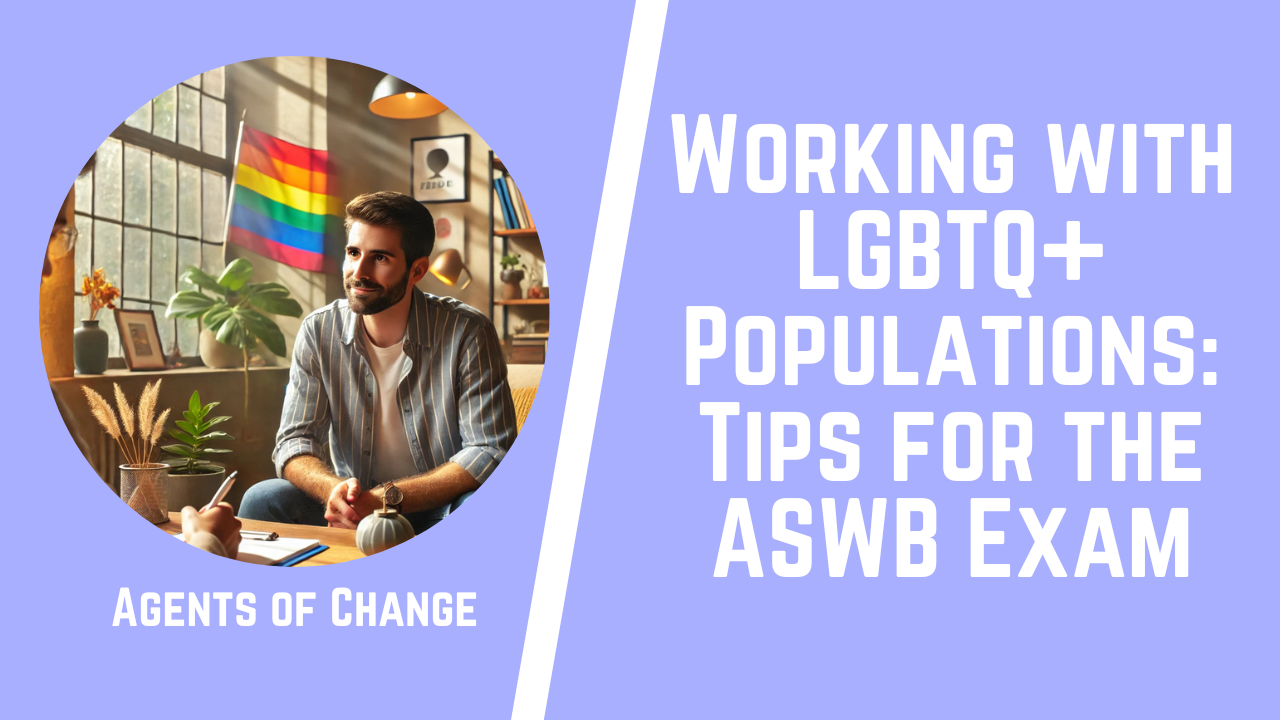
A therapist Working with LGBTQ client

By fostering cultural competency, Social Workers can create safe spaces for LGBTQ+ individuals, helping them feel seen, respected, and supported. This not only aligns with the values of Social Work but also enhances the effectiveness of care and builds trust, which is critical for successful client relationships.

The Role of Cultural Competency in Client Care

Cultural competency helps Social Workers better understand their clients’ unique perspectives, allowing them to provide more effective and meaningful support. For LGBTQ+ clients, who may have had past experiences of invalidation or misunderstanding, working with a culturally competent Social Worker can make a significant difference in their willingness to seek and continue receiving help.

Some specific ways LGBTQ+ cultural competency benefits client care include:

  • Building Trust: Clients are more likely to open up and engage in meaningful discussions if they feel understood and respected.
  • Reducing Barriers to Care: LGBTQ+ individuals often face structural barriers, and a competent Social Worker can help navigate these.
  • Fostering Empowerment: Affirming a client’s identity can reinforce their self-worth and encourage positive self-expression.

Challenges LGBTQ+ Individuals Face in Accessing Services

LGBTQ+ individuals face a range of barriers when accessing health and Social Work services. Recognizing these challenges enables Social Workers to provide relevant support and advocate effectively for their clients. Common barriers include:

  • Discrimination and Bias: LGBTQ+ individuals often experience discrimination in various settings, from healthcare facilities to workplaces.
  • Healthcare Disparities: LGBTQ+ populations face higher rates of certain health issues, such as HIV/AIDS among certain demographics and mental health concerns across the board.
  • Economic Disadvantages: Due to discrimination, LGBTQ+ people are more likely to experience economic hardship, unemployment, and housing instability.

For many LGBTQ+ individuals, these challenges lead to a hesitancy to seek care, fearing discrimination, misunderstanding, or stigma. Cultural competency enables Social Workers to identify these concerns, validate clients’ experiences, and offer nonjudgmental support.

Specific Health Disparities in LGBTQ+ Populations

One of the most critical aspects of LGBTQ+ cultural competency in Social Work is understanding the specific health disparities this community faces. These health disparities are often compounded by systemic discrimination, social stigma, and a lack of access to competent healthcare providers.

  • Mental Health: LGBTQ+ populations have higher rates of depression, anxiety, and suicidal ideation compared to their heterosexual and cisgender counterparts. This is often due to experiences of rejection, discrimination, and internalized stigma.
  • Substance Use: Studies have shown that LGBTQ+ individuals are more likely to struggle with substance use, frequently as a coping mechanism for dealing with discrimination or isolation.
  • HIV/AIDS: Certain groups within the LGBTQ+ community, particularly gay and bisexual men and transgender women, are disproportionately affected by HIV/AIDS due to factors like limited access to preventive healthcare and societal stigma.

A competent Social Worker must not only recognize these disparities but also be prepared to offer referrals to appropriate resources, advocate for equitable treatment, and assist clients in managing the effects of these health challenges on their lives.

The Importance of Inclusive Language and Communication

Language plays a powerful role in establishing trust and respect with LGBTQ+ clients. Using inclusive language signals respect for clients’ identities and helps reduce the likelihood of misunderstandings or assumptions.

  • Asking for Pronouns: This small act can make a huge difference. Asking a client their preferred pronouns (she/her, he/him, they/them, etc.) shows you value their identity.
  • Avoiding Assumptions: Avoid assuming clients’ gender, sexual orientation, or relationship status based on appearance or superficial cues.
  • Using Affirming Terms: Respect terms clients use to describe their identities, even if they differ from more commonly recognized labels. If you’re unsure about a term or label, it’s often best to ask respectfully rather than assume.

Inclusive language fosters open communication and builds a strong foundation for the client-Social Worker relationship. Additionally, it can encourage LGBTQ+ clients to express themselves fully, knowing they’re in a safe space free of judgment or bias.

Addressing Intersectionality: Beyond Sexual Orientation and Gender Identity

An effective approach to LGBTQ+ cultural competency also requires understanding intersectionality. Intersectionality acknowledges that each individual has multiple, overlapping identities—such as race, ethnicity, socioeconomic status, and ability—which can collectively impact their experience.

For example, a Black transgender woman may experience discrimination not only based on her gender identity but also due to racial prejudice. By understanding these intersections, Social Workers can provide support that acknowledges the complexities of their clients’ lived experiences, rather than treating each identity in isolation.

  • Impact of Multiple Marginalizations: LGBTQ+ clients who are also part of other marginalized groups (e.g., people of color, immigrants) often face compounded challenges that affect their access to care and social services.
  • Recognizing Cultural Influences on Identity: Cultural backgrounds can influence how LGBTQ+ individuals perceive their own identities. For instance, someone from a conservative or religious community may experience different challenges in coming out compared to someone from a more progressive environment.

Incorporating intersectionality into Social Work practice helps ensure that clients receive support that is both culturally and contextually relevant.

Ethical Considerations in LGBTQ+ Cultural Competency

Ethics are central to Social Work, and LGBTQ+ cultural competency requires a commitment to ethical practice. When working with LGBTQ+ clients, ethical considerations include:

  • Client Confidentiality: Given the stigma that can still surround LGBTQ+ identities, it’s critical to protect client confidentiality, especially if they have not openly disclosed their identity in other areas of their life.
  • Client Self-Determination: Social Workers must respect clients’ autonomy, especially when it comes to identity. For example, they should allow clients to define their own identities rather than assuming labels or encouraging “outings.”
  • Avoiding Biases: Social Workers must actively examine and challenge any personal biases or preconceived notions they might have about LGBTQ+ individuals.

Ethical cultural competency builds trust and respects clients’ rights, which is foundational to effective Social Work. By investing in LGBTQ+ cultural competency, Social Workers can offer LGBTQ+ clients the care, advocacy, and respect they need to thrive. This improves outcomes and reinforces Social Work’s dedication to inclusivity, empathy, and justice for all.

Agents of Change packages include 30+ ASWB topics, 2 free study groups per month, and hundreds of practice questions so you’ll be ready for test day!

2) Core LGBTQ+ Terms and Concepts to Know

For Social Workers, understanding key LGBTQ+ terms and concepts is essential to practicing cultural competency. Language is more than just vocabulary; it reflects respect, understanding, and a commitment to affirming each client’s unique identity.

Being well-versed in LGBTQ+ terminology helps avoid misunderstandings, builds trust, and allows Social Workers to create a more inclusive environment. Here, we’ll cover the foundational terms, explain the distinction between sexual orientation and gender identity, and explore the fluidity and complexity of identity.

Foundational LGBTQ+ Terminology

To engage with LGBTQ+ clients respectfully and empathetically, it’s important to understand and use the correct terminology. Here are some foundational terms every Social Worker should know:

  • Sexual Orientation: Refers to whom a person is emotionally, romantically, or sexually attracted. Common orientations include:

    • Heterosexual: Attraction to people of a different gender.
    • Homosexual: Attraction to people of the same gender.
    • Bisexual: Attraction to people of more than one gender.
    • Pansexual: Attraction to people regardless of gender.
  • Gender Identity: Describes a person’s inner sense of being male, female, both, neither, or somewhere along the gender spectrum. This identity may not align with the person’s sex assigned at birth.

  • Cisgender: Individuals whose gender identity matches their sex assigned at birth. For example, someone assigned female at birth who identifies as a woman is cisgender.

  • Transgender: Refers to individuals whose gender identity differs from their sex assigned at birth. This term is often abbreviated as “trans.”

  • Nonbinary: Individuals who do not identify exclusively as male or female. They may identify as both, neither, or a blend of genders.

Sexual Orientation vs. Gender Identity: Key Differences

While the terms “sexual orientation” and “gender identity” are often discussed together, they refer to distinct aspects of identity. Understanding this distinction is essential for Social Workers, as confusing the two can lead to misunderstandings and misinterpretations of clients’ experiences.

  • Sexual Orientation: Focuses on a person’s attraction to others. For example, someone might identify as gay, bisexual, or heterosexual, which speaks to whom they are attracted.

  • Gender Identity: Relates to one’s internal sense of self as male, female, both, or neither. Gender identity is separate from sexual orientation and does not imply anything about whom a person is attracted to.

Some examples to clarify the distinction:

  • A transgender woman may identify as heterosexual if she is attracted to men.
  • A cisgender man might identify as bisexual if he is attracted to both men and women.

By clearly understanding these distinctions, Social Workers can engage with clients using precise and respectful language, avoiding assumptions about clients’ identities and experiences.

Expanding the Gender Spectrum: Beyond Male and Female

The concept of gender as a binary—strictly male or female—is increasingly recognized as too limiting to encompass the full range of human gender experiences. Many individuals identify outside of these traditional categories, challenging Social Workers to broaden their understanding of gender.

Key Nonbinary and Gender-Expansive Terms

  • Genderqueer: A term used by people who reject traditional gender distinctions and may identify as both male and female, neither, or outside the gender binary altogether.
  • Genderfluid: Describes individuals whose gender identity may shift or change over time. A genderfluid person might feel more aligned with one gender some days and a different gender on others.
  • Agender: Refers to individuals who do not identify with any gender. Agender individuals may feel that gender is irrelevant to them or simply identify as having no gender.

Pronouns and Their Importance in LGBTQ+ Cultural Competency

Pronouns are a central part of gender identity and a powerful way for Social Workers to demonstrate respect for LGBTQ+ clients. Using the correct pronouns affirms clients’ identities and signals that you value their self-expression.

  • Common Pronouns: He/him, she/her, and they/them are some of the most common pronouns used. “They/them” is often used by nonbinary or gender-nonconforming individuals.
  • Neopronouns: Some people use pronouns outside the traditional binary, such as ze/zir or xe/xem. Neopronouns are less commonly used but should be respected just like any other pronouns.
  • Asking for Pronouns: Social Workers should ask clients for their pronouns at the start of their interactions, demonstrating openness and respect for their identity.

Tips for Respectful Pronoun Use

  • Ask Directly: A simple “What pronouns do you use?” can be a welcoming way to inquire about a client’s pronouns without making assumptions.
  • Practice and Remember: Make an effort to remember clients’ pronouns. If you slip up, offer a brief apology, correct yourself, and continue the conversation.
  • Avoiding Assumptions: Avoid assuming pronouns based on appearance, name, or voice. Instead, allow clients to introduce themselves however they’re most comfortable.

Identity Fluidity and Evolving Terms

Identity is not always fixed; for many people, gender and sexual orientation can be fluid, evolving over time or even within different contexts. Understanding this fluidity is important for Social Workers, as it helps them remain adaptable and supportive of clients’ self-discovery processes.

Common Fluid Identities

  • Queer: Historically used as a derogatory term, “queer” has been reclaimed by many within the LGBTQ+ community as an umbrella term that describes non-normative sexual orientations and gender identities. For some, “queer” feels more flexible and encompassing than other specific labels.
  • Two-Spirit: This term is used by some Indigenous peoples in North America to describe a gender or sexual identity that includes both masculine and feminine qualities. “Two-Spirit” is not only a gender identity but also carries significant cultural meaning within Indigenous communities.

Why Fluidity Matters in Social Work

Social Workers must be prepared for clients who may shift their identities over time or prefer not to label themselves strictly. Fluid identities challenge traditional labels and highlight the need for open-mindedness. Clients may express different facets of their identity depending on their circumstances, experiences, or personal growth. Acknowledging and respecting this fluidity is key to creating an affirming and supportive environment.

Affirming Clients’ Unique Identities: Using Identity Terms Respectfully

Not every LGBTQ+ person will use mainstream identity labels. Some may create or use labels specific to their personal experiences, communities, or cultural contexts. Respecting each client’s chosen terms fosters inclusivity and helps them feel seen and understood.

Best Practices for Using Identity Terms

  • Listen and Reflect: Listen carefully to how clients describe themselves and reflect that language back in your interactions.
  • Ask if Unsure: If a client uses an unfamiliar term, it’s okay to ask respectfully, “Could you share more about what this term means to you?”
  • Adapt to Clients’ Preferences: Always default to the language that clients feel best represents their experiences. This demonstrates respect and helps clients feel validated.

By understanding and respecting LGBTQ+ terms, Social Workers can make their practice more inclusive and effective. Language reflects a Social Worker’s commitment to cultural competency and can have a profound impact on building trust and rapport with clients.

A deep knowledge of terminology, combined with openness to individual expression, creates a strong foundation for culturally competent Social Work with LGBTQ+ individuals.

3) Preparing for LGBTQ+ Cultural Competency Questions on the ASWB Exam

The ASWB (Association of Social Work Boards) exam assesses a Social Worker’s ability to work ethically and effectively with diverse populations, including LGBTQ+ individuals. As LGBTQ+ cultural competency is essential to delivering inclusive care, questions on the ASWB exam often test your understanding of LGBTQ+ terms, identity issues, and best practices for building respectful, supportive client relationships.

This section covers the types of LGBTQ+ cultural competency questions you might encounter, strategies for answering them effectively, and core concepts to focus on as you prepare.

Types of LGBTQ+ Cultural Competency Questions You Might Encounter

The ASWB exam may include multiple-choice or scenario-based questions involving LGBTQ+ cultural competency. Familiarizing yourself with these question types and the knowledge they require can help you feel prepared and confident on exam day. Here are some common question formats:

1. Terminology and Definitions Questions

These questions test your understanding of key LGBTQ+ terms, such as sexual orientation, gender identity, cisgender, transgender, and nonbinary. They may ask you to define a term or choose the most respectful and accurate description of a client’s identity.

  • Example Question: “Which of the following terms best describes a person whose gender identity does not align with their sex assigned at birth?”
    • Answer: Transgender

2. Scenario-Based Questions on Identity Exploration

Scenario-based questions may present a situation in which a client is exploring their gender or sexual identity and seeking support. These questions assess your ability to respond with empathy and uphold ethical principles like client self-determination and confidentiality.

  • Example Scenario: “A 17-year-old client confides in you that they’re questioning their gender identity and are unsure whether to come out to their family. What is the most appropriate response?”
    • Answer: Support the client’s exploration and discuss potential support resources while respecting their right to disclose their identity on their terms.

3. Ethics and Confidentiality Scenarios

Questions may also explore ethical challenges, particularly in maintaining confidentiality for LGBTQ+ clients or managing cases where a client faces discrimination. These scenarios test your ability to apply ethical standards, prioritize client safety, and demonstrate respect for clients’ rights.

  • Example Scenario: “A young LGBTQ+ client expresses fear of discrimination at school. Which of the following actions best aligns with Social Work ethics?”
    • Answer: Discuss the client’s concerns, explore options for support, and provide information about resources that protect their rights without breaching confidentiality.

Strategies for Answering LGBTQ+ Cultural Competency Questions Effectively

Succeeding on LGBTQ+ cultural competency questions requires more than just memorizing terms—it involves demonstrating empathy, understanding, and a commitment to inclusive care. Here are some strategies for approaching these questions confidently:

1. Prioritize Empathy and Client Self-Determination

When answering questions about LGBTQ+ clients, always choose responses that respect client autonomy. The ASWB exam often emphasizes client self-determination, which means allowing clients to make decisions about their identities and lives without pressure or judgment from the Social Worker.

  • Tip: Look for answers that support clients’ choices and validate their feelings.
  • Avoid: Answers that impose your views or suggest that you know what’s “best” for the client.

2. Choose Answers that Reflect Cultural Humility and Openness

Cultural humility is essential for working with LGBTQ+ populations. This means remaining open to clients’ unique identities and experiences, rather than assuming you fully understand them. Many questions will have answers that reflect humility, acknowledging that each client’s experience is individual and may require you to learn more.

  • Tip: Select answers that involve asking the client about their experience, using inclusive language, and respecting identity differences.
  • Avoid: Responses that make assumptions based on stereotypes or force clients into predefined categories.

3. Emphasize Confidentiality and Client Safety

Confidentiality is particularly critical for LGBTQ+ clients, who may face significant risks if their identity is disclosed without consent. Look for answers that prioritize confidentiality and allow the client to decide if and when they disclose personal information.

  • Tip: When confidentiality is at stake, choose answers that prioritize the client’s right to privacy and consider potential risks they may face.
  • Avoid: Options that suggest breaking confidentiality or sharing information without client consent.

4. Be Aware of Intersectionality and Systemic Challenges

LGBTQ+ clients may face unique challenges when other identity factors intersect, such as race, religion, disability, or socioeconomic status. Understanding these intersections helps you make more nuanced decisions that respect the complexity of each client’s experience.

  • Tip: Choose answers that acknowledge systemic challenges and offer supportive resources specific to the client’s intersecting identities.
  • Avoid: Simplistic responses that don’t consider the client’s full context or potential multiple marginalizations.

Core Concepts to Focus on for LGBTQ+ Cultural Competency Preparation

As you study for the ASWB exam, focus on key concepts that commonly appear in LGBTQ+ cultural competency questions. Developing a clear understanding of these areas will improve your ability to answer confidently and effectively.

Core LGBTQ+ Terms and Identity Frameworks

Make sure you’re familiar with LGBTQ+ terminology, as well as the distinctions between sexual orientation, gender identity, and gender expression. Understanding foundational terms like transgender, nonbinary, cisgender, and genderqueer will help you accurately interpret exam questions and select respectful responses.

  • Recommended Focus Terms:
    • Sexual orientation vs. gender identity
    • Cisgender and transgender
    • Nonbinary, genderqueer, and genderfluid
    • Pronoun usage (he/him, she/her, they/them)

Ethical Standards and LGBTQ+ Cultural Competency

Many questions will explore ethical standards in working with LGBTQ+ populations, especially those related to confidentiality, client autonomy, and respect for diversity. Make sure you’re familiar with the National Association of Social Workers (NASW) Code of Ethics, specifically the sections that address cultural competency, confidentiality, and self-determination.

  • Key Ethical Standards to Review:
    • Commitment to cultural competence and social diversity
    • Client self-determination
    • Confidentiality in sensitive identity situations

Client-Centered and Trauma-Informed Approaches

LGBTQ+ individuals often face trauma related to discrimination, rejection, and societal stigma. Exam questions may assess your understanding of trauma-informed care and client-centered approaches that support LGBTQ+ clients’ healing and resilience.

  • Focus Areas:
    • Trauma-informed care principles
    • Creating a safe, affirming space
    • Recognizing and addressing minority stress (stress due to discrimination or prejudice)

Health Disparities and Resource Accessibility for LGBTQ+ Populations

Understanding health disparities faced by LGBTQ+ populations helps Social Workers offer appropriate resources and referrals. The ASWB exam may include questions about common challenges LGBTQ+ clients face in accessing healthcare and mental health support.

  • Key Health Disparities to Review:
    • Mental health (higher rates of depression, anxiety, and suicide)
    • Substance use concerns in LGBTQ+ communities
    • HIV/AIDS among gay and bisexual men, transgender women, and certain communities of color

Practice Questions and Scenario Review for the ASWB Exam

Applying what you’ve learned by practicing with sample questions is a great way to prepare. Consider the following practice scenarios that reflect common ASWB exam themes:

  1. Confidentiality and Safety Concerns:

    • Scenario: “A 15-year-old client who identifies as gay shares concerns about coming out to their family, fearing a negative reaction. What’s the best course of action for the Social Worker?”
    • Best Answer: Support the client’s concerns, explore their feelings, and discuss ways to navigate their family dynamics safely, while respecting their decision on disclosure timing.
  2. Supporting Identity Exploration:

    • Scenario: “A client is questioning their gender identity and seeks a supportive space to explore their feelings. How can the Social Worker best respond?”
    • Best Answer: Provide resources, validate their feelings, and allow the client to explore their identity without pressure or judgment.
  3. Resource Accessibility and Health Disparities:

    • Scenario: “A transgender client reports experiencing healthcare discrimination and is now hesitant to seek medical care. How should the Social Worker respond?”
    • Best Answer: Empathize with the client’s experience, discuss supportive healthcare providers or LGBTQ+-affirming services, and help them access these resources without fear of discrimination.

By practicing these scenarios and keeping the key strategies in mind, you’ll be well-equipped to answer LGBTQ+ cultural competency questions on the ASWB exam. Preparing for these questions will also empower you to become a more effective and compassionate advocate for LGBTQ+ clients in your Social Work practice.

4) FAQs – Working with LGBTQ+ Populations: Cultural Competency Tips for the ASWB Exam

Q: What should I focus on to best prepare for LGBTQ+ cultural competency questions on the ASWB exam?

A: To effectively prepare for LGBTQ+ cultural competency questions, concentrate on understanding core LGBTQ+ terms and identity concepts, such as sexual orientation, gender identity, and the distinctions between terms like cisgender, transgender, and nonbinary. Familiarize yourself with ethical standards outlined in the NASW Code of Ethics, especially those concerning cultural competency, confidentiality, and client self-determination.

Additionally, practice client-centered and trauma-informed approaches, which are essential for working with LGBTQ+ clients, many of whom may face challenges related to discrimination or social stigma. Lastly, understand common health disparities and systemic challenges LGBTQ+ populations encounter, as these topics are likely to appear on the exam.

Q: How can I ensure I’m using the correct language and pronouns with LGBTQ+ clients?

A: Using correct language and pronouns is essential to building trust and showing respect for LGBTQ+ clients. Begin by asking clients their pronouns directly, rather than making assumptions based on appearance or name. If you’re unsure how to refer to aspects of their identity, ask politely or use open-ended questions that give clients room to describe themselves in their own terms.

Familiarize yourself with inclusive terms like nonbinary, genderqueer, and agender, and remember that identity language is fluid—clients may change how they identify over time. Always respect clients’ preferred terms and pronouns and correct yourself promptly if you make a mistake.

Q: What are some ethical challenges Social Workers may face when working with LGBTQ+ clients?

A: Social Workers may encounter specific ethical challenges when working with LGBTQ+ clients, particularly around confidentiality, client self-determination, and handling bias. Confidentiality is especially important for LGBTQ+ clients who may not be open about their identity in all areas of their lives, so it’s critical to protect their privacy rigorously.

Additionally, Social Workers must prioritize client self-determination, allowing clients to explore and express their identities without external pressure or judgment. Lastly, Social Workers must be mindful of personal biases, challenging any assumptions or stereotypes to avoid projecting them onto clients. Addressing these challenges ethically enhances the support provided to LGBTQ+ clients and aligns with the NASW Code of Ethics.

5) Conclusion

In preparing for the ASWB exam, mastering LGBTQ+ cultural competency is an invaluable step for any Social Worker committed to providing inclusive, respectful care. LGBTQ+ clients face unique challenges related to discrimination, mental health disparities, and barriers to accessing affirming resources.

By gaining a deep understanding of core terms, respectful language practices, and the ethical standards specific to LGBTQ+ populations, you’re equipping yourself to serve this community with empathy and skill. Each client interaction is an opportunity to reinforce trust, offer validation, and create a safe environment for self-expression.

As you study, focus on building a strong foundation of knowledge and practice for real-world scenarios, like handling confidentiality issues, supporting identity exploration, and advocating for clients’ rights. The ASWB exam will test your ability to apply these principles in a way that respects each client’s unique journey and autonomy.

Remember, your cultural competency doesn’t just help you pass an exam—it transforms the quality of care you provide, fostering a supportive space where LGBTQ+ clients feel seen and valued.

6) ASWB Practice Question: Working with LGBTQ+ Populations

A 16-year-old client has recently come out as transgender to their Social Worker. They express concern about how their family might react if they find out, as their parents have made negative comments about LGBTQ+ individuals in the past. The client asks for advice on how to approach this issue. What is the most appropriate response for the Social Worker?

A) Advise the client to have an honest conversation with their parents as soon as possible to avoid misunderstandings.

B) Encourage the client to wait until they feel completely certain of their gender identity before telling anyone else.

C) Offer support to the client in exploring their feelings and discuss potential coping strategies if the family reacts negatively.

D) Contact the client’s parents to educate them about transgender issues and promote a supportive home environment.

Correct Answer: C) Offer support to the client in exploring their feelings and discuss potential coping strategies if the family reacts negatively.

Rationale:
The correct answer is C because it prioritizes the client’s self-determination, emotional safety, and autonomy in deciding when and how to disclose their gender identity. By offering support in exploring their feelings and discussing coping strategies, the Social Worker is helping the client navigate a potentially challenging family dynamic while respecting their timing and boundaries. This approach aligns with the NASW Code of Ethics, which emphasizes supporting clients’ self-determination and respecting their right to disclose personal information at their own pace.

Option A is incorrect because advising the client to disclose to their parents may put them in an emotionally vulnerable or unsafe situation, especially given the family’s negative attitudes. Option B is also inappropriate because it implies that the client’s current understanding of their gender identity is insufficient, which could be invalidating. Option D is not correct, as contacting the parents without the client’s consent would violate confidentiality and could risk the client’s emotional and physical safety if the family responds negatively.


► Learn more about the Agents of Change course here: https://agentsofchangeprep.com

About the Instructor, Meagan Mitchell: Meagan is a Licensed Clinical Social Worker and has been providing individualized and group test prep for the ASWB for over 8 years. From all of this experience helping others pass their exams, she created the Agents of Change course to help you prepare for and pass the ASWB exam!

Find more from Agents of Change here:

► Facebook Group: https://www.facebook.com/groups/aswbtestprep

► Podcast: https://podcasters.spotify.com/pod/show/agents-of-change-sw

#socialwork #testprep #aswb #socialworker #socialwork #socialworktest #socialworkexam #exam #socialworktestprep #socialworklicense #socialworklicensing #licsw #lmsw #lcsw #aswbexam #aswb #lcswexam #lmswexam #aswbtestprep #aswbtest #lcswtestprep #lcswtest #lmswtestprep #lmswtest #aswbcourse #learningstyles #learningstyle

Disclaimer: This content has been made available for informational and educational purposes only. This content is not intended to be a substitute for professional medical or clinical advice, diagnosis, or treatment.

Share:

Discover more from Agents of Change

Subscribe now to keep reading and get access to the full archive.

Continue reading