Duty to Warn, Confidentiality, and Tarasoff: Applied Ethics Scenarios for the ASWB Exam
Duty to Warn, Confidentiality, and Tarasoff: Applied Ethics Scenarios for the ASWB Exam
Duty to warn and confidentiality questions are some of the most challenging ethics scenarios on the ASWB exam. A client may express anger, describe violent thoughts, or make a concerning statement, leaving the Social Worker to decide whether to protect privacy, gather more information, consult with a supervisor, or take immediate action. These questions can feel complicated because several answer choices may seem reasonable at first.

Many of these scenarios are connected to the landmark Tarasoff court case, which established that mental health professionals may have a responsibility to take reasonable steps to protect an identifiable person when a client presents a serious threat of harm. This responsibility is often described as a duty to warn or, more broadly, a duty to protect. On the exam, the correct response usually depends on details such as the client’s intent, plan, access to means, identified target, and the immediacy of the threat.

This guide explores Duty to Warn, Confidentiality, and Tarasoff for the ASWB Exam through practical examples and clear decision-making strategies. You’ll learn how to recognize common exam traps, distinguish violent thoughts from credible threats, and choose the most appropriate response when confidentiality and safety appear to conflict.

Learn more about the ASWB exam and create a personalized ASWB study plan with Agents of Change. We’ve helped hundreds of thousands of Social Workers pass their ASWB exams and want to help you be next! We also offer full-length, timed practice exams here.

1) Limitations of Confidentiality and Privacy

Confidentiality is essential to the relationship between a Social Worker and a client, but it isn’t absolute. Clients should generally be able to trust that the personal information they share will remain private. However, there are situations in which a Social Worker may be legally or ethically required to disclose information, even when the client hasn’t provided permission.

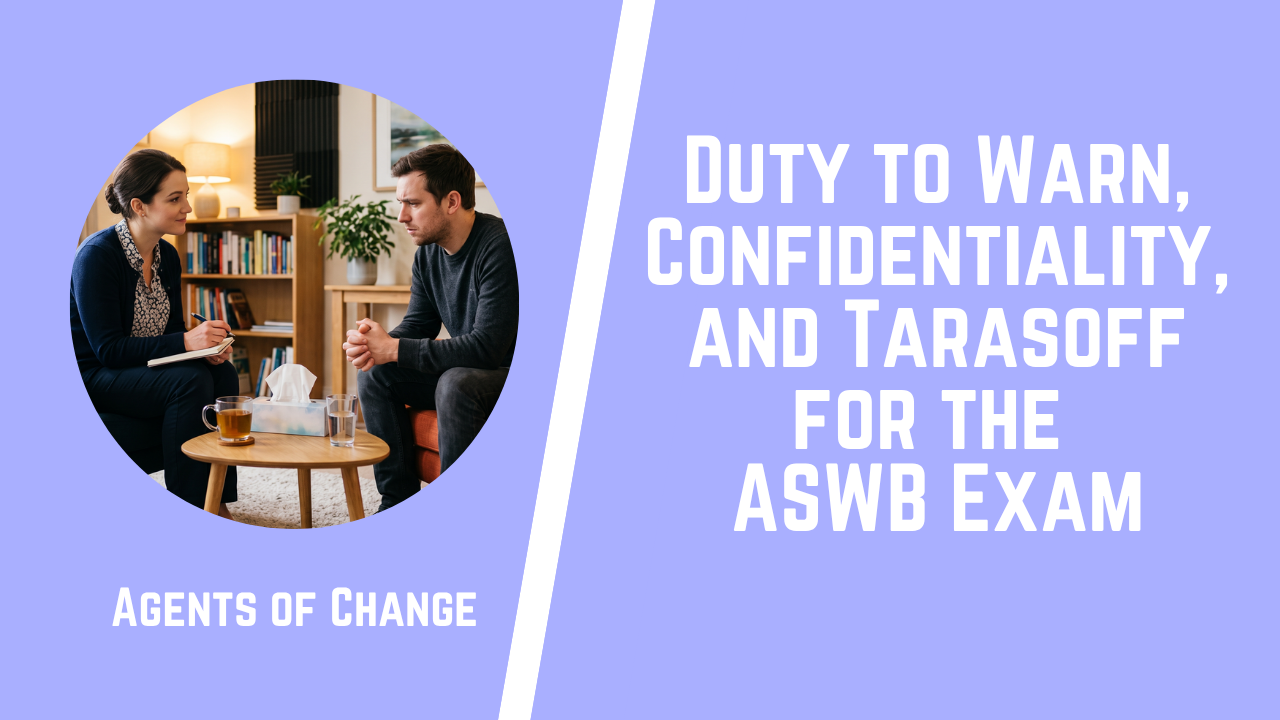
a therapist having a serious conversation with a client

Common limitations of confidentiality may include:

  • A serious, foreseeable, and imminent risk of harm to the client or another person
  • Suspected abuse or neglect of a child, older adult, or vulnerable adult
  • A valid court order requiring the release of information
  • A client’s written authorization to share specific information
  • Certain emergencies in which disclosure is necessary to protect health or safety
  • Professional consultation or supervision, with identifying information limited whenever possible

Social Workers should explain these limitations during the informed consent process so clients understand when confidentiality may need to be broken. This conversation shouldn’t be treated as a one-time formality. A Social Worker may need to revisit confidentiality when circumstances change, family members become involved, services move online, or a safety concern develops.

Privacy can also be compromised without releasing a full clinical record. Confirming that someone is a client, acknowledging that the person attended an appointment, leaving a detailed voicemail, or discussing a case where others can overhear may reveal protected information. For ASWB exam questions, pay close attention to seemingly minor disclosures. A spouse, parent, employer, or attorney doesn’t automatically have a right to information simply because they ask for it.

When disclosure is required, the Social Worker should generally share the minimum information necessary to accomplish the protective or legal purpose. Breaking confidentiality to address one specific threat doesn’t justify sharing unrelated diagnoses, treatment details, or personal history. The Social Worker should also document the reason for the disclosure, the information shared, the people contacted, any consultation obtained, and the actions taken.

On the ASWB exam, confidentiality should usually be treated as the starting point. Before choosing an answer that involves disclosure, ask whether the scenario establishes a clear exception. If essential information is missing, the best first step may be to assess the situation, review applicable requirements, or seek consultation rather than immediately releasing information.

Agents of Change packages include 30+ ASWB topics, 2 free study groups per month, and hundreds of practice questions so you’ll be ready for test day!

2) Duty to Warn, Confidentiality, and Tarasoff: Applied Ethics Scenarios for the ASWB Exam

Rather than memorizing one sentence about Tarasoff, use a structured threat-assessment framework.

The following CLEAR framework is a study aid, not a legal definition:

C: Is There a Concrete Target?

Has the client identified a person, group, location, workplace, school, or event?

Compare:

  • “People are going to regret how they treated me.”
  • “Tomorrow morning, I’m going to my former supervisor’s office to shoot him.”

The second statement provides a concrete target, time, and intended action. The first statement still deserves attention, but it doesn’t provide enough information to determine the level of danger.

L: What Is the Level of Potential Harm?

Is the client talking about yelling, damaging property, hitting someone, using a weapon, or killing someone?

All threats should be assessed. However, the seriousness and potential lethality of the proposed act influence the urgency of the response.

E: What Evidence of Intent Is Present?

Does the client describe a passing fantasy, or do they appear committed to acting?

Listen for statements about:

  • Rehearsing the act
  • Writing messages or notes
  • Following the intended victim
  • Selecting a date
  • Making preparations
  • Refusing alternatives
  • Expressing determination rather than ambivalence

A client can have violent thoughts without intending to act on them. The Social Worker’s job is to assess the distinction rather than assume it.

A: Does the Client Have Access and Ability?

Does the client possess the weapon, transportation, physical access, knowledge, or opportunity needed to carry out the threat?

A plan becomes more concerning when the means are available. Likewise, a client’s history of violence, current intoxication, escalating symptoms, or recent loss may affect the risk assessment.

R: How Recent and Imminent Is the Danger?

Did the client describe something they might do someday, or something they plan to do in an hour?

Timing matters. An immediate threat may require action before a routine consultation can occur. A vague or distant statement may allow for additional assessment, safety planning, consultation, and continued monitoring.

Reading too quickly, the word angry can feel like an emergency. It isn’t the emotion alone that determines the response. The surrounding facts do.

A Practical ASWB Decision Sequence

When a vignette involves threatened harm, mentally move through this sequence:

  1. Maintain confidentiality as the default.
  2. Assess the threat when essential details are missing.
  3. Determine seriousness, foreseeability, intent, means, target, and imminence.
  4. Consult applicable law, agency policy, supervision, or legal resources when time permits.
  5. Act immediately when the danger is serious and imminent.
  6. Use reasonable protective measures appropriate to the circumstances.
  7. Disclose only the information necessary for protection.
  8. Document the assessment, consultation, decisions, and actions taken.

The order can change during an emergency. If a client is actively preparing to attack someone, “wait until the weekly supervision meeting” would be an unsafe answer. Consultation is important, but it shouldn’t become a hiding place when immediate protection is required.

Applied Ethics Scenario 1: The Angry Client

A client was recently fired and tells a Social Worker, “My manager humiliated me. I swear, I could kill that guy.” The client then looks away and says nothing else.

What should the Social Worker do FIRST?

A. Contact the former manager and warn him.
B. Ask the client to explain what they mean and assess the risk of harm.
C. Contact law enforcement and provide the client’s address.
D. End the session because the client has threatened violence.

Best answer: B. Ask the client to explain what they mean and assess the risk of harm.

The statement is concerning, but the vignette hasn’t established a plan, intent, access to means, timing, or commitment to act. The Social Worker needs additional information before determining whether confidentiality must be breached.

An exam candidate may choose the warning option because it feels safest. Yet disclosing prematurely could violate confidentiality and damage the therapeutic relationship without a sufficient protective basis.

Ask about:

  • What the client means by “kill”
  • Whether the client intends to confront the manager
  • Whether there’s a plan
  • Whether weapons or other means are available
  • Whether the client has a history of violence
  • When the client might act
  • What has prevented the client from acting so far

Assessment isn’t avoidance. It’s the action that allows the Social Worker to select an intervention proportional to the risk.

Applied Ethics Scenario 2: A Specific and Immediate Threat

During a session, a client states, “My former partner gets off work at 6:00. I bought a gun yesterday, and I’m waiting outside the building tonight. I’ve already decided.”

What should the Social Worker do NEXT?

A. Explore the client’s childhood experiences with rejection.
B. Ask the client to sign a release allowing contact with the former partner.
C. Take immediate reasonable steps to protect the intended victim according to law and agency procedure.
D. Schedule another appointment for the following morning.

Best answer: C. Take immediate reasonable steps to protect the intended victim according to law and agency procedure.

The vignette includes a target, plan, means, timing, access, and expressed intent. This isn’t the moment for routine therapeutic exploration.

Protective actions may involve emergency services, law enforcement, crisis intervention, hospitalization procedures, warning the intended victim, or another intervention permitted or required in the jurisdiction. The Social Worker should limit any disclosure to the information necessary to address the threat.

Notice that the answer says protect, rather than assuming one universal procedure. That distinction reflects the broader principle associated with Tarasoff.

Applied Ethics Scenario 3: Violent Thoughts Without Current Intent

A client receiving treatment for obsessive-compulsive disorder reports recurring, unwanted images of stabbing a family member. The client is distressed by the images, avoids knives, repeatedly seeks reassurance, and states, “I’d never want to hurt anyone.”

What should the Social Worker do FIRST?

A. Warn the family member.
B. Report the client to law enforcement.
C. Assess the nature, meaning, intent, and risk associated with the thoughts.
D. Terminate services because the client is dangerous.

Best answer: C. Assess the nature, meaning, intent, and risk associated with the thoughts.

Thoughts about violence aren’t automatically threats of violence. Intrusive, ego-dystonic thoughts may be experienced as unwanted and frightening. The scenario provides evidence that the client is distressed by the thoughts and is taking steps to avoid harm.

Still, the Social Worker shouldn’t simply assume there’s no risk. Assessment remains appropriate. The key is avoiding a reflexive breach of confidentiality based solely on disturbing content.

This is a classic duty to warn ASWB trap: confusing the subject of a thought with an intention to act.

Applied Ethics Scenario 4: A Threat Reported by Someone Else

A client’s adult sibling calls a clinic and says, “My brother told me he’s going to hurt his neighbor tonight. He has been drinking, and he keeps showing me a baseball bat.” The client hasn’t made the statement directly to the Social Worker.

What should the Social Worker do FIRST?

A. Ignore the report because it didn’t come directly from the client.
B. Immediately release the client’s complete record to the sibling.
C. Gather relevant information and initiate an urgent risk assessment.
D. Tell the sibling that confidentiality prevents the clinic from listening.

Best answer: C. Gather relevant information and initiate an urgent risk assessment.

Confidentiality generally restricts what a Social Worker may disclose. It doesn’t prevent the Social Worker from receiving information.

The Social Worker may listen without confirming that the person receives services. The caller can be asked about the alleged threat, timing, target, means, intoxication, current location, and immediate circumstances. The Social Worker should then follow emergency, legal, clinical, and agency procedures appropriate to the risk.

The source of the information affects how it’s evaluated, but it shouldn’t automatically be dismissed.

Applied Ethics Scenario 5: Threats of Self-Harm

A client says, “I’ve saved enough medication to end my life tonight. My children will be at their other parent’s house, so no one will interrupt me.”

Is this primarily a Tarasoff situation?

A. Yes, because every confidentiality exception is called Tarasoff.
B. No, but it presents an urgent safety issue requiring suicide-risk intervention.
C. No, so the Social Worker must maintain absolute confidentiality.
D. Yes, and the Social Worker’s only responsibility is to warn the children.

Best answer: B. No, but it presents an urgent safety issue requiring suicide-risk intervention.

Tarasoff is generally associated with danger to another person or foreseeable victim. A threat of suicide requires an urgent assessment and protective response focused on the client.

The NASW confidentiality standard recognizes serious, foreseeable, and imminent harm to the client as a potential basis for necessary disclosure.

The Social Worker should assess intent, plan, means, timing, prior attempts, protective factors, current location, substance use, and willingness to accept help. Depending on the findings and applicable rules, emergency intervention may be necessary.

Don’t let terminology distract you from the core priority: safety.

Applied Ethics Scenario 6: A Subpoena for Records

A Social Worker receives a subpoena from an attorney requesting a client’s complete treatment file. The client hasn’t authorized the release.

What should the Social Worker do FIRST?

A. Send the entire record immediately.
B. Destroy any notes that could embarrass the client.
C. Review the request and consult appropriate supervisory or legal resources regarding confidentiality and privilege.
D. Call the opposing party and describe the client’s treatment verbally.

Best answer: C. Review the request and consult appropriate supervisory or legal resources regarding confidentiality and privilege.

A legal-looking document shouldn’t be ignored, but it also shouldn’t automatically trigger the release of a complete file. The Social Worker needs to determine the nature and validity of the request, whether client authorization can be obtained, whether privilege applies, and whether the scope can be challenged or narrowed.

The NASW Code of Ethics advises Social Workers to protect confidential information during legal proceedings to the extent permitted by law. When disclosure is ordered and could harm the client, the Social Worker should seek to have the order withdrawn, limited, or otherwise protected when appropriate.

The exam lesson is simple: a request for records and a valid court order aren’t automatically the same thing.

3) Common ASWB Exam Traps and How to Avoid Them

Questions about confidentiality, duty to warn, and Tarasoff often include several answers that sound ethical or protective. The challenge is identifying which response is appropriate at that exact point in the scenario. Watch for these common traps.

Treating Every Threat as an Immediate Emergency

A client saying, “I could kill him,” isn’t automatically the same as having a specific plan to harm someone. The statement should be taken seriously, but the Social Worker may need to assess intent, access to means, timing, the intended target, and the client’s ability to carry out the threat.

How to avoid it: When important details are missing, look for an answer that gathers more information before breaking confidentiality.

Believing Confidentiality Is Absolute

Some candidates choose answers that preserve confidentiality under every circumstance. However, confidentiality may be limited when there is a serious and imminent risk of harm, suspected abuse or neglect, or another legal requirement to disclose information.

How to avoid it: Treat confidentiality as the starting point, then determine whether the facts support a recognized exception.

Breaking Confidentiality Too Quickly

The opposite mistake is assuming that any mention of violence requires immediate disclosure. Warning a potential victim or contacting law enforcement without first establishing a credible threat may be premature.

How to avoid it: Ask whether the Social Worker has enough information to justify protective action. If the threat is vague or unclear, assessment is often the best first step.

Confusing Violent Thoughts With Intent to Act

A client may experience intrusive or unwanted thoughts about harming someone without wanting to act on them. This can occur in conditions such as obsessive-compulsive disorder. Disturbing content alone doesn’t establish dangerousness.

How to avoid it: Look for evidence of intent, planning, preparation, access to means, and willingness to act.

Assuming Duty to Warn Always Means Calling the Victim

Tarasoff is often described as a duty to warn, but the broader responsibility is a duty to protect. Depending on the circumstances and applicable law, protective actions may include contacting emergency services, law enforcement, a crisis team, or the potential victim.

How to avoid it: Choose the response that reasonably protects the person at risk rather than assuming there is one required action in every case.

Sharing More Information Than Necessary

Even when disclosure is justified, the Social Worker shouldn’t automatically release the client’s entire record or unrelated treatment information.

How to avoid it: Select answers that limit disclosure to the information needed to address the safety concern.

Ignoring the Question Qualifier

The words FIRST, NEXT, BEST, and MOST can change the correct answer. Assessment may be the best first step when risk is unclear, while immediate protection may be necessary after a serious and imminent threat has already been confirmed.

How to avoid it: Identify the qualifier before reviewing the answer choices, then determine where the Social Worker is in the decision-making process.

4) Checklist for ASWB Exam Day

When a question involves confidentiality, duty to warn, or Tarasoff, pause and ask:

  • Is there a specific threat or only a vague statement?
  • Has the client identified a person or group at risk?
  • Is there evidence of intent, a plan, access to means, and immediacy?
  • Does the Social Worker need more information before acting?
  • Is there a clear exception to confidentiality?
  • Would consultation delay an urgent safety response?
  • Does the answer protect safety while limiting unnecessary disclosure?
  • Is the question asking what the Social Worker should do FIRST, NEXT, BEST, or MOST?

When the risk is unclear, assessment is often the best first step. When a serious and immediate threat has already been established, protective action takes priority.

5) FAQs – Duty to Warn, Confidentiality, and Tarasoff

Q: Does every threat require a Social Worker to break confidentiality?

A: No. The Social Worker should first assess the seriousness of the threat, including the client’s intent, plan, access to means, identified target, and timeline. If the threat is vague and essential details are missing, further assessment is often the most appropriate first step.

Q: What is the difference between duty to warn and duty to protect?

A: Duty to warn generally refers to notifying an identifiable person who may be at risk, while duty to protect is a broader responsibility that may involve warning the person, contacting law enforcement, arranging emergency intervention, or taking another reasonable protective step. The appropriate response depends on the circumstances and the laws of the jurisdiction.

Q: How should I approach Tarasoff questions on the ASWB exam?

A: Start by determining whether the scenario establishes a serious, foreseeable, and imminent threat toward an identifiable person or group. Pay close attention to whether the question asks what the Social Worker should do FIRST, NEXT, BEST, or MOST, since assessment may come before disclosure when the level of danger is still unclear.

6) Conclusion

Questions about confidentiality, duty to warn, and Tarasoff can feel difficult because they require Social Workers to balance client privacy with the responsibility to protect people from serious harm. On the ASWB exam, the strongest answer usually reflects careful assessment, appropriate sequencing, and respect for confidentiality whenever possible. The goal is to avoid acting too quickly while recognizing when a credible, immediate threat requires decisive protective action.

When reviewing these scenarios, focus on the details that clarify the level of risk. Look for an identified target, a specific plan, access to means, intent, and immediacy, then consider whether the Social Worker needs more information, consultation, or emergency intervention. Paying close attention to words such as FIRST, NEXT, BEST, and MOST will also help you choose the response that fits the exact stage of the situation.


► Learn more about the Agents of Change course here: https://agentsofchangeprep.com

About the Instructor, Dr. Meagan Mitchell: Meagan is a Licensed Clinical Social Worker and has been providing individualized and group test prep for the ASWB for over 11 years. From all of this experience helping others pass their exams, she created the Agents of Change course to help you prepare for and pass the ASWB exam!

Find more from Agents of Change here:

► Facebook Group: https://www.facebook.com/groups/aswbtestprep

► Podcast: https://podcasters.spotify.com/pod/show/agents-of-change-sw

#socialwork #testprep #aswb #socialworker #socialwork #socialworktest #socialworkexam #exam #socialworktestprep #socialworklicense #socialworklicensing #licsw #lmsw #lcsw #aswbexam #aswb #lcswexam #lmswexam #aswbtestprep #aswbtest #lcswtestprep #lcswtest #lmswtestprep #lmswtest #aswbcourse #learningstyles #learningstyle

Disclaimer: This content has been made available for informational and educational purposes only. This content is not intended to be a substitute for professional medical or clinical advice, diagnosis, or treatment.

Note: Certain images used in this post were generated with the help of artificial intelligence.

Share:

Discover more from Agents of Change

Subscribe now to keep reading and get access to the full archive.

Continue reading