The Mental Status Exam (MSE) Cheat Sheet for the ASWB Exam
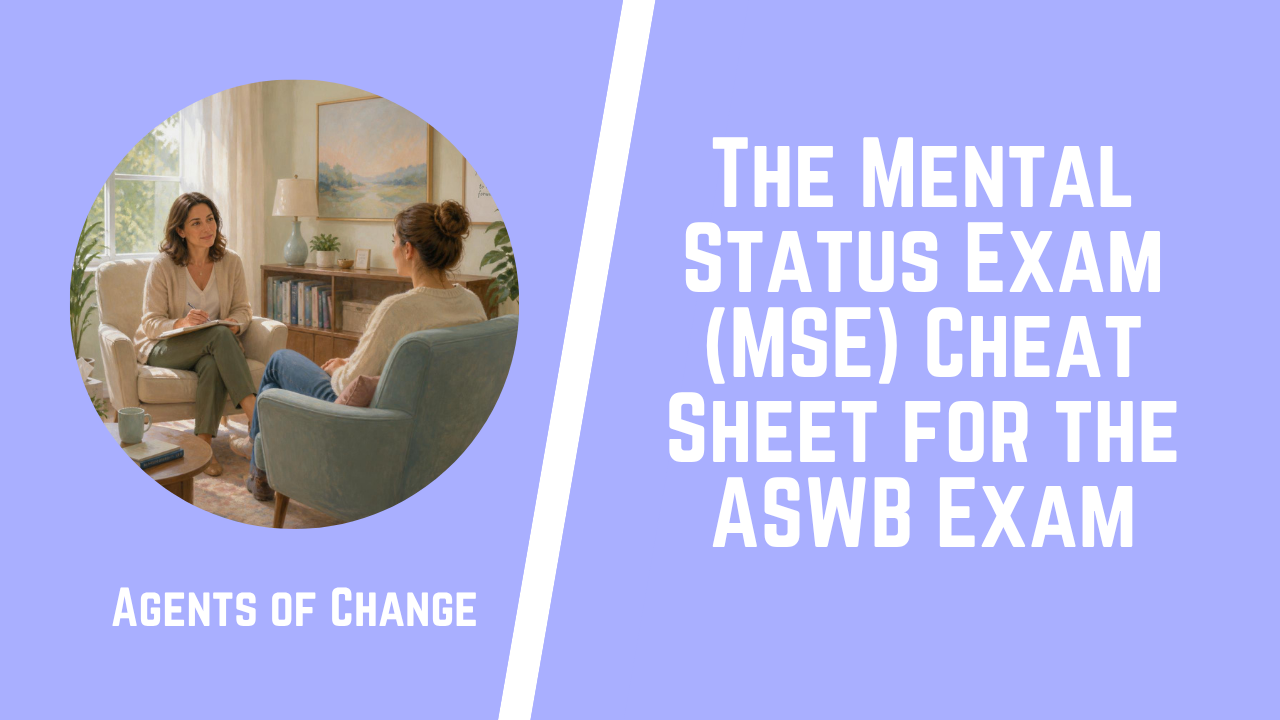
a therapist talking with a client for the first time in a calming office setting

The Mental Status Exam (MSE) Cheat Sheet for the ASWB Exam
The Mental Status Exam can feel like a long list of clinical terms until you understand what each category is actually measuring. Mood, affect, thought process, perception, insight, judgment, and orientation may sound technical at first, but each one helps a Social Worker describe how a client is functioning in the present moment. On the ASWB exam, these concepts often appear inside questions about assessment, diagnosis, crisis intervention, safety, substance use, and treatment planning.

What makes MSE questions challenging is that the exam rarely asks for a simple definition. Instead, you may be given a short client scenario and asked what the Social Worker should notice, assess, or do next. A client may report hearing voices, speak in a way that is difficult to follow, appear emotionally disconnected, or suddenly become confused. To select the best answer, you need to recognize the MSE finding while also considering safety, medical causes, cultural context, and the need for additional assessment.

This Mental Status Exam (MSE) Cheat Sheet for the ASWB Exam breaks the major categories into clear, manageable sections. You’ll learn how to distinguish commonly confused terms, identify frequent exam traps, and connect clinical observations to the next appropriate Social Work action. With practice, the MSE becomes less about memorizing vocabulary and more about understanding what the client’s presentation is telling you.

Learn more about the ASWB exam and create a personalized ASWB study plan with Agents of Change. We’ve helped hundreds of thousands of Social Workers pass their ASWB exams and want to help you be next! We also offer full-length, timed practice exams here.

1) What Is the Mental Status Exam?

The Mental Status Exam is a clinical snapshot of a client’s psychological functioning at a particular point in time. Think of it as the mental health equivalent of a physical examination.

a therapist talking with a client for the first time in a calming office setting

A physician might document a patient’s temperature, blood pressure, breathing, pain level, and physical appearance. A Social Worker or other mental health professional may document the client’s appearance, behavior, speech, emotional presentation, thought patterns, perception, cognition, insight, and judgment.

The phrase “snapshot” is important. An MSE doesn’t automatically describe the client’s personality, lifelong functioning, or permanent diagnosis. Someone’s mental status may change because of:

  • A psychiatric condition
  • A medical emergency
  • Sleep deprivation
  • Medication effects
  • Substance intoxication or withdrawal
  • Trauma exposure
  • Acute stress
  • Grief
  • Neurological changes
  • Environmental conditions

A client who is disoriented during one appointment may be experiencing delirium, intoxication, a medication interaction, or another medical condition. That single observation doesn’t establish a lifelong cognitive disorder.

For ASWB exam purposes, the MSE helps you identify what is happening now and determine whether further assessment, safety intervention, medical evaluation, or treatment planning is needed.

Agents of Change packages include 30+ ASWB topics, 2 free study groups per month, and hundreds of practice questions so you’ll be ready for test day!

2) The Mental Status Exam (MSE) Cheat Sheet for the ASWB Exam

Although documentation formats vary, most MSEs evaluate the same core areas:

  1. Appearance
  2. Behavior and psychomotor activity
  3. Attitude toward the interviewer
  4. Speech
  5. Mood
  6. Affect
  7. Thought process
  8. Thought content
  9. Perception
  10. Cognition
  11. Insight
  12. Judgment
  13. Impulse control
  14. Risk and safety

You may see these categories combined or labeled differently. That’s okay. On the ASWB exam, understanding the concepts matters more than memorizing one specific documentation template.

1. Appearance

Appearance includes what the Social Worker can reasonably observe about the client’s physical presentation.

This may include:

  • Apparent age
  • Clothing
  • Grooming
  • Hygiene
  • Posture
  • Physical condition
  • Signs of injury
  • Whether clothing is appropriate for the weather
  • Distinguishing physical features that are clinically relevant

Examples include:

  • “Client appeared their stated age and was dressed appropriately for the weather.”
  • “Client appeared disheveled and wore visibly soiled clothing.”
  • “Client wore several layers of clothing despite warm temperatures.”
  • “Client appeared fatigued, with dark circles under their eyes.”

The key is objective language. Writing that a client “looked irresponsible” is judgmental and vague. Writing that the client wore stained clothing and had uncombed hair describes what was actually observed.

ASWB Exam Tip

Unusual appearance can be clinically relevant, but it rarely proves a diagnosis by itself. A Social Worker should gather more information before drawing conclusions.

A winter coat in July could relate to psychosis, homelessness, limited access to other clothing, sensory preferences, cultural practices, a medical condition, or simply personal choice. Curious and careful, the Social Worker assesses before interpreting.

2. Behavior and Psychomotor Activity

Behavior describes how the client acts during the interaction. Psychomotor activity refers to the connection between psychological functioning and physical movement.

Possible observations include:

  • Calm
  • Restless
  • Agitated
  • Cooperative
  • Guarded
  • Withdrawn
  • Tearful
  • Hostile
  • Hyperactive
  • Tremulous
  • Sedated
  • Catatonic
  • Repetitive movements
  • Limited eye contact
  • Excessive eye contact
  • Pacing
  • Slowed movement

Psychomotor Agitation

Psychomotor agitation involves increased, often purposeless movement. A client may pace, wring their hands, tap their feet, shift constantly, or appear unable to sit still.

This can occur with anxiety, mania, substance use, medication side effects, trauma reactions, or other conditions.

Psychomotor Retardation

Psychomotor retardation involves slowed movement, speech, and physical responsiveness. It may appear in severe depression, certain medical conditions, medication effects, or catatonia.

Important Caution

Eye contact should be interpreted carefully. Limited eye contact may reflect anxiety, cultural norms, trauma, Autism, shame, discomfort, or personal communication style. It shouldn’t automatically be labeled resistance or deception.

3. Attitude Toward the Interviewer

Attitude describes how the client relates to the Social Worker during the assessment.

Common descriptions include:

  • Cooperative
  • Engaged
  • Guarded
  • Suspicious
  • Hostile
  • Defensive
  • Apathetic
  • Evasive
  • Friendly
  • Seductive
  • Uncooperative

A client can be cooperative while still feeling anxious. A client can also be guarded without being hostile.

The ASWB exam may test whether you respond therapeutically to a guarded client. Usually, the best response isn’t confrontation. It’s establishing rapport, acknowledging discomfort, and clarifying the purpose of the assessment.

4. Speech

Speech refers to how the client communicates, rather than the specific ideas being communicated.

Assess:

  • Rate
  • Volume
  • Rhythm
  • Fluency
  • Tone
  • Quantity
  • Spontaneity
  • Clarity

Possible descriptions include:

  • Normal rate and volume
  • Rapid
  • Pressured
  • Slow
  • Loud
  • Soft
  • Monotone
  • Slurred
  • Hesitant
  • Sparse
  • Excessive
  • Mumbled
  • Difficult to interrupt

Rapid Speech vs. Pressured Speech

These terms are related, but they aren’t identical.

Rapid speech simply means the person is speaking quickly.

Pressured speech is fast, urgent, difficult to interrupt, and often experienced as driven or excessive. It’s commonly associated with mania, hypomania, stimulant use, or severe anxiety.

A nervous client may speak rapidly. A manic client may speak rapidly and continuously, resisting interruption while moving quickly between ideas.

Speech vs. Thought Process

Here’s a common exam trap: speech describes how the client talks, while thought process describes how the client’s ideas are organized.

Someone can speak slowly while maintaining a logical thought process. Another client can speak at a normal rate while giving tangential or disorganized answers.

3) Mood vs. Affect

Mood and affect are closely related, but they describe different parts of a client’s emotional presentation. On the ASWB exam, confusing these terms can make an otherwise straightforward Mental Status Exam question feel much harder than it needs to be.

Mood is the client’s internal emotional state. It is subjective because the client typically describes it in their own words. A Social Worker might ask, “How have you been feeling lately?” or “How would you describe your mood today?” The client may report feeling anxious, depressed, irritable, calm, euphoric, hopeless, or emotionally numb.

Affect is the outward expression of emotion that the Social Worker observes during the interaction. It may be reflected in the client’s facial expressions, tone of voice, posture, movements, and emotional responsiveness. Affect may be described as full, constricted, blunted, flat, or labile.

The easiest way to remember the difference is:

  • Mood is reported by the client.
  • Affect is observed by the Social Worker.

For example, a client might state, “I feel deeply depressed,” while speaking quietly, looking downward, and becoming tearful. The client’s reported depression is their mood, while the tearfulness and limited emotional energy describe their affect.

The exam may also ask whether mood and affect are congruent. Congruent affect matches the client’s reported mood or the topic being discussed. A grieving client who becomes tearful while discussing a recent loss displays congruent affect. Incongruent affect appears inconsistent with the client’s stated mood or the situation, such as laughing while describing a frightening event.

However, the Social Worker shouldn’t assume that incongruent affect automatically indicates a psychiatric disorder. Nervous laughter, cultural expectations, trauma responses, neurodivergence, and discomfort can all affect emotional expression.

Watch for these common affect terms:

  • Constricted: Reduced emotional range
  • Blunted: Markedly limited emotional expression
  • Flat: Little or no visible emotional expression
  • Labile: Rapidly shifting or unpredictable emotion
  • Full: A typical and varied emotional range

When answering ASWB questions, identify what the client says about their emotions first, then separate that from what the Social Worker can directly observe.

4) Thought Process vs. Thought Content

Thought process and thought content describe two different parts of a client’s thinking. The simplest way to separate them is this: thought process is how the client’s ideas are organized, while thought content is what the client is thinking about.

Thought process focuses on the flow, structure, and connection of ideas. A Social Worker listens for whether the client’s responses are logical, coherent, linear, and goal-directed. When the client’s ideas are difficult to follow, the thought process may be described using terms such as:

  • Circumstantial: The client gives excessive details but eventually answers the question.
  • Tangential: The client moves away from the topic and never returns to answer the question.
  • Flight of ideas: The client shifts rapidly between topics, but the connections can usually be followed.
  • Loose associations: Ideas move between topics with weak or illogical connections.
  • Thought blocking: The client suddenly stops speaking and appears to lose their train of thought.
  • Perseveration: The client repeatedly returns to the same word, answer, or idea.

Thought content refers to the beliefs, fears, concerns, and themes occupying the client’s mind. This can include suicidal or homicidal thoughts, delusions, obsessions, paranoia, phobias, hopelessness, excessive guilt, and preoccupations.

For example, a client may clearly and logically explain that government agents are monitoring them through the television. Their thought process may be linear and organized, while their thought content includes a persecutory delusion. Unusual thought content doesn’t automatically mean the thought process is disorganized.

The ASWB exam may also test whether the Social Worker responds appropriately to concerning thought content. If a client reports suicidal thoughts, violent thoughts, or command hallucinations, the priority is to assess safety, intent, planning, access to means, and the client’s ability to maintain control.

Remember:

  • Process asks, “How are the thoughts connected?”
  • Content asks, “What are the thoughts about?”

Keeping that distinction clear can help you recognize the correct MSE term and determine what the Social Worker should assess next.

5) Perception: Hallucinations and Other Disturbances

Perception refers to how a client experiences and interprets sensory information. During the Mental Status Exam, a Social Worker may assess whether the client is seeing, hearing, feeling, smelling, or tasting something that others do not perceive.

A hallucination is a sensory experience that occurs without an external stimulus. Hallucinations may be:

  • Auditory: Hearing voices, music, or sounds that are not present
  • Visual: Seeing people, objects, lights, or images that are not present
  • Tactile: Feeling sensations on or under the skin without a physical cause
  • Olfactory: Smelling an odor that others do not detect
  • Gustatory: Experiencing a taste without an identifiable source

An illusion is different. It occurs when a real external stimulus is misinterpreted. For example, mistaking a coat hanging in a dark room for a person is an illusion. Seeing a person when nothing is present is a hallucination.

The ASWB exam may also describe a client as responding to internal stimuli. Signs may include looking toward an empty area, speaking to someone who is not present, pausing as though listening, or becoming distracted by something the Social Worker cannot observe. These behaviors may suggest hallucinations, but the Social Worker should ask questions rather than make assumptions.

Helpful questions include:

  • “What are you noticing right now?”
  • “What are the voices saying?”
  • “Are they telling you to do anything?”
  • “Do you feel able to ignore or resist them?”
  • “Do you feel safe?”

Command hallucinations require particular attention because they instruct the client to take an action. If a voice tells the client to harm themselves or another person, the Social Worker should immediately assess intent, access to means, past behavior, ability to resist the command, and current safety.

Hallucinations do not automatically mean that a client must be hospitalized. The Social Worker should assess risk, distress, functioning, substance use, medication effects, possible medical causes, and available supports before determining the least restrictive appropriate response.

6) Cognition: Orientation, Attention, Memory, and More

Cognition refers to the mental processes a client uses to understand information, stay focused, remember experiences, solve problems, and make sense of their surroundings. During the Mental Status Exam, a Social Worker may assess orientation, attention, concentration, memory, language, and abstract thinking.

Orientation describes whether the client understands who they are, where they are, the current time, and why they are in the situation. This is often summarized as being oriented to:

  • Person
  • Place
  • Time
  • Situation

A client may be oriented to person and place but confused about the date or the reason for hospitalization. On the ASWB exam, sudden disorientation is especially important because it may indicate delirium, intoxication, medication effects, infection, or another medical emergency.

Attention and concentration refer to the client’s ability to focus, follow a conversation, and complete a mental task. A client who is highly anxious, manic, sleep-deprived, intoxicated, or experiencing ADHD symptoms may have difficulty maintaining attention. However, one distracted response is not enough to establish a diagnosis.

Memory is commonly divided into three areas:

  • Immediate memory: Recalling information moments after hearing it
  • Recent memory: Remembering events from earlier that day or the past several days
  • Remote memory: Recalling events from the distant past

The Social Worker should also consider factors that may affect performance, including language differences, hearing difficulties, education, trauma, fatigue, cultural background, and neurodivergence.

Other areas of cognition may include abstract thinking, fund of knowledge, and the ability to understand similarities, proverbs, or hypothetical situations. These tasks should be interpreted carefully because limited education or unfamiliarity with a phrase does not automatically indicate cognitive impairment.

For ASWB questions, pay close attention to the timing of cognitive changes. A slow, long-term decline may suggest a different concern than a rapid change over several hours. When confusion or impaired attention appears suddenly, medical assessment is usually a higher priority than psychotherapy or long-term treatment planning.

7) Insight, Judgment, and Impulse Control

Insight, judgment, and impulse control help a Social Worker understand how well a client recognizes their difficulties, makes decisions, and manages urges. Although these areas are related, they measure different abilities.

Insight refers to the client’s awareness and understanding of their condition, emotions, behavior, or circumstances. A client with good insight might say, “When I stop sleeping and start spending excessively, it usually means my mania is returning.” A client with limited insight may recognize the behavior but minimize its seriousness. Poor insight can affect treatment participation, medication adherence, and willingness to seek help.

Judgment is the ability to evaluate a situation, anticipate consequences, and make safe, realistic decisions. Social Workers may assess judgment by reviewing recent choices or asking how the client would respond to a hypothetical problem. For example, contacting a crisis line when suicidal thoughts increase may demonstrate intact judgment. Driving while intoxicated despite understanding the danger suggests impaired judgment.

A client can have insight while still demonstrating poor judgment. Someone may understand that gambling is causing financial problems but continue placing large bets. The client recognizes the concern, but their decisions do not reflect that understanding.

Impulse control refers to the ability to resist urges and pause before acting. Difficulties may involve:

  • Aggression or destruction of property
  • Self-harm
  • Substance use
  • Reckless driving
  • Impulsive spending
  • Gambling
  • Risky sexual behavior
  • Other dangerous or poorly considered actions

On the ASWB exam, poor impulse control should prompt further assessment rather than an automatic conclusion about diagnosis or hospitalization. The Social Worker should explore the behavior’s frequency, triggers, consequences, history, and current level of danger.

Remember:

  • Insight: Does the client understand the problem?
  • Judgment: Can the client make safe decisions about it?
  • Impulse control: Can the client stop themselves before acting?

When impaired judgment or impulse control creates an immediate safety concern, risk assessment becomes the priority.

8) Risk and Safety Assessment

Risk and safety assessment helps a Social Worker determine whether a client may be in immediate danger of harming themselves, harming someone else, or being unable to care for their basic needs. Although risk may be documented separately from the Mental Status Exam, it is closely connected to findings such as hopelessness, hallucinations, impaired judgment, severe agitation, and poor impulse control.

When a client expresses suicidal thoughts, the Social Worker should assess:

  • Current suicidal ideation
  • Plan and level of detail
  • Intent to act
  • Access to means
  • Timeframe
  • Previous attempts or self-harm
  • Substance use
  • Recent losses or stressors
  • Protective factors
  • Available supports
  • Ability to participate in a safety plan

The same principle applies when a client expresses homicidal thoughts or makes a threat. The Social Worker should clarify whether there is an identifiable target, a specific plan, access to weapons or other means, intent, a history of violence, and an immediate opportunity to act.

On the ASWB exam, vague or indirect statements should still be taken seriously. If a client says, “Everyone would be better off without me,” the Social Worker should ask direct questions about suicide rather than offering reassurance or changing the subject. Asking about suicide does not create suicidal thoughts. It provides the information needed to evaluate risk.

Command hallucinations also require careful assessment. If a client reports that a voice is instructing them to harm themselves or someone else, the Social Worker should determine what the voice is saying, whether the client intends to obey it, whether they have acted on similar commands before, and whether they can maintain safety.

Risk factors do not automatically require hospitalization. The Social Worker should select the least restrictive intervention that adequately protects the client and others. Depending on the level of danger, this may involve safety planning, mobilizing supports, crisis services, emergency evaluation, or hospitalization.

For ASWB questions, remember the priority: assess immediate safety before beginning long-term treatment planning, interpretation, reassurance, or routine referrals.

9) Five MSE Practice Scenarios

The ASWB exam may not ask you to identify a Mental Status Exam term directly. More often, it presents a brief client interaction and asks what the Social Worker should assess, recognize, or do next. Use the following scenarios to practice connecting MSE findings with appropriate clinical action.

Scenario 1: Mood and Affect

A client states, “I feel completely empty and hopeless.” During the interview, the client speaks in a monotone voice, shows little facial expression, and remains emotionally unresponsive while discussing a recent loss.

What MSE findings are present?

The client’s reported feelings of emptiness and hopelessness describe their mood. The monotone voice, limited facial expression, and reduced emotional responsiveness describe a blunted or flat affect, depending on the degree of observable expression.

Exam takeaway: Mood is reported by the client, while affect is observed by the Social Worker.

Scenario 2: Circumstantial Thought Process

A Social Worker asks a client whether they attended a medical appointment. The client describes the bus schedule, the weather, the clinic waiting room, and a conversation with the receptionist before eventually confirming that they attended.

Which thought process is demonstrated?

The client demonstrates circumstantial thinking. They provide excessive and unnecessary details but eventually return to the original question and answer it.

Exam takeaway: Circumstantial thinking eventually reaches the point. Tangential thinking does not.

Scenario 3: Command Hallucinations

A client says, “A voice keeps telling me to jump from my apartment balcony. I’ve been trying to ignore it, but it’s getting louder.”

What should the Social Worker do first?

The Social Worker should conduct an immediate suicide and safety assessment. This includes asking about intent, access to the balcony, ability to resist the command, previous responses to similar voices, current supports, and whether the client can remain safe.

Exam takeaway: When hallucinations involve commands to cause harm, safety assessment takes priority over exploring the origin or meaning of the hallucination.

Scenario 4: Sudden Cognitive Change

An older adult who was alert and oriented during a previous appointment suddenly appears confused, cannot identify the date, has difficulty focusing, and reports seeing insects on the wall.

What is the priority response?

The Social Worker should arrange prompt medical evaluation. Sudden disorientation, impaired attention, and visual hallucinations may indicate delirium, infection, medication effects, intoxication, or another medical emergency.

Exam takeaway: An abrupt cognitive change should be treated differently from a gradual decline. Medical causes must be considered quickly.

Scenario 5: Insight and Judgment

A client says, “I know drinking is damaging my health and putting my job at risk, but I’m still planning to drive home after having several drinks tonight.”

How should insight and judgment be described?

The client demonstrates some insight because they understand that alcohol use is creating serious problems. Their judgment is impaired because they plan to make an unsafe decision despite recognizing the risks.

Exam takeaway: A client may understand a problem while still making dangerous or unrealistic choices. Insight and judgment are related, but they are not the same.

10) FAQs – The Mental Status Exam (MSE) Cheat Sheet for the ASWB Exam

Q: What is the Mental Status Exam used for?

A: The Mental Status Exam is used to describe a client’s current psychological functioning. It helps mental health professionals assess presentation, communication, emotion, thinking, perception, cognition, insight, judgment, and safety.

Q: Do I need to memorize every MSE term for the ASWB exam?

A: You should know the major categories and the commonly confused terms. Focus especially on mood versus affect, thought process versus thought content, hallucinations versus delusions, circumstantial versus tangential thinking, and insight versus judgment.

Q: Is the MSE the same as a diagnosis?

A: No. The MSE provides information that may contribute to diagnostic assessment, but it doesn’t establish a diagnosis by itself. Diagnosis requires a broader review of symptoms, duration, functioning, history, context, and possible medical or substance-related causes.

11) Conclusion

The Mental Status Exam becomes much easier to understand when you stop treating it as a list of isolated clinical terms. Each category helps the Social Worker build a clearer picture of how a client is functioning in the present moment. Appearance, speech, mood, affect, thought patterns, perception, cognition, insight, judgment, and safety all provide information that can guide further assessment and intervention.

On the ASWB exam, recognizing an MSE finding is only part of the task. You also need to determine what the Social Worker should do with that information. This may involve asking additional questions, assessing immediate danger, considering medical or substance-related causes, gathering collateral information, or selecting the least restrictive response that protects the client and others.

As you review The Mental Status Exam (MSE) Cheat Sheet for the ASWB Exam, focus on the distinctions that appear most often in practice questions. Remember that mood is reported while affect is observed, thought process describes how ideas connect, and thought content describes what the client is thinking about. With repeated practice and a structured study plan, you can approach MSE questions with greater confidence and identify the safest, most ethical Social Work response.


► Learn more about the Agents of Change course here: https://agentsofchangeprep.com

About the Instructor, Dr. Meagan Mitchell: Meagan is a Licensed Clinical Social Worker and has been providing individualized and group test prep for the ASWB for over 11 years. From all of this experience helping others pass their exams, she created the Agents of Change course to help you prepare for and pass the ASWB exam!

Find more from Agents of Change here:

► Facebook Group: https://www.facebook.com/groups/aswbtestprep

► Podcast: https://podcasters.spotify.com/pod/show/agents-of-change-sw

#socialwork #testprep #aswb #socialworker #socialwork #socialworktest #socialworkexam #exam #socialworktestprep #socialworklicense #socialworklicensing #licsw #lmsw #lcsw #aswbexam #aswb #lcswexam #lmswexam #aswbtestprep #aswbtest #lcswtestprep #lcswtest #lmswtestprep #lmswtest #aswbcourse #learningstyles #learningstyle

Disclaimer: This content has been made available for informational and educational purposes only. This content is not intended to be a substitute for professional medical or clinical advice, diagnosis, or treatment.

Note: Certain images used in this post were generated with the help of artificial intelligence.

Share:

Discover more from Agents of Change

Subscribe now to keep reading and get access to the full archive.

Continue reading