Cultural Humility and Competence on the 2026 ASWB Exam
Cultural Humility and Competence on the 2026 ASWB Exam
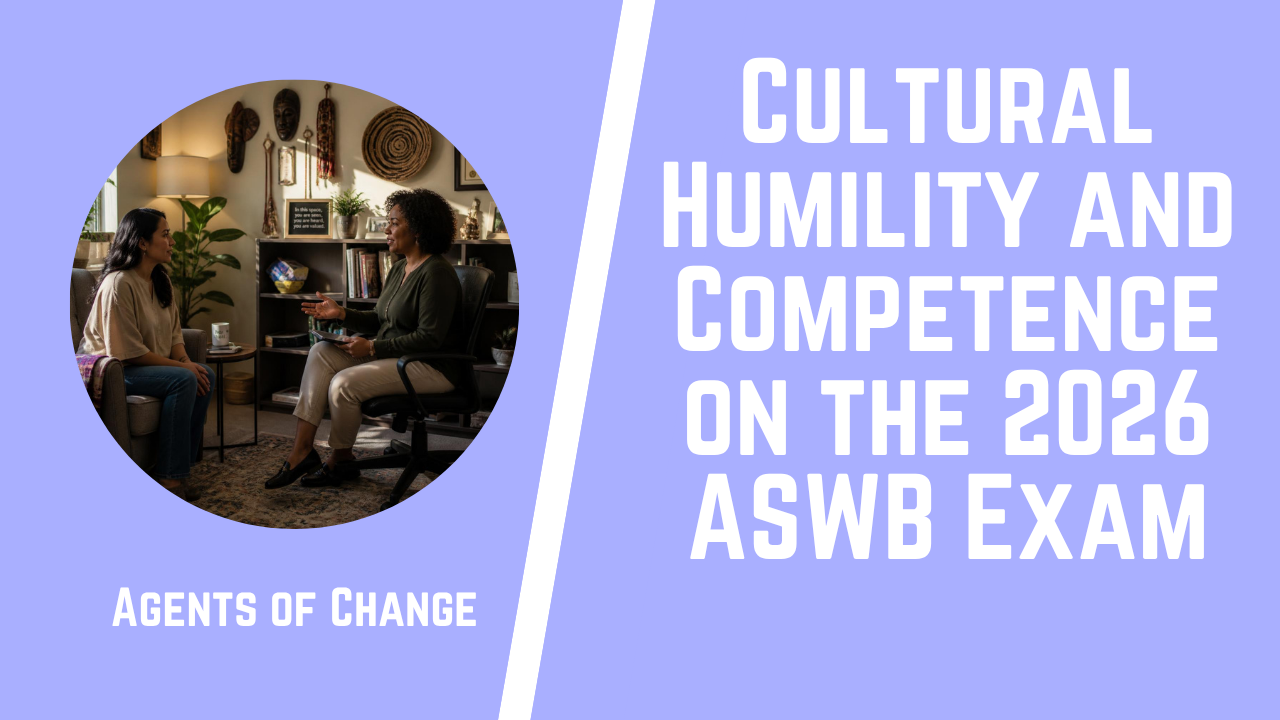
Cultural considerations can completely change how an ASWB exam question should be interpreted. A client may decline a recommended service, describe distress through a spiritual or cultural framework, request that family members participate in decision-making, or express distrust of an institution based on past discrimination. In each situation, the Social Worker must look beyond memorized definitions and consider the client’s identity, environment, preferences, access to services, and right to self-determination. These questions often feel challenging because several answers may appear respectful or clinically reasonable at first glance.

Cultural humility and competence on the 2026 ASWB Exam will require examinees to apply professional judgment rather than simply recognize vocabulary. The expanded Values and Ethics content area includes diversity and social justice topics such as implicit bias, intersectionality, cultural accessibility, language access, privilege, oppression, and service delivery to historically marginalized communities. Cultural factors may also appear in questions about assessment, intervention planning, informed consent, advocacy, diagnosis, and professional relationships. This means culture should not be studied as an isolated topic. It should be considered throughout every stage of the Helping Process.

The strongest exam responses will usually demonstrate curiosity without making assumptions, respect without ignoring safety, and cultural awareness without stereotyping the client. A Social Worker may need to ask how the client understands a concern, identify barriers within an agency, arrange qualified interpretation, reflect on personal bias, or seek consultation before moving forward. Throughout this article, you will learn how to recognize culturally relevant details, avoid common answer traps, and choose responses that protect dignity while remaining grounded in Social Work ethics and professional responsibility.

Learn more about the ASWB exam and create a personalized ASWB study plan with Agents of Change. We’ve helped hundreds of thousands of Social Workers pass their ASWB exams and want to help you be next! We also offer full-length, timed practice exams here.

1) Why Culture Is More Than a Background Detail

On the ASWB exam, cultural information is rarely included by accident. A client’s race, ethnicity, religion, language, gender identity, sexual orientation, immigration history, disability, socioeconomic status, or community background may influence how the situation should be understood. These details can affect communication, trust, family involvement, access to services, treatment preferences, and the meaning a client assigns to a concern.

therapist and indigenous client in office

The challenge is recognizing cultural context without turning it into a stereotype. A Social Worker should never assume that every person from a particular group shares the same beliefs, values, or experiences. Cultural knowledge can guide thoughtful questions, but it cannot replace an individualized assessment. For example, knowing that family involvement may be important in some communities does not mean the Social Worker should automatically contact relatives. The better response is usually to ask the client who they would like involved and how decisions are typically made within their support system.

Culture may also shape how clients describe distress. One client may speak openly about anxiety, while another may focus on headaches, fatigue, or stomach problems. A spiritual experience that seems unusual to the Social Worker may be accepted and meaningful within the client’s community. Rather than immediately labeling the experience as pathological, the Social Worker should assess its context, meaning, frequency, impact, and relationship to the client’s functioning.

Exam questions may also use cultural details to highlight barriers outside the client. Limited interpreter access, inaccessible offices, discriminatory policies, financial obstacles, and mistrust of institutions can all affect engagement and outcomes. In these situations, the Social Worker may need to address the environment rather than expecting the client to adapt to an inequitable system.

Ultimately, culture is not just a descriptive detail added to make a scenario feel realistic. It may be the key to understanding what the client needs, what assumptions should be avoided, and which answer best supports dignity, self-determination, and ethical Social Work practice.

Agents of Change packages include 30+ ASWB topics, 2 free study groups per month, and hundreds of practice questions so you’ll be ready for test day!

2) Cultural Humility and Competence on the 2026 ASWB Exam: What the Blueprint Signals

The 2026 ASWB blueprint sends a clear message: cultural responsiveness isn’t an optional topic or a small set of definitions to memorize. It’s part of the professional reasoning expected from an entry-level Social Worker. For exams administered on or after August 3, 2026, ASWB has reorganized the material into three major content areas and increased the emphasis on applying Social Work knowledge to practice situations. Questions may have either three or four answer options, but they will still require examinees to identify the single best response.

a social worker and a teen in a lunchroom setting

Diversity and Social Justice Is Now Part of Values and Ethics

One of the most important changes is the placement of Diversity and Social Justice within the Values and Ethics content area. Values and Ethics represents 35% of the Bachelors, Masters, and Advanced Generalist exams and 36% of the Clinical exam. This doesn’t mean that more than one-third of the exam will consist entirely of cultural questions. It does mean that culture, power, oppression, access, and social justice are closely connected to ethical Social Work practice across every exam level.

The Diversity and Social Justice competency may include:

  • Anti-oppressive and anti-racist approaches
  • Social, racial, environmental, and economic justice
  • The effects of culture, race, ethnicity, sexual orientation, gender, and intersectionality
  • Language, physical, and cultural accessibility
  • Translation, interpretation, neurodiversity, and American Sign Language
  • Privilege, implicit bias, and microaggressions
  • Power differentials and racial privilege
  • Exploitation affecting marginalized communities
  • Restorative practices and work with historically oppressed communities
  • Immigration, refugee experiences, globalization, and barriers to service delivery

These topics appear across the Bachelors, Masters, Advanced Generalist, and Clinical outlines.

What does this mean for your studying?

Don’t study cultural humility as a list of communities and presumed characteristics. That approach can lead directly to stereotyping, which is often the problem an exam question is testing.

Instead, learn how to apply a few core principles:

  1. Ask rather than assume.
  2. Consider the client’s individual understanding of culture and identity.
  3. Recognize the Social Worker’s power and possible bias.
  4. Protect self-determination while addressing safety and legal duties.
  5. Identify whether the barrier exists within the client, the environment, or both.

For example, knowing that family participation may be valued within a client’s community doesn’t give the Social Worker permission to contact relatives automatically. The Social Worker should ask the client whom they want involved, explain confidentiality, and obtain proper consent.

Culture May Be Tested Outside the Diversity Competency

Another major blueprint signal is that cultural considerations appear in Assessment and Planning, too. The official content outlines identify culture as one factor in selecting intervention or treatment modalities and specifically include cultural considerations when creating an intervention plan. They also address language differences, interpreters, client involvement, communication, available resources, and barriers to change.

This means you may encounter cultural reasoning in questions that appear to be about:

  • Engagement
  • Assessment
  • Diagnosis
  • Informed consent
  • Treatment planning
  • Intervention selection
  • Community resources
  • Client resistance
  • Advocacy
  • Termination
  • Professional boundaries
  • Agency policies

A question doesn’t have to use the words culture, diversity, or cultural humility to test these concepts.

A client who repeatedly misses telehealth appointments, for example, may be facing limited internet access, disability-related barriers, language differences, caregiving responsibilities, or distrust based on prior institutional harm. Labeling the client “noncompliant” would be premature. The stronger response would usually involve assessing the reason for the missed appointments and working with the client to improve access.

Expect Application, Not Cultural Trivia

The updated exam’s focus on applied knowledge means you’re more likely to be asked what the Social Worker should do than to be asked for a simple definition.

You might be asked:

  • What should the Social Worker do FIRST after a client identifies a microaggression?
  • What is the BEST way to communicate when the client has limited English proficiency?
  • What should the Social Worker assess NEXT when a belief may have cultural or spiritual meaning?
  • Which intervention is MOST culturally responsive?
  • What should the Social Worker do when an agency procedure creates unequal access?

These questions often include more than one answer that sounds respectful. Your job is to determine which option fits the current stage of the Helping Process.

Consider this example:

A client tells a Social Worker that a comment made during the previous session felt culturally insensitive. What should the Social Worker do first?

One answer may suggest explaining the Social Worker’s intention. Another may suggest transferring the client to someone with a similar identity. The strongest initial response would usually be to acknowledge the concern and invite the client to explain its impact. Explaining intent too quickly becomes defensive, while an immediate referral avoids the opportunity for accountability and repair.

Translate Each Blueprint Topic Into a Practice Decision

Use the following table to turn broad blueprint language into exam-ready thinking:

Blueprint Signal How It May Appear in a Question Strong Exam Approach
Anti-oppressive practice An agency rule disadvantages certain clients Identify the barrier and consider advocacy or accommodation
Intersectionality Several identities shape the client’s experience Avoid reducing the concern to one identity or explanation
Language access A family member is interpreting Assess language preference and use a qualified interpreter
Implicit bias A Social Worker notices an assumption affecting judgment Pause, reflect, seek consultation, and reassess objectively
Microaggressions A client reports feeling dismissed or stereotyped Acknowledge the concern, listen, and repair the relationship
Power differentials A client agrees quickly but seems uncomfortable Clarify options and support voluntary, informed participation
Immigration status A client fears seeking services Explore concerns, explain confidentiality, and avoid unnecessary disclosure
Cultural accessibility Services conflict with language, disability, or cultural needs Adapt access when possible rather than blaming the client
Restorative practices Harm has affected a group or community Consider accountability, participation, repair, and community context
Cultural intervention planning A standard treatment conflicts with client beliefs or priorities Explore preferences and collaborate on an appropriate plan

Apply a Five-Question Cultural Humility Check

When cultural details appear in a question, pause and ask:

1. What is the immediate issue?

Is the question about engagement, assessment, safety, informed consent, planning, intervention, or advocacy?

2. What information is missing?

Look for assumptions the Social Worker may be making about the client’s beliefs, behavior, family, or preferences.

3. Has the client’s perspective been heard?

If the client hasn’t yet explained what the experience means, further exploration may come before education, referral, or intervention.

4. Is there an access or power barrier?

Consider whether language, disability, finances, discrimination, immigration concerns, or agency procedures are affecting the situation.

5. Is there a genuine safety or legal concern?

Cultural humility doesn’t mean ignoring imminent risk, abuse, neglect, or legal responsibilities. At the same time, unfamiliarity isn’t the same as danger. Assess the facts provided rather than inventing an emergency.

Build Cultural Reasoning Into Your Practice Questions

When reviewing practice questions, don’t stop after identifying the correct answer. Use each question to strengthen your reasoning.

For every culturally relevant scenario, write down:

  • The stage of the Helping Process
  • The cultural or environmental factor affecting the situation
  • Any assumption contained in the distractors
  • The client’s stated preference
  • Any missing information that should be assessed
  • Whether the answer supports self-determination
  • Whether a safety, ethical, or legal responsibility changes the sequence

Then ask yourself, Why is each incorrect answer wrong right now?

An answer may be appropriate later but still be incorrect as the first action. A referral might eventually be helpful, for instance, but first the Social Worker may need to explore the client’s concern. Education may be appropriate, but first the Social Worker may need to assess what the client understands. Advocacy may be needed, but first the Social Worker may need to determine what outcome the client wants.

The Main Takeaway From the Blueprint

The 2026 blueprint treats cultural responsiveness as something a Social Worker does, not simply something a Social Worker knows. You’ll need to recognize bias, respect identity, improve access, consider power, collaborate with clients, and examine how institutions affect service delivery.

As you study Cultural Humility and Competence on the 2026 ASWB Exam, keep one principle at the center of your reasoning: culture should inform the assessment, but it should never replace an individualized assessment. The strongest answer will usually respect the client’s expertise, avoid unsupported assumptions, and move the Helping Process forward in a safe, ethical, and collaborative way.

3) A Practical Framework for Answering Cultural Questions on the ASWB Exam

Cultural questions on the ASWB exam can feel complicated because several answers may sound respectful. Use this five-step framework to identify the best response.

1. Identify the Immediate Task

Ask what the Social Worker needs to do right now. Is the question testing engagement, assessment, safety, planning, intervention, or advocacy?

Do not choose a later step when more information is still needed.

2. Check for Safety or Legal Duties

Look for evidence of immediate danger, abuse, neglect, or another clear legal responsibility.

Do not assume that an unfamiliar cultural belief or practice is automatically unsafe. Base your decision on the facts provided.

3. Notice Any Assumptions

Eliminate answers that stereotype the client or make decisions based only on group identity.

Culture should guide thoughtful questions, but it should never replace an individualized assessment.

4. Center the Client’s Perspective

When there is no immediate danger, the best answer often involves asking, exploring, clarifying, or collaborating.

Look for responses that help the Social Worker understand:

  • What the experience means to the client
  • What the client prefers
  • Who the client wants involved
  • What barriers may be affecting services
  • What outcome the client hopes to achieve

5. Consider the Environment

Ask whether the problem is partly caused by an agency policy, language barrier, lack of accessibility, discrimination, or unequal access to resources.

The Social Worker may need to support the client while also addressing the system creating the barrier.

A helpful reminder is:

Assess before assuming. Collaborate before directing. Address safety without inventing danger.

When two answers seem correct, choose the one that best fits the current stage of the Helping Process and respects the client’s dignity, self-determination, and individual circumstances.

4) Common ASWB Exam Traps to Avoid

Cultural questions on the ASWB exam often include several answers that sound respectful or professionally appropriate. The key is recognizing which response fits the client’s immediate needs and the current stage of the Helping Process. Watch for these five common traps.

Trap 1: Making Assumptions Based on Cultural Identity

An answer may assume that a client holds certain beliefs because of their race, religion, ethnicity, gender identity, sexual orientation, or family background. Even when the assumption sounds positive or culturally informed, it can still stereotype the client.

How to avoid it: Choose the response that asks the client about their individual beliefs, preferences, and experiences. Cultural knowledge should guide the Social Worker’s questions, not determine the answers in advance.

Trap 2: Ignoring Culture Because Everyone Should Be Treated the Same

Some answer choices may suggest using the same communication style, intervention, or policy for every client. Although equal treatment may sound fair, it can overlook differences in language, accessibility, discrimination, family roles, or treatment preferences.

How to avoid it: Look for answers that provide equitable and individualized services. The Social Worker may need to arrange an interpreter, modify communication, provide an accommodation, or adapt an intervention so the client can participate fully.

Trap 3: Referring the Client Too Quickly

The exam may offer an immediate referral to a provider who shares the client’s identity or specializes in the client’s community. A referral may eventually be appropriate, but transferring the client before exploring the concern can communicate avoidance or reinforce the idea that the Social Worker cannot work across cultural differences.

How to avoid it: First assess what the client wants, what concern has developed, and whether consultation or supervision could support competent practice. Refer when the client requests it, specialized expertise is necessary, or the Social Worker cannot provide appropriate services.

Trap 4: Educating or Correcting Before Listening

A Social Worker may want to explain agency procedures, challenge a belief, or provide information immediately. However, education is usually premature when the Social Worker has not yet understood the client’s perspective.

How to avoid it: Select the answer that begins with acknowledging, asking, exploring, or clarifying. Once the Social Worker understands the client’s concerns, information can be provided in a respectful and collaborative way.

Trap 5: Treating an Unfamiliar Belief as a Crisis

A spiritual experience, family practice, communication style, or cultural tradition may seem unusual to the Social Worker. That does not automatically make it dangerous, unhealthy, or a symptom of mental illness.

How to avoid it: Assess the experience’s meaning, context, frequency, impact, and relationship to functioning. Take action when the question provides evidence of immediate danger or a clear legal responsibility, but do not invent risk simply because a practice is unfamiliar.

A useful reminder is:

Ask before assuming. Assess before acting. Listen before educating. Refer only when appropriate. Respond to actual risk, not personal discomfort.

When two answers seem correct, choose the one that protects safety, supports self-determination, and fits the current stage of the Helping Process.

5) FAQs – Cultural Humility and Competence on the 2026 ASWB Exam

Q: How will cultural humility appear on the 2026 ASWB exam?

A: Cultural humility may appear in questions about assessment, engagement, informed consent, intervention planning, advocacy, language access, and ethical decision-making. You may be asked to recognize bias, explore a client’s perspective, address a barrier, or select a culturally responsive next step. These questions will likely focus more on application than memorizing definitions.

Q: What is the difference between cultural competence and cultural humility?

A: Cultural competence involves building the knowledge and skills needed to work effectively across cultures. Cultural humility emphasizes ongoing self-reflection, awareness of power, and openness to learning from each client. On the exam, the strongest answer will usually combine cultural knowledge with curiosity and individualized assessment.

Q: What should I do when two culturally responsive answers seem correct?

A: First, identify the current stage of the Helping Process and determine whether the question is asking for assessment, planning, intervention, or advocacy. Then choose the answer that avoids assumptions, centers the client’s perspective, and addresses any immediate safety or legal concern. The best response is often the one that gathers necessary information before moving to a later action.

6) Conclusion

Cultural humility and competence are more than isolated exam topics. They shape how a Social Worker understands the client, responds to differences, recognizes barriers, and makes ethical decisions throughout the Helping Process. On the 2026 ASWB exam, these concepts may appear in questions about engagement, assessment, intervention planning, advocacy, language access, bias, and professional relationships.

The strongest answers will usually avoid stereotypes, gather individualized information, and respect the client’s right to participate in decisions. When a question includes cultural details, slow down and ask what those details may be signaling. Consider whether the Social Worker needs to assess further, address a barrier, seek consultation, protect safety, or collaborate more directly with the client.

As you study cultural humility and competence on the 2026 ASWB Exam, focus on applying the principles rather than memorizing perfect phrases. Practice identifying assumptions, separating discomfort from danger, and choosing the response that fits the current stage of the Helping Process. With consistent practice, these questions can become less intimidating and much easier to approach with confidence.


► Learn more about the Agents of Change course here: https://agentsofchangeprep.com

About the Instructor, Dr. Meagan Mitchell: Meagan is a Licensed Clinical Social Worker and has been providing individualized and group test prep for the ASWB for over 11 years. From all of this experience helping others pass their exams, she created the Agents of Change course to help you prepare for and pass the ASWB exam!

Find more from Agents of Change here:

► Facebook Group: https://www.facebook.com/groups/aswbtestprep

► Podcast: https://podcasters.spotify.com/pod/show/agents-of-change-sw

#socialwork #testprep #aswb #socialworker #socialwork #socialworktest #socialworkexam #exam #socialworktestprep #socialworklicense #socialworklicensing #licsw #lmsw #lcsw #aswbexam #aswb #lcswexam #lmswexam #aswbtestprep #aswbtest #lcswtestprep #lcswtest #lmswtestprep #lmswtest #aswbcourse #learningstyles #learningstyle

Disclaimer: This content has been made available for informational and educational purposes only. This content is not intended to be a substitute for professional medical or clinical advice, diagnosis, or treatment.

Note: Certain images used in this post were generated with the help of artificial intelligence.

Share:

Discover more from Agents of Change

Subscribe now to keep reading and get access to the full archive.

Continue reading