I Passed the ASWB — Now What? A Post-Licensure Roadmap for New LMSWs and LCSWs
I Passed the ASWB — Now What? A Post-Licensure Roadmap for New LMSWs and LCSWs
 

You passed the ASWB exam, and that moment probably felt like a mix of relief, pride, and maybe even a little disbelief. After all the studying, internships, and long hours, you’ve officially stepped into the professional world of Social Work. It’s a major accomplishment, and it deserves to be acknowledged. At the same time, a new question tends to surface almost immediately: what comes next?

Moving from student or supervisee to a licensed Social Worker brings new responsibilities, decisions, and opportunities. There are practical steps to figure out, like supervision, job placement, and continuing education. There are also personal adjustments, such as building confidence and finding your professional voice in real-world settings.

This guide is designed to help you navigate that in-between space with clarity and purpose. Whether you’re stepping into your first role or mapping out your long-term goals, you’ll find direction here. Think of it as a grounded, realistic companion for your next phase in Social Work, one that helps you move forward without feeling overwhelmed.

Learn more about the ASWB exam and create a personalized ASWB study plan with Agents of Change.We’ve helped hundreds of thousands of Social Workers pass their ASWB exams and want to help you be next! We also offer full-length, timed practice exams here.

1) The Post-Licensure Roadmap for New LMSWs and LCSWs

Passing the exam is a huge milestone, but licensure is really the starting line. Once you have those letters after your name, the next question becomes practical very quickly: what should you actually do first, and when should you do it? For new LMSWs and LCSWs, the post-licensure period can feel exciting, disorienting, and strangely administrative all at once. One minute you’re celebrating, and the next you’re trying to figure out supervision rules, renewal dates, documentation systems, and whether your first job is actually a good fit.

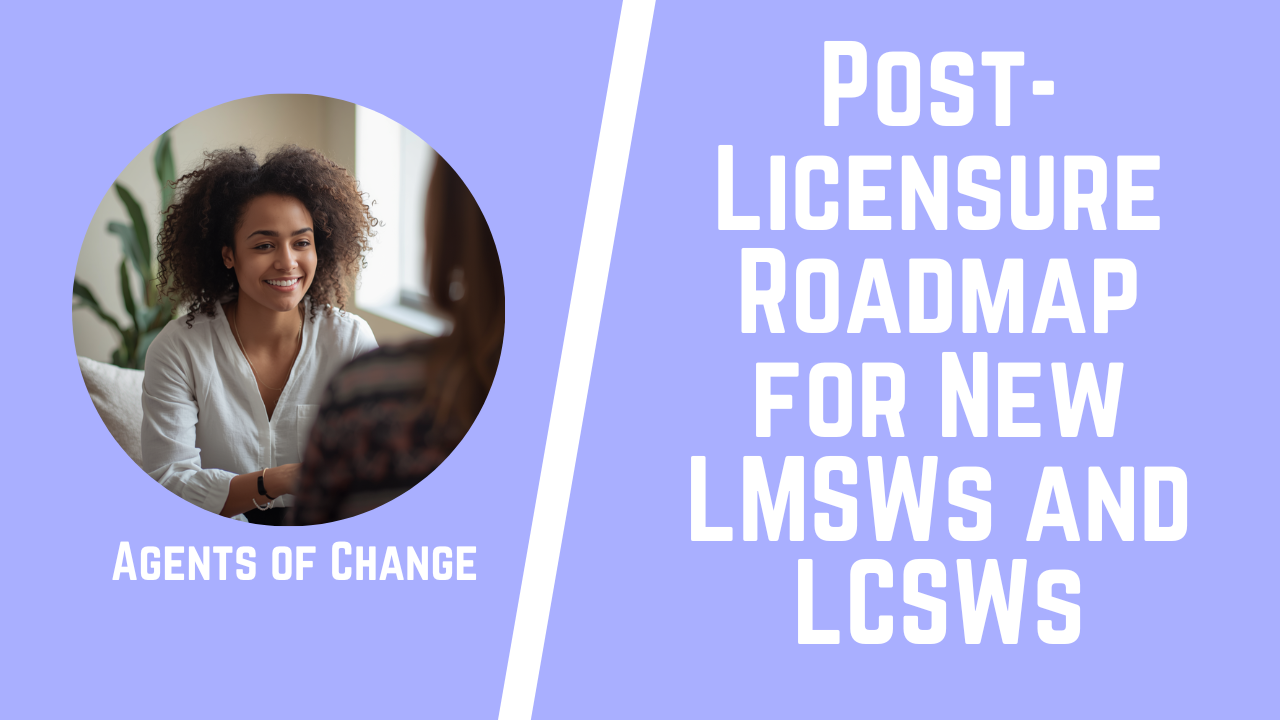
a professional but new social worker in their young 20's doing therapy session

That’s exactly why a clear roadmap helps. Instead of reacting to each new requirement as it pops up, you can move through your first year of licensure with a plan. Some steps should happen immediately after licensure. Others make more sense after you’ve settled into your role and have enough experience to make informed decisions. Timing matters here. Take a step too late, and you may create avoidable delays in supervision, continuing education, or career advancement. Move too fast, and you may commit to a path that doesn’t actually fit your long-term goals.

The good news? You do not need to have everything figured out on day one. You just need a strong sequence. Below is a detailed, step-by-step roadmap for new LMSWs and LCSWs, organized by approximate timing after licensure so you can focus on the right priorities at the right time.

Step 1: Confirm Your License Is Active and Fully Processed

Approximate timing: Immediately to 2 weeks post-licensure

Before you do anything else, make sure your license is officially active with your state board. Passing the ASWB exam does not always mean you are instantly cleared to practice. In some states, there is a delay between exam passage, final board approval, and public verification.

At this stage, you should:

  • Check your state licensing board website for your name and license status
  • Save a screenshot or a PDF of your active license verification
  • Confirm your official license number
  • Review the exact title associated with your license, such as LMSW or LCSW
  • Make sure you understand what your license legally permits you to do in your state

This step sounds basic, but it matters more than people think. Employers, credentialing panels, insurance systems, and supervisors may ask for proof right away. Caught up in the excitement, it is easy to assume everything is complete when one final approval is still pending.

Step 2: Learn the Rules That Apply to Your Specific License

Approximate timing: Within the first 2 weeks post-licensure

Now that your license is active, spend time understanding the rules attached to it. This is where many new Social Workers get tripped up. An LMSW in one state may have different supervision and practice permissions than an LMSW in another. The same goes for LCSWs, especially around private practice, diagnosis, independent practice, telehealth, and supervision authority.

Focus on these questions:

  1. What is my scope of practice?
  2. Do I need supervision, and if so, how much?
  3. How often do I renew my license?
  4. How many continuing education hours do I need?
  5. Are there required topic areas like ethics, suicide prevention, or cultural competence?
  6. What documentation should I keep in case of audit?

Do not rely on what a classmate said or what a coworker thinks the rules are. Check your licensing board directly. Save the renewal requirements somewhere easy to find. Starting your career with clarity will save you a lot of stress later.

Step 3: Set Up a License Management System

Approximate timing: Within the first month post-licensure

Once you know your requirements, create a system to track them. Even if your renewal is far away, this is the time to get organized. Waiting until the final month before renewal is how credits get lost, deadlines get missed, and panic sets in.

Your system should track:

  • License issue date
  • Renewal date
  • Required CE hours
  • Required CE topic categories
  • Supervision hours, if applicable
  • Copies of certificates
  • Supervisor contracts or verification forms
  • Board correspondence

A simple spreadsheet can work, but using a dedicated tool is often easier. Readers should be encouraged to use the free CE requirements tracker to understand what their license requires and keep everything organized: https://agentsofchangeprep.com/continuing-education/tracker/

That kind of system helps you shift from reactive to proactive, which is exactly what you want in your first year.

Step 4: Clarify Your Career Direction Before Accepting Every Opportunity

Approximate timing: First month post-licensure

Right after licensure, it is tempting to say yes to the first reasonable offer. Sometimes that is the right move. Sometimes it is a fast track to burnout. Before locking yourself into a role, take a little time to think through what kind of Social Work you actually want to do.

Ask yourself:

  • Do I want clinical, macro, medical, school-based, or community work?
  • Do I need a job that offers supervision?
  • Do I want a highly structured environment or more autonomy?
  • What populations am I most interested in serving?
  • What schedule and workload are sustainable for me?
  • Am I hoping to move toward advanced clinical practice or leadership?

You do not need a ten-year plan, but you do need some direction. Even a rough sense of what you want will help you evaluate job opportunities more clearly.

Step 5: Secure the Right Job, Not Just the First Job

Approximate timing: 1 to 3 months post-licensure

For many new LMSWs and LCSWs, the first major post-licensure step is employment. If you already have a role lined up, great. If not, this is when your job search should become focused and strategic.

When evaluating positions, look beyond salary and title. Pay attention to:

  • Supervision availability and quality
  • Caseload expectations
  • Training and onboarding support
  • Documentation demands
  • Population served
  • Opportunities for growth
  • Workplace culture and turnover
  • Benefits, including CE support or licensure reimbursement

For LMSWs especially, supervision access is critical. If a position does not provide the kind of supervision your state requires for future advancement, that job could slow down your long-term plans.

For LCSWs, this is also a good time to think about whether you want agency work, group practice, hospital work, school systems, nonprofit leadership, or eventual private practice. There is no one right path, but there is a difference between gaining experience intentionally and drifting into a role that is hard to build from.

Step 6: Establish Supervision Early and Put It in Writing

Approximate timing: 1 to 2 months post-licensure for LMSWs; optional but valuable for new LCSWs

For LMSWs working toward clinical advancement, this is one of the most important steps in the whole roadmap. Do not assume your supervision “counts” just because someone more experienced meets with you sometimes. It must meet state requirements, and in many cases, it should be documented formally from the beginning.

You should:

  • Verify your supervisor is approved or qualified under your state rules
  • Confirm how often supervision will occur
  • Clarify whether sessions are individual, group, or both
  • Review how clinical hours and supervision hours will be documented
  • Create or sign a supervision agreement if required
  • Keep your own independent log, even if your employer tracks hours

For new LCSWs, formal supervision may not be required, but consultation still matters. Clinical independence can feel surprisingly intense at first. Having a trusted consultant, mentor, or peer consultation group can make the transition much smoother.

Step 7: Create a Documentation and Compliance Routine

Approximate timing: 1 to 3 months post-licensure

Early practice can feel like a blur. You are learning systems, trying to build confidence, and adjusting to full professional responsibility. That is exactly why you need a routine for documentation and compliance sooner rather than later.

Start building habits around:

  • Timely case notes
  • Treatment plans
  • Progress updates
  • Consent forms
  • Confidentiality practices
  • Record storage and security
  • Time tracking for billable work if relevant
  • Supervision note preparation

If you wait until you are overwhelmed, your documentation habits will become reactive and inconsistent. Better to build a clean, repeatable process early. It saves time, reduces anxiety, and protects both you and your clients.

Step 8: Start Continuing Education Early Instead of Waiting for Renewal Season

Approximate timing: 2 to 4 months post-licensure

This is where new licensees often procrastinate. Renewal feels far away, so CE gets pushed aside. Then suddenly the deadline is close and you are scrambling to piece together credits, figure out category requirements, and locate missing certificates.

A better strategy is to begin early and spread your learning out across the renewal cycle.

A strong early CE plan might include:

  • Taking one or two foundational courses in your practice area
  • Completing ethics training early
  • Tracking every certificate immediately after completion
  • Identifying required CE categories unique to your state
  • Choosing topics that strengthen your actual day-to-day work

This is also a great time to explore free CE courses from Agents of Change CE: https://agentsofchangeprep.com/continuing-education/free-continuing-education/

And for live learning, readers should also check out the free CE events available from Agents of Change CE, including one free event each quarter:
https://agentsofchangeprep.com/continuing-education/elevate-your-social-work-practice-with-live-webinars-and-unlimited-ce-courses/

Starting CE early makes professional growth feel manageable instead of rushed.

Step 9: Build a Professional Support Network

Approximate timing: 2 to 6 months post-licensure

New licensure can feel strangely isolating. You may be surrounded by coworkers, but still unsure where you fit professionally. That is why building a network matters. Your network does not need to be huge, polished, or formal. It just needs to exist.

Focus on developing relationships with:

  • Supervisors
  • Trusted colleagues
  • Former professors or field instructors
  • Peer consultation groups
  • Professional association members
  • Social Workers in roles you may want later

These relationships can help with clinical questions, job transitions, ethical dilemmas, and emotional sustainability. They can also remind you that you are not the only one learning as you go.

Step 10: Audit Your Skills and Identify Gaps

Approximate timing: 3 to 6 months post-licensure

Once you have some real-world experience, you will start to notice where you feel strong and where you still feel shaky. That is a good thing. Awareness is what allows intentional growth.

Look at the skills that show up in your work most often:

  • Clinical assessment
  • Risk assessment
  • Treatment planning
  • Motivational interviewing
  • Crisis intervention
  • Documentation
  • Care coordination
  • Boundary setting
  • Ethical decision-making
  • Cultural humility in practice

Pick two or three areas that need strengthening and make those your focus for the next few months. This is where targeted CE, supervision, consultation, and hands-on experience can work together.

Step 11: Reassess Your Work Environment Honestly

Approximate timing: 4 to 6 months post-licensure

By this point, the initial excitement has worn off, and you probably have a clearer picture of your job. This is the right time to ask some honest questions.

  • Is this setting helping me grow?
  • Am I getting the supervision or support I need?
  • Is my caseload sustainable?
  • Am I learning the skills I hoped to develop?
  • Can I realistically stay here for another year?
  • Is the workplace aligned with my values?

Sometimes the answer is yes, and that is great. Sometimes the answer is more complicated. Either way, this is the moment to assess rather than coast. Making an early course correction is much easier than staying in a poor-fit role for years out of inertia.

Step 12: Begin Shaping Your Professional Niche

Approximate timing: 6 to 9 months post-licensure

Once you are more settled, start paying attention to what kinds of work energize you. Maybe you are drawn to trauma work, school-based services, hospital discharge planning, substance use treatment, child welfare, grief support, policy advocacy, or supervision. That emerging interest matters.

You do not need to declare a lifelong specialty yet. Still, this is a smart time to begin shaping a direction.

You can do that by:

  • Choosing CE topics related to your interests
  • Asking for cases or projects that build relevant experience
  • Seeking mentors in that practice area
  • Reading current material on that specialty
  • Joining relevant professional groups or communities

Specialization usually develops gradually. It starts with curiosity, then repetition, then deeper training.

Step 13: Make a Financial Plan for Your Professional Life

Approximate timing: 6 to 9 months post-licensure

This part often gets left out of career conversations, but it should not. Your professional life needs a financial strategy. Licensure comes with expenses, and so does long-term growth. CE courses, renewals, liability insurance, association dues, supervision, and future certifications can add up quickly.

Take time to map out:

  • License renewal costs
  • CE budget
  • Supervision expenses if they are out of pocket
  • Liability insurance
  • Student loan repayment strategy
  • Salary goals for your next move
  • Emergency savings if you hope to change jobs later

Passion for Social Work is important, but sustainability matters too. A financial plan helps you stay in the profession with less stress and more choice.

Step 14: Review Ethics in Real-World Practice

Approximate timing: 6 to 12 months post-licensure

Ethics look different in actual practice than they do on an exam. Once you are working independently or semi-independently, gray areas become much more real. Dual relationships, documentation decisions, mandated reporting questions, boundaries, self-disclosure, and employer pressure can all show up in ways that are more complex than a multiple-choice question.

During this stage, make it a point to:

  • Review your code of ethics regularly
  • Bring ethical tensions into supervision or consultation
  • Take an ethics CE course early in your renewal cycle
  • Reflect on where your values, employer expectations, and client needs may conflict

The goal is not perfection. It is staying reflective and grounded when things get messy, which they sometimes will.

Step 15: Set Your 1-Year and 3-Year Career Goals

Approximate timing: Around 9 to 12 months post-licensure

As your first post-licensure year comes into view, zoom out. What do you want your next few years to look like?

Your 1-year goals might include:

  • Staying on track with supervision
  • Completing a set number of CE hours
  • Improving documentation and assessment skills
  • Feeling more confident in your role
  • Exploring a possible specialty

Your 3-year goals might include:

  • Advancing toward clinical licensure if you are an LMSW
  • Moving into a higher-level role
  • Transitioning to a new population or setting
  • Preparing for leadership or supervision
  • Exploring private practice options if appropriate
  • Increasing salary and professional flexibility

Write these goals down. Revisit them every few months. Career growth happens more effectively when you are intentional.

Step 16: Protect Yourself From Burnout Before It Becomes a Crisis

Approximate timing: Ongoing, but especially important by the end of year one

This step belongs at every stage, but by the time you are several months into licensed practice, it becomes urgent. New Social Workers often push hard in the beginning. You want to prove yourself. You want to help. You want to be competent, dependable, and ready for anything. That drive is understandable. It is also one of the reasons burnout can sneak up so quickly.

Build prevention into your routine by:

  • Setting work boundaries early
  • Using your time off instead of hoarding it
  • Debriefing difficult cases appropriately
  • Maintaining interests outside of work
  • Watching for signs of emotional exhaustion
  • Seeking therapy or support when needed
  • Being honest when your workload becomes unsustainable

Burnout prevention is professional development. It is not separate from being a strong Social Worker. It is part of being one.

A Simple Timeline at a Glance

Here is a practical snapshot of when these steps often make the most sense:

Immediately to 2 Weeks Post-Licensure

  • Confirm your license is active
  • Verify your license number and public status
  • Review state board rules and scope of practice

First Month Post-Licensure

  • Set up a license and CE tracking system
  • Clarify your career direction
  • Start planning your job search or evaluate your current role

1 to 3 Months Post-Licensure

  • Secure a job aligned with your goals
  • Establish supervision if required
  • Build routines for documentation and compliance

2 to 4 Months Post-Licensure

  • Begin CE activities
  • Use the free CE requirements tracker
  • Explore free CE courses and quarterly CE events

2 to 6 Months Post-Licensure

  • Build your professional support network
  • Strengthen consultation and mentoring relationships

3 to 6 Months Post-Licensure

  • Audit your skills
  • Identify learning gaps
  • Reassess whether your current role is a good fit

6 to 12 Months Post-Licensure

  • Develop an emerging specialty or niche
  • Create a professional financial plan
  • Strengthen real-world ethics practice
  • Set 1-year and 3-year career goals
  • Watch closely for burnout and address it early

The first year after licensure is rarely neat and perfectly linear. Some steps will happen faster for you, and some may take longer. That is okay. What matters most is that you move intentionally. This roadmap is not about creating pressure to do everything at once. It is about helping you focus on the right priorities in the right season so your career in Social Work starts with structure, confidence, and room to grow.

Agents of Change packages include 30+ ASWB topics, 2 free study groups per month, and hundreds of practice questions so you’ll be ready for test day!

2) Real Talk About Your Post-Licensure Journey

a professional but new social worker in their young 20's doing therapy session

You passed the exam. You got the license. You stepped into the role.

And then… reality hit a little differently than expected.

This phase of your career isn’t just about building skills or checking off supervision hours. It’s also about navigating uncertainty, adjusting expectations, and figuring out who you are as a Social Worker when the safety net of school is gone. Some days will feel meaningful and affirming. Other days might leave you second-guessing everything.

That’s normal.

This section is the honest version of what many new LMSWs and LCSWs experience but don’t always hear out loud.


You Might Not Feel “Ready” — Even Though You Are

There’s this quiet assumption that once you’re licensed, you’ll suddenly feel confident and fully prepared.

That’s rarely how it works.

Instead, many new Social Workers walk into their first post-licensure role thinking:

  • What if I miss something important?
  • What if I don’t know what to say?
  • What if someone realizes I’m still figuring this out?

That internal questioning doesn’t mean you’re unqualified. It means you’re aware of the responsibility you now carry.

Confidence in Social Work builds through repetition, reflection, and time—not instant transformation.


Imposter Syndrome Might Show Up Uninvited

Even after passing the ASWB exam, imposter syndrome has a way of creeping in.

You might find yourself comparing your skills to coworkers who have years of experience or feeling like you somehow slipped through the cracks.

Here’s what that can look like:

  • Over-preparing for every session or task
  • Avoiding speaking up in team meetings
  • Doubting your clinical judgment even when it’s sound
  • Feeling like you need to prove yourself constantly

The truth? Most Social Workers go through this phase.

Instead of trying to eliminate those feelings completely, focus on grounding yourself in what you do know. Use supervision, consultation, and ongoing learning to reinforce your confidence.


The Work Can Feel Heavier Than You Expected

Textbooks and internships prepare you, but full-time practice introduces a different level of emotional weight.

You’re now responsible for:

  • Managing ongoing client relationships
  • Handling crises in real time
  • Making decisions that impact people’s lives
  • Balancing ethical considerations with organizational constraints

Some days, that responsibility can feel intense.

You might carry stories home with you. You might replay conversations in your head. You might feel the emotional residue of the work long after your shift ends.

That doesn’t mean you chose the wrong profession. It means you’re engaging with it fully.


Burnout Isn’t a Future Problem — It Can Start Early

A lot of people think burnout happens years into a career.

In reality, it can begin within the first year if you’re not careful.

Early burnout often shows up as:

  • Feeling drained even on days that aren’t particularly difficult
  • Losing enthusiasm for work you were once excited about
  • Becoming more detached or less emotionally present
  • Dreading the start of your workday

There are a few common contributors:

  • High caseloads without adequate support
  • Lack of quality supervision
  • Unrealistic expectations from employers
  • Difficulty setting boundaries
  • Internal pressure to “prove yourself”

Ways to Protect Yourself Early On

  • Set clear work boundaries from the beginning
  • Take your breaks, even when things feel busy
  • Use supervision as a space for support, not just reporting
  • Keep realistic expectations about what you can accomplish
  • Make time for activities that have nothing to do with Social Work

Burnout prevention is not something you wait to address later. It starts now.


Your First Job Might Not Be Your Forever Job

There’s a lot of pressure to “get it right” when choosing your first role after licensure.

But here’s the reality: your first job is often a stepping stone.

You might discover:

  • The population you thought you’d love isn’t the best fit
  • The setting feels too fast-paced or too restrictive
  • The supervision isn’t as strong as you hoped
  • The organizational culture doesn’t align with your values

That doesn’t mean you failed. It means you’re learning what works for you.

Signs It Might Be Time to Reevaluate

  • You’re not receiving the supervision or support you need
  • Your workload is consistently unmanageable
  • You’re not gaining meaningful skills or experience
  • Your mental health is being negatively impacted

You are allowed to pivot. In fact, making thoughtful changes early can strengthen your long-term career path.


Growth Happens in Small, Uneven Steps

It’s easy to expect rapid progress right after licensure. You might think you’ll feel more confident in a few weeks or fully competent within a few months.

In reality, growth looks more like this:

  • One session where you feel completely in sync with a client
  • Another where you walk away unsure and reflective
  • A moment where something finally “clicks”
  • Followed by a new challenge you didn’t anticipate

What Progress Actually Looks Like

  • You recover more quickly after difficult sessions
  • You ask better questions over time
  • You rely less on scripts and more on instinct
  • You become more comfortable with silence and uncertainty
  • You trust your clinical reasoning more often

It’s gradual. Sometimes subtle. But it’s happening.


You Don’t Have to Figure Everything Out Alone

There’s a quiet pressure in professional spaces to appear competent and self-sufficient.

But Social Work was never meant to be done in isolation.

Lean Into Support Systems

  • Supervision for guidance and skill development
  • Peer consultation for shared learning
  • Mentors for a long-term perspective
  • Professional communities for connection

Asking questions does not make you look inexperienced. It shows that you’re engaged and committed to doing the work well.


Your “Why” Might Shift — And That’s Okay

The reasons you entered Social Work might evolve once you’re in the field full-time.

You may start with a strong passion for a specific population or issue, only to discover new interests or challenges along the way.

That shift is not a loss of direction. It’s part of your professional development.

Give Yourself Permission To

  • Explore different areas of practice
  • Change your long-term goals
  • Redefine what fulfillment looks like
  • Adjust your expectations based on real-world experience

Careers in Social Work are rarely linear. They grow through experience, reflection, and adaptation.


Some Days Will Feel Really Good

It’s important to say this out loud, too.

Amid the uncertainty, the learning curve, and the challenges, there will be moments that remind you exactly why you chose this path.

Moments where:

  • A client makes meaningful progress
  • You navigate a difficult situation effectively
  • You feel connected, present, and purposeful
  • You recognize how much you’ve grown

Those moments might not happen every day. Still, they matter.

They add up.


Final Thought: You’re Building Something, Even When It Feels Messy

The post-licensure phase is not about having everything figured out. It’s about building a foundation.

Some parts will feel structured. Others will feel uncertain. You’ll have days where you feel capable and days where you question yourself.

That mix is part of the process.

Stay engaged. Stay reflective. Keep showing up.

Over time, the uncertainty softens, the skills deepen, and your identity as a Social Worker becomes something steady and real.

3) Exploring Specializations in Social Work: Finding Your Niche

At some point after licensure, a subtle shift starts to happen. You move from asking, “How do I do this job?” to “What kind of Social Worker do I want to be?” That question doesn’t always have an immediate answer, and honestly, it’s not supposed to. Specialization in Social Work develops over time through exposure, curiosity, and experience—not instant clarity.

Still, being intentional about exploring different paths can help you avoid feeling stuck or directionless. Whether you’re an LMSW building toward clinical licensure or an LCSW refining your focus, this is the phase where you begin shaping your niche.


Why Specialization Matters More Than You Think

Early in your career, it’s normal to take on a wide range of responsibilities. You’re learning, adapting, and building foundational skills. But over time, having a generalist approach can start to feel limiting.

Specializing allows you to:

  • Deepen your clinical or professional expertise
  • Increase your confidence in specific areas
  • Become more marketable in the job market
  • Open doors to advanced roles or private practice
  • Align your work more closely with your interests and values

It doesn’t mean you’re locked into one path forever. It just gives your work more direction.


Common Specializations in Social Work

If you’re not sure where to start, it helps to know what’s out there. Social Work is a broad field, and many niches exist within it.

Some common areas include:

  • Mental Health and Clinical Practice
    Individual therapy, diagnosis, trauma work, CBT, DBT
  • Substance Use and Recovery
    Addiction counseling, harm reduction, relapse prevention
  • Medical Social Work
    Hospitals, hospice care, chronic illness support
  • School Social Work
    Student support, IEPs, behavioral interventions
  • Child Welfare and Family Services
    Foster care, adoption, family reunification
  • Gerontology
    Aging populations, long-term care, end-of-life support
  • Crisis and Emergency Response
    Crisis intervention, disaster response, mobile crisis teams
  • Macro and Policy Social Work
    Advocacy, program development, community organizing

Reading through these, you might feel drawn to one or two—or none at all yet. That’s okay. Interest often becomes clearer through hands-on experience.


How to Start Exploring Your Niche Without Feeling Overwhelmed

You don’t need to commit to a specialization immediately. Instead, think of this phase as exploration with intention.

Here are a few ways to begin:

1. Pay Attention to What Energizes You

After a few months on the job, patterns start to emerge.

Ask yourself:

  • Which cases do I feel most engaged with?
  • What kind of work leaves me feeling fulfilled rather than drained?
  • Which topics do I find myself wanting to learn more about?

Your answers don’t have to be perfect. They just need to be honest.


2. Use Continuing Education as a Low-Stakes Way to Explore

One of the easiest ways to test out a potential specialization is through continuing education. You can build skills, gain exposure, and see what resonates—without making a major career commitment.

A great place to start is with free CE courses from Agents of Change CE: https://agentsofchangeprep.com/continuing-education/free-continuing-education/

These courses allow you to:

  • Explore new topics without financial pressure
  • Build foundational knowledge in different areas
  • Strengthen skills you’re already using in practice

You might take a course on trauma-informed care and realize it deeply resonates. Or maybe you try something in substance use and decide it’s not the right fit. Either outcome is useful.


3. Attend Live CE Events to Deepen Your Exposure

There’s something different about live learning. It feels more interactive, more immediate, and often more connected to real-world practice.

Agents of Change CE offers free live CE events each quarter, which can be a great way to explore different specialties while engaging with current topics in Social Work:
https://agentsofchangeprep.com/continuing-education/elevate-your-social-work-practice-with-live-webinars-and-unlimited-ce-courses/

Live events can help you:

  • Hear how experienced Social Workers approach specific issues
  • Ask questions and engage in discussion
  • Stay current with emerging trends in the field
  • Feel more connected to the broader Social Work community

Sometimes, a single event can spark a new direction you hadn’t considered before.


Building Skills in a Chosen Specialization

Once something starts to stand out as a potential niche, the next step is building real competence in that area.

That doesn’t happen overnight, but you can move intentionally.

Start with These Steps

  • Take multiple CE courses within the same topic area
  • Seek out cases or projects related to that specialization at work
  • Ask your supervisor for targeted feedback in that area
  • Read books, articles, or research related to the field
  • Connect with professionals already working in that space

Example Path

Let’s say you’re drawn to trauma-focused work:

  • You take an introductory CE course on trauma-informed care
  • Then attend a live CE event focused on trauma interventions
  • You request more trauma-related cases at your job
  • You begin learning specific modalities like CBT or EMDR (depending on training access)

Over time, that interest becomes a skill set.


You Can Have More Than One Niche

There’s a misconception that you have to choose one specialty and stick with it forever.

In reality, many Social Workers develop overlapping areas of expertise.

For example:

  • Trauma + substance use
  • Medical Social Work + grief counseling
  • School Social Work + behavioral interventions
  • Clinical practice + supervision or teaching

Your niche can evolve, expand, and shift as your career grows.


What If You Still Don’t Know Your Niche?

That’s more common than people admit.

If you’re unsure, focus on building strong general skills while continuing to explore:

  • Communication and rapport-building
  • Assessment and documentation
  • Ethical decision-making
  • Cultural competence
  • Boundary setting

These skills transfer across every specialization in Social Work. While you’re developing them, keep using CE courses and live events to test different directions.

Clarity often comes through action, not overthinking.


Final Thought: Your Niche Will Find You As Much As You Find It

Finding your niche isn’t about making a perfect decision early on. It’s about staying open, paying attention, and taking small, intentional steps toward what interests you.

Using tools like free CE courses and live events from Agents of Change CE gives you a practical way to explore without pressure. You’re learning, growing, and refining your path at the same time.

Over time, what once felt uncertain starts to take shape.

And one day, without even realizing when it happened, you’ll notice that you’re no longer just practicing Social Work—you’re practicing your version of it.

4) FAQs – Post-Licensure Roadmap for New LMSWs and LCSWs

Q: How long does it typically take to move from LMSW to LCSW, and what should I be doing during that time?

A: The timeline varies by state, but most LMSWs take about 2 to 4 years to complete the required supervised clinical hours for LCSW eligibility. During that period, your focus should be on more than just logging hours—you’re building the foundation for independent practice.

To make the most of this time:

  • Secure consistent, qualified supervision early and track your hours carefully
  • Seek out clinical experiences that strengthen assessment, diagnosis, and treatment planning skills
  • Take continuing education courses that align with clinical growth areas
  • Regularly review your state’s requirements to ensure you’re staying on track

Using tools like the free CE tracker (https://agentsofchangeprep.com/continuing-education/tracker/) can help you stay organized and avoid delays when it’s time to apply for your clinical license.

Q: What’s the best way to stay on top of continuing education requirements without getting overwhelmed?

A: The key is to start early and stay consistent rather than waiting until your renewal deadline is approaching. Many new Social Workers underestimate how quickly time passes, which leads to last-minute stress.

A manageable approach includes:

  • Tracking your CE requirements as soon as you’re licensed
  • Completing a few hours every couple of months instead of all at once
  • Prioritizing required topics like ethics early in your cycle
  • Keeping all certificates saved and organized in one place

You can simplify the process by using the free CE tracker mentioned above, along with exploring free CE courses (https://agentsofchangeprep.com/continuing-education/free-continuing-education/) and quarterly free live CE events (https://agentsofchangeprep.com/continuing-education/elevate-your-social-work-practice-with-live-webinars-and-unlimited-ce-courses/). These options make it easier to stay compliant while actually building useful skills.

Q: How do I know if I’m in the right job after getting licensed, or if I should consider making a change?

A: It’s completely normal to question your first post-licensure role. The goal isn’t to find a perfect job immediately—it’s to find a role that supports your growth.

You’re likely in a good position if:

  • You’re gaining relevant experience and developing new skills
  • You have access to quality supervision or mentorship
  • Your workload is challenging but manageable
  • You feel supported by your team or organization

It may be time to reconsider your role if:

  • You’re not receiving the supervision required for your goals
  • Your caseload is consistently overwhelming
  • You’re not learning or growing in meaningful ways
  • Your mental health is being negatively impacted

Making a change early in your career is not a failure. It’s part of refining your path in Social Work and finding a setting where you can thrive long-term.

5) Conclusion

Reaching this stage in your journey is something to be proud of. Passing the ASWB exam and earning your license marks the transition from student to practicing Social Worker, and that shift carries both opportunity and responsibility. As you move forward, it is important to remember that growth in Social Work does not happen all at once. It unfolds through experience, reflection, supervision, and a willingness to keep learning even when things feel uncertain.

The path ahead may not always feel clear, but that does not mean you are off track. Each step you take, whether it is securing supervision, exploring a specialization, or completing continuing education, helps shape your professional identity. Tools like the free CE tracker and accessible learning opportunities through Agents of Change CE can make this process more manageable while keeping you aligned with your requirements. Staying organized and intentional allows you to focus more on your development and less on last-minute stress.

As you continue building your career, give yourself permission to evolve. Your interests may shift, your goals may change, and your confidence will grow over time. What matters most is that you stay engaged, grounded in your values, and open to the learning that comes with real-world practice. You have already taken a significant step forward. Now it is about continuing that momentum and creating a career in Social Work that feels both sustainable and meaningful.


► Learn more about the Agents of Change course here: https://agentsofchangeprep.com

About the Instructor, Dr. Meagan Mitchell: Meagan is a Licensed Clinical Social Worker and has been providing individualized and group test prep for the ASWB for over 11 years. From all of this experience helping others pass their exams, she created the Agents of Change course to help you prepare for and pass the ASWB exam!

Find more from Agents of Change here:

► Facebook Group: https://www.facebook.com/groups/aswbtestprep

► Podcast: https://podcasters.spotify.com/pod/show/agents-of-change-sw

#socialwork #testprep #aswb #socialworker #socialwork #socialworktest #socialworkexam #exam #socialworktestprep #socialworklicense #socialworklicensing #licsw #lmsw #lcsw #aswbexam #aswb #lcswexam #lmswexam #aswbtestprep #aswbtest #lcswtestprep #lcswtest #lmswtestprep #lmswtest #aswbcourse #learningstyles #learningstyle

Disclaimer: This content has been made available for informational and educational purposes only. This content is not intended to be a substitute for professional medical or clinical advice, diagnosis, or treatment.

Note: Certain images used in this post were generated with the help of artificial intelligence.

Share:

Discover more from Agents of Change

Subscribe now to keep reading and get access to the full archive.

Continue reading