Blog

Agents of Change Blog

Search

Our Recent Posts

Unspecified Mood Disorder and the ASWB Exam

Welcome to our blog post on Unspecified Mood Disorder and its role in the ASWB Exam. It’s essential to grasp the nuances of this complex topic. Unspecified Mood Disorder is a critical aspect that demands understanding, especially in the diverse

NASW Code of Ethics and the ASWB Exam

Welcome to our comprehensive guide designed to help Social Workers prepare for the Association of Social Work Boards (ASWB) exam with a special focus on the National Association of Social Workers (NASW) Code of Ethics. This exam is a pivotal

Paraphilic Disorder and the ASWB Exam

Welcome to our deep dive into Paraphilic Disorder and its role in the ASWB Exam. This blog post is tailored for students gearing up to conquer the exam and eager to gain a comprehensive understanding of this complex subject. As

Introjection Defense Mechanism and the ASWB Exam

Welcome to our latest blog post, where we’re diving into the Introjection Defense Mechanism, and its connection to the ASWB Exam.  Whether you’re a Social Worker, a psychology student, or simply someone curious about the psychological phenomena shaping our behaviors

Magical Thinking and the ASWB Exam

Welcome to our latest blog post, where we dive into the world of ‘Magical Thinking’ as it appears in the ASWB Exam. Often cloaked in mystery and misunderstanding, this concept is a crucial part of the Social Work lexicon, vital

Kohlberg’s Stages of Moral Development and the ASWB Exam

Originally published on December 1st, 2023. Last updated on March 9th, 2026. Welcome to the world of Kohlberg’s Stages of Moral Development and their pivotal role in the ASWB Exam! As you embark on your journey to becoming a licensed

The Family Life Cycle and the ASWB Exam

Welcome to our latest blog post, where we dive into the Family Life Cycle and its pivotal role in the ASWB (Association of Social Work Boards) exam. This is a topic provides a comprehensive framework for understanding the dynamic and

Theories of Couples Development and the ASWB Exam

If you’re preparing for the ASWB exam or simply intrigued by the dynamics of romantic relationships, you’ve come to the right place. In this comprehensive guide, we’ll dive into the theories of couples development, a topic that’s not only important

Theories of Spiritual Development and the ASWB Exam

Welcome to the world of spiritual development and its surprising link to the Association of Social Work Boards (ASWB) exam. As you prepare for the ASWB exam, understanding the theories of spiritual development isn’t just an academic exercise. It’s a

Culture-Bound Syndromes and the ASWB Exam

Welcome to the fascinating world of culture-bound syndromes and their pivotal role in the ASWB exam preparation journey. As you start on the path to becoming a licensed Social Worker, understanding the intricacies of mental health through the lens of

Social Media

New from Agents of Change

Get The Latest Updates

Subscribe to Get Weekly Practice Questions

Jumpstart your studying journey with free content from Agents of Change.

Most Popular Stories

Neurodiversity-Affirming Therapy Approaches

For many years, mental health treatment often viewed neurological differences through a deficit-based lens. Autistic clients were encouraged to appear less Autistic, people with ADHD were told to become more organized or disciplined, and those with sensory or communication differences

Trauma-Informed Care and the Stress Response

A client misses an appointment, shuts down during an assessment, becomes irritated by a routine question, or struggles to remember what was discussed moments earlier. These reactions may be labeled as avoidance, resistance, poor motivation, or noncompliance. Yet beneath the

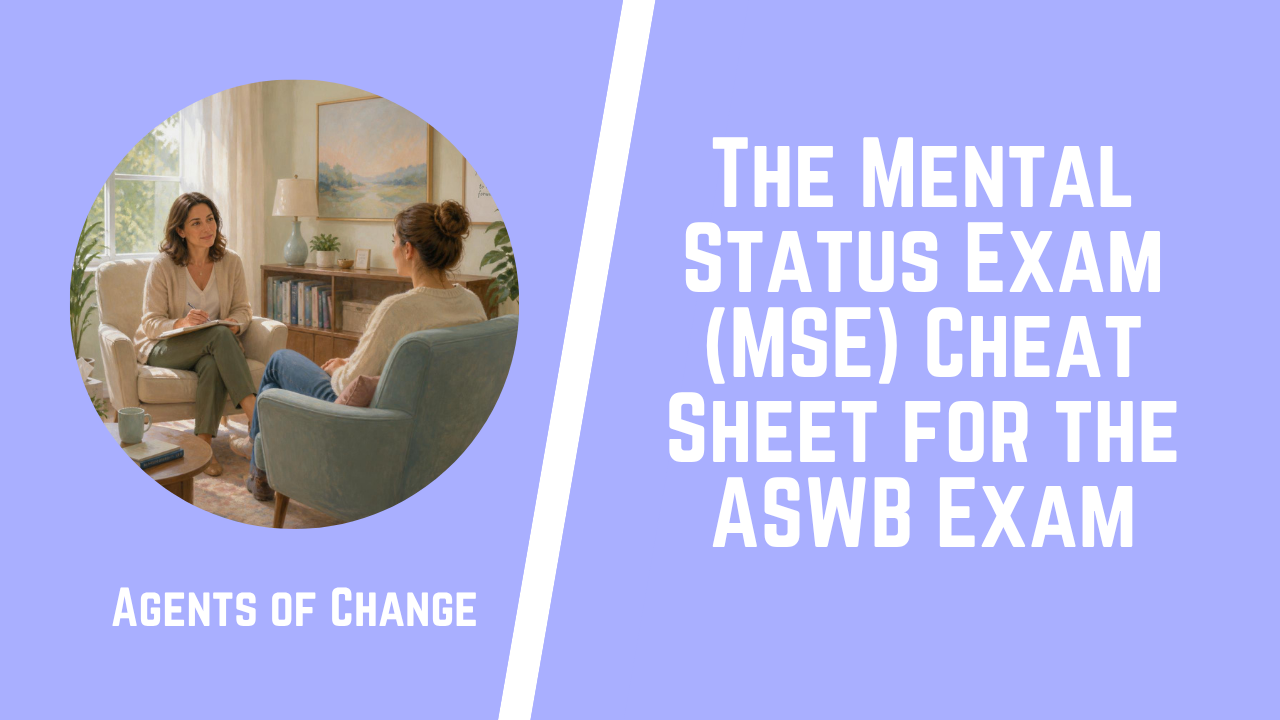
a therapist talking with a client for the first time in a calming office setting

The Mental Status Exam (MSE) Cheat Sheet for the ASWB Exam

The Mental Status Exam can feel like a long list of clinical terms until you understand what each category is actually measuring. Mood, affect, thought process, perception, insight, judgment, and orientation may sound technical at first, but each one helps