
Finishing the ASWB exam is a major milestone, but understanding your results can sometimes feel almost as confusing as taking the exam itself. Your score report includes important information about whether you passed, how many questions you answered correctly, and, if you did not pass, where you may want to focus your preparation before trying again.
The ASWB exam changed significantly on August 3, 2026, including updates to the number of questions, the exam structure, and the way content is organized. The current exam includes 122 total questions, with 110 scored questions and 12 unscored pretest questions, and is organized around three main content areas.
In this guide, we will walk through how the ASWB exam is scored, what your passing score means, how to read your score report, and how to use your results to guide your next steps. Whether you passed or are preparing for another attempt, understanding your score can help you make sense of your performance and move forward with a clearer plan.
Agents of Change offers (4) 122-question practice exams that match the new (as of 8/3/26) exam structure: 122 Question Exam 1, 122 Question Exam 2, 122 Question Exam 3, 122 Question Exam 4.
1) The Basics of ASWB Exam Scoring
How many questions are on the 2026 ASWB exam?
The current ASWB licensing exam contains:
- 122 total questions
- 110 scored questions
- 12 unscored pretest questions
- 4 hours of testing time
- Two 61-question sections
- An optional 10-minute scheduled break between the two sections
Each 61-question section has its own two-hour time limit. Once you submit the first section, you cannot return to those questions. The optional scheduled break occurs between the two sections, and the testing clock stops for up to 10 minutes.
That means it is more accurate to say that candidates receive four hours of testing time, plus an optional 10-minute scheduled break, rather than describing the exam as having a four-hour-and-ten-minute time limit.
How many questions do you need to get right to pass the ASWB exam?
There is not one universal number of correct answers that guarantees a passing score.
ASWB uses multiple versions, or forms, of each examination. Because there can be small differences in difficulty between exam forms, the exact number of questions you need to answer correctly can vary.
Under the 2026 exam structure, ASWB states that the passing score generally falls between 66 and 78 correct answers out of the 110 scored questions.
For example, one candidate’s exam form might require 70 correct answers to pass, while another form could require a slightly different number. The purpose of these statistical adjustments is to ensure candidates are being held to the same standard of minimum competence regardless of which exam form they receive.
Are ASWB scores scaled?
This is an important change from how ASWB scoring is sometimes described online.
Your current ASWB score report shows the number of questions you answered correctly and the number of questions you needed to answer correctly to pass. ASWB does make statistical adjustments when establishing the passing requirement for different exam forms, but candidates should not think of the number on their report as a separate “scaled score” that was converted from their raw score.
For example, your report might essentially tell you:
Questions needed to pass: 72
Questions answered correctly: 76
In that example, you passed because your number of correct responses met or exceeded the passing requirement for your specific exam form.
The exam is pass/fail
The ASWB licensing examinations are ultimately reported as pass/fail exams.
You are not competing against the other people testing that day. Instead, your performance is compared with the established standard for minimum competence at your level of social work practice.
So another candidate performing exceptionally well does not make it harder for you to pass.
2) What Your Score Means
If you pass the ASWB exam
Congratulations!
A passing result means that your performance met or exceeded the passing standard for your examination.
Your licensing process may not be completely finished, however. ASWB forwards official examination results to the appropriate licensing board or college, and the jurisdiction will complete its remaining licensing requirements and processing.
According to ASWB, it can take approximately two weeks to two months for a licensing board to process an exam score, depending on the jurisdiction.
If you do not pass the ASWB exam
First, look at how close you were to passing.
Unlike a vague numerical score, the current report gives you two especially useful pieces of information:
How many questions you needed to answer correctly to pass
and
How many questions you actually answered correctly.
For example:
Needed to pass: 72
Correct answers: 68
You would know that you were four questions below the passing requirement for that particular exam.
That information can help you determine whether your preparation needs a major overhaul or whether you were relatively close and need more targeted practice.
3) Interpreting Your Score Sheet
After you complete the exam and the brief exit survey, you will receive your result on the testing computer.
Your unofficial score report should then become available in your ASWBCentral dashboard approximately 24 hours after your exam, where it will remain available in your candidate portal. See an example below from a test taker who took the exam on 8/4/26.
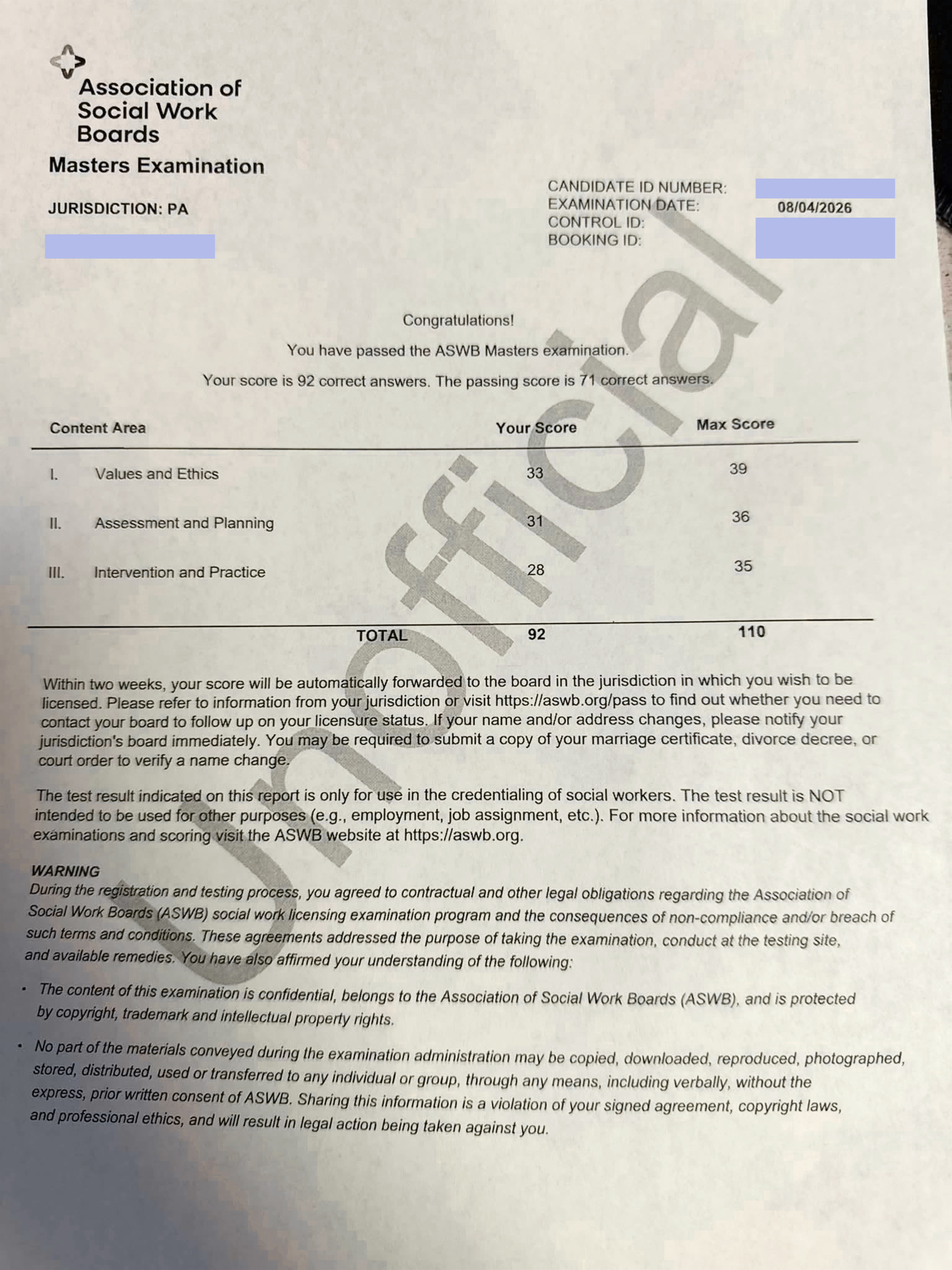
Your score report includes your overall result
The most important information is:
- Whether you passed or failed
- The number of questions required to pass your exam form
- The number of scored questions you answered correctly
Remember that only 110 of the 122 questions count toward your score. The remaining 12 are unscored pretest questions and do not affect whether you pass or fail.
Looking for more ASWB content and exam strategies? Agents of Change includes 30+ topics, hundreds of practice questions, and 2 live study groups per month.
4) Understanding the New Three ASWB Content Areas
One of the biggest changes to the ASWB exam in 2026 is the move from four content areas to three.
The three current content areas are:
- Values and Ethics
- Assessment and Planning
- Intervention and Practice
ASWB reorganized the exam following its most recent analysis of social work practice, and Values and Ethics now receives the greatest weighting across the exam categories.
Here is the current breakdown:
| Exam | Values and Ethics | Assessment and Planning | Intervention and Practice |
|---|---|---|---|
| Associate/Bachelors | 35% | 33% | 32% |
| Masters | 35% | 33% | 32% |
| Advanced Generalist | 35% | 33% | 32% |
| Clinical | 36% | 32% | 32% |
The Associate and Bachelors examinations share the same questions and content outline.
For the Clinical exam, for example, approximately 36% of the scored questions relate to Values and Ethics, while approximately 32% relate to Assessment and Planning and 32% to Intervention and Practice.
5) What Does the Content Area Breakdown on a Failed ASWB Score Report Mean?
If you do not pass the exam, your score report provides additional information that can be extremely useful when preparing for your retake.
ASWB states that an unsuccessful score report includes a breakdown showing:
- The number of questions you answered correctly in each content area
- The total number of questions in each content area
This is different from the previous description of the report as simply giving you a percentage in each area.
For example, your report might show that you performed very strongly in Values and Ethics but answered a smaller proportion of the Assessment and Planning questions correctly.
That gives you a much better starting point for your next study plan.
Don’t study only your weakest area
Your score report is useful, but be careful about overcorrecting.
Because the ASWB exam is assessing your performance across the entire exam, you do not want to abandon areas where you performed well just to concentrate on your lowest section.
Instead:
- Maintain your strengths.
- Increase your study time in weaker areas.
- Identify why questions were difficult.
- Practice applying knowledge to scenarios rather than relying only on memorization.
- Continue practicing FIRST, NEXT, BEST, MOST, and priority-style questions.
That final point is particularly important with the 2026 exam. ASWB has specifically increased the exam’s emphasis on application, problem-solving, and reasoning, rather than relying as heavily on straightforward recall.
6) FAQs
Q: What is a passing score on the ASWB exam in 2026?
A: There is no single passing score that applies to every ASWB exam because the number of correct answers required can vary slightly based on the difficulty of the exam form you receive. Under the current 2026 exam structure, ASWB states that passing scores generally range from 66 to 78 correct answers out of the 110 scored questions. Your score report will show both the number of questions you answered correctly and the number you needed to answer correctly to pass your specific exam form. The remaining 12 questions on the 122-question exam are unscored pretest questions and do not affect your result.
Q: What information is included on an ASWB score report if you do not pass?
A: If you do not pass the ASWB exam, your score report shows how many questions you answered correctly and how many correct answers were required to pass your exam form. It also provides a breakdown of your performance across the exam’s three content areas: Values and Ethics, Assessment and Planning, and Intervention and Practice. This information can help you identify areas that may need additional study before your next attempt. However, it is important to continue practicing across all three content areas rather than focusing exclusively on the section where you performed lowest.
Q: How soon do you get your ASWB exam results?
A: You will find out whether you passed or failed shortly after completing the ASWB exam and the exit survey at the testing center. Your unofficial score report is generally available in your ASWBCentral dashboard approximately 24 hours after your exam. ASWB then sends your official examination results to the licensing board or college associated with your registration. Your jurisdiction may take additional time to process your score and complete the remaining steps required for licensure.
7) Conclusion
Understanding your ASWB exam results can make the licensing process feel much more manageable. With the updated 2026 exam structure, it is especially important to know how many questions are scored, how the passing requirement is determined, and what information appears on your score report. Knowing what the numbers mean can help you better understand your performance and what comes next.
If you passed, your score report confirms that you met the standard of minimum competence required for your examination level, and your next step is to follow your jurisdiction’s remaining licensing requirements. If you did not pass, your results can still provide valuable information. Reviewing how close you were to the passing requirement and examining your performance across the three content areas can help you create a more focused and effective study plan for your next attempt.
Whether you are preparing to take the ASWB exam for the first time or getting ready for a retake, make sure your study materials reflect the current exam structure that began in August 2026. Focus not only on learning social work content, but also on practicing how to apply that knowledge to the types of scenarios and decision-making questions you will encounter on exam day. With a clear understanding of the exam, targeted preparation, and consistent practice, you can approach the ASWB exam with greater confidence and a stronger plan for success.
► Learn more about the Agents of Change course here: https://agentsofchangeprep.com
About the Instructor, Dr. Meagan Mitchell: Meagan is a Licensed Clinical Social Worker and has been providing individualized and group test prep for the ASWB for over 11 years. From all of this experience helping others pass their exams, she created the Agents of Change course to help you prepare for and pass the ASWB exam!
Find more from Agents of Change here:
► Facebook Group: https://www.facebook.com/groups/aswbtestprep
► Podcast: https://podcasters.spotify.com/pod/show/agents-of-change-sw
#socialwork #testprep #aswb #socialworker #socialwork #socialworktest #socialworkexam #exam #socialworktestprep #socialworklicense #socialworklicensing #licsw #lmsw #lcsw #aswbexam #aswb #lcswexam #lmswexam #aswbtestprep #aswbtest #lcswtestprep #lcswtest #lmswtestprep #lmswtest #aswbcourse #learningstyles #learningstyle
Disclaimer: This content has been made available for informational and educational purposes only. This content is not intended to be a substitute for professional medical or clinical advice, diagnosis, or treatment.
————————————————————————————————————————————————
► Learn more about the Agents of Change course here: https://agentsofchangeprep.com
About the Instructor, Meagan Mitchell: Meagan is a Licensed Clinical Social Worker and has been providing individualized and group test prep for the ASWB for over five years. From all of this experience helping others pass their exams, she created the Agents of Change course to help you prepare for and pass the ASWB exam!
Find more from Agents of Change here:
► Facebook Group: https://www.facebook.com/groups/aswbtestprep
► Podcast: https://anchor.fm/agents-of-change-sw
#socialwork #testprep #aswb #socialworker #socialwork #socialworktest #socialworkexam #exam #socialworktestprep #socialworklicense #socialworklicensing #licsw #lmsw #lcsw #aswbexam #aswb #lcswexam #lmswexam #aswbtestprep #aswbtest #lcswtestprep #lcswtest #lmswtestprep #lmswtest #aswbcourse #learningstyles #learningstyle
Disclaimer: This content has been made available for informational and educational purposes only. This content is not intended to be a substitute for professional medical or clinical advice, diagnosis, or treatment