The NASW Code of Ethics on the 2026 ASWB Exam: The Questions That Now Carry the Most Weight
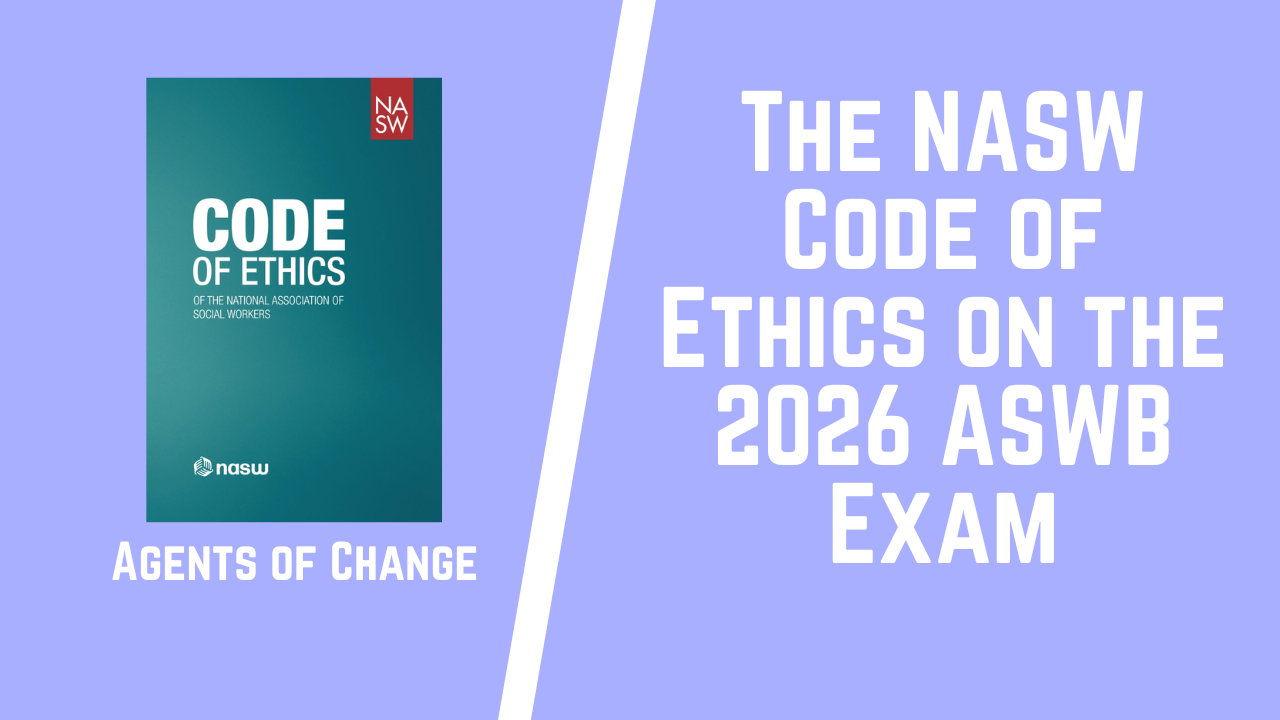
The NASW Code of Ethics on the 2026 ASWB Exam: The Questions That Now Carry the Most Weight
The NASW Code of Ethics has always mattered on the ASWB exam, but the 2026 exam changes make ethical decision-making feel even more important. With fewer questions and a stronger focus on applied reasoning, test-takers need to do more than recognize familiar Social Work values. They need to understand how those values shape the best answer when a client, family member, agency, court, or supervisor is pulling the Social Worker in different directions.

That’s where many exam questions get tricky. The ASWB rarely asks ethics questions in a simple, memorization-based way. Instead, it places you inside real practice situations where confidentiality, safety, self-determination, boundaries, competence, cultural humility, and documentation may overlap. One answer might sound compassionate, another might sound protective, and another might sound procedurally correct. Your job is to choose the response that best reflects ethical Social Work practice.

In this article, we’ll look at the NASW Code of Ethics on the 2026 ASWB exam and the types of questions that now carry the most weight. We’ll break down the ethical themes most likely to appear, the traps that can cost you points, and the study strategies that help you think like the exam wants you to think. With the right preparation, especially through a structured program like Agents of Change, ethics questions can become much more manageable.

Learn more about the ASWB exam and create a personalized ASWB study plan with Agents of Change. We’ve helped hundreds of thousands of Social Workers pass their ASWB exams and want to help you be next! We also offer full-length, timed practice exams here.

1) Why Ethics Feels Bigger on the 2026 ASWB Exam

Ethics has always been a major part of ASWB exam prep, but the 2026 exam changes make it feel even more central. With fewer total questions and a stronger emphasis on applied reasoning, each question carries more weight. That means ethical judgment may show up in places where test-takers don’t immediately expect it, including assessment, intervention, documentation, supervision, crisis response, and client engagement.

a 20 something diverse worman studying for an exam in a coffee shop thinking deeply

Fewer Questions Means Less Room for Guessing

The 2026 ASWB Exam has fewer questions than the previous version, which can make every item feel more important. When the exam is shorter, test-takers may feel like each missed question matters more. That pressure can be especially intense with ethics questions because the answer choices often sound similar.

You may see two responses that both seem compassionate or professional. One might support the client’s self-determination, while another might prioritize safety. The challenge is choosing the answer that best fits the Social Worker’s ethical responsibility in that exact moment.

Ethics Is Built Into Scenario-Based Questions

Ethics questions are rarely labeled as ethics questions. That’s part of what makes them tricky. A question may look like it’s about a client in crisis, but the real issue may be confidentiality. Another may seem focused on family conflict, while the deeper issue is informed consent or client self-determination.

On the 2026 exam, test-takers should expect ethics to appear in realistic practice situations. Instead of asking you to simply define an ethical concept, the exam may ask what the Social Worker should do first, next, or best.

The Exam Tests Judgment, Not Just Memory

Memorizing the NASW Code of Ethics is helpful, but it isn’t enough by itself. The exam wants to know whether you can apply ethical principles when the situation is messy. And real Social Work practice is messy!

For example, what happens when a client’s right to privacy conflicts with safety concerns? What if a parent wants information from a minor client’s session? What if a Social Worker is asked to provide services outside their area of competence? These questions require reasoning, not just recall.

Ethical Themes Overlap

Many ASWB questions include more than one ethical issue at a time. Confidentiality may overlap with mandated reporting. Boundaries may overlap with cultural humility. Self-determination may overlap with risk. Supervision may overlap with competence.

That’s why ethics feels bigger on the 2026 ASWB Exam. It’s not just one content area to review. It’s a lens you’ll use across the whole test. The more comfortable you become with ethical decision-making, the easier it becomes to spot what the question is really asking.

Agents of Change packages include 30+ ASWB topics, 2 free study groups per month, and hundreds of practice questions so you’ll be ready for test day!

2) The Ethics Questions That Now Carry the Most Weight

Ethics questions on the 2026 ASWB Exam are likely to feel less like “Do you know the rule?” and more like “Can you make the best professional decision when several responsibilities are competing at once?” That shift matters. A Social Worker may need to protect confidentiality, support self-determination, assess safety, follow the law, seek supervision, and document appropriately, all within the same scenario.

a 20 something diverse worman studying for an exam in a coffee shop thinking deeply

The key is to slow down and identify what the question is really testing. Many ethics questions include emotional details that can pull you toward a reactive answer. A client is upset. A parent is demanding information. A supervisor is pressuring the Social Worker. A colleague is behaving questionably. Sitting there, trying to pick the “most ethical” response, it’s easy to overthink it. But most questions are built around a few major ethical patterns.

Confidentiality and Its Limits

Confidentiality is one of the biggest ethics themes because it shows up in so many Social Work settings. The exam may give you a client, family member, teacher, attorney, doctor, or agency administrator asking for information. Your job is to decide whether the Social Worker can share anything, what can be shared, and what needs to happen before disclosure.

A strong approach is to ask:

  • Does the client give informed consent?
  • Is there a legal requirement to disclose?
  • Is there an immediate safety concern?
  • Is the person requesting information entitled to it?
  • Can the Social Worker share limited information rather than everything?

Be careful with answers that casually release information because someone sounds official. A school principal, spouse, parent, or employer may feel important in the question, but that doesn’t automatically give them access to client information. Also watch for the opposite mistake: choosing strict confidentiality when there is a clear duty to protect, report, or respond to imminent risk.

On the exam, the best answer often protects privacy while recognizing valid exceptions.

Client Self-Determination

Self-determination questions test whether you can respect the client’s choice even when the choice makes you uncomfortable. A client may reject treatment, stay in a relationship, decline a referral, make a parenting decision, or choose a path the Social Worker personally disagrees with.

The question to ask is: Does the client have the right and capacity to make this decision?

If the client understands the options, consequences, and risks, the Social Worker usually supports the client’s right to decide. That doesn’t mean the Social Worker stays silent. It may be appropriate to explore concerns, provide information, assess safety, and help the client think through choices.

However, self-determination has limits. If there is imminent danger, abuse, coercion, impaired capacity, or serious risk to another person, the Social Worker may need to take protective action.

The exam often rewards answers that sound like:

  • Explore the client’s understanding.
  • Clarify options and possible consequences.
  • Assess for safety or coercion.
  • Support the client’s informed choice.
  • Document the discussion.

Avoid answers that pressure, shame, threaten, or override the client simply because the Social Worker thinks they know better.

Mandated Reporting and Safety

Mandated reporting questions carry weight because they combine ethics, law, risk, and professional responsibility. These questions may involve suspected child abuse, elder abuse, abuse of a vulnerable adult, threats of harm, or neglect.

A major test-taking trap is waiting for proof. Social Workers are usually not expected to investigate allegations themselves. If the scenario provides reasonable suspicion and the client is within a protected category, the correct answer often involves making a report to the appropriate authority.

That said, the exam may also test sequencing. If there is immediate danger, safety comes first. If the client is in the office and says they plan to harm someone after leaving, the Social Worker should not jump straight to routine documentation while ignoring the immediate risk.

Ask yourself:

  1. Is someone currently at risk?
  2. Is the Social Worker a mandated reporter in this situation?
  3. Is there reasonable suspicion?
  4. What action protects the vulnerable person?
  5. What must be documented afterward?

The best answer usually balances urgency with procedure. Report when required, protect safety when needed, and document what happened.

Boundaries and Dual Relationships

Boundary questions are common because they test professional judgment, not just rule memorization. A client may offer a gift, invite the Social Worker to an event, request a personal favor, send a social media request, or have an unavoidable community connection with the Social Worker.

The exam is asking whether the Social Worker can recognize risk. Is there potential exploitation? Could the Social Worker’s judgment be impaired? Could the client feel pressured? Would the relationship shift away from professional service and toward personal benefit?

A helpful way to approach these questions is to ask:

  • Who benefits from this boundary crossing?
  • Could the client be harmed or confused?
  • Is there a power imbalance?
  • Is this avoidable?
  • Has the Social Worker discussed the boundary clearly?
  • Is consultation needed?

The strongest answer is usually neither overly casual nor overly dramatic. The Social Worker may need to discuss the concern, clarify boundaries, consult with a supervisor, and document the decision. Immediate termination is rarely the first step unless the situation involves serious harm, exploitation, or an unavoidable conflict that prevents ethical practice.

Competence and Scope of Practice

Competence questions test whether the Social Worker knows when they are qualified to provide a service and when they need support. These questions may involve unfamiliar diagnoses, specialized interventions, cultural considerations, language barriers, telehealth across jurisdictions, or requests for services outside the Social Worker’s training.

The exam does not expect Social Workers to know everything. It does expect them to be honest about what they know, seek consultation, obtain training, and refer when appropriate.

A strong answer may include:

  • Consulting with a supervisor or expert
  • Seeking additional training
  • Referring when the client’s needs exceed the Social Worker’s competence
  • Collaborating with another provider
  • Avoiding abandonment during the transition
  • Explaining limitations honestly to the client

The key is balance. Don’t keep treating a client when you clearly lack competence. Don’t immediately abandon the client either. Ethical practice often means creating a safe plan for consultation, support, or referral.

Informed Consent

Informed consent questions often appear at the start of services, during changes in treatment, or when working with minors, families, groups, or involuntary clients. These questions may also involve fees, confidentiality limits, telehealth, recording sessions, or client access to records.

The exam wants to know whether the client understands what they are agreeing to. A signed form alone is not enough if the client doesn’t understand the information.

When reading these questions, ask:

  • Has the Social Worker explained the service clearly?
  • Does the client understand limits to confidentiality?
  • Are fees, risks, benefits, and alternatives explained?
  • Is consent voluntary?
  • Does the client have capacity to consent?
  • Are there special issues because the client is a minor, part of a family system, or court-ordered?

A strong answer often involves explaining information in plain language, checking understanding, and documenting the consent process.

Documentation and Records

Documentation questions may look boring, but they carry ethical weight. Records affect continuity of care, client rights, legal accountability, supervision, billing, and risk management.

The exam may ask what should be documented after a mandated report, boundary concern, risk assessment, informed consent conversation, referral, consultation, or client disagreement.

Good documentation is:

  • Timely
  • Accurate
  • Objective
  • Relevant
  • Professional
  • Respectful
  • Clear about actions taken

Avoid answers that include unnecessary personal opinions, judgmental language, vague notes, or unsupported conclusions. Also avoid answers that suggest changing records to hide mistakes. If an error is made, it should be corrected according to proper policy, not erased as if it never happened.

Supervision and Consultation

Supervision and consultation are often correct when the issue is complex, uncertain, or outside the Social Worker’s competence. However, they are not a way to avoid responsibility.

For example, if a supervisor tells a Social Worker to do something unethical, the Social Worker still has ethical obligations. The exam may test whether you can recognize that following orders is not a defense for harming a client or violating professional standards.

Use consultation when:

  • The ethical issue is unclear
  • The Social Worker may be outside their competence
  • A boundary concern has emerged
  • Agency policy conflicts with ethical duties
  • There is uncertainty about legal or reporting responsibilities
  • The situation involves high risk

But remember, if the client is in immediate danger, the Social Worker must respond to safety first. Consultation can happen, but it should not delay urgent protective action.

How to Choose the Best Answer

When ethics questions feel confusing, use a simple decision process:

  1. Identify the ethical issue.
    Is this about confidentiality, safety, consent, boundaries, competence, documentation, or self-determination?
  2. Find the client.
    Who is the Social Worker responsible to in this scenario?
  3. Assess risk.
    Is anyone in immediate danger? Is there abuse, neglect, exploitation, or serious harm?
  4. Look for consent or authority.
    Is the Social Worker allowed or required to share information or take action?
  5. Choose the least harmful ethical step.
    The best answer usually protects the client, respects rights, follows professional standards, and avoids unnecessary overreaction.
  6. Watch for sequencing words.
    “First,” “next,” and “best” are not the same. A question asking what to do first may require assessment before intervention. A question asking what is best may require the most complete ethical response.

Ethics questions carry so much weight because they reveal how you think. The exam is not looking for perfection or panic. It is looking for professional judgment. Slow down, identify the core issue, protect the client, and choose the answer that reflects ethical Social Work practice.

3) How to Read Ethics Questions on the 2026 ASWB Exam

Ethics questions on the 2026 ASWB Exam can feel intense because they often include several competing priorities at once. A client may want privacy, a family member may want information, an agency may have a policy, and the Social Worker may have a legal or ethical duty to act. Reading too quickly, it’s easy to grab the answer that sounds caring or urgent. But the best answer is usually the one that follows a clear ethical sequence.

The goal is to read the question like a Social Worker, not like a panicked test-taker. Slow down, identify the central issue, and pay attention to what the question is actually asking.

Start With the Final Sentence

Before getting lost in the details, read the last sentence of the question. This tells you what the exam wants.

Look for wording like:

  • What should the Social Worker do first?
  • What should the Social Worker do next?
  • What is the best response?
  • What is the Social Worker’s ethical obligation?
  • Which action would be most appropriate?
  • Which action should the Social Worker avoid?

These words matter. “First” usually points to the immediate next step, such as assessing risk, clarifying information, or ensuring safety. “Best” may ask for the most complete or ethically sound response. “Avoid” asks you to spot what would be inappropriate or unethical.

A lot of missed points happen when someone answers what they would eventually do instead of what the question asked them to do right now.

Identify the Real Ethical Issue

Next, ask yourself: What is this question really about?

Ethics questions are often disguised as clinical, administrative, school-based, medical, or family practice scenarios. A question may look like it’s about a difficult parent, but the ethical issue is confidentiality. Another may seem like a crisis question, but the heart of it is duty to protect. A supervision question may actually be testing competence.

Common ethical issues include:

  • Confidentiality
  • Informed consent
  • Mandated reporting
  • Client self-determination
  • Boundaries
  • Dual relationships
  • Conflict of interest
  • Competence
  • Cultural humility
  • Documentation
  • Supervision
  • Termination or referral
  • Technology and telehealth ethics

Once you name the issue, the answer choices usually become easier to sort.

Ask Who the Client Is

This step is huge. In many ASWB scenarios, several people are involved, but the Social Worker’s primary responsibility may not be to the loudest or most demanding person in the question.

Ask:

  • Is the client an individual, couple, family, group, or organization?
  • Is the client a minor?
  • Is the parent or guardian involved?
  • Is the Social Worker serving the court, agency, school, or client?
  • Is there a conflict between what different people want?

For example, if a parent demands details from a teenager’s session, the exam is likely testing confidentiality, informed consent, and the limits of parental access. The parent’s authority matters, but it does not automatically erase the minor client’s privacy interests.

Look for Safety Concerns

After identifying the client and ethical issue, scan for risk. Safety can change the correct answer.

Look for details involving:

  • Suicide risk
  • Homicide risk
  • Child abuse or neglect
  • Elder abuse
  • Abuse of a vulnerable adult
  • Domestic violence
  • Exploitation
  • Medical danger
  • Impaired capacity
  • Threats to identifiable people

If there is immediate danger, the Social Worker usually needs to act to protect safety before moving into slower steps like routine documentation or general exploration. However, don’t assume every uncomfortable situation is a crisis. The exam rewards measured judgment, not overreaction.

Separate Facts From Emotional Noise

ASWB questions often include emotional details that make the situation feel urgent. A client may be angry, crying, embarrassed, demanding, or disappointed. A family member may accuse the Social Worker of being unhelpful. A supervisor may seem confident while giving questionable advice.

These details matter, but they may not determine the ethical answer.

Ask yourself:

  • What facts change the Social Worker’s ethical duty?
  • What details are included to distract me?
  • What information is missing?
  • Do I need to assess before acting?

If the question says a client is upset because the Social Worker won’t share confidential information with a relative, the client’s distress matters clinically. But ethically, the Social Worker still needs to protect confidentiality unless consent or a valid exception applies.

Watch for Extreme Answer Choices

Ethics questions often include answers that are too broad, too harsh, or too casual. These can be tempting when you’re anxious.

Be cautious with answers that say the Social Worker should:

  • Always disclose
  • Never disclose
  • Immediately terminate
  • Ignore agency policy
  • Promise complete confidentiality
  • Tell the family everything
  • Refuse services without discussion
  • Investigate abuse personally before reporting
  • Practice outside their competence because the client needs help

Ethical Social Work usually involves balance. The strongest answer often protects the client, respects rights, follows the law, uses consultation when appropriate, and avoids unnecessary harm.

Use the “Least Intrusive, Most Ethical” Rule

When two answers seem possible, choose the one that addresses the issue without overstepping.

For example, if a client offers a small gift, the best answer may not be to automatically accept or automatically terminate. A better answer may be to explore the meaning of the gift, consider the policy and cultural context, assess boundary concerns, consult if needed, and document the decision.

If a client refuses a referral, the best answer may not be to force the referral. A better answer may be to explore the client’s concerns, provide information, assess risk, and support informed decision-making.

The exam often prefers thoughtful professional action over dramatic action.

Pay Attention to Sequencing

Many ethics questions are really sequencing questions. They don’t just ask what matters. They ask what comes first.

A helpful sequence is:

  1. Ensure immediate safety.
  2. Clarify the facts.
  3. Identify the ethical or legal duty.
  4. Discuss options with the client when appropriate.
  5. Consult or seek supervision if needed.
  6. Act within professional standards.
  7. Document what happened.

Documentation is important, but it usually does not come before safety. Consultation is useful, but it should not delay a required report or urgent protective action. Client self-determination matters, but it does not override imminent danger.

Read the Answers Before Choosing

Once you understand the issue, read every answer choice carefully. Don’t stop at the first answer that sounds decent.

Ask:

  • Which answer addresses the ethical issue most directly?
  • Which answer protects the client while respecting their rights?
  • Which answer fits the Social Worker’s role?
  • Which answer avoids doing too much or too little?
  • Which answer would be easiest to defend ethically?

Sometimes the correct answer isn’t perfect. It’s simply the best option provided. That can feel frustrating, but it mirrors real exam logic.

Practice Thinking Like the Exam

The 2026 ASWB Exam is not just testing whether you know ethical language. It is testing whether you can apply ethical judgment in realistic Social Work situations. That means your study routine should include practice questions, rationales, and reflection.

When you miss an ethics question, don’t just memorize the correct answer. Ask yourself:

  • What was the ethical issue?
  • What detail did I overlook?
  • Did I answer “eventually” instead of “first”?
  • Did I over-prioritize feelings over safety?
  • Did I ignore client self-determination?
  • Did I choose an answer that was too extreme?
  • What pattern should I recognize next time?

The more you practice this process, the less random ethics questions start to feel. You begin to see the structure underneath the scenario, and that’s where confidence grows.

4) Where Test-Takers Lose Points on Ethics

Ethics questions can be some of the most frustrating questions on the ASWB exam because the wrong answers often sound reasonable. That’s the trap. The exam usually isn’t asking whether you can spot one obviously terrible choice. It’s asking whether you can choose the best ethical response when several options seem partly correct.

Most missed ethics questions come from the same few patterns. Once you know those patterns, you can slow down, read more carefully, and avoid giving away points you actually knew how to earn.

Mistake 1: Answering Emotionally Instead of Ethically

Many ethics questions are written to make you feel something. A parent is angry. A client is crying. A supervisor is pressuring the Social Worker. A colleague is acting in a way that feels unfair or unsafe. Because the scenario feels urgent, test-takers often choose the answer that sounds the most comforting, protective, or forceful.

The problem? The most emotionally satisfying answer isn’t always the most ethical one.

For example, if a client is upset because the Social Worker won’t release confidential information to a family member, the comforting answer may be to share “just enough” to calm everyone down. But ethically, the Social Worker still needs proper consent or a valid legal exception before disclosing protected information.

How to Avoid It

Pause before choosing. Ask:

  • What is the ethical issue?
  • What is the Social Worker allowed or required to do?
  • Does this answer protect the client’s rights?
  • Am I choosing this because it feels good or because it is ethically correct?

A good exam answer may still be compassionate, but compassion has to stay inside ethical boundaries.

Mistake 2: Missing the Word “First,” “Next,” or “Best”

This is one of the easiest ways to lose points. A question may ask what the Social Worker should do first, but the test-taker chooses something that should happen later. The answer may be reasonable in real life, but it’s wrong for the sequence the exam is testing.

For example, documentation matters. It matters a lot. But if a client is in immediate danger, the Social Worker should address safety before documenting. Consultation matters too, but it shouldn’t delay a required mandated report when the facts already meet the reporting threshold.

“First,” “next,” and “best” are not interchangeable.

How to Avoid It

Before reading the answer choices, underline the task in your mind:

  • First usually means the immediate priority.
  • Next usually means what follows after the current concern is addressed.
  • Best usually means the most complete, ethical, and professionally sound option.
  • Avoid means you’re looking for the unethical or inappropriate action.

Then choose the answer that fits the timing. Don’t choose what you’d eventually do if the question is asking what to do right now.

Mistake 3: Treating Confidentiality as Absolute

Confidentiality is one of the most important ethical responsibilities in Social Work, but it is not absolute. Some test-takers lose points because they choose confidentiality in every situation, even when the scenario includes imminent risk, mandated reporting concerns, or another valid exception.

On the other hand, some test-takers go too far in the opposite direction and disclose information too quickly. A spouse, parent, teacher, employer, or agency administrator may request information, but that does not automatically mean they have a right to receive it.

The exam is testing whether you understand both sides: protect confidentiality whenever possible, and recognize when disclosure is required or permitted.

How to Avoid It

Ask these questions before choosing:

  • Is there client consent?
  • Is there a legal requirement to report or disclose?
  • Is there imminent risk to the client or another person?
  • Who is requesting the information?
  • What is the minimum necessary information that should be shared?

The best answer usually protects privacy while responding appropriately to safety or legal obligations.

Mistake 4: Overriding Client Self-Determination Too Quickly

Social Workers often want to help clients avoid pain, harm, or regret. That instinct is human. But on the exam, pushing too hard can violate client self-determination.

Test-takers may lose points when they choose answers that tell the client what to do, pressure the client into a referral, contact family without permission, or take control of a decision the client has the right to make.

A client can make a decision the Social Worker disagrees with. That alone does not mean the Social Worker should override the client’s choice.

How to Avoid It

Ask:

  • Does the client understand the options and consequences?
  • Is the client making an informed decision?
  • Is there coercion, impaired capacity, abuse, or imminent danger?
  • Can the Social Worker explore concerns without taking over?

A strong answer often supports the client’s right to choose while making sure the client has enough information, support, and safety planning. Respecting self-determination doesn’t mean doing nothing. It means helping without controlling.

Mistake 5: Choosing an Extreme Answer

Ethics questions often include answer choices that sound decisive. Immediately terminate services. Always report. Never disclose. Refuse the client. Ignore the policy. Tell the family everything. These answers can feel appealing because they seem clear.

But ethical Social Work is rarely that extreme. Most situations require assessment, discussion, consultation, supervision, informed consent, or documentation before taking a dramatic step.

Extreme answers are sometimes correct when there is immediate danger, exploitation, abuse, or a clear legal duty. But they should earn your suspicion.

How to Avoid It

When an answer sounds extreme, slow down and ask:

  • Is this action required by law or ethics?
  • Is there immediate danger?
  • Is there a less intrusive ethical step?
  • Would consultation or clarification be more appropriate first?
  • Does this answer create unnecessary harm?

The best answer is often balanced. It protects the client, respects rights, uses professional judgment, and avoids overreacting.

A Simple Way to Protect Your Points

When you feel stuck between two ethics answers, return to the basics:

  1. Identify the ethical issue.
  2. Determine who the client is.
  3. Assess immediate safety.
  4. Check consent, law, and professional responsibility.
  5. Respect client self-determination when possible.
  6. Use consultation or supervision when appropriate.
  7. Document once the necessary action is taken.

Most ethics mistakes happen when test-takers move too fast. Slow reading is not wasted time. It’s how you catch the detail that changes the answer.

5) FAQs – The NASW Code of Ethics on the 2026 ASWB Exam

Q: How much of the 2026 ASWB Exam will focus on ethics?

A: Ethics may not appear as one isolated section on every version of the exam, but ethical decision-making is woven throughout the ASWB. That’s why it can feel bigger than a single content category. A question may look like it’s about assessment, crisis response, documentation, supervision, family dynamics, or service planning, while the real issue is confidentiality, client self-determination, informed consent, boundaries, mandated reporting, or competence.

For the 2026 ASWB Exam, test-takers should expect ethics to show up through applied scenarios rather than simple definition questions. Instead of asking you to recite a line from the NASW Code of Ethics, the exam is more likely to ask what the Social Worker should do first, next, or best in a realistic situation. The safest way to prepare is to study the major ethical principles, then practice applying them to exam-style questions with strong rationales.

Q: Do I need to memorize the entire NASW Code of Ethics for the ASWB exam?

A: You don’t need to memorize every word of the NASW Code of Ethics, but you do need to understand how the Code guides Social Work decision-making. Memorization alone can fall apart on scenario-based questions because the exam is usually testing judgment, not word-for-word recall.

Focus on the ethical areas that come up most often in practice questions, including confidentiality, informed consent, self-determination, mandated reporting, professional boundaries, conflicts of interest, cultural humility, competence, supervision, documentation, and termination. When studying, ask yourself how each ethical standard would shape the Social Worker’s next step in a real practice situation. That kind of applied thinking is much more useful than simply rereading the Code over and over without practicing questions.

Q: What is the best way to study ethics questions for the 2026 ASWB Exam?

A: The best way to study ethics is to combine content review with repeated practice. Start by reviewing the major themes in the NASW Code of Ethics, then move quickly into practice questions that force you to apply those themes. After each question, spend time with the rationale. Don’t just ask, “What was the correct answer?” Ask, “Why was this the best answer?” and “Why were the other choices tempting but wrong?”

A structured program like Agents of Change can be especially helpful because it gives you comprehensive ASWB exam prep materials, practice exams, flashcards, study plans, and 2 live study groups per month. The study plans help you stay on track, while the practice questions and rationales help you build the ethical reasoning skills the exam is really testing. And because Agents of Change gives you access until you pass, you can start preparing early without worrying that you bought too soon.

6) Conclusion

Ethics questions on the 2026 ASWB exam are really questions about professional judgment. They ask whether you can recognize the Social Worker’s responsibility when client rights, safety concerns, confidentiality, self-determination, agency expectations, and legal duties all meet in one complicated situation. That can feel overwhelming at first, but once you understand the common patterns, the questions start to feel much more manageable.

The NASW Code of Ethics gives you the framework for making those decisions. Instead of trying to memorize every line, focus on how the Code applies in real practice. Ask who the client is, what ethical issue is being tested, whether anyone is at risk, what consent or authority exists, and what action best protects the client while staying within the Social Worker’s role. That process can help you slow down and avoid common traps like overreacting, ignoring safety, disclosing too much, or overriding client choice too quickly.

As you prepare, remember that strong ethics performance comes from practice. Review the major ethical themes, work through scenario-based questions, study the rationales, and build a plan that keeps you consistent. Agents of Change can be an important support in that process, offering comprehensive ASWB exam prep materials, practice exams, flashcards, study plans, and 2 live study groups per month. Since you have access until you pass, you can start early, study steadily, and walk into exam day with a clearer sense of how ethical Social Work decisions are made.


► Learn more about the Agents of Change course here: https://agentsofchangeprep.com

About the Instructor, Dr. Meagan Mitchell: Meagan is a Licensed Clinical Social Worker and has been providing individualized and group test prep for the ASWB for over 11 years. From all of this experience helping others pass their exams, she created the Agents of Change course to help you prepare for and pass the ASWB exam!

Find more from Agents of Change here:

► Facebook Group: https://www.facebook.com/groups/aswbtestprep

► Podcast: https://podcasters.spotify.com/pod/show/agents-of-change-sw

#socialwork #testprep #aswb #socialworker #socialwork #socialworktest #socialworkexam #exam #socialworktestprep #socialworklicense #socialworklicensing #licsw #lmsw #lcsw #aswbexam #aswb #lcswexam #lmswexam #aswbtestprep #aswbtest #lcswtestprep #lcswtest #lmswtestprep #lmswtest #aswbcourse #learningstyles #learningstyle

Disclaimer: This content has been made available for informational and educational purposes only. This content is not intended to be a substitute for professional medical or clinical advice, diagnosis, or treatment.

Note: Certain images used in this post were generated with the help of artificial intelligence.

Share:

Discover more from Agents of Change

Subscribe now to keep reading and get access to the full archive.

Continue reading